Chad Rubin
April 24, 2026 · 10 min read
Operator notes by email
Short, opinionated takes on AI agents, Amazon PPC, pricing, and inventory. No fluff. About once a week.
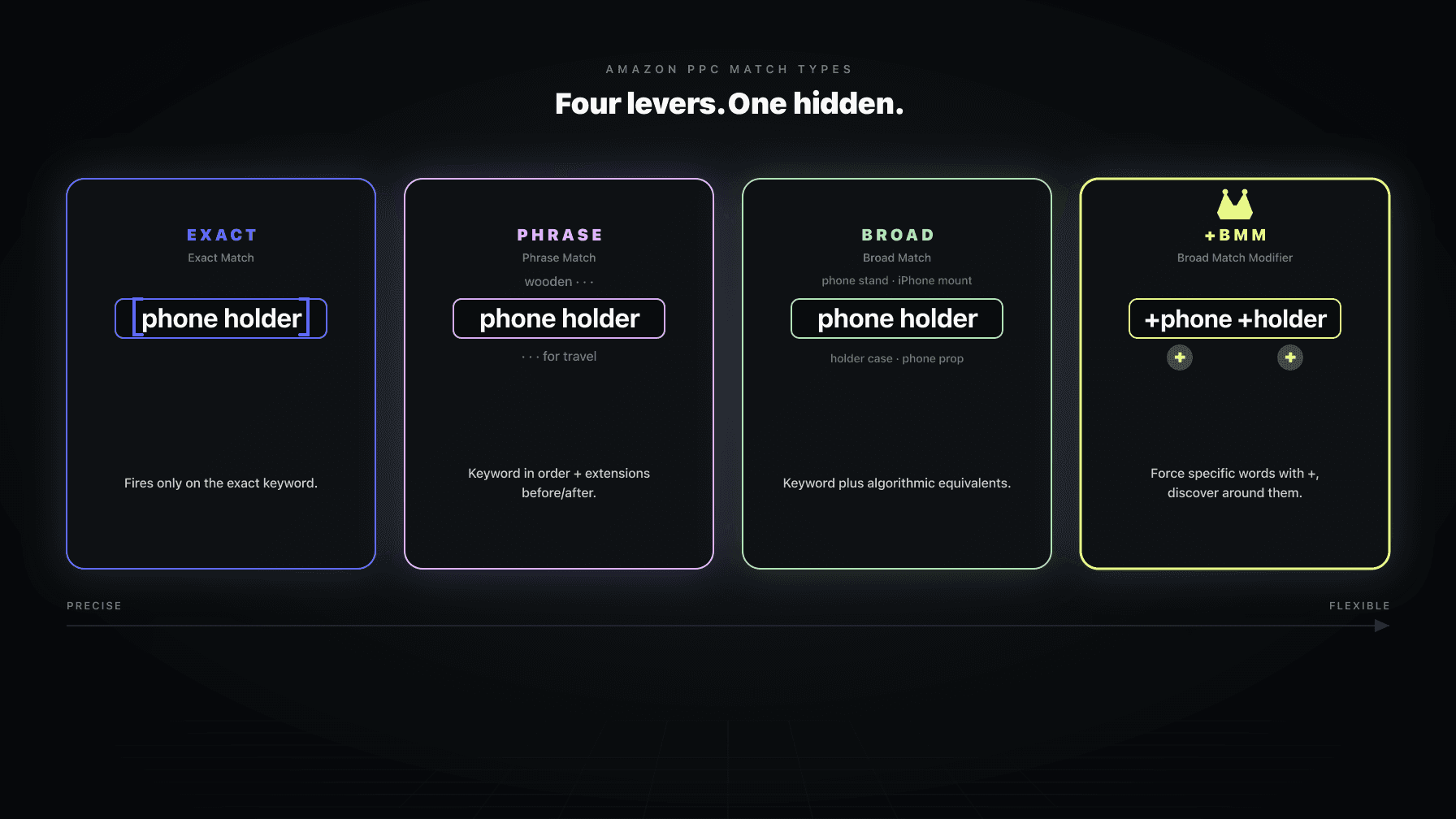
Amazon PPC match types control how tightly Amazon matches your keyword target to a shopper's search. Exact, phrase, and broad are the three match types Amazon will show you inside the campaign builder. The fourth — broad match modifier — is the one Amazon does not surface, and it is the one serious sellers have been leaning on the hardest.
I have run a 7-figure Amazon brand for over a decade and watched match-type best practices rewrite themselves every 18 months. The rules that worked in 2020 (pile into exact match, keep broad tightly capped) are not the rules that work now. Amazon's algorithm has gotten aggressive about using its own leeway inside exact match, and broad match has quietly become the most powerful discovery-and-performance tool in the match-type menu.
This guide walks you through all four match types — what they do, when to use each, the counterintuitive case where broad match outperforms exact on the same keyword, and how to structure your campaigns so that match-type decisions stop costing you profit.
Key Takeaways
+). Match types only apply to Sponsored Products and Sponsored Brands — Sponsored Display does not use keyword targeting.+keyword +keyword) is the pro-level move: force Amazon to include specific words in the search term while letting it discover new variants around them.Before anything else: match types only exist for two of Amazon's three main ad types.
From reading to action
If the framework above sounds familiar, your Amazon account is probably carrying the same drag. Apply and we will show what Marko, Oracle, and Bruno would change in your first week.

Ran a 7-figure Amazon brand for a decade. Founded Skubana (acquired). Co-founded Prosper Show. 15+ years on Amazon.
Head-to-head comparisons between Profasee and the tools most Amazon sellers already use.
Join the brands that replaced agencies and tools with AI employees.
If you are looking for match-type controls inside a Sponsored Display campaign, you will not find them. That is not a bug. Sponsored Display runs on audiences and product relevance instead.
Everything below applies to Sponsored Products and Sponsored Brands.
What it means: Amazon should only show your ad when the shopper searches your exact keyword.
If you target wooden phone holder as exact match, your ad is eligible to show when someone types wooden phone holder into the search bar. In theory, it should not show for wooden phone stand or phone holder wooden or anything else.
In practice, Amazon has started giving itself leeway even inside exact match. Over 2024 and 2025, exact match quietly stopped being truly exact. Amazon will now sometimes show your exact-match keyword against close variants like wooden phone stand without warning you. Treat exact match as "mostly exact" in 2026, not "strictly exact."
1. Keywords you already know are profitable. If you found a term through an auto campaign or through a broad-match discovery run, confirmed it converts well, and have clean search term report data backing it up — add it to an exact-match campaign so you can allocate budget deliberately against that specific demand.
2. Important keywords you need to rank for organically. Pick your top 3–5 most important keywords for a product. For each one, create a single-keyword exact-match campaign. This gives you maximum control over placement bid adjusters for that keyword:
Single-keyword exact-match campaigns are the scalpel of Amazon PPC. Use them for the terms where precision matters most.
What it means: Amazon can show your ad for any search term that contains your keyword in order, with additional words allowed before or after.
If you target phone holder as phrase match, you can show for:
wooden phone holderphone holder for travelkids phone holderbest phone holder for carBut not for holder phone (wrong order) or phone stand (substituted word).
Honestly, in 2026 I rarely use phrase match. The jobs phrase match used to do are done better now by broad match modifier (below). The only consistent use case I still reach for: when you have identified a specific multi-word root you want to hold word order on, and you want to see what longer-tail variants Amazon surfaces around it. Even then, broad match modifier usually wins.
Phrase match is not broken. It is just outclassed.
What it means: Amazon can show your ad for search terms it considers equivalent or related, even if those terms do not contain your exact keyword.
If you target phone holder as broad match, you can show for:
phone holder (the exact term)phone stand (substituted word)iPhone mount (equivalent concept)holder for iPhone (word order changed, substituted word)Broad match is the loosest of the three headline match types. It is also the one where Amazon's algorithm does the most work on your behalf.
1. Keyword discovery. If you are trying to expand into new long-tail keywords and do not already know what is out there, broad match is the fastest way to let Amazon surface new profitable search terms. You seed it with a known good keyword and let the algorithm find adjacent demand.
2. When you want Amazon's algorithm to do more of the work. This is the unintuitive one. Every year, more of Amazon's ad platform (like Facebook, YouTube, and Google before it) is becoming AI-first. Broad match gives Amazon's algorithm the most room to decide when and where to show your ad, and increasingly that produces better results than tightly-controlled exact match.
Here is one that trips up most sellers.
On one of our products, we had the same keyword — pancake batter dispenser — running in two campaigns. In the exact-match campaign, it was generating around a 56% ACoS. In the broad-match campaign, the same keyword was generating around a 20% ACoS.
That is not a typo, and it is not an edge case. We have seen the same pattern across multiple brands.
Why does this happen? Broad match gives Amazon more freedom to decide when and to whom to serve the ad. With that extra latitude, the algorithm can concentrate impressions against the sub-segments of search traffic that convert well and hold back on the traffic that does not. Exact match ties its hands — Amazon has to serve the ad every time the exact term fires, regardless of context.
This is why "broad match is for beginners" is outdated advice. Broad match is often where the performance is. Before you kill a broad campaign, compare its performance on specific search terms against what the same terms are doing in your exact-match campaigns. You may be looking at a meaningful profit leak.
Amazon does not list broad match modifier (BMM) as a separate match type inside the campaign builder. You access it by selecting broad match, then prefixing specific words in your keyword with a plus sign (+).
phone holder (no modifier) — standard broad match. Amazon has maximum leeway; it can substitute either word.+phone holder — Amazon must include phone in the search term but can substitute holder with anything related.+phone +holder — Amazon must include both words, but they can appear in any order and with other words around them.With +phone +holder, you could show for:
phone holder for carholder for phone woodenphone case and holderBut not for phone stand (missing holder) or iPhone holder (missing phone, even though iPhone is functionally equivalent).
BMM gives you what phrase match promises but with more flexibility:
+mom or +baby, product-defining terms like +waterproof or +organic).+ are free to be substituted or expanded, giving Amazon room to surface new variants.The specific case where BMM shines: you know something about your product that Amazon does not yet know. You are selling a phone holder specifically for moms, or a protein powder specifically for women, or a supplement specifically for runners. Force the audience word with + and let Amazon explore around it.
Once you are comfortable with BMM, phrase match becomes essentially obsolete. Nearly everything phrase match does, BMM does better.
When you are setting up a new campaign or rebalancing an existing one, the decision tree I use:
Is this a keyword I have already proven is profitable in my account? → Exact match. Allocate budget deliberately. Consider a single-keyword exact-match campaign if it is a hero term.
Is this a keyword I need to rank organically for because it is commercially important? → Single-keyword exact-match campaign with carefully tuned placement bid adjusters.
Am I trying to discover new long-tail variants around a known-good root? → Broad match modifier. Force the root words with +, let Amazon explore around them.
Am I expanding into a new category or audience and want to see what converts? → Broad match (no modifier). Maximum algorithmic leeway. Harvest search terms from the report weekly.
Am I trying to hold exact word order on a specific multi-word phrase? → Still probably broad match modifier, but phrase match is a defensible alternative.
The biggest mistake I see sellers make: treating match types as a one-time setup choice instead of as a dynamic allocation that should shift as the account matures. Match-type mix should evolve. A brand new launch leans heavily on broad and BMM for discovery. A mature account leans more on exact and single-keyword exact for the winners it has already identified.
Once you have run match-type rebalancing manually for a while, you realize most of the decisions are rule-based. Search term converts at under your target ACoS for 2+ weeks? Promote it to an exact-match campaign. Broad-match search term hits your ACoS ceiling repeatedly? Add it as a negative. Winning BMM variant has 30+ orders? Move it to exact match and add higher bid.
This is exactly the kind of repetitive decision work Marko, Profasee's AI PPC manager, does automatically. Marko continuously:
Standalone PPC software can do the match-type mechanics. None of them coordinate the decisions with pricing and inventory the way coordinated AI employees do, which is why the same match-type logic produces meaningfully different profit outcomes between a siloed tool and a connected one.
Here is the structure we actually use across our portfolio, boiled down:
Per hero ASIN, we maintain four campaign types:
The flow of keywords is: auto → broad/BMM → exact → single-keyword exact. Each promotion happens only when the data warrants it.
Sellers who ignore this structure usually end up with one of two failure modes:
The match-type mix is a portfolio, not a single choice.
There are four: exact match (shows only for the exact keyword), phrase match (shows for the keyword in word order with additions), broad match (shows for the keyword and algorithmically-related variants), and broad match modifier (broad match with + signs forcing specific words to appear). Amazon surfaces three of these in the campaign builder; broad match modifier is accessed through the + syntax inside a broad campaign.
Exact match only fires on the exact keyword (with some 2025-era leeway for close variants Amazon considers equivalent). Phrase match fires on any search term that contains the keyword in its original word order, with additional words allowed before or after. Exact is narrower; phrase captures longer-tail extensions of your keyword.
Yes. Google retired broad match modifier in its ads platform in 2021, but Amazon's version is still fully supported. Amazon does not surface it as a named match-type option — you access it by selecting broad match and prefixing individual words with + (for example, +phone holder or +phone +holder). The behavior is the same as Google's old BMM: the + words must appear in the search term, the other words can be substituted.
Use broad match for keyword discovery (finding new converting search terms around a known root), for expanding into new audiences or categories, and any time you want Amazon's algorithm to do more of the targeting work. In 2026, broad match often outperforms exact match on the same keyword because Amazon's algorithm has more latitude to concentrate impressions against the sub-segments of search traffic that convert best.
Every 3–4 weeks for most accounts. You need that long to accumulate enough search term data to separate signal from noise. When you rebalance, move consistent winners from broad/BMM to exact, promote your exact winners into single-keyword campaigns when the volume warrants it, and add losing search terms as negatives across the relevant campaigns. Weekly tweaking tends to overfit to noise.
No. Sponsored Display does not use keyword targeting at all. It targets products, categories, audiences, or remarketing segments. Match types only apply to Sponsored Products and Sponsored Brands.