Chad Rubin
April 19, 2026 · Updated April 23, 2026 · 9 min read
Operator notes by email
Short, opinionated takes on AI agents, Amazon PPC, pricing, and inventory. No fluff. About once a week.
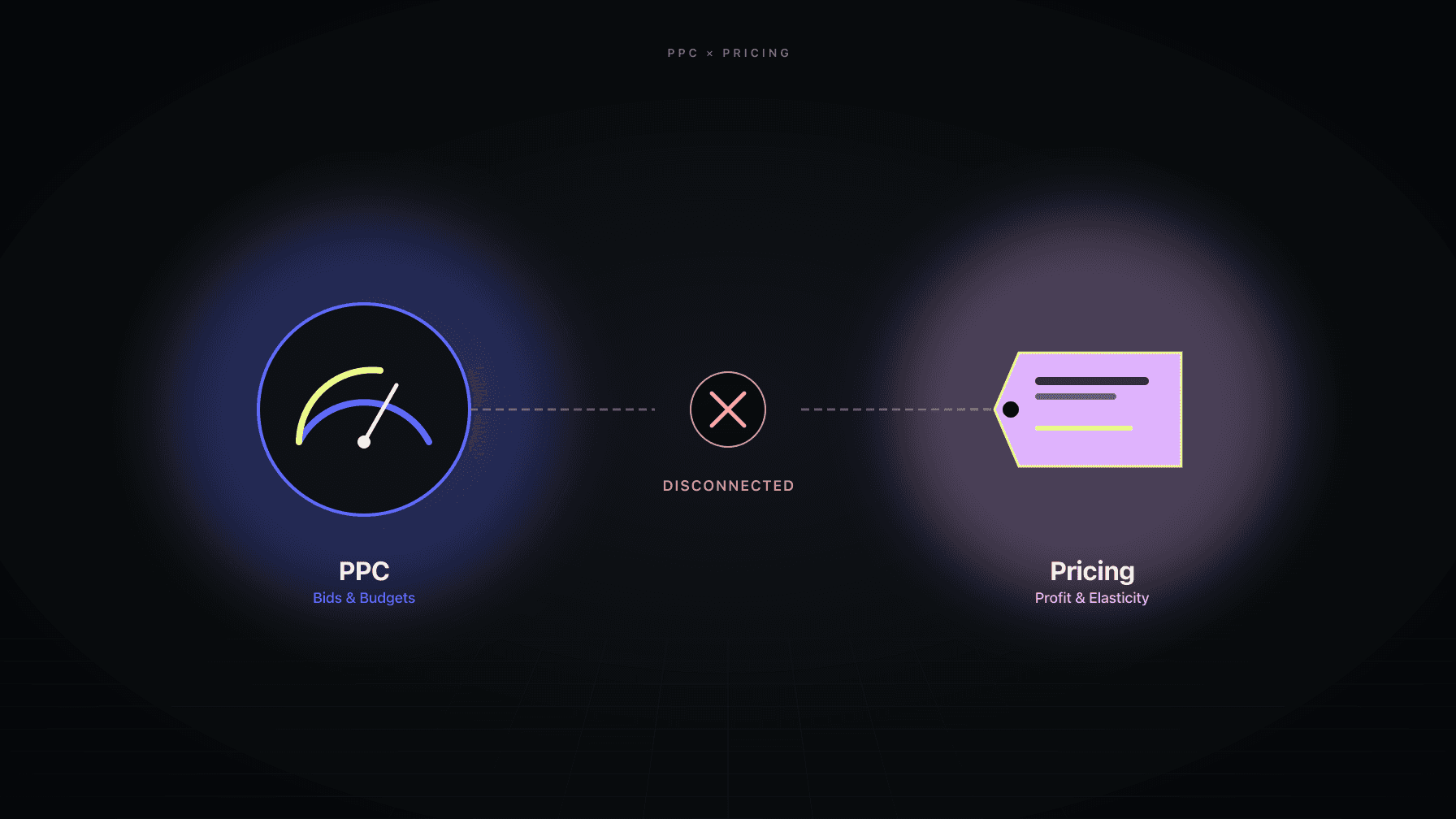
Most Amazon sellers run their PPC and pricing in completely separate tools. One tool manages bids and budgets. Another tool manages repricing rules. Neither one knows what the other just did.
This creates a profit leak that is almost invisible in your daily numbers but devastating at scale. Every time your repricer changes a price, your PPC tool is optimizing against stale data. Every time your PPC tool scales spend on a product, your repricer has no idea whether that ad spend is profitable after the new bid price.
I built Profasee because I lived this problem for a decade running my own Amazon brand. The gap between PPC and pricing cost me more money than any single bad product decision ever did. And when I talked to other sellers, the story was always the same: two tools, two dashboards, zero coordination.
This post breaks down exactly what goes wrong when your amazon ppc pricing strategy runs on disconnected tools, how much it actually costs, and what connected coordination looks like in practice.
Key Takeaways
The problem is not that your PPC tool is bad. The problem is not that your repricer is bad. The problem is that they cannot see each other.
Your PPC tool optimizes bids based on conversion data, ACoS targets, and historical performance. Your repricer adjusts prices based on competitor movements, Buy Box eligibility, and margin floors — which is why Amazon itself offers Automate Pricing as a first-party fallback. Both tools are doing exactly what you told them to do. But neither tool accounts for what the other one just changed.
This creates a feedback loop that quietly drains profit. Your repricer raises a price by 8%. Conversion rate drops because the product is now more expensive relative to competitors. Your PPC tool sees the conversion rate drop and either keeps spending at the same rate (wasting budget on lower-converting traffic) or pulls back bids aggressively (killing velocity you actually want at the higher margin).
From reading to action
If the framework above sounds familiar, your Amazon account is probably carrying the same drag. Apply and we will show what Marko, Oracle, and Bruno would change in your first week.

Ran a 7-figure Amazon brand for a decade. Founded Skubana (acquired). Co-founded Prosper Show. 15+ years on Amazon.
Head-to-head comparisons between Profasee and the tools most Amazon sellers already use.
Join the brands that replaced agencies and tools with AI employees.
Neither response is correct because neither tool has the full picture. The right response depends on whether the margin gain from the price increase offsets the conversion rate dip. But that calculation requires data from both systems, and disconnected tools do not share data.
The cost compounds across your catalog. If you have 50 ASINs and your repricer makes price adjustments multiple times per day, you are generating hundreds of PPC misalignment events per week that no one catches.
This is the most common coordination failure, and it plays out the same way almost every time.
Your repricer detects an opportunity to capture more margin. Maybe a competitor went out of stock. Maybe demand is spiking. The repricer raises your price by 10-15%. This is the right pricing decision in isolation.
But your PPC tool is still running yesterday's bid strategy. It has a target ACoS of 25% based on the old price and the old conversion rate. At the new, higher price, fewer shoppers convert. Your actual ACoS climbs to 35-40% before the PPC tool has enough data to detect the shift and recalculate.
Depending on your PPC tool's learning cycle, this misalignment window can last anywhere from 6 hours to 3 days. During that window, every ad click costs more relative to the margin you expected to gain from the price increase. On a product spending $200/day in PPC, a 3-day misalignment window at 15 percentage points of ACoS overshoot costs roughly $90 in wasted spend. That is $90 per product per price increase event.
Now multiply that across your catalog and across every price change your repricer makes. For a seller with 30 actively advertised ASINs and daily repricing, this easily reaches $2,000-$4,000 per month in coordination waste. You will never see a line item for it in your PPC dashboard because the tool does not know the waste exists.
The reverse is equally damaging. When your repricer drops a price to win the Buy Box, your PPC tool does not know that margins just shrank. It keeps bidding at levels that made sense at the old margin. You win more clicks, but each click is now less profitable than your PPC tool thinks it is.
The second coordination failure involves inventory, and it is arguably more expensive because the damage extends beyond wasted ad spend.
Here is how it works. Your PPC tool identifies a product that is converting well. ACoS is low, ROAS is strong, and the tool's algorithm does what it is designed to do: it increases bids and budget to scale a winner. Meanwhile, your inventory is sitting at 3 weeks of supply and your next shipment is 5 weeks away.
Your PPC tool does not know about the inventory situation because inventory data lives in a completely different system. So it scales spend, accelerates sales velocity, and burns through your remaining stock faster. You stock out 10 days early.
The immediate cost is the lost sales during the stockout period. But the larger cost is what happens to your organic rank. Amazon's own FBA inventory guidance notes that sustained stockouts degrade listing health, and in practice the algorithm penalizes products that go out of stock. When you restock, your organic position has dropped. Now you need even more PPC spend to recover the ranking you had before the stockout. You are paying twice for the same position.
A connected system would see the inventory signal and do the opposite: taper ad spend as stock gets low, preserve inventory for organic sales that protect your ranking, and ramp spend back up only when new stock arrives.
This is not a hypothetical. I have talked to hundreds of Amazon sellers who have lived this exact scenario. The stockout recovery cost alone often exceeds the total PPC spend that caused it.
Connected PPC and pricing is not about building a single monolithic tool that does everything poorly. It is about creating a shared data layer so that each specialized function can see the full picture before making a decision.
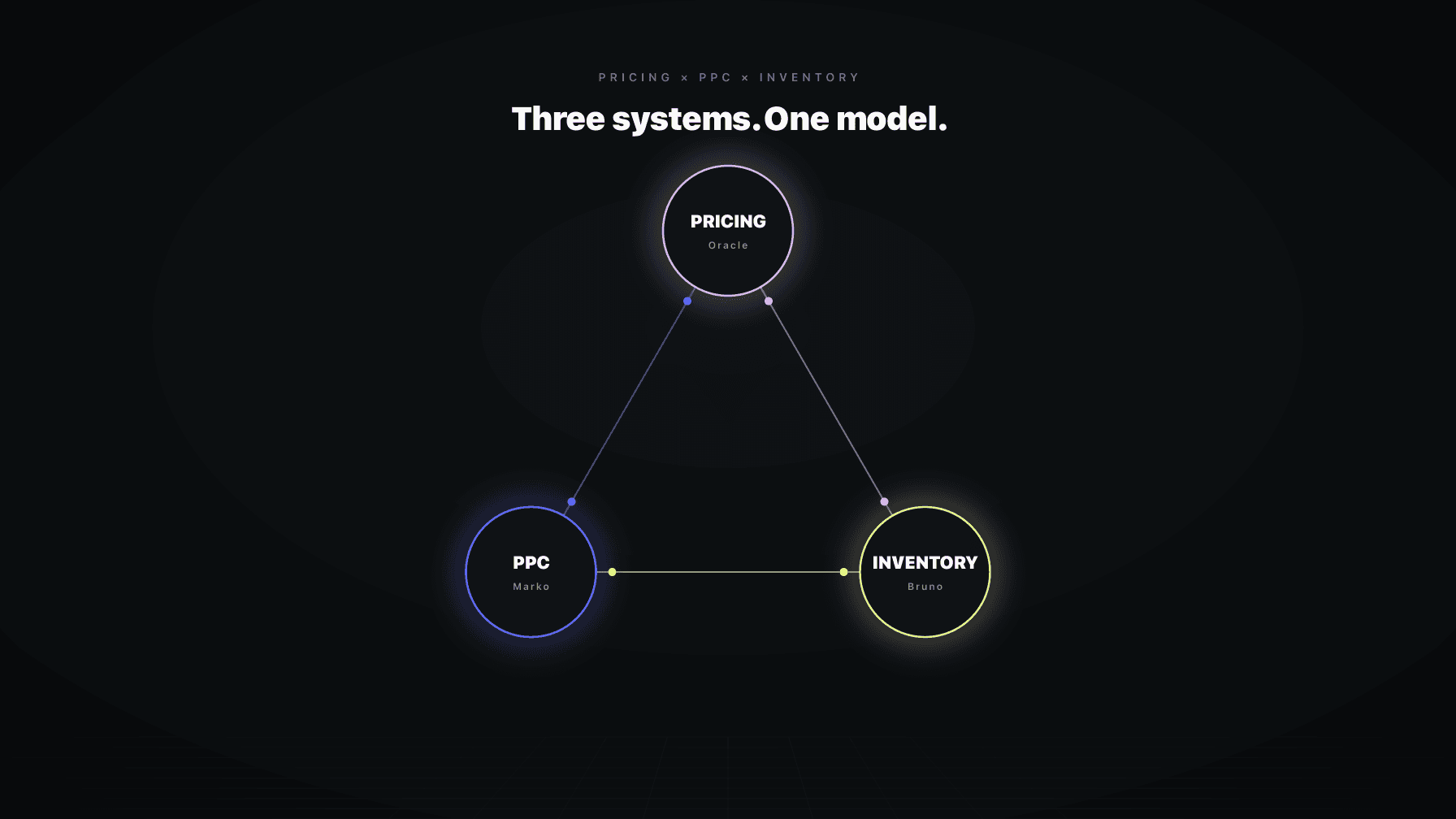
At Profasee Ultra, this works through AI employees that share a common understanding of your business. Oracle handles pricing. Marko handles PPC. Bruno handles inventory and demand planning. Each one is a specialist, but they all operate on the same data.
When Oracle raises a price on an ASIN, Marko immediately knows. Marko recalculates the expected margin at the new price, adjusts the target ACoS accordingly, and modifies bids before the next ad auction. There is no 6-hour learning window. There is no 3-day lag while the algorithm catches up. The adjustment happens in the same decision cycle as the price change.
When Bruno flags that inventory is dropping below a safety threshold, Marko reduces ad spend on that ASIN automatically. Oracle can simultaneously raise the price slightly to slow organic velocity. The combined effect is that you preserve stock, protect organic rank, and avoid the expensive stockout recovery cycle.
When Marko sees that a particular search term is converting well at high volume, Oracle factors that PPC demand signal into its pricing model. If PPC is driving strong incremental volume at healthy margins, Oracle knows it can hold price rather than dropping to chase the Buy Box on organic alone.
This is what coordination looks like. Not one tool trying to do everything, but multiple specialized tools that share data and react to each other's decisions in real time. No standalone PPC software or standalone repricer can do this because they are architecturally incapable of seeing each other's data.
Let's put rough numbers on the coordination gap. These are based on patterns we see across hundreds of Profasee customers, not theoretical projections.
Price increase misalignment cost:
Price decrease margin erosion:
Inventory-driven stockout acceleration:
Total estimated coordination waste for a mid-size seller (30 ASINs, $4,500/day total PPC spend):
These numbers scale linearly with catalog size and PPC spend. A seller running 100 ASINs with $15,000/day in ad spend can easily lose $40,000-$65,000 per month to coordination gaps alone. That is money that does not show up as a line item anywhere. It just looks like "normal" ACoS fluctuation and "normal" stockout frequency.
You do not need to take my word for it. You can measure your own coordination gap with data you already have. Here is a straightforward audit process.
Step 1: Pull your price change log. Export a list of all price changes across your top 20 ASINs for the last 30 days, with timestamps. Your repricer should have this data.
Step 2: Pull your PPC bid change log. Export bid adjustments for those same ASINs over the same period. Note the timestamps.
Step 3: Measure the gap. For each price change, find the next corresponding bid adjustment on that ASIN. The time between the price change and the bid adjustment is your misalignment window. Anything over 2 hours is costing you money.
Step 4: Calculate the ACoS during misalignment windows. Compare your ACoS during misalignment windows (the hours after a price change but before a bid adjustment) against your ACoS during aligned periods. The difference is your coordination tax.
Step 5: Check inventory-PPC correlation. Look at ASINs that stocked out in the last 90 days. Pull their PPC spend trend in the 2 weeks before the stockout. If spend was increasing while inventory was decreasing, you found an inventory coordination gap.
Most sellers who run this audit find that their misalignment windows average 18-36 hours and their ACoS during those windows runs 10-20 percentage points higher than during aligned periods. If that matches your data, the coordination gap is real and it is significant.
If you want help running this audit or want to see what connected PPC and pricing looks like on your actual catalog, you can apply for Profasee Ultra here.
The coordination gap matters less if you sell fewer than 5 ASINs because you can manually monitor price changes and adjust PPC bids yourself. Once you cross 10-15 actively advertised ASINs with dynamic repricing, manual coordination becomes impossible at the speed your tools operate.
Syncing update schedules helps slightly but does not solve the core problem. Even if both tools run at the same hour, your PPC tool does not know what price was just set. It still needs time to detect the conversion rate shift caused by the price change and then recalculate bids. The lag is algorithmic, not just a timing issue.
Amazon's native PPC automation (dynamic bidding, bid adjustments by placement) operates independently from any repricer. Amazon does not connect its ad platform to third-party pricing tools. You end up with the same disconnection problem, just with Amazon as the PPC tool instead of a third-party platform.
The clearest signal is ACoS volatility that you cannot explain. If your ACoS swings 10+ percentage points on ASINs that have stable search volume and stable competition, the swings are likely caused by price changes that your PPC tool is reacting to after the fact. Run the five-step audit above on your top 10 ASINs and the data will tell you.
Sellers spending $3,000/month or more on PPC with 10+ ASINs and active repricing will see meaningful savings from connected tools. Below that threshold, the absolute dollar waste from coordination gaps may not justify the switch. But the percentage of waste is the same regardless of scale. A 15% coordination tax on $3,000/month is $450. On $30,000/month it is $4,500. The math just gets harder to ignore as you grow.