Chad Rubin
May 4, 2026 · Updated May 11, 2026 · 12 min read
Operator notes by email
Short, opinionated takes on AI agents, Amazon PPC, pricing, and inventory. No fluff. About once a week.
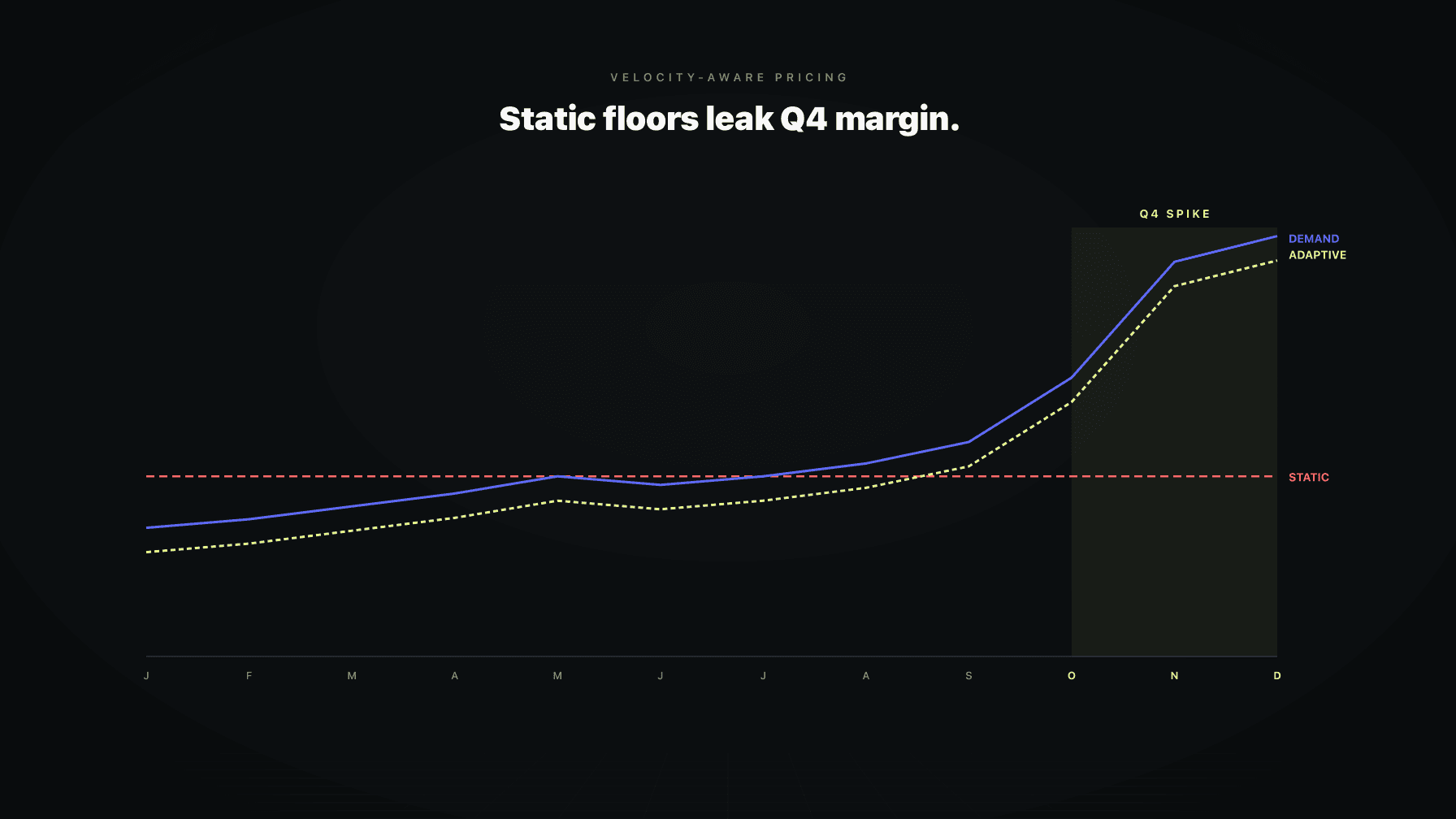
Most Amazon sellers set a floor and a ceiling once a quarter, sometimes once a year, and let the repricer fight inside that band. In stable months, that works. Then November shows up.
Q4 is a different animal. Demand pressure changes faster than your settings. Inventory positions shift weekly. Prime Big Deal Days, BFCM, the December cliff, and the post-holiday return wave all distort price elasticity in ways your static band never accounted for. The repricer keeps fighting at the floor while the market is willing to pay more, or sits frozen at the ceiling while a competitor just dumped inventory below cost.
The fix is not a smarter floor. It is a band that moves. Velocity-aware pricing adjusts the floor and ceiling based on what the product is doing right now: how fast it is selling, how much cover you have, where it sits on the BSR curve, and whether the calendar has anything dangerous in the next 14 days. The repricer still operates inside the band. The band becomes adaptive.
This post is the operator playbook: the four signals that should move the band, how to handle Prime Day and BFCM, where AI repricing fails, and a Q4 prep checklist.
## Key takeaways- Static floors and ceilings cost margin in Q4 because they cannot react to demand pressure changing inside a 7-day window.- Velocity-aware pricing moves the band itself, not just the price inside it. The repricer keeps doing its job. The boundaries get smarter.- Four signals worth wiring into the band: days of cover, BSR slope, conversion rate at current price, and the promo calendar.- During Prime Day and BFCM, the failure mode is not pricing too high. It is letting your repricer chase a competitor who is liquidating.- When inventory is short, the floor should rise. When it is long, the floor can drop. Most sellers do the opposite.- Post-peak, prices need to walk back to baseline gradually, not snap. The algorithm punishes sudden price jumps in low-demand windows.
Static setup: you pick a floor of $19.99, a ceiling of $26.99, and the repricer competes inside the band. The band does not change unless you log in and change it.
Velocity-aware pricing keeps the same machinery but adds a layer above. The floor and ceiling are functions, not constants. They move based on what the product is doing right now. If the product is selling 3x its trailing 30-day baseline and you have 14 days of cover, the floor lifts. If it is moving slowly and you have 180 days of cover, the floor relaxes so the repricer can compete harder for the buy box.
This is not the same as a more aggressive repricer. The repricer can stay simple. The band around it gets intelligent. Most sellers conflate these and try to solve a band problem by tuning the repricer, which is why their Q4 results never improve.
Two layers. The strategic layer (the band) reflects business reality: inventory, demand, calendar, margin. The tactical layer (the repricer) reflects market reality: competitor moves, buy box, MAP. Velocity-aware pricing means the strategic layer updates daily, not quarterly.
From reading to action
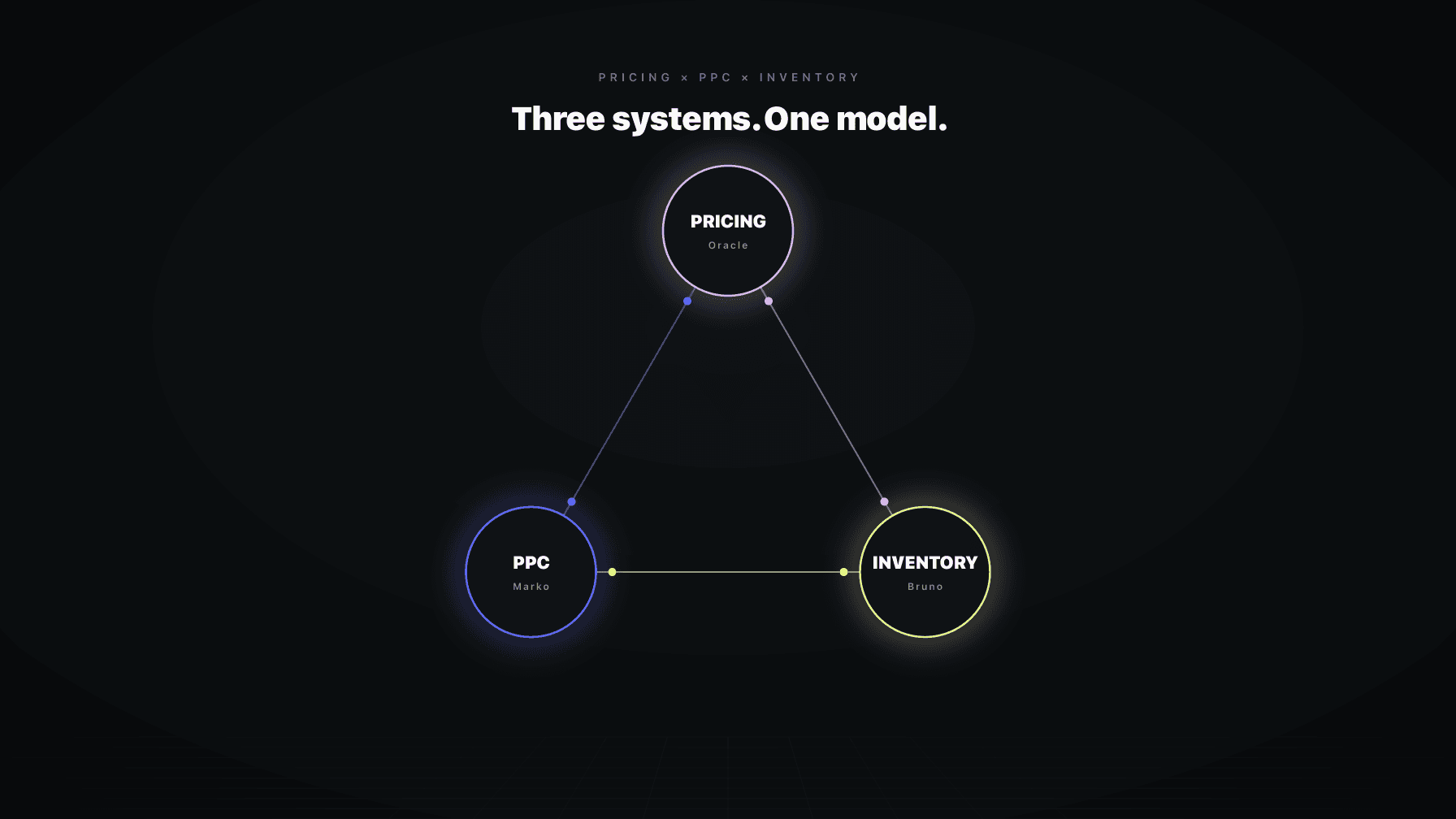
If the framework above sounds familiar, your Amazon account is probably carrying the same drag. Apply and we will show what Marko, Oracle, and Bruno would change in your first week.

Ran a 7-figure Amazon brand for a decade. Founded Skubana (acquired). Co-founded Prosper Show. 15+ years on Amazon.
Join the brands that replaced agencies and tools with AI employees.
Three things happen in Q4 that a static band cannot handle.
First, demand pressure changes faster than your settings. A product doing 80 units a day in October can do 240 in mid-November and 400 during BFCM. Your static floor was set when the product was doing 80. The repricer is still trying to win the buy box at a price that made sense at 80. You leak margin for three weeks straight.
Second, inventory positions shift weekly. 60 days of cover on November 1 can be 18 days by November 15 if a deal hits hard. Your floor should have moved up the moment cover dropped below 30. It did not, because the floor is a number in a spreadsheet nobody touched.
Third, your competitors are doing dumb things. Some are liquidating Q4 overstock. Some are running rule-based repricers chasing the lowest price. If your repricer follows them down, you end up at break-even during the highest-demand window of the year. That is the moment you should be making your year, not matching a competitor clearing inventory.
Sellers feel it as "Q4 was strong on units but weak on contribution margin." That is the band failing to move.
You do not need 47 inputs. Four signals cover most of the work.
Get these four right. Do not start with twelve signals. Start with four.
Most sellers know that low inventory should mean higher prices. Almost nobody has wired this into their repricer. The floor stays put while cover goes from 60 to 12.
The mechanic is straightforward. If lead time is 75 days and you have 14 days of cover, you are going to stock out. Raise the floor so the repricer slows velocity. You sell fewer units at higher margin, bridge to the next inbound shipment, and do not torch your BSR rebuilding from zero post-stockout.
Rule of thumb: when cover drops below half your replenishment lead time, the floor moves up by a meaningful step. Below a quarter, it moves again, or you switch to raise-only.
Opposite case: long inventory. Post-peak, 200 days of cover on a seasonal SKU. The floor should drop so the repricer competes harder. A lower price that moves units faster is cheaper than long-term storage fees plus aged inventory surcharges.
Most sellers do exactly the wrong thing. They keep prices high during peak when they are short, and high after peak when they are long. Both are velocity failures.
Sales velocity tells you what happened. BSR slope tells you what is about to happen.
BSR improvement leads sales velocity by 24 to 72 hours in most categories. If your BSR is improving sharply, you are in a demand window. A competitor went out of stock, a viral mention hit, a category-wide pull started. Whatever the cause, you have a short window where the customer will pay more before the algorithm catches up and drives more competitors into the buy box rotation.
Velocity-aware pricing uses BSR slope to lift the ceiling during these windows. Not the floor. The ceiling. You let the repricer push higher because the demand signal says the market will absorb it. When BSR slope flattens, the ceiling drops back to baseline.
If BSR is decaying fast, the product is losing relevance and the floor needs to drop to defend rank. Sitting at the same price while BSR slides is how good products turn into dead inventory.
This is hard with rule-based repricers because BSR slope is a derivative. AI handles it naturally. The signal is in the slope, not the level.
Prime Day and BFCM are the moments where most sellers either make their year or accidentally torch their margin. The difference is almost always whether the pricing system was promo-aware.
Freeze the floor before the event. Most major Amazon deals (Lightning, 7-Day, Best Deal, Prime Exclusive) require the deal price to be a meaningful discount off a recent reference price. If your repricer drifts the price down in the weeks leading up, your reference price drops with it, and the deal is no longer a valid discount. Your deal gets pulled or adjusted upward. Freeze the floor at least 30 days before any deal you care about.
Do not chase competitors who are liquidating. During BFCM, some competitors clear Q4 overstock at break-even. Your repricer will try to match. Wrong instinct. If you have 60 days of cover and a competitor has 5 days trying to clear, you do not need to match. They run out, the price floor resets, and you sold through at full margin. A velocity-aware ceiling lets you stay above that liquidation price.
Reopen the band gradually after the event. The day after Prime Day, sellers often raise prices in one step back to baseline. The algorithm reads this as a sudden change and demotes the listing in low-demand windows. Stair-step back over 5 to 10 days instead. The repricer can do this. The band has to allow it.
If your pricing system has no concept of a promo calendar, all three get done by hand, which means they get done wrong or skipped under pressure.
Floors get all the attention, but ceilings matter just as much. A ceiling that never moves means you never capture the upside of a demand spike.
Push the ceiling when BSR slope is positive, conversion is healthy or improving, days of cover is dropping toward stockout, or a category competitor went out of stock or got suppressed.
Hold the ceiling when sessions are up but conversion is dropping (you hit the customer's pain point), a competitor with deeper inventory just lowered their price, you are entering a deal window where reference price matters, or the product has a coupon stacked on it.
The ceiling is the most underused tool in Amazon pricing. Most sellers set it once based on margin math, never touch it, and miss the upside of every demand window.
AI handles velocity better than rule-based, but it is not magic.
What AI does well: time-series data. BSR slope, velocity changes, conversion trends, competitor price patterns. These are derivatives, exactly what a model trained on Amazon data is built for. It can also learn per-ASIN elasticity, so the response to a demand signal is calibrated to that product, not a category average.
What AI fails at: business context the model cannot see. New variant launched last week, no history. COGS changed, the model does not know. Private MAP agreement with a retailer, the model does not know. About to run a TV spot and want prices held high, the model does not know.
The fix is not to replace AI with rules. Layer the AI inside a system that knows the business context. Pricing posture (cutting allowed, frozen, raise-only) comes from inventory and calendar. Price moves inside that posture come from the model. Same pattern as AI PPC management: model is great at tactics, strategy comes from the operator.
Run this in early October. Re-run mid-November.
The point: surface the decisions that have to be made before the season starts. Making them under pressure on December 6 is how Q4 results get bad.
Post-peak is where I see the most wasted margin. Sellers ran Q4 well, did good volume, then in early January either snap back to full price (and lose ranking in the slow window) or stay low too long (and bleed margin into the new year).
The right pattern is a controlled walk-up. After your last holiday deal, the band reopens gradually. The floor walks up over 5 to 10 days. The ceiling moves with it. The repricer keeps competing inside the band, but the band moves toward baseline at a controlled pace.
Two reasons this matters. The algorithm reads price stability as a quality signal. A product that snaps from $19.99 to $26.99 overnight in a low-demand window will lose buy box share to a competitor who held more stable. And the customer is not stupid. A product they considered at $19.99 on December 28 looks suspicious at $26.99 on January 2.
For seasonal SKUs, post-peak is also when you confirm whether the band needs to drop into deeper liquidation. Cover is the trigger. Went into peak with 90 days, did 50% of projected volume, now have 60 days going into a slow January? Floor needs to come down. Sold through hard, only 20 days left? Floor walks back to baseline as planned.
The walk-up is boring. That is why it works. It is the part of pricing most sellers skip because Q4 is over and they have moved on.
Profasee Oracle is built around this layered model. The repricing engine handles tactics. The band is velocity-aware by default.
Oracle reads inventory state from Bruno, our demand planner. Bruno tracks days of cover at the SKU level, factoring lead time, sell-through rate, and inbound shipments. Oracle uses that signal to set the pricing posture: cutting allowed when cover is healthy, frozen when cover is below half lead time, raise-only when cover drops below a quarter.
The velocity baseline is per-ASIN and refreshes daily. Oracle is not using a category average. It uses your product's own trailing window, so a "demand spike" is defined relative to that ASIN's normal pattern.
The promo calendar drives freeze windows automatically. Commit to a Lightning Deal or Best Deal, the floor freezes 30 days before. After the event, the band reopens on a controlled walk-up. You do not have to remember. The calendar is part of the system.
For the full loop with PPC and inventory, see pricing, PPC, and inventory coordination.
A repricing approach where the floor and ceiling of the price band move based on real-time signals: inventory cover, BSR slope, conversion rate, and the promo calendar. The repricer keeps doing its job inside the band. The band itself updates daily based on what the product is doing in the market.
Pull days of cover for every SKU in early October. Flag anything under 60 days. Map your promo calendar and set 30-day freeze windows before each event. Set velocity-aware floors and ceilings rather than static numbers. Write down your liquidation policy in advance. Plan the post-peak walk-up so prices return to baseline gradually.
Depends on inventory and demand. If you have a deal locked in, the deal price is fixed and the question is what the non-deal price should be. Short inventory plus improving BSR, push the ceiling higher. Long cover and a competitive category, compete harder inside the band. The mistake to avoid is letting your repricer chase a competitor who is liquidating overstock. Their economics are not yours.
Days of cover drives the floor directly. When cover drops below half your replenishment lead time, the floor lifts. Below a quarter, the floor lifts again or you switch to raise-only. When cover is long (post-peak overstock), the floor relaxes so the repricer can compete harder for the buy box and clear units before storage fees compound.
BSR slope is the trend in Best Sellers Rank over a 7-day or 14-day window. Positive slope (rank improving) is a leading indicator of demand pressure: the market will tolerate a higher price. Negative slope means the product is losing relevance and the floor probably needs to drop. BSR slope leads sales velocity by 24 to 72 hours in most categories.
In theory, yes, but maintenance gets ugly fast. Rule-based systems handle point-in-time values well. They struggle with derivatives like BSR slope or velocity changes. You can approximate velocity awareness with nested conditions, but you end up with a rule tree nobody understands and that breaks every time market conditions shift. AI handles time-series signals natively, which is why most serious velocity-aware setups use AI inside the band.
Three things. Freeze the floor 30 days before any deal where reference price matters. Define a velocity-aware ceiling that rises when BSR slope is positive and inventory is short. And narrow your competitive set. A repricer watching every competitor will get dragged into other people's liquidation decisions. Watch the ones whose economics match yours.