Chad Rubin
May 6, 2026 · Updated May 11, 2026 · 13 min read
Operator notes by email
Short, opinionated takes on AI agents, Amazon PPC, pricing, and inventory. No fluff. About once a week.
I have been selling on Amazon for over a decade. The first repricer I ever ran cost me about $40,000 in a single weekend because it did exactly what I told it to do. It moved. Constantly. On every signal. Including the signals that should have been ignored.
That is the part nobody talks about when they sell you software. AI repricers want to be busy. They were trained on action. Every input is treated as a reason to do something, because the loss function rewards doing something when the data shifts. Sitting still feels like a bug to a model. It rarely is.
The most underrated skill in Amazon pricing is knowing when busy is wrong. Knowing when the right move is to do nothing for 6 hours, or 3 days, or until inventory clears. Most of the margin damage I see on seller P&Ls does not come from repricers being too slow. It comes from repricers being too eager during the exact windows when prices should have been frozen.
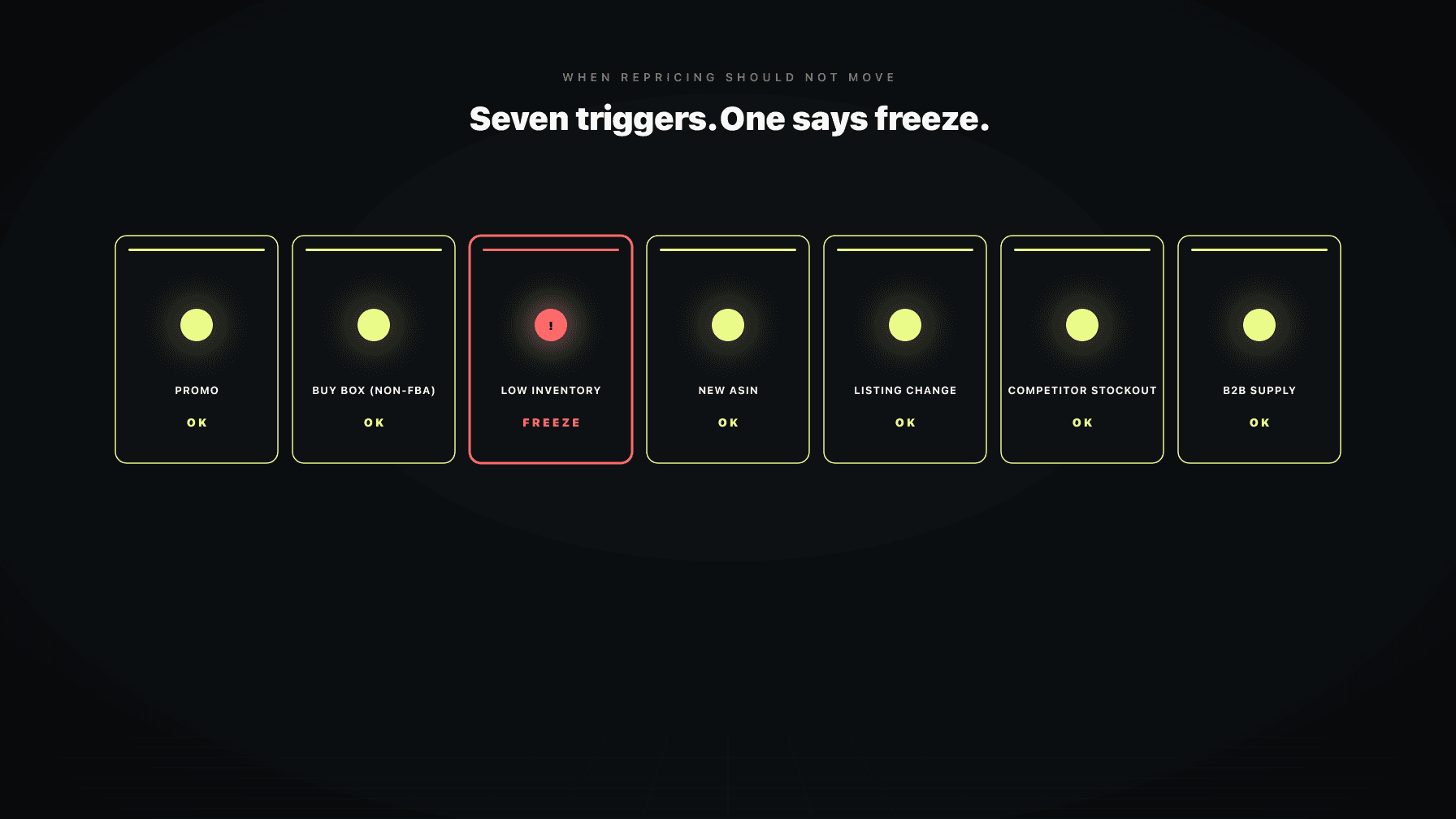
This post is the freeze playbook. Seven triggers where your repricer should hold position, plus how to encode those triggers as rules and when to override them. If you only read one section, read the one on promos, because that is where I see the most blood on the floor.
## Key takeaways >- A repricer that acts on every signal will lose you money during promos, inventory crunches, and new ASIN ramps.- Lightning Deals and Best Deals already discount your reference price. A repricer dropping further is double-dipping the discount.- Buy Box loss to a non-FBA seller is almost never worth chasing. The buyer pool is different.- New ASINs in their first 14 to 30 days need price stability, not optimization. Amazon's algorithm is still learning who you are.- Competitor stockouts create fake price collapses. Match those and you will reset your floor for nothing.- Listing changes (main image, title, A+) reset conversion data. Pricing on stale data is pricing blind.- The right repricer is one that knows when to sit on its hands.
Most pricing tools are sold on responsiveness. The pitch is: we react in 60 seconds, we beat the competition by a penny, we never miss a Buy Box. That sounds great in a demo. It is wrong in practice.
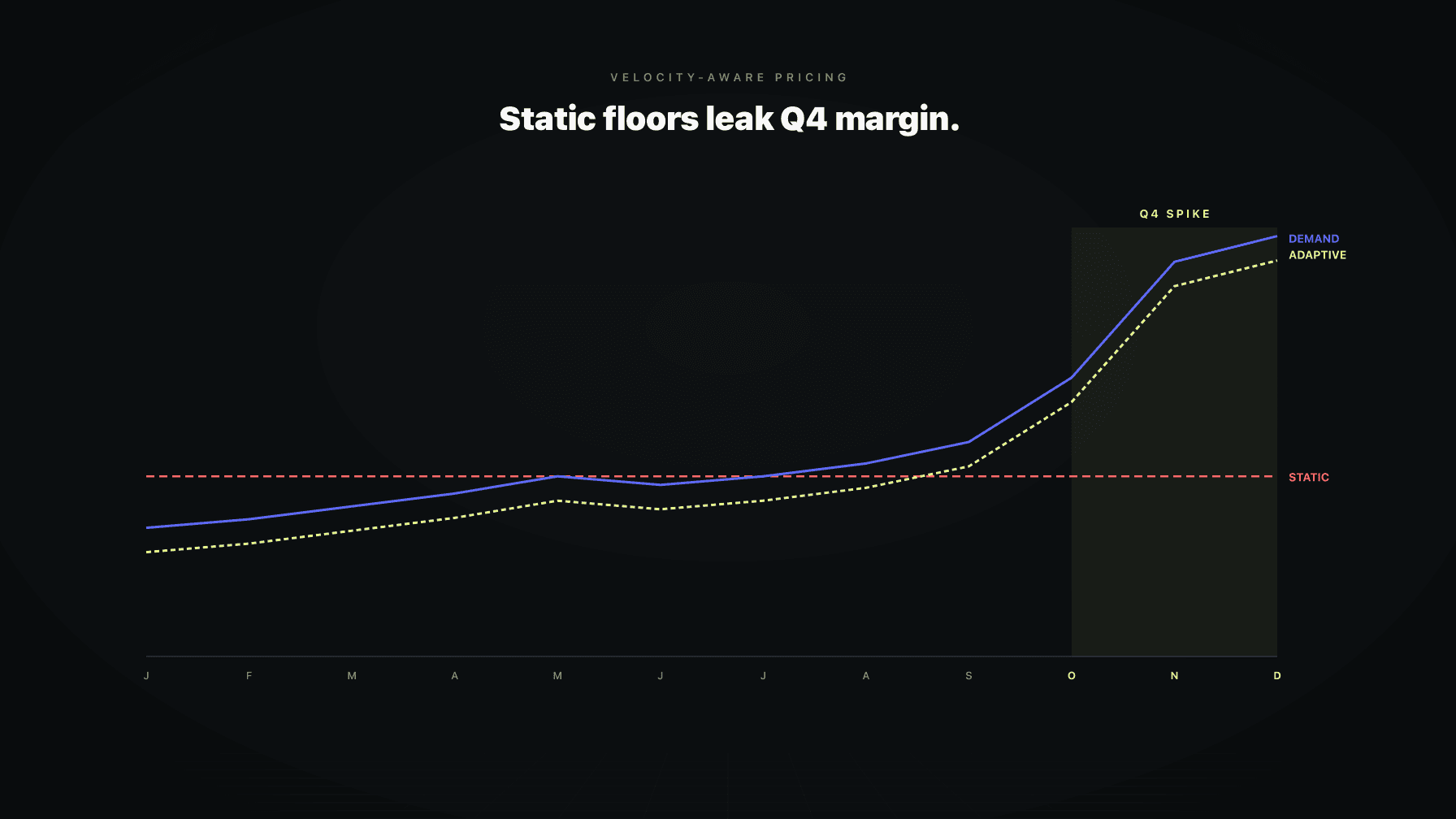
The hard part of pricing is restraint. A model that fires on every input will produce a chart that looks like a seismograph during an earthquake, and your average selling price will drift down because every micro-decision is biased toward a small drop (it almost always wins the immediate Buy Box) and against a small raise (which loses the Buy Box for a few minutes). That asymmetry is the thing nobody warns you about. Over 90 days of small drops, your floor is now your ceiling.
Restraint is harder than action because restraint requires the system to model context. Action only requires the system to model the input. So when I say "freeze rules," I mean rules that override the default action bias of the underlying optimizer. They are guardrails on top of intelligence, not replacements for it.
From reading to action
If the framework above sounds familiar, your Amazon account is probably carrying the same drag. Apply and we will show what Marko, Oracle, and Bruno would change in your first week.

Ran a 7-figure Amazon brand for a decade. Founded Skubana (acquired). Co-founded Prosper Show. 15+ years on Amazon.
Join the brands that replaced agencies and tools with AI employees.
This is the one that costs sellers the most money. You schedule a Lightning Deal at 20% off. Your repricer sees the discount as a "new lower price" and decides the market has moved down, so it pushes your post-deal price down too. Or worse, it stacks a competitive drop on top of the deal price, and now your $39.99 product is selling at $27.50 with a 20% Lightning Deal layered on, which means you are giving away another 30% on top of what you intended.
Lightning Deals require a reference price. Amazon will reject the deal if the price has been at or below the deal price recently. So when your repricer drops the regular price during the deal, you may also be sabotaging the next month's deal eligibility.
The freeze rule here is simple. From 24 hours before a scheduled promo until 24 hours after, the repricer should not change list price. Subscribe & Save percentage stays where it is. Coupons stay where they are. The only thing that should be moving is the deal price itself, which is set by the deal, not by the repricer.
I have seen sellers wipe out an entire Prime Day worth of profit because their repricer was set to "aggressive" and decided the deal price was the new normal. Three days after Prime Day they were still at the deal price, with no deal active, just selling at a 20% discount for nothing.
A merchant-fulfilled seller undercuts you by 8%. Your repricer wants to match. Do not match.
The Buy Box is not awarded purely on price. Amazon weighs fulfillment method, seller metrics, ship time, and dozens of other factors. An FBM seller who undercuts an FBA seller by 8% rarely takes the Buy Box from you anyway, because Prime eligibility and ship speed dominate the calculation for most categories. If they do take it, they often hold it for an hour or two before Amazon rotates it back, because the buyer pool that converts on FBM is smaller and slower.
The same logic applies to used condition listings undercutting your new condition listing. Different buyer pool. Different conversion rate. Different return profile. Your repricer treating those as comparable is treating apples and onions as the same fruit.
The freeze rule: ignore Buy Box price changes from non-FBA competitors and from used listings. Track them, log them, do not act on them. If you are losing the Buy Box to an FBM seller for more than 48 consecutive hours, that is a different problem (probably your seller metrics) and pricing will not fix it.
You have 600 units. Your reorder lead time is 45 days. Your daily velocity is 22 units. Math: 27 days of cover. You are short.
Most repricers would treat this as a normal pricing situation. The smart move is the opposite. When you cannot replenish in time, dropping price is destroying margin on units you cannot replace. Every $0.50 you cut off price below what would have cleared the inventory anyway is a $0.50 you handed back for nothing.
The freeze rule here is actually a "freeze and lift" rule. When days of cover drops below lead time minus a buffer (I usually use 10 days), the repricer should not drop price. Many of the operators I work with go further. They lift price. The argument is straightforward. If you are going to stock out, stock out at a higher price. The unit economics on the last 600 units are different from the unit economics on a steady-state replenishment cycle, because the cost of the stockout is real and includes the BSR damage and the keyword ranking damage that comes after.
Repricers that do not see inventory data cannot make this decision. Most do not see it. That is a problem.
A new ASIN has no conversion history. Amazon's algorithm is still figuring out who clicks, who buys, who returns. Pricing decisions made in this window are pricing decisions made on noise.
The freeze rule: hold list price flat for the first 14 to 30 days, depending on category velocity. In high-velocity categories (consumables, beauty, basics) you can probably start moving price at day 14 because you have enough sessions. In slower categories (durables, niche electronics) you may need 45 days before the conversion rate stabilizes.
What sellers usually do instead is panic. The product launches, sales are slower than expected for the first 5 days (because of course they are, the algorithm has not learned it yet), and they drop price. The repricer sees the drop and learns the new lower price. Now the ASIN is anchored low forever, the algorithm is still confused, and they have set themselves up for a year of trying to claw price back up.
Hold price flat. Run PPC into the launch to generate sessions. Let conversion data accumulate. Then start letting the optimizer move.
You change your main image. Conversion rate goes from 14% to 11% over the next 72 hours. Was that the image, or was that something else? You do not know yet. The repricer definitely does not know yet.
Here is what happens when you let a repricer act during a listing change window. It sees declining conversion. It interprets that as price being too high for the current market. It drops price. Conversion comes back up (because of the price drop, not because of the image). The model now believes the new lower price is correct. You changed your main image and accidentally lowered your price.
Or the inverse. New A+ content goes live. Conversion improves. The repricer sees room to push price up. Price goes up, conversion drops back down to the prior level. Now you are above where the market wants to be, and you are not sure if it was the A+ or the price.
The freeze rule: when any listing element changes (main image, title, the first three bullets, A+ modules), price holds for 7 to 10 days. Long enough to attribute conversion movement to the listing change rather than to price.
Three competitors all stock out the same week. The fourth one, who has 8 units left, prices them at $19.99 just to clear them. Your repricer sees the new low price in the competitive set and matches.
Two days later, competitor #1 restocks at $34.99. Now you are 43% below the actual market and your repricer, depending on how it is configured, may not even raise you back up because it just learned that $19.99 is a "valid" price.
This is one of the sneakiest forms of margin destruction in repricing. A real human looking at the situation would notice that the $19.99 seller has 8 units left and is liquidating. A repricer will not notice unless someone built that signal into it.
The freeze rule: when competitive set stock count drops below a threshold (I use 15% of normal aggregate inventory in the comp set), do not match. Track the floor, ignore it for action purposes, wait for restock data. If you do not have stock data on competitors, use price velocity. If a competitor's price drops by more than 15% in 24 hours and they are the only one moving, that is liquidation, not the market.
You sell something with a key input that just got hit by a 20% raw material price increase. Your supplier has not raised your unit cost yet because you have a contract. But every other private label seller in the category will be affected within 6 weeks. The market price is about to move up.
Your repricer does not know this. It is looking at Buy Box prices, sales velocity, and conversion rate. It is going to keep you priced based on the world that exists today. The world that exists in 6 weeks will be different.
The freeze rule here is more of a manual flag. When you have intelligence about upstream supply constraints (tariffs, raw material moves, currency shifts on imported goods, port delays, supplier announcements), you flag the SKU as "supply-aware hold" and the repricer becomes much more conservative on downward moves. Upward moves are still permitted. The asymmetry matches the directional bet.
This one needs a human in the loop. No model is going to read tariff news and update its pricing strategy. You read the tariff news, you flag the affected SKUs, the repricer respects the flag.
Knowing when to freeze is one thing. Encoding it into a system that actually respects the freeze is another. Most rule-based repricers I have audited have a freeze feature, but it is binary and global. Pause all repricing. That is too coarse.
What you want is a layered system:
If your current tool does not support most of this, you are running with one hand tied behind your back. The freezes are doing the work of preserving margin. Without them you are sailing without a rudder.
Rules break. Every freeze rule I have laid out has edge cases where the right move is to override.
Promo freeze override: a competitor launches an unannounced deal during your promo and is destroying your conversion. You may need to drop the regular price to keep the deal viable. This is rare. Document the override.
Inventory freeze override: you got an unexpected restock notice. Lead time just collapsed. The freeze should lift.
New ASIN ramp override: a competitor launched the same week you did at a price 30% below yours. Your conversion is below 1%. The launch is failing. Pull the price down once, document it, accept that the ramp window is reset.
Listing change freeze override: the listing change actually fixed a mismatch (you corrected a wrong product image), conversion is up 40%, you have enough signal in 3 days instead of 10. Move.
The discipline here is that overrides should be rare and documented. If you are overriding a freeze every other week, the freeze rule is wrong, not the freeze. Fix the rule.
Oracle was built around the idea that pricing is mostly about restraint. Every freeze trigger covered in this post is a first-class concept inside the system, not a duct-taped rule on top of a "match Buy Box" optimizer.
Promos, inventory levels, and new ASIN ramp windows are auto-detected. Oracle pulls promo schedules from your Seller Central calendar, reads inventory and lead time from the same data feed Bruno (the inventory AI employee) uses for replenishment forecasting, and tags ASINs by age automatically. Listing changes need a manual flag, because Amazon's API does not reliably surface every listing edit, and you do not want to find out about a title change three weeks late.
Mission Control surfaces every active freeze in one view. You can see which ASINs are frozen, why, when the freeze expires, and whether any blocked price changes happened during the freeze (with the reason). Override is one click, with a required reason code that gets logged for audit.
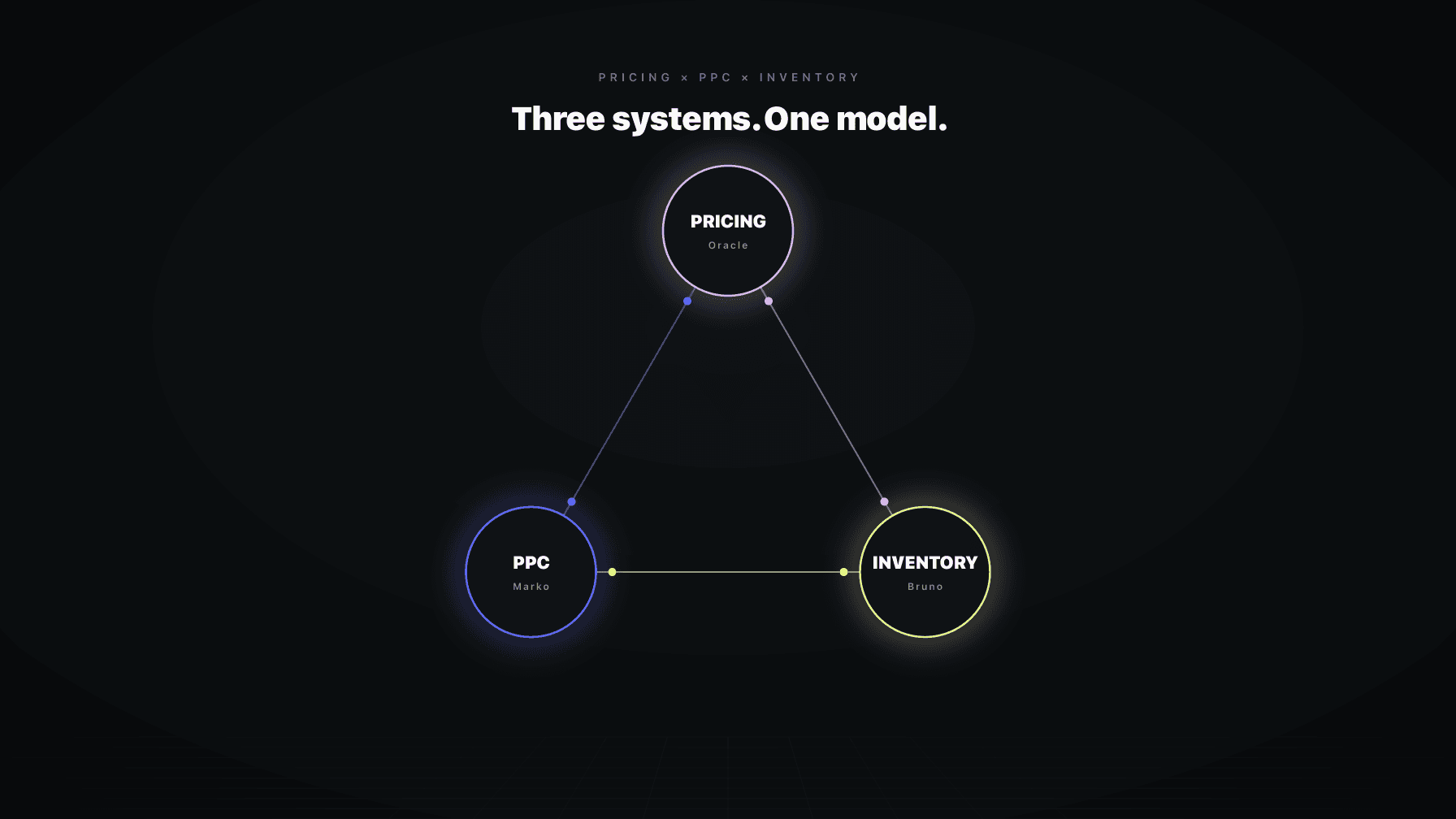
The other piece worth mentioning is coordination. A freeze is not just a pricing event. When Oracle freezes a price during a Lightning Deal, Marko (the PPC AI employee) gets notified to lift bids, because traffic is going to be 4x to 8x normal and you want to ride the surge. When Oracle freezes a price during low inventory, Bruno gets notified to expedite replenishment. The freeze itself is the trigger for actions across the rest of the operation. That is the part you cannot do with a standalone repricer that does not talk to PPC and inventory.
If your current setup does not have these freezes built in, or has them but does not coordinate across PPC and inventory, you are leaving margin on the table during exactly the windows where margin matters most.
At minimum: during scheduled promos (24 hours before to 24 hours after), when inventory drops below lead-time cover, during the first 14 to 30 days of a new ASIN, after any major listing change, and when a competitor stockout creates an artificial price collapse. Beyond those, freeze pricing whenever you have information the repricer does not (upstream supply moves, tariff news, planned brand-level pricing changes).
Almost never. Merchant-fulfilled and used-condition sellers compete in a different buyer pool than FBA new. Their Buy Box wins are usually short-lived because Amazon weighs Prime eligibility heavily. If you are losing the Buy Box to a non-FBA seller for more than 48 consecutive hours, the issue is probably your seller health metrics, not your price.
Freeze list price for 24 hours before the deal starts and 24 hours after it ends. The deal price is set by the deal mechanism, not by the repricer. If your repricer drops list price during the deal window, you risk both stacking discounts (giving away more margin than intended) and disqualifying the next deal due to reference price recency rules.
A new ASIN has no conversion history. Amazon's algorithm is still learning who clicks, who buys, who converts. Pricing decisions made on the first 14 to 30 days of data are pricing decisions made on noise. Hold price flat, run PPC to generate sessions, let the conversion data stabilize, then start letting the optimizer move price.
Two things to watch for. First, the spike. If competitors stock out and the remaining seller raises price, that is real and you can lift with them. Second, the collapse. If a competitor liquidates remaining stock at a low price before stocking out, that is a fake floor. Do not match a single liquidating seller. Wait for restock data before treating the new price as market.
Manually flag it. Most repricers do not reliably detect listing changes from Amazon's API, so you need to log it yourself. When the main image, title, first three bullets, or A+ modules change, set a 7 to 10 day freeze. The freeze gives you time to attribute conversion movement to the listing change rather than to price.
Not as a blanket rule, no. Q4 is the worst time to stop optimizing because volume is highest and the cost of a bad price is highest. What you should do during Q4 is tighten the freeze rules around promos (Black Friday, Cyber Monday, the week before Christmas) and watch inventory triggers more carefully because lead times effectively collapse to zero (you cannot replenish in time for the season). Optimize harder between promos, freeze tighter during them.