Chad Rubin
May 1, 2026 · Updated May 11, 2026 · 13 min read
Operator notes by email
Short, opinionated takes on AI agents, Amazon PPC, pricing, and inventory. No fluff. About once a week.
Most sellers treat their Amazon price as a single number. They pick a price, watch the Buy Box, and adjust when something feels off. That worked when you had three SKUs and one competitor. It does not scale to 200 ASINs across five categories with five different competitive shapes, demand curves, and inventory profiles.
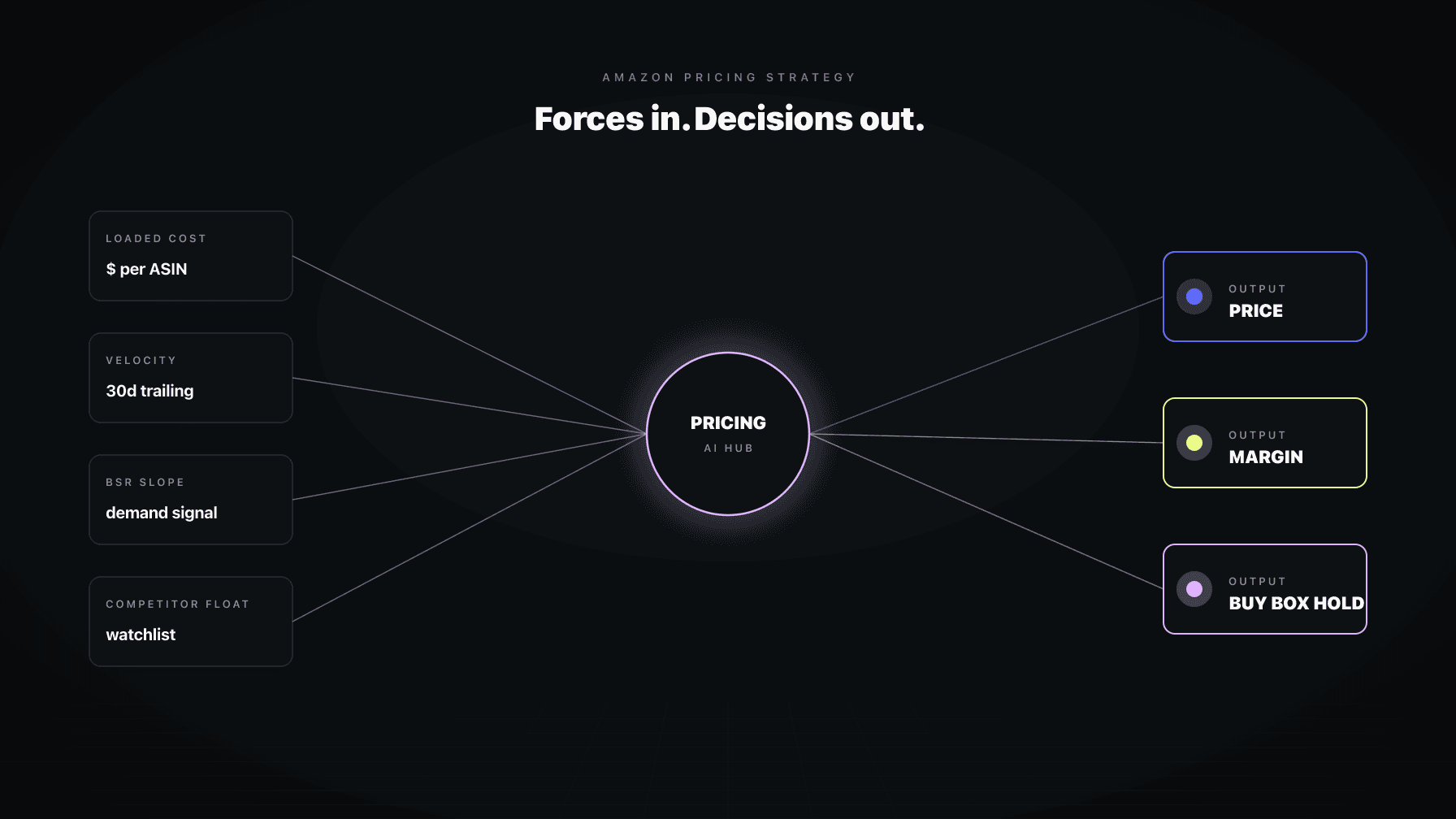
The sellers who run profitable Amazon businesses in 2026 stopped thinking of price as a number. They think of it as the output of a system. That system has inputs (cost, velocity, BSR, competitor float, inventory health, promo calendar, ad efficiency) and constraints (floor, ceiling, margin target, Buy Box hold rate). When you set the system up correctly, the price is the answer the system produces. You do not pick it. You verify it.
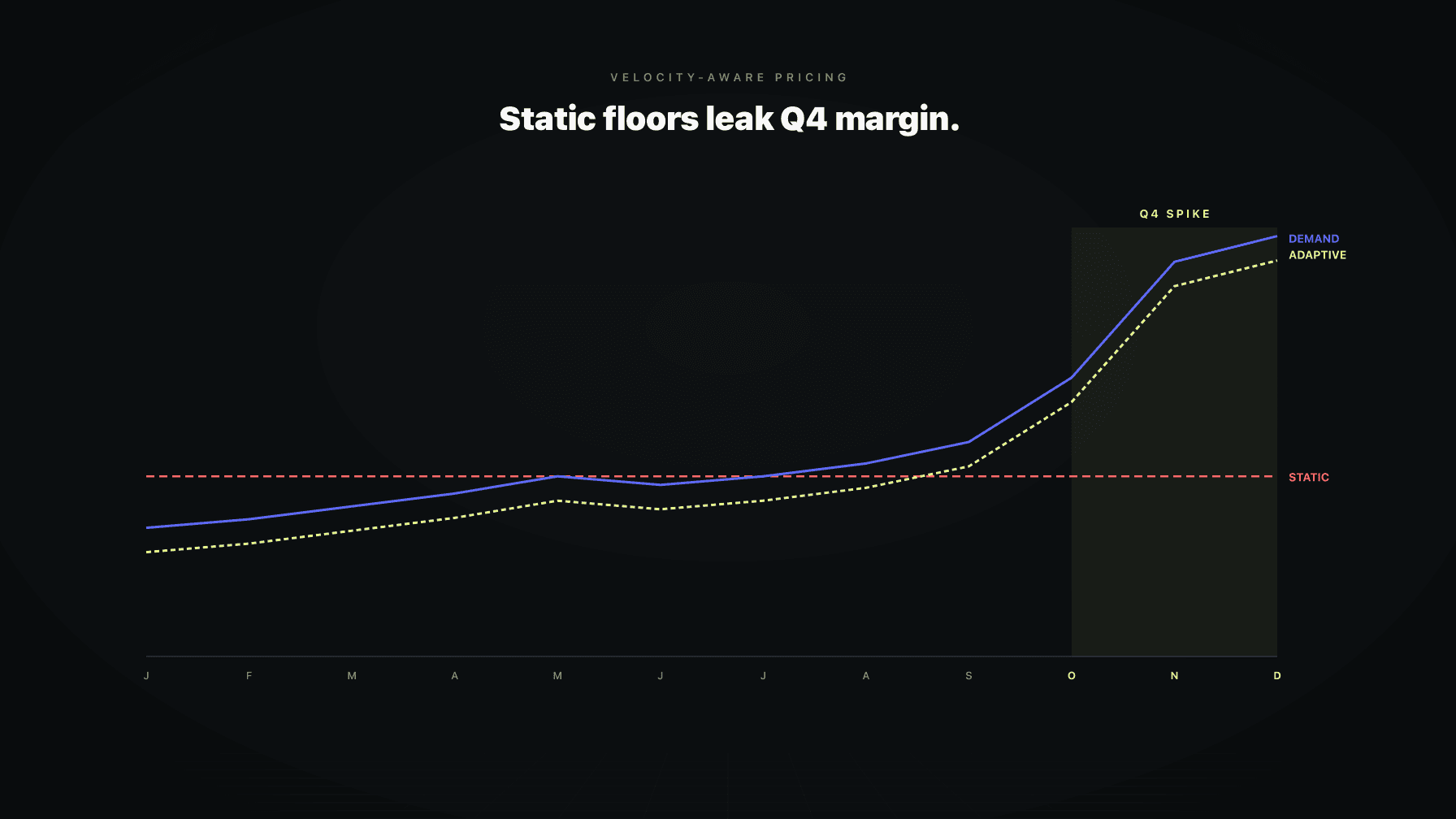
This is the part most pricing software gets wrong. It treats repricing as a chase: match the lowest competitor, then maybe shave a penny, then adjust again. That is not strategy. That is reaction. And reaction is what kills margin in Q4 when demand spikes and you keep cutting price because the algorithm says to.
This playbook is the operator framework I run for myself and for the brands I work with. It assumes you have AI repricing in your toolkit and need to operate it without it operating you.
## Key takeaways >- Amazon pricing is a system of forces, not a number. Cost, velocity, BSR signal, competitor float, inventory health, promo calendar, and ad efficiency all act on every ASIN every day.- Floor and ceiling are not safety rails. They are the playing field. Set them wrong and the AI will play the wrong game.- Operating modes (observe, recommend, approve, autonomous) matter as much in pricing as they do in PPC. Most sellers should not start in autonomous mode.- Contribution margin per unit beats price as a target. You can win on price and lose on profit if your costs are not loaded correctly.- Pricing decisions interact with PPC and inventory. A price change should propagate through the system, not happen in isolation.
A 1% price change moves contribution margin by far more than 1%, because cost is fixed and competition is not. On a product with a 30% gross margin, a 1% price increase that holds Buy Box adds roughly 3.3% to contribution margin per unit. A 1% price decrease that does not lift volume bleeds margin at the same rate.
Compare that to PPC. A 1% improvement in ACoS on a campaign with 25% ACoS moves contribution margin by a fraction of a percent on the units sold through that campaign. Real, but smaller. PPC is a flow valve. Pricing is the underlying pressure.
The leverage cuts both ways. Bad pricing does more damage faster than bad PPC. A repricer that races to the bottom in a competitive category can turn a profitable SKU into a losing SKU in a single day. A PPC bug rarely moves the needle that fast.
From reading to action
If the framework above sounds familiar, your Amazon account is probably carrying the same drag. Apply and we will show what Marko, Oracle, and Bruno would change in your first week.

Ran a 7-figure Amazon brand for a decade. Founded Skubana (acquired). Co-founded Prosper Show. 15+ years on Amazon.
Join the brands that replaced agencies and tools with AI employees.
This is why pricing strategy needs an operator. Not a setting. An actual decision-making framework.
Every ASIN price you set is the equilibrium of four forces. If you only think about one, you are flying blind on the other three.
Demand pressure. What does the BSR curve look like in your category? Is demand stable or seasonal? Are you on the upslope of a holiday or post-peak? Demand pressure tells you how much price elasticity you have. High demand pressure means small price increases stick. Low demand pressure means cuts get matched immediately and nothing improves.
Competitive float. How many competitors are within 10% of your price? Are they private label or resellers? Are they running promos? Competitive float tells you how aggressive your repricer should be. A category with three reseller competitors all racing to the bottom needs a different strategy than a category where you and two other private label brands are stable.
Inventory health. How many days of cover do you have? Are you about to stock out or sitting on too much? Inventory health is the dial that should move price up or down regardless of competition. Stockout coming means raise price to slow velocity and protect margin on remaining units. Glut means cut to clear and free up cash.
Ad efficiency. What is your TACoS for this ASIN? Are paid clicks profitable at the current price? If you cut price to win the Buy Box, are your PPC campaigns now losing money on every click because POAS dropped below break-even? Ad efficiency couples pricing to PPC, and most repricers ignore it.
A pricing system that handles all four forces is what you need. A pricing system that handles only competitive float is what most repricers actually do.
The operating-mode framework I use for PPC management applies just as cleanly to pricing. Maybe more cleanly, because the failure cost of a bad pricing decision is higher.
Observe. The AI watches your account, builds a model, and shows you what it would do. No actions taken. This is week one. If the AI's proposals match your gut, trust starts to build. If they do not, you fix the inputs (cost, floor, ceiling, target margin) before going further.
Recommend. The AI surfaces specific proposals each day with reasons attached. Raise this ASIN by 4% because BSR is improving and inventory is light. Drop this ASIN by 2% because three competitors moved and your Buy Box hold dropped 18%. You approve or reject in batches. This is where most sellers should live for the first month.
Approve. The AI sends you a daily digest of proposed price changes. You approve all, reject some, and the rest move automatically. Same control, less friction. This is where you graduate to once you trust the recommendations.
Autonomous. The AI moves prices within your guardrails without asking. You review weekly. You intervene on edge cases. This is where mature accounts run, but it is not where new accounts should start. The temptation to skip ahead is strong. Resist it.
The mistake sellers make is going straight to autonomous because the AI demo looked impressive. The demo did not have your COGS loaded wrong. The demo did not have a hidden floor that allowed the AI to drop below your true break-even. Live data is messier than demo data. Operating modes give you a way to discover where your data is wrong before the AI acts on it.
Most sellers treat floor and ceiling as safety rails. Set them, forget them. That is wrong. Floor and ceiling are the playing field. The AI will spend most of its time inside that range, so the range better be the right range.
A floor that is too low gives the AI permission to give away margin. A floor that is too high makes the repricer impotent in a real price war. A ceiling that is too low caps your upside in low-competition periods. A ceiling that is too high never matters because Amazon Buy Box logic will price you out anyway.
The right way to set them:
The point is to set them with intent. Not to set them once and never revisit. Floor and ceiling should change quarterly, sometimes monthly, as costs shift, competitive landscape shifts, and your inventory profile shifts. Treat them like a budget. Review them on a cadence.
Floor and ceiling math is its own deep topic with worked examples.
If you set "match the Buy Box price" as your target, you are asking the AI to optimize for revenue. Revenue without margin is theater. Set contribution margin per unit as the target and the AI will sometimes recommend a higher price even when that means losing the Buy Box temporarily.
That is the right behavior. Buy Box hold rate is a means to an end. The end is profit. There are categories and SKUs where being out of the Buy Box 30% of the day at a higher margin produces more total contribution margin than holding 95% Buy Box at a lower price. Your repricer needs to know which case it is operating in.
Loading COGS correctly is the prerequisite. Wrong COGS turns every other decision wrong. If your COGS is missing freight, missing returns, missing storage, missing allocated overhead, the AI is optimizing on a false floor. Spend the day getting COGS right before you spend the day tuning your repricer. This is non-negotiable.
A price change is not a pricing decision. It is a system change.
When price drops 5%, your PPC campaigns now have a different POAS. Bids that were profitable at the old price may be losing money at the new price. The PPC layer needs to know about the price change in real time, not wake up tomorrow with mystery losses.
When price goes up 8%, conversion rate may drop. Inventory cover extends because velocity slows. Your demand forecast for the next 30 days now needs to be revised. The inventory layer needs to know about the price change, otherwise it places the wrong reorder.
When inventory drops below 30 days of cover, the pricer should know and stop cutting. The pricer should consider raising. A pricer that does not see inventory data will keep cutting price right into a stockout, where you sell out faster at lower margin and miss the Q4 spike that was the whole point of having inventory.
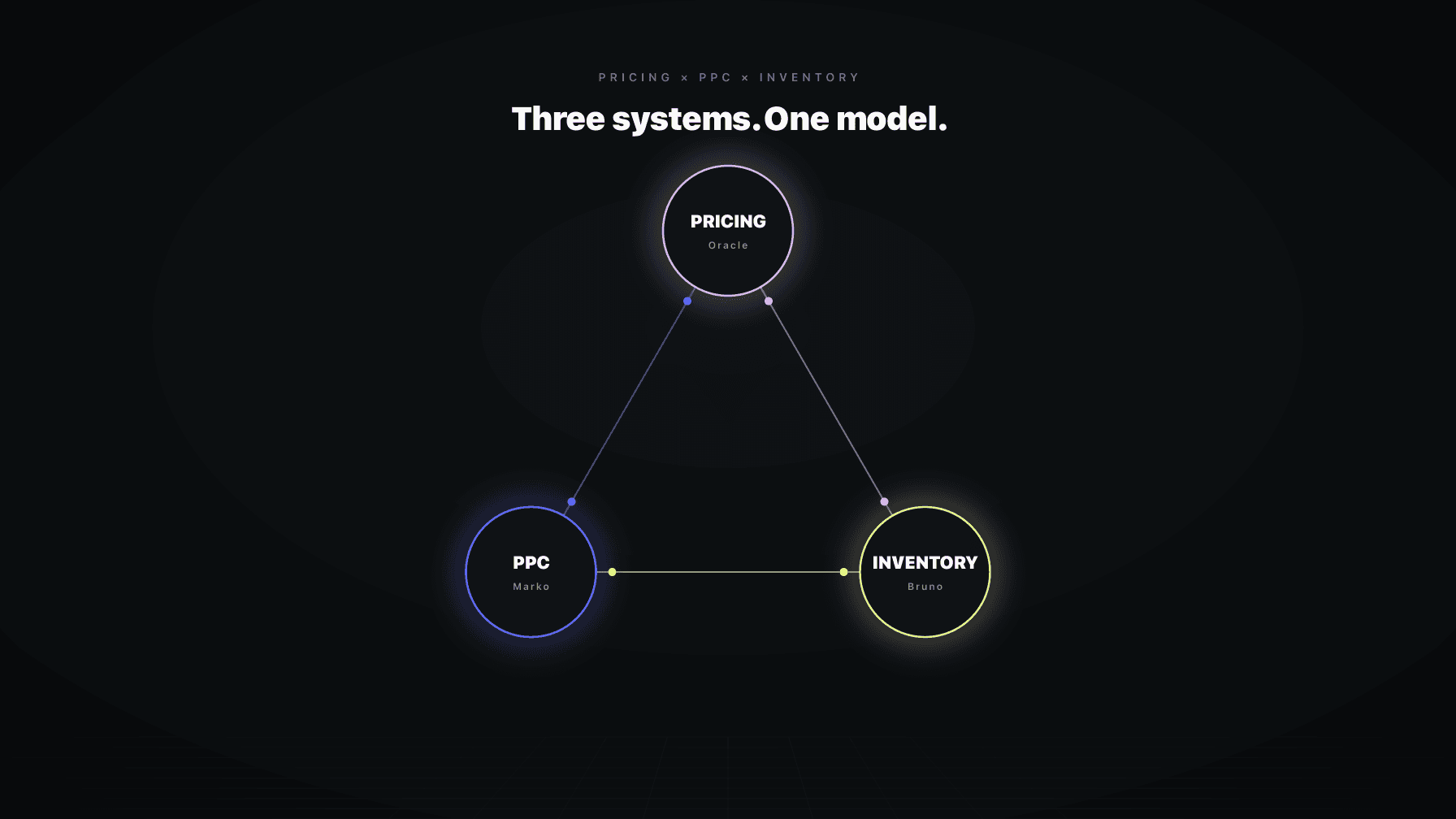
This is the three-system coordination problem that most operators solve with calendar reminders and Slack messages. The brands that win in 2026 solve it with shared system state. Pricing, PPC, and inventory all read from and write to the same model of the business.
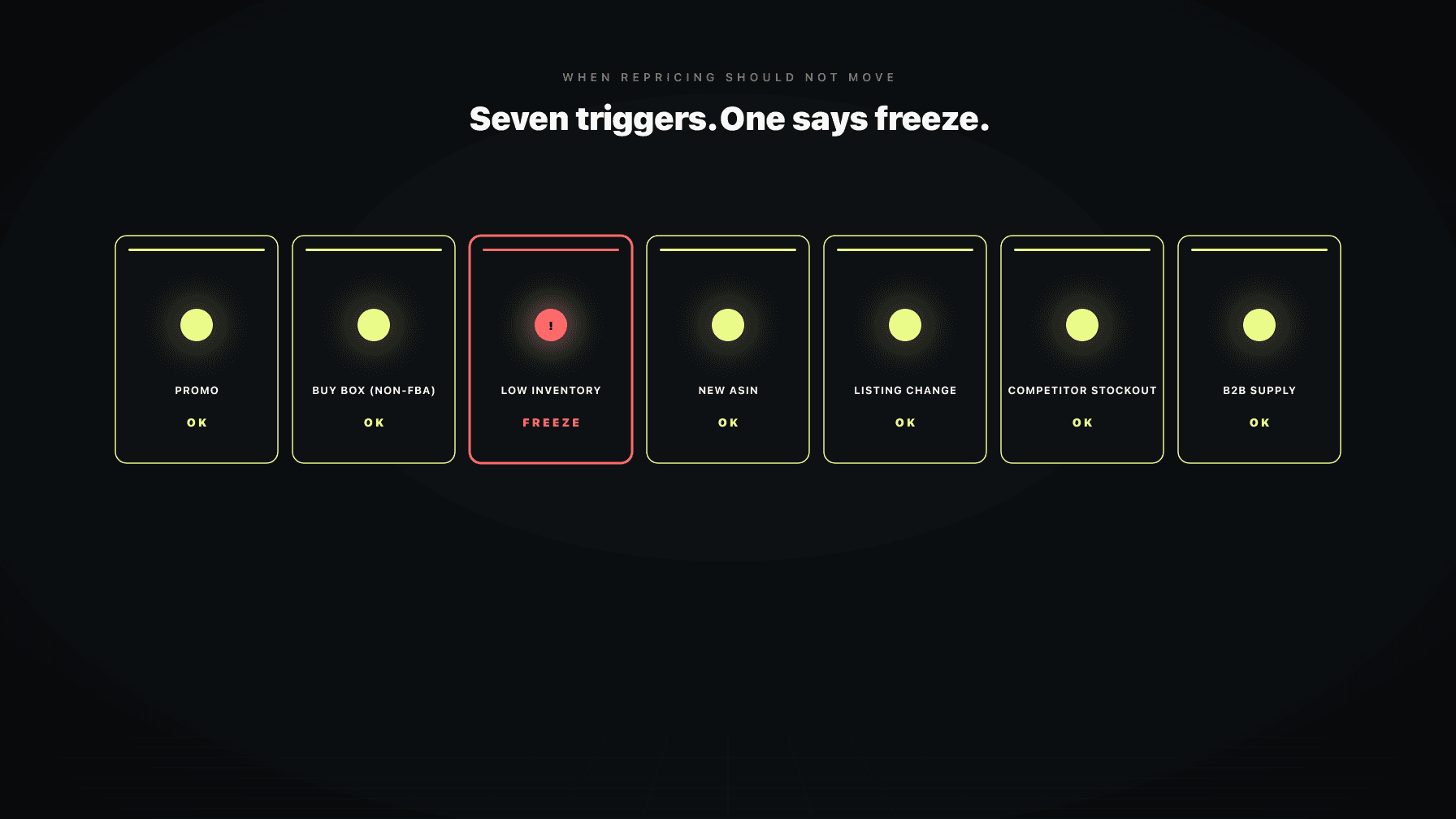
The most underrated pricing skill is knowing when to do nothing. AI repricers want to be busy. That is what they were trained to do. Guardrails are how you teach them when busy is wrong.
Promo periods. When you are running a Lightning Deal, Best Deal, or Subscribe & Save promotion, the repricer should freeze. Otherwise it will react to the artificial competition and lock you into a lower price after the promo ends.
Buy Box loss to a non-FBA seller. When you lose Buy Box to a merchant fulfilled or used seller, that is not a pricing fight worth winning. The repricer should hold price.
Inventory critical. When days of cover drops below your reorder lead time, the repricer should stop cutting and consider raising. Margin protection beats velocity at this point.
New ASIN ramp. Brand-new ASINs need price stability while organic ranking forms. A repricer racing the price down on day three of a launch is destroying the long-term position to win a short-term Buy Box.
Major listing change. When you change the main image, title, or A+ content, conversion rate will drift for a week. Hold price during the readjustment so you can read the data clean.
These should-not-move triggers belong in the AI's rule set, not in your human memory.
Garbage in, garbage decisions out. If your AI repricer is operating on bad data, it will make bad decisions confidently. The minimum data set:
Without these, you are paying for repricing software that operates on assumptions you cannot see.
Failure 1: Optimizing for Buy Box hold instead of margin. This is the default behavior of most repricers. They were built for resellers, where Buy Box is everything. Private label sellers who run that logic are training their repricer to give away margin every time competition appears.
Failure 2: Not coordinating with PPC and inventory. Price moves in isolation create losses you cannot trace. PPC stops being profitable. Inventory stocks out at the worst time. The fix is shared state, not better dashboards.
Failure 3: Skipping operating modes. Going straight to autonomous because the AI demo was impressive. The first 30 days of running a new repricer in autonomous mode is the period where bad COGS, bad floors, and missing constraints cost the most. Use observe and recommend modes to find the bugs before the AI acts on them.
These are not edge cases. They are the median seller's experience.
Daily review is too short. Monthly review is too long. Weekly is the right cadence for most accounts, with daily exception handling for emergencies.
What goes in a weekly pricing review:
This is also where you tune the repricer's settings, not on a daily basis. Daily tweaking creates whiplashed configurations.
Three things to evaluate, in this order:
1. Does it optimize for contribution margin per unit, not just price match? Ask explicitly. If the answer is "we match the Buy Box price intelligently," that is a no.
2. Does it expose operating modes? A tool that only has on/off is not built for trust building. You need observe, recommend, approve, autonomous as discrete settings.
3. Does it coordinate with PPC and inventory in real time? Or is it a standalone repricer that does not know what is happening with your ads or your stock? Coordination is the feature that separates 2026 software from 2018 software.
Everything else (UI, dashboards, reports) is secondary. The decision-making framework matters more than the cosmetics.
For a deeper AI repricing comparison, the rule-based vs AI repricing post breaks down where each approach wins and breaks.
Oracle is the AI pricing employee we built at Profasee. Oracle does not run alone. That is the key difference from standalone repricers.
When Marko sees a campaign drift on POAS, Oracle gets a signal that the price may be too low for the current ad efficiency. When Bruno flags low inventory, Oracle stops cutting and starts holding or raising. When a promo is scheduled, Oracle freezes during the promo window and resumes correctly afterward.
Coordination across pricing, PPC, and inventory is the feature. No standalone repricer can do it because no standalone repricer has access to the other systems in real time.
Pricing strategy is the framework: which forces matter, what targets you optimize for, when to move and when to hold. Repricing is the execution layer that moves prices within the strategy. Strategy without repricing is slow. Repricing without strategy is dangerous. You need both.
Below about $50K per month in revenue across maybe 15 ASINs, the coordination overhead of a full AI repricer is not worth the cost. A simple rule-based repricer with disciplined floors and ceilings will do most of the work. Above that volume, AI repricing typically pays for itself within 60 days through better margin defense in competitive periods.
At minimum, quarterly. In practice, monthly for active categories. Costs shift (freight, COGS), competitive landscape shifts, and your inventory profile shifts. Treat floor and ceiling like a budget review, not a one-time setup task.
Modern AI repricing handles Buy Box logic better than rule-based tools because it can learn the latent variables (seller rating, ship speed, fulfillment method) that drive Buy Box assignment. The catch is that it needs the right target. If you tell it to optimize Buy Box hold, it will. If you tell it to optimize contribution margin, it will sometimes choose to lose Buy Box on purpose, which is often the right call.
Good AI repricing systems have guardrails (floor, ceiling, max daily change percentage, freeze triggers) that contain bad decisions before they damage margin. They also have audit logs. The recurring-breach signal matters more than the single-bad-decision signal. One floor breach is the system doing its job. Five a week means your floor is wrong.
The coordination question is the one that separates good repricing software from bad. When price changes, ad efficiency changes. When ad efficiency changes, the price you can profitably hold changes. Without shared state, the two systems make conflicting decisions. With shared state, they reinforce each other. This is the case for an integrated platform over point solutions.
No. Run in observe mode for the first week to see what the AI proposes without any actions. Move to recommend mode for two to four weeks while you tune COGS, floor, ceiling, and targets. Move to approve mode for another month. Move to autonomous only when you have run a full month with zero major surprises in the daily digest. Most sellers who skip ahead pay for it within the first 30 days.