Chad Rubin
April 29, 2026 · 11 min read
Operator notes by email
Short, opinionated takes on AI agents, Amazon PPC, pricing, and inventory. No fluff. About once a week.
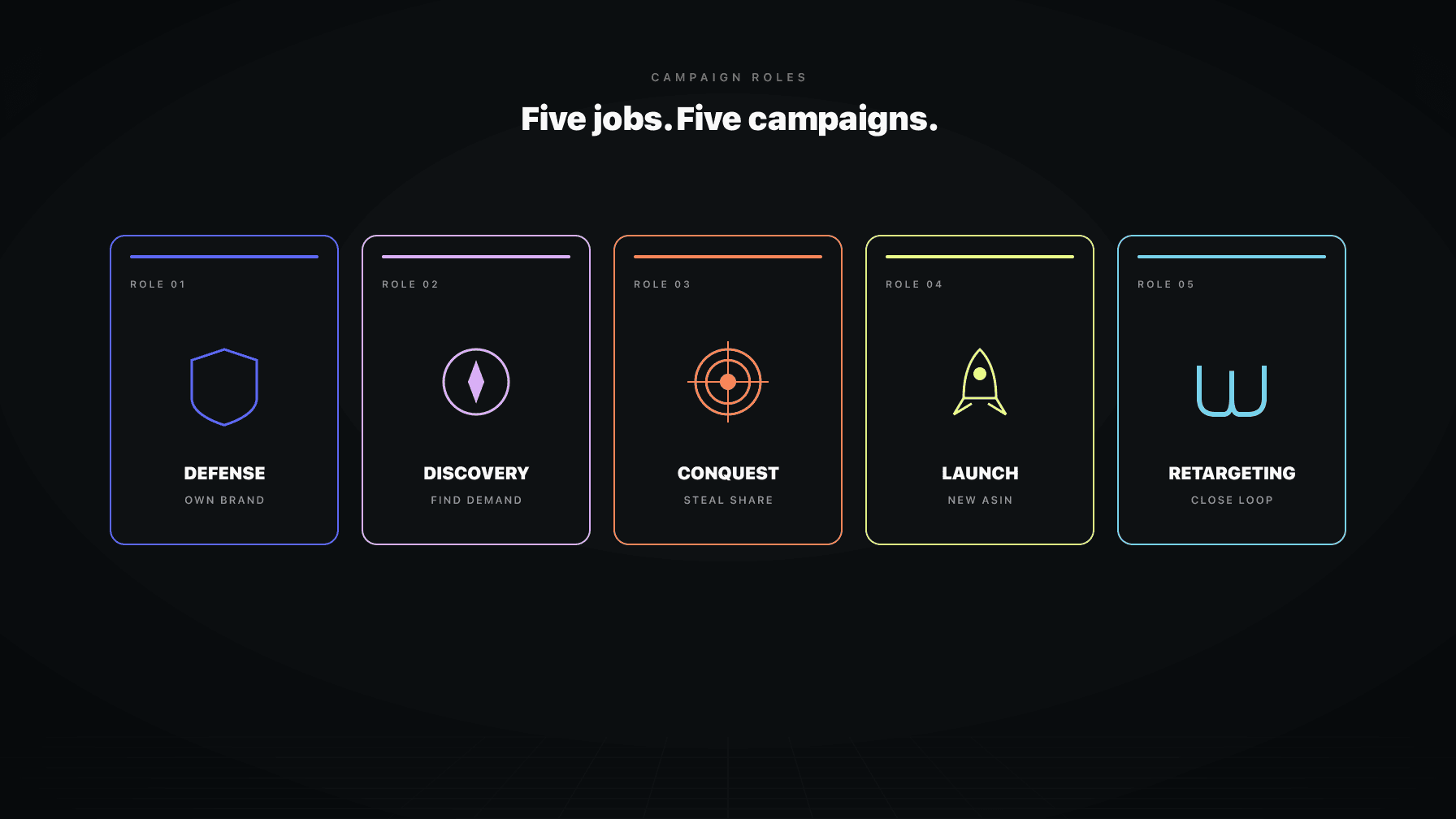
The single biggest unlock most sellers leave on the table in their PPC AI tool is campaign role assignment. They run the same target ACoS across every campaign, the same guardrails across every product, and then wonder why the AI keeps making decisions that feel wrong on launch products and overcorrects on hero products.
The issue is that the AI does not know which campaign does which job. A brand-defense campaign protecting your top-seller has nothing in common with a discovery campaign trying to find new audiences. A conquest campaign attacking a competitor has different economics than a launch campaign on a new ASIN. Treating them the same is the structural error.
I ran a 7-figure Amazon brand for over a decade and now run Profasee. The accounts that get the most out of AI Amazon PPC management share one trait: every campaign has a labeled role, every role has its own targets and guardrails, and every product is marked hero, launch, or steady-state. That is the framework. Without it, even the best AI tool produces generic decisions that under-protect the products you care about and over-spend on the ones you do not.
This post is the deep-dive on the campaign-strategy layer covered in our AI Amazon PPC management playbook. It explains the five campaign roles, how each one should be configured, and how product-level marking (hero versus launch) changes the posture inside each role.
Key Takeaways
Most accounts have grown by accretion. A campaign for one launch, then a defense campaign added later, then a conquest experiment, then a few audience-targeting tests. Over time these all sit at the same level in the dashboard, with the same target ACoS, the same default guardrails, and the same bidding strategy.
The AI cannot tell them apart. It treats the conversion-rate gap between the brand-defense campaign and the discovery campaign as a performance problem instead of an intentional design choice. It sees the launch campaign's high ACoS as something to suppress, when really it is the cost of buying ranking. The result is a portfolio where the AI is constantly rebalancing for the wrong reasons.
From reading to action
If the framework above sounds familiar, your Amazon account is probably carrying the same drag. Apply and we will show what Marko, Oracle, and Bruno would change in your first week.

Ran a 7-figure Amazon brand for a decade. Founded Skubana (acquired). Co-founded Prosper Show. 15+ years on Amazon.
Head-to-head comparisons between Profasee and the tools most Amazon sellers already use.
Join the brands that replaced agencies and tools with AI employees.
Role assignment fixes this. When the AI knows a campaign's job, it stops trying to optimize all campaigns toward the same definition of "good." It starts treating defense as defense, discovery as discovery, launch as launch. The configuration unlocks the algorithm.
Defense campaigns protect your branded search traffic. The job is to make sure when someone searches for your brand name or your hero ASINs, you are the first sponsored result. If you do not show up there, a competitor can.
Defense traffic converts at very high rates. ACoS on a well-run defense campaign is typically in the 5% to 15% range because the searcher already wanted you. The work is not finding new customers; the work is preventing competitors from poaching customers who are already searching for you.
How to configure defense:
Defense campaigns should never run aggressive bid changes. They are stable by nature. A 10% daily bid change limit is appropriate.
Discovery campaigns find new audiences and new keywords. The job is exploration: bid on a wide net of search terms, see which ones convert, harvest the winners.
Discovery is paying for learning. ACoS on discovery typically runs 30% to 60% during the active learning phase, settling toward 25% to 40% once harvest cycles have run. If discovery ACoS is at 15%, you are not exploring widely enough.
How to configure discovery:
Discovery campaigns should run daily bid change limits in the 20% to 30% range. Faster movement helps the system find winners quickly.
Conquest campaigns target competitor brand terms or competitor ASINs. The job is to capture searchers who started with a competitor in mind.
Conquest is the most economically variable role. Conversion rates depend on how differentiated your product is, how strong the competitor's brand affinity is, and how aggressive the competitor's defense is. A conquest campaign that converts at 8% can be wildly profitable; one that converts at 2% can be a money pit.
How to configure conquest:
Conquest campaigns should be reviewed weekly, not daily. The signal-to-noise on conquest performance is lower than other roles, and daily reactions tend to overcorrect.
Launch campaigns drive traffic to new ASINs during their 90-day window. The job is to buy ranking, accumulate reviews, and prove conversion before the SKU graduates to steady-state.
Launch is the role where every other rule bends. ACoS in the first 30 days can run 80% to 150%. POAS can sit below 1.0 deliberately. Spend is high relative to revenue because you are buying market position, not just current orders.
How to configure launch:
The most common launch failure mode is forgetting to graduate. The campaign keeps running launch posture six months in, the SKU is now hero-tier, and ad spend keeps targeting launch ACoS levels. Set graduation criteria when you create the campaign, not after.
Retargeting campaigns show ads to people who have already engaged with your brand: viewed your detail page, added to cart, purchased before, or interacted with your Sponsored Brands campaigns.
Retargeting traffic converts at the highest rates in the portfolio because the audience has already declared intent. ACoS on retargeting should be the lowest in the account, typically 10% to 20%. POAS should be the highest.
How to configure retargeting:
Retargeting is the role most often left under-utilized. If your account does not have a retargeting role assigned, that is the first gap to close.
Roles assign jobs to campaigns. Product marking assigns priority to ASINs. Both are required.
Hero products are the SKUs driving most of your revenue. The top 10% to 20% of ASINs by revenue. They have ranking equity, conversion advantages, and review depth. They deserve premium protection across every campaign that touches them.
When an ASIN is marked as hero, the AI should:
Launch products are the SKUs in their 90-day ranking window. When an ASIN is marked as launch, the AI should:
Steady-state products are everything else. The long tail of ASINs that have stabilized but are not hero-tier. They should run with default account-level configurations.
The marking matters because the AI cannot infer it. Revenue rank is a fact in the data, but "hero status" is a strategic call. Some sellers want hero treatment for high-margin SKUs even if they are not top-revenue. Others want hero treatment for products with strategic positioning value. Tell the AI directly.
The intersection of campaign role and product mark is where the AI actually makes decisions.
A defense campaign targeting a hero product runs at the tightest configuration in the account: low ACoS tolerance, tight bid change limits, high max bid for placement protection. This is the most expensive configuration to maintain but also the most valuable; defending a hero is the most defensible spend in the portfolio.
A discovery campaign targeting a launch product runs aggressively: high ACoS tolerance, loose bid change limits, broad keyword exploration, fast harvest cycles. Most of the spend will look unprofitable. That is the design.
A conquest campaign targeting a hero product is a measured aggressive: tight enough on ACoS to avoid cannibalizing margin, but loose enough to compete. This combination is usually under-funded; sellers focus conquest on launch SKUs and miss the opportunity to protect hero positioning.
A retargeting campaign targeting any product runs at the lowest ACoS posture in the account, regardless of product mark. The audience quality dominates the product-level configuration here.
Most PPC tools require you to configure each campaign individually because they cannot reason about role plus product mark together. Tools that support both let you configure roles once and the AI applies the right posture automatically.
Even with role assignment and product marking in place, structural campaign work should always be human-approved. Specifically:
These are rare, high-leverage decisions. Even in mature accounts running Handling It mode for daily work, structural changes belong to weekly or monthly review with explicit approval. The reason is simple: structural mistakes are hard to unwind. Reverting a bid change takes a day. Reverting a campaign restructure can take weeks.
Marko supports campaign-role assignment as a first-class configuration. The five roles (defense, discovery, conquest, launch, retargeting) each have their own default targets and guardrail profiles. Sellers tell Marko which campaign is which, and the system applies the right posture automatically.
Hero and launch product marking is also first-class. Marko maintains a list of which ASINs sit in which tier, with explicit graduation criteria for launch products that promote them to steady-state automatically once the criteria are met.
Coordination matters here too. When Oracle changes the price on a hero product, Marko sees the new margin in the same cycle and recalibrates the role-specific bid ceilings. When Bruno flags a stockout risk on a launch ASIN, Marko adjusts the launch campaign's posture before the manual threshold would catch it.
Without that coordination, role assignment is a static label. With it, role assignment becomes dynamic posture that adapts as the underlying business changes. That is the difference between a configuration setting and an actual operating system.
Amazon PPC campaign roles assign each campaign a specific job: defense (protect branded search), discovery (find new keywords and audiences), conquest (target competitors), launch (drive traffic to new ASINs in the 90-day window), or retargeting (re-engage past visitors). Each role has its own ACoS targets, max bids, and guardrails because the work is genuinely different. Treating all campaigns the same is the most common configuration error in AI PPC tools.
A defense campaign protects your branded search traffic so you appear as the first sponsored result when someone searches for your brand or hero ASINs. Defense traffic converts at high rates because the searcher already wants you, so ACoS typically runs in the 5% to 15% range. The job is preventing competitors from poaching searches that are already directed at you, not finding new customers.
Launch campaigns inside the 90-day window run looser than steady-state campaigns. Target ACoS at 50% to 80%, target POAS at 0.6 to 1.0, max bid at the high end, and daily budget that exceeds what current revenue justifies. The point is buying ranking and review velocity, not unit profit. Set explicit graduation criteria (review count, organic rank, conversion rate) so the campaign promotes to steady-state automatically when the criteria are met.
Hero product marking tells the AI that this ASIN deserves premium protection across every campaign that touches it: tighter daily bid change limits, higher max bid to defend placement, tighter emergency-brake thresholds, and bias toward stability over experimentation. Hero ASINs are typically the top 10% to 20% of revenue, but the marking is a strategic call that includes high-margin or strategically positioned SKUs even if they are not top-revenue.
Yes. Retargeting traffic converts at the highest rates in the portfolio because the audience has already declared intent. Target ACoS on retargeting should be the lowest in the account, typically 12% to 18%. Target POAS should be the highest, often 2.5 plus. Most accounts under-utilize retargeting; if your account does not have a retargeting role assigned, that is the first gap to close.
Rarely. Role assignment is a strategic decision that belongs in monthly review, not daily or weekly. The triggers for changing a role: a launch product graduates to hero status, a hero product slows down and needs defense posture, a discovery experiment matures into a steady-state campaign. Frequent role changes signal that the original assignment was wrong, which is itself a signal to slow down and reconsider the campaign architecture.
Creating new campaigns or ad groups, restructuring existing campaigns, changing a campaign's role assignment, promoting or demoting a product mark, and retiring campaigns. These are rare, high-leverage decisions where mistakes are hard to unwind. Reverting a bid change takes a day; reverting a campaign restructure can take weeks. Even mature accounts running fully autonomous bid management should keep structural decisions approval-gated.