Chad Rubin
April 26, 2026 · 10 min read
Operator notes by email
Short, opinionated takes on AI agents, Amazon PPC, pricing, and inventory. No fluff. About once a week.
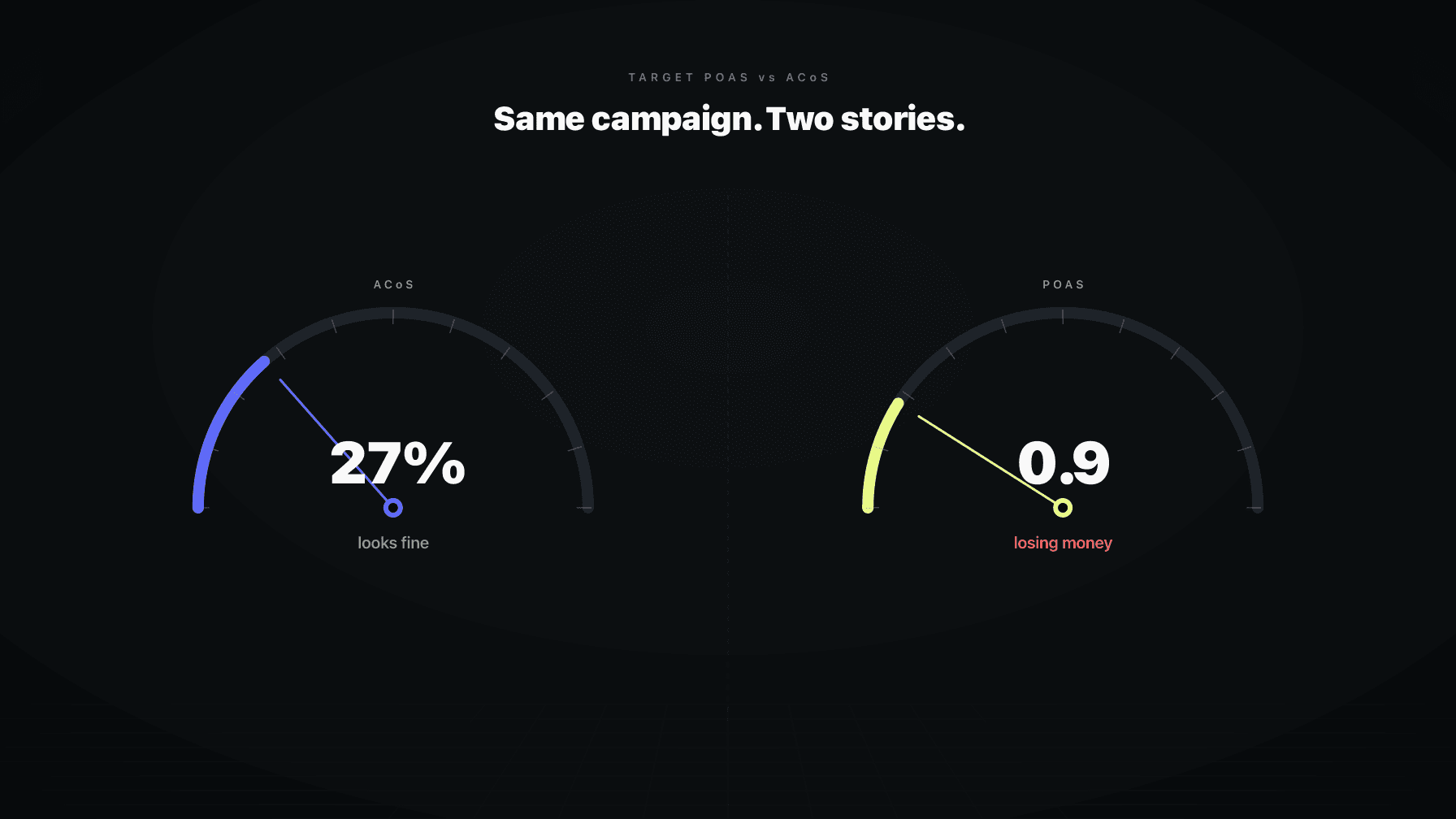
Most Amazon sellers configure their PPC software with the same target they have been using since 2017: target ACoS. They pick a number that feels reasonable, plug it in, and assume the AI will keep them profitable.
It will not. Target ACoS is a revenue-side metric. It tells the algorithm what percentage of attributed sales you are willing to spend on ads. It does not know your unit cost, your fees, your shipping, or your repeat-purchase rate. It does not know whether the dollar of sales it produced was worth eighty cents to you or four cents.
I ran a 7-figure Amazon brand for over a decade and have watched dozens of accounts get this exactly wrong. The setting that quietly decides whether your AI Amazon PPC management is making you money is not the campaign structure or the bid strategy. It is target POAS versus target ACoS. Get it right and the rest of the playbook works. Get it wrong and you can hit your ACoS target every month while your bottom line erodes.
This post is the deep-dive on the most consequential decision in our AI Amazon PPC management playbook. It covers what each metric measures, where the math diverges, when each one fits, how to set your target POAS number, and the failure modes that show up when you run the wrong target.
Key Takeaways
Target ACoS is your acceptable advertising cost of sale as a percentage of attributed revenue. If you set target ACoS at 25%, you are telling the platform: "I will spend up to 25 cents on ads for every dollar of attributed sales."
It is the metric Amazon's reporting was built around. Every PPC dashboard surfaces it. It is easy to communicate, easy to benchmark against category norms, and easy for a Sponsored Products algorithm to optimize against.
The problem is what it leaves out. ACoS does not see:
From reading to action
If the framework above sounds familiar, your Amazon account is probably carrying the same drag. Apply and we will show what Marko, Oracle, and Bruno would change in your first week.

Ran a 7-figure Amazon brand for a decade. Founded Skubana (acquired). Co-founded Prosper Show. 15+ years on Amazon.
Head-to-head comparisons between Profasee and the tools most Amazon sellers already use.
Join the brands that replaced agencies and tools with AI employees.
A campaign with a 25% ACoS can be wildly profitable on a high-margin item or actively cash-negative on a low-margin one. Same number. Opposite outcome. That is the structural flaw in running an entire account against an ACoS target.
Target POAS, profit on ad spend, is the inverse framing. Instead of asking "what percentage of revenue went to ads," it asks "how many dollars of profit did each dollar of ad spend produce."
A POAS of 1.0 means you broke even. Every dollar of ad spend produced one dollar of margin. Below 1.0 you are losing money on advertised orders. Above 1.0 you are making money.
Most healthy Amazon brands target a POAS in the 1.5 to 3.0 range, depending on category, growth stage, and how aggressively they value lifetime value. A brand investing heavily in customer acquisition might run POAS at 1.2 on launch products and 2.5 on hero products. A brand focused on profit harvest might run POAS at 2.5 across the catalog.
The point is that POAS reads the same way profit reads. ACoS does not.
Consider an ASIN selling for $40. Cost of goods sold is $10. Amazon fees are $14 (referral plus FBA). Net unit margin before ads is $16, or 40%.
You run a Sponsored Products campaign at 28% ACoS. That means you spent $11.20 in ads to produce that $40 sale. Subtract from your $16 pre-ad margin and you are left with $4.80 in profit per order. POAS on that campaign is $4.80 divided by $11.20, or 0.43.
By the ACoS dashboard, the campaign looks healthy. 28% sits right at the category average. By the POAS reading, you are making 43 cents of profit for every dollar of ad spend. You would be better off pulling spend and accepting fewer sales.
Now run the same product at 18% ACoS. Ad spend per order drops to $7.20. Profit per order rises to $8.80. POAS jumps to 1.22. The campaign moves from "looks fine, is bad" to "looks tighter, is genuinely making money."
The ACoS-only reading missed the difference. The POAS reading catches it.
Target ACoS and target POAS diverge sharpest in three situations. These are the patterns where running ACoS alone hurts the most.
Low-margin SKUs. If your product margin after fees is under 25%, ACoS is dangerous. A 20% ACoS feels modest but might consume your entire margin. POAS will flag the problem instantly.
Aggressive launch periods. During the 90-day launch window, ACoS targets are typically loosened to buy ranking. The risk is that a tactical loosening becomes a permanent setting. POAS lets you separate "buying rank intentionally at POAS 0.6" from "drifting into POAS 0.6 because nobody noticed."
Category fee variance. Categories with referral fees above 15% (jewelry, accessories, certain apparel) leave less margin behind every order. ACoS targets that work in 8% referral categories will quietly destroy 17% referral categories. POAS reads through the fee structure automatically.
If any of those three describe your catalog, you are leaving money on the table by running pure ACoS.
POAS is only as honest as the cost data you load. If you skip cost of goods sold, you are running POAS against an assumed margin, which is not really POAS at all. It is a renamed ACoS.
The high-quality version requires:
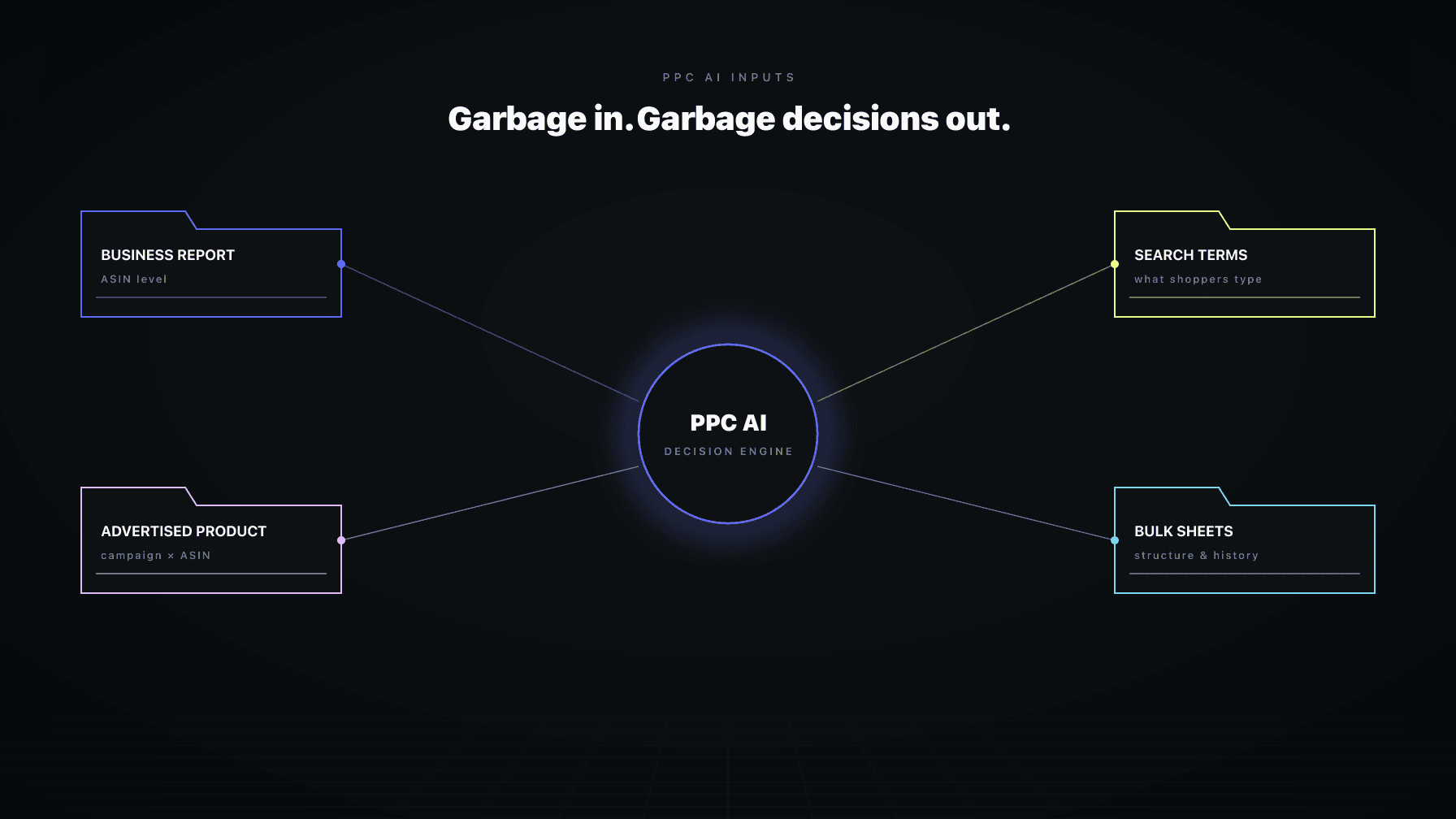
Sellers who upload all four get a true POAS. Sellers who upload only the unit cost get a directionally correct POAS that still beats ACoS but understates the real picture. Sellers who upload nothing should stay on ACoS until they finish the cost work, because POAS without inputs is misleading. The full data checklist is covered in our PPC AI inputs deep-dive.
Once you swap targets, the AI's bidding behavior changes. It is not subtle.
On target ACoS, the algorithm rewards keywords with strong sales attribution. A high-converting keyword with a thin margin gets the same treatment as a high-converting keyword with a fat margin. As long as ACoS is in line, the bid stays.
On target POAS, the algorithm prefers keywords on high-margin SKUs even if their ACoS is identical to keywords on lower-margin SKUs. Bids on premium-margin products tilt up. Bids on tight-margin products tilt down. The system stops paying the same to acquire a $0.40 customer and a $4 customer.
You will see this in the first two or three weeks after switching. Bid distribution changes. Spend rotates. Total ad volume may dip in the short term as the AI finds the right level. By week four to six, the account typically has the same revenue at meaningfully lower cost. Or higher revenue at the same cost. Either way, profit moves in the right direction.
Target ACoS is not always wrong. There are cases where it is the right anchor.
Pure top-line growth missions. If you are running an aggressive land-grab in a new category, the goal is rank and review velocity, not unit profit. ACoS lets you authorize spend without the AI second-guessing the strategy.
Brands without clean COGS. If you cannot get reliable cost data into the system, do not fake POAS. Run ACoS until you can.
Subscription or LTV-heavy categories where one order does not represent the lifetime value. This one is debatable. The better answer is to run POAS with an LTV multiplier. But if your AI tool does not support LTV math, ACoS plus a generous target can substitute.
Internal reporting alignment. If your CFO and your team have always spoken in ACoS, the cost of switching the conversation is real. Run both targets visibly for a quarter and migrate when the team is ready.
The default for most operators is target POAS. ACoS is the exception, not the rule.
There is no category benchmark for POAS. The number is derived from your business, not the market. The four inputs:
Pick a number. Watch the account for two cycles. Adjust. The first POAS target you set is rarely the final one. What matters is having a real number, not a placeholder.
Target POAS lives differently across the catalog. A blanket POAS target across every ASIN is almost always wrong.
Hero products, the SKUs driving most of your revenue, deserve premium POAS targets. They have ranking equity, conversion rate advantages, and review depth. Targeting POAS 2.0 plus on these is realistic. They are also the products where AI Amazon PPC management adds the least value. Most of the work is keeping the floor stable.
Launch products are the opposite. The first 60 to 90 days are about ranking, not profit. Run POAS at 0.6 to 1.0 with the explicit understanding that you are buying market position. Set a graduation criterion: review count, organic rank, conversion rate, and let the AI escalate the POAS target once those criteria are hit.
Long-tail and tail SKUs sit in the middle. POAS at 1.2 to 1.5 is usually right. They do not need premium protection but they are not investments either. The job is to keep them paying their own way.
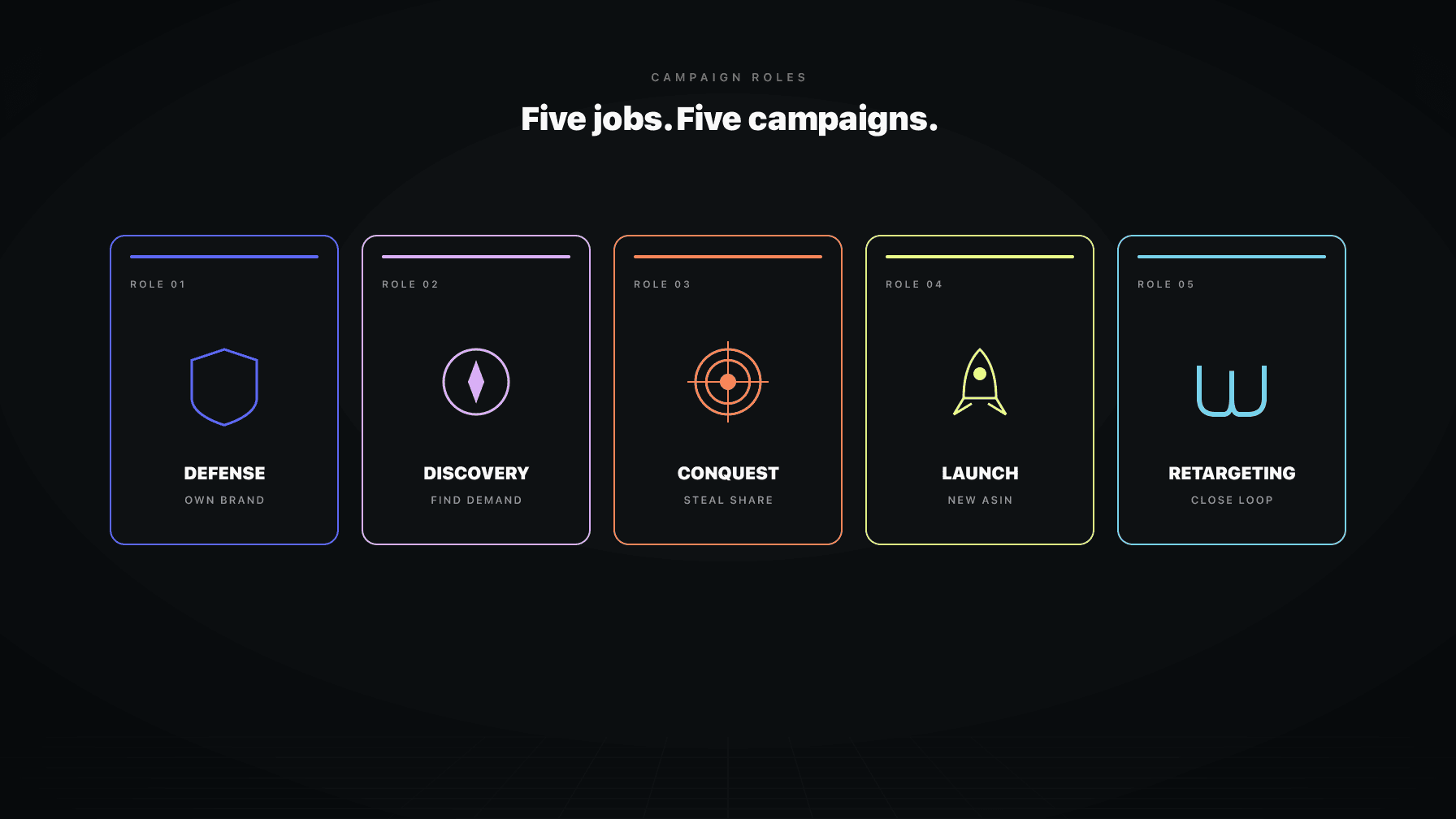
Campaign role assignment is what makes per-product POAS targets actually work. Without role assignment the AI cannot know which posture applies. Full treatment in the campaign roles deep-dive.
Sellers who switch from ACoS to POAS often forget to revise their guardrails. The maximum bid, the daily change limit, and the emergency-brake threshold were all calibrated against an ACoS target. Once the target changes, the guardrails should change with it.
A 28% ACoS emergency brake stops being meaningful when the campaign target is POAS 1.5. The campaign can hit 28% ACoS while POAS is healthy. The campaign can hit 18% ACoS while POAS is dying. Decoupling the brake from the target metric is how guardrails fail silently.
When you switch targets, audit every threshold. The full list is in the PPC guardrails deep-dive.
Marko is built for POAS by default. Cost of goods sold is a first-class input, not a bolt-on. The system will not let you set a target POAS without COGS loaded, because POAS without cost data is misleading and silently corrupts every downstream decision.
Marko also coordinates with Oracle, our pricing AI. When Oracle moves a price, Marko sees the new margin and recalibrates bid ceilings within the cycle. A standalone PPC tool cannot do that because it does not know the price changed. The result: target POAS stays accurate as your prices move, instead of drifting out of sync.
If you are running on ACoS today and your COGS exists somewhere in a spreadsheet, the migration path is straightforward. Upload the cost data. Run POAS in review-only mode for two weeks. Watch how Marko's recommendations differ from your current account behavior. Graduate when the proposals make sense. The full operator framework lives in the AI Amazon PPC management playbook.
Target ACoS is the percentage of attributed revenue you are willing to spend on ads. Target POAS is the dollars of profit produced per dollar of ad spend. ACoS is a revenue metric, POAS is a profit metric, and the two diverge fastest on low-margin SKUs and in high-fee categories. POAS requires cost-of-goods data; ACoS does not.
Most healthy Amazon brands target POAS in the 1.5 to 3.0 range. Hero products and steady-state SKUs sit at the higher end (2.0 plus). Launch products in the first 60 to 90 days run at 0.6 to 1.0 because the goal is rank, not profit. The right number is derived from your contribution margin and business goal, not from a category benchmark.
Because POAS is profit divided by ad spend, and the only way to compute profit honestly is to subtract COGS, fees, and shipping from revenue. Without COGS the system is calculating POAS against an assumed margin, which is just ACoS with a relabeled output. POAS without cost data is worse than running ACoS, because it gives a false sense of profit accuracy.
Yes, and many operators do during the migration period. The cleanest approach is to anchor decisions on POAS while keeping ACoS visible as a secondary metric for team alignment and historical reporting. After a quarter or two, most teams stop checking ACoS day-to-day because POAS captures everything they actually care about.
Two to three weeks for the bidding behavior to rebalance, four to six weeks for the profit picture to stabilize. The first sign is bid redistribution: the AI shifts spend toward higher-margin SKUs and away from tight-margin ones. By week six, total revenue is typically flat to slightly up while ad spend is meaningfully down, which is the same dollars at higher margin.
Yes, but with a deliberately lower POAS number during the launch window. Set POAS at 0.6 to 1.0 for the first 60 to 90 days with explicit graduation criteria (review count, organic rank, conversion rate). Once the criteria are met, the target POAS escalates. The mistake is forgetting to escalate, which leaves a launch posture running on a mature SKU and silently overspending forever.