Chad Rubin
May 1, 2026 · Updated May 11, 2026 · 12 min read
Operator notes by email
Short, opinionated takes on AI agents, Amazon PPC, pricing, and inventory. No fluff. About once a week.
Amazon brands do not have a tooling problem. They have a coordination problem.
Walk into any 7-figure Amazon business and you will find the same setup. A repricing tool. A PPC tool. An inventory forecasting tool. Maybe a listing optimizer. Maybe a review monitor. Each one with its own login, its own dashboard, its own definition of "performance," and its own set of automations that fire off based on rules that nobody fully remembers writing.
The dashboards do not talk to each other. The repricer does not know that PPC is bleeding on a low-margin SKU. The PPC tool does not know that inventory is about to stock out on the bestseller. The inventory tool does not know that a price increase yesterday is going to slow velocity for the next two weeks.
Each tool individually is fine. Together, they create a category of failure that does not show up in any single dashboard: coordination drift. The systems make locally correct decisions that combine into globally wrong outcomes.
The fix is not another tool. The fix is an operating system.
## Key takeaways >- Amazon brands run on three systems that constantly interact: pricing, PPC, and inventory. Most software treats each as standalone, which is where coordination drift comes from.- An AI operating system for Amazon is a set of specialized agents (PPC, pricing, inventory, catalog) that share state through a central layer, not a single mega-tool.- Mission Control is the human surface where you set targets, set guardrails, and review what the agents did. It is not a dashboard. It is a control room.- The shift from tools to operating system is structural, not cosmetic. You cannot bolt this onto a stack of disconnected SaaS subscriptions.- The right unit of measurement for an Amazon AI operating system is the time between a signal arriving and the right system reacting to it. Tools measure in days. An operating system measures in minutes.
Strip away the dashboards, the reports, and the email digests. The actual work that happens inside an Amazon brand is the operation of three systems.
Pricing. The system that sets the dollar number on each ASIN given cost, demand, competition, and inventory state. Output: per-ASIN price, updated as needed.
PPC. The system that allocates ad spend across campaigns, keywords, ASINs, and times. Output: bids, budgets, negative keywords, campaign structure.
Inventory. The system that decides when to reorder, how much to ship to FBA, and when to slow or accelerate sell-through. Output: purchase orders, shipment plans, restock alerts.
These three systems are not independent. Every output of one is an input to the others. Price affects ad efficiency and velocity. Ad spend affects velocity and inventory burn. Inventory state affects what price is sustainable.
From reading to action
If the framework above sounds familiar, your Amazon account is probably carrying the same drag. Apply and we will show what Marko, Oracle, and Bruno would change in your first week.

Ran a 7-figure Amazon brand for a decade. Founded Skubana (acquired). Co-founded Prosper Show. 15+ years on Amazon.
Join the brands that replaced agencies and tools with AI employees.
When you run them on three different platforms with three different operators, the coupling is informal. Someone has to remember that pricing changed yesterday so today's PPC review accounts for it. Someone has to remember that inventory is tight so today's pricing review does not cut. The forgetting is where margin leaks.
I have watched the same pattern play out across dozens of brands.
A repricer cuts a popular SKU by 6% to chase a Buy Box fight. PPC bids stay where they were. POAS on that ASIN drops below break-even because the ad math now assumes the lower price. Inventory burn accelerates because the lower price moved more units, and now days of cover is at 18 instead of 35. The PPC tool finally notices the POAS drop a week later and pulls back bids, killing organic momentum on the SKU. By the time anyone reads the inventory alert, you are 9 days from stockout heading into peak season.
No single system did anything wrong. The repricer matched competition. The PPC tool reacted to its data. The inventory system reported what it saw. Each was locally correct. The total result is a $40K margin loss and a Q4 stockout you cannot afford.
This is coordination drift. It is the dominant failure mode for Amazon brands running stacked tools, and it is invisible in any single dashboard. You only see it in your P&L two months later.
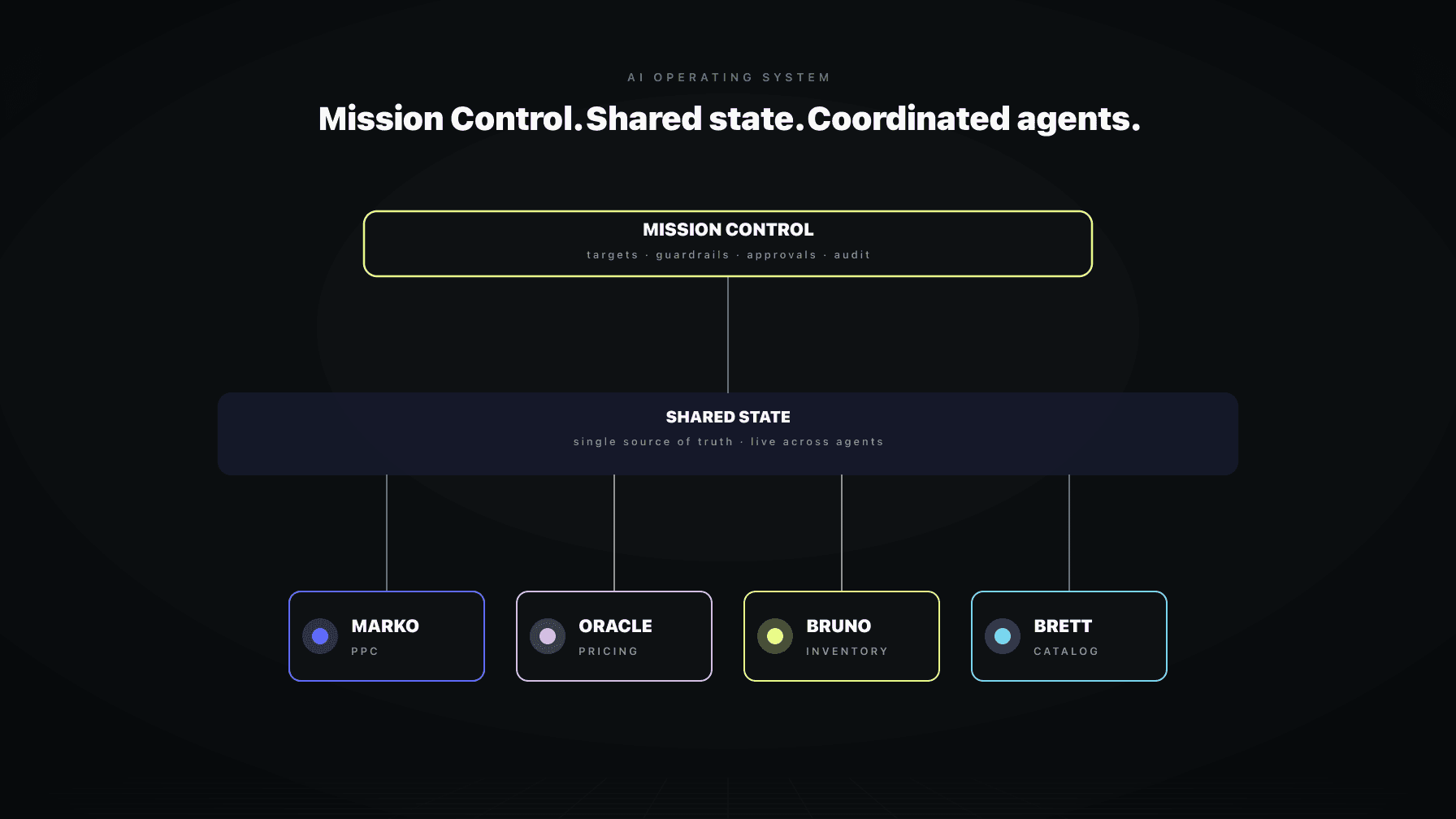
Operating system is a deliberate term. It does not mean a bigger dashboard. It means the layer underneath the dashboards that lets specialized agents share state and coordinate.
In an AI operating system for Amazon, you have:
This is not a single AI doing everything. That fails. Specialized agents with shared state outperform monolithic AI on every dimension that matters: explainability, debuggability, recovery from bad decisions.
"Having real-time intelligence is the only way to survive as a business. With Profasee you get a round-the-clock platform that is always optimizing your price based on your goals and millions of data points. Profasee gives you superpowers you did not know you could have."
Most Amazon software treats the human as a passive viewer. You log in, scroll through charts, maybe export a CSV. Mission Control is different. It treats the human as an operator.
A real Mission Control gives you:
The point is not to look pretty. The point is to give an operator one surface where they can run the entire account. If you spend more than 60 minutes a day operating your Amazon business, your operating system is wrong.
You do not start in autonomous mode. The trust ladder for AI agents is non-negotiable for any operator who wants to keep their account intact.
Observe. Agents watch. No actions taken. The operator sees what each agent would do given the data and targets. This is week one to two. The bugs you catch here are usually data bugs (COGS wrong, BSR feed broken, attribution missing) not agent bugs.
Recommend. Agents propose specific actions with reasons. The operator approves or rejects in batches. This is week two to four. The bugs you catch here are usually target bugs (wrong POAS, wrong contribution margin floor, wrong inventory thresholds).
Approve. Agents send a daily digest of pending actions. Operator approves all, rejects some, the rest move automatically. This is month two to three. By now you should have very few rejections per week.
Autonomous. Agents act within guardrails without asking. Operator reviews exceptions and audits weekly. This is where mature accounts run. It is not where new accounts run. The temptation to skip is strong. The cost of skipping is real.
This ladder applies to each agent independently. PPC may be in autonomous mode while pricing is in approve mode while inventory is in observe mode. That is fine. Different systems mature at different rates depending on data quality.
"Profasee helps you unlock profit with your hands off the wheel."
The most common path I see right now is what I call DIY agent automation. An operator hooks Claude or GPT up to Seller Central via Zapier, MCP, or a homegrown API integration. The agent has read access to the account. Maybe write access to PPC. The operator describes what they want in natural language and the agent executes.
This works in demos. It breaks in production. Here is why.
No shared state. The DIY agent reads Seller Central, makes a decision, and moves on. The next decision starts fresh. There is no persistent model of the business. No memory of what was decided yesterday. No coordination with other agents because there are no other agents.
No guardrails. The agent has the same permissions you do. There is no max-change limit. No freeze conditions. No pending-approval queue. The first time the agent has a bad day, it can do real damage before anyone notices.
No audit log. When something goes wrong, you cannot trace why the agent did what it did. You can ask the agent, and the agent will hallucinate a plausible explanation. That is worse than no explanation.
No specialization. A general-purpose agent operating on Amazon is mediocre at every job. Pricing has decades of optimization theory behind it. PPC has its own model class. Inventory forecasting is its own discipline. A generalist agent does none of them well.
DIY AI automation gets the demo right and the production wrong. The fix is not better prompts. The fix is structural: specialized agents, shared state, guardrails, audit log. That is an operating system, not a chatbot.
The shape of an Amazon brand changes when the operating system shows up.
Before:
Six people, sometimes 12, often more across multiple categories. Each operating their own system, with weekly meetings to sync.
After:
The repetitive operational decisions (bidding, repricing, restock proposals, search-term negations, budget rebalancing) move to specialized agents. The strategic and creative decisions stay with humans. The human team gets smaller and the work each person does gets more leveraged.
This is not theoretical. The brands running this way are already outperforming brands running the old org chart on the same revenue base. The no-employee Amazon business is a real category emerging in 2026, and the operating system is what makes it possible.
If you are running a typical 7-figure Amazon brand right now, your stack probably includes:
Total: $1,000 to $7,400 a month, plus the operational time to keep them all glued together.
An AI operating system replaces the first three (or four, depending on scope) and the manual coordination work. The reporting tool becomes redundant because the operating system has Mission Control. What stays in your stack: customer service tools, accounting, brand-side creative tools, and external reporting if you have investors.
The economics work even before you count the coordination drift losses you stop having.
You cannot turn your existing stack into an operating system by adding a Slack bot or a unified dashboard. The shift is structural.
What has to change:
This is why a stack of disconnected SaaS subscriptions cannot become an operating system through better integrations. The integrations help, but the underlying structure has to be designed for coordination from the start.
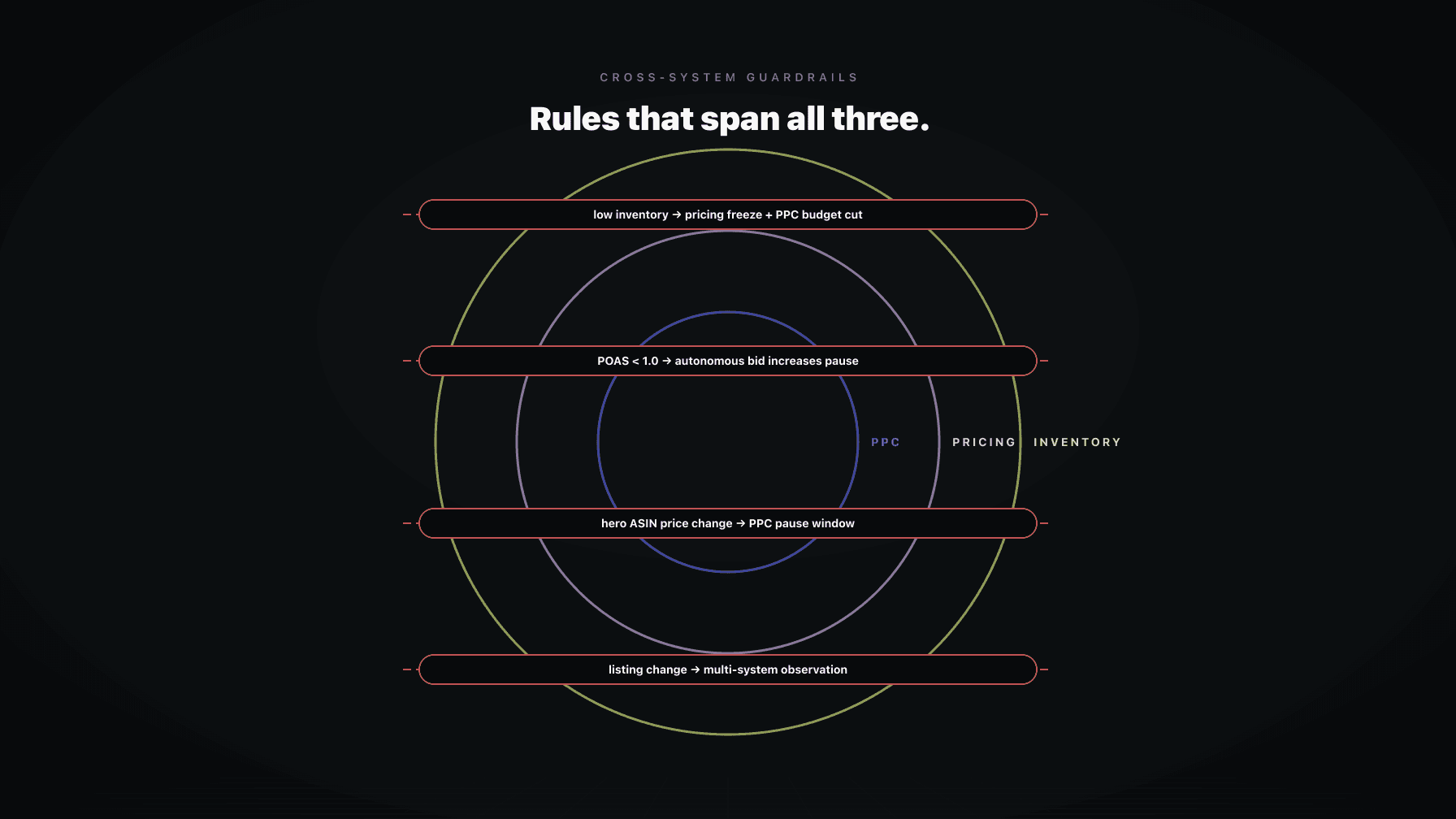
Guardrails per tool are not enough. You need guardrails that span systems.
Examples:
These rules cannot live in any single tool because they touch multiple tools. They have to live at the operating system layer. This is the trust layer that lets autonomous operation work without breaking the business.
Profasee Ultra is the AI operating system we built for Amazon brands. The agents are real and named: Marko for PPC, Oracle for pricing, Bruno for inventory, Brett for catalog and listing.
The agents share state. When Oracle changes a price, Marko sees it within minutes and adjusts bids. When Bruno flags low inventory, Marko pulls back spend and Oracle stops cutting. When Brett finds a listing issue, Marko accounts for the conversion-rate impact before pushing more traffic.
Mission Control is the human surface. Targets, guardrails, pending approvals, audit log, all in one place. Operators run the account from Mission Control, not from four logins.
The point is not to sell more tools. The point is to give Amazon brands a way to run leaner, faster, and with less coordination drift than the stacked-tool model allows. That is what an AI operating system does. That is the category we are building.
An AI operating system for Amazon brands is a coordinated set of specialized AI agents (pricing, PPC, inventory, catalog) that share state through a central layer and operate under common guardrails. It replaces the typical stacked-tool approach where each system runs independently and humans glue them together.
A dashboard is a passive view of what happened. An operating system is the active coordination layer where decisions get made. The operator surface in an operating system (Mission Control) lets you set targets, set guardrails, approve decisions, and review actions. A dashboard cannot do any of those things because it is read-only.
Yes for the operational layer (pricing, PPC, inventory). The whole point of an operating system is shared state and coordination, which you cannot bolt onto disconnected tools. You can keep customer service tools, accounting, and creative tools. The operational core has to be coordinated by design.
Coordination drift is the failure mode where individual systems make locally correct decisions that combine into globally wrong outcomes. Repricer cuts price, PPC tool keeps spending at the old POAS assumption, inventory burns faster than expected. Each system did its job. The brand loses money. The fix is shared state across systems, not better dashboards.
The technical setup is days. The trust-building is weeks. Most brands run in observe and recommend modes for the first month while data quality issues surface and get fixed. Autonomous operation typically starts in month two for PPC, month three for pricing, and month four or later for inventory.
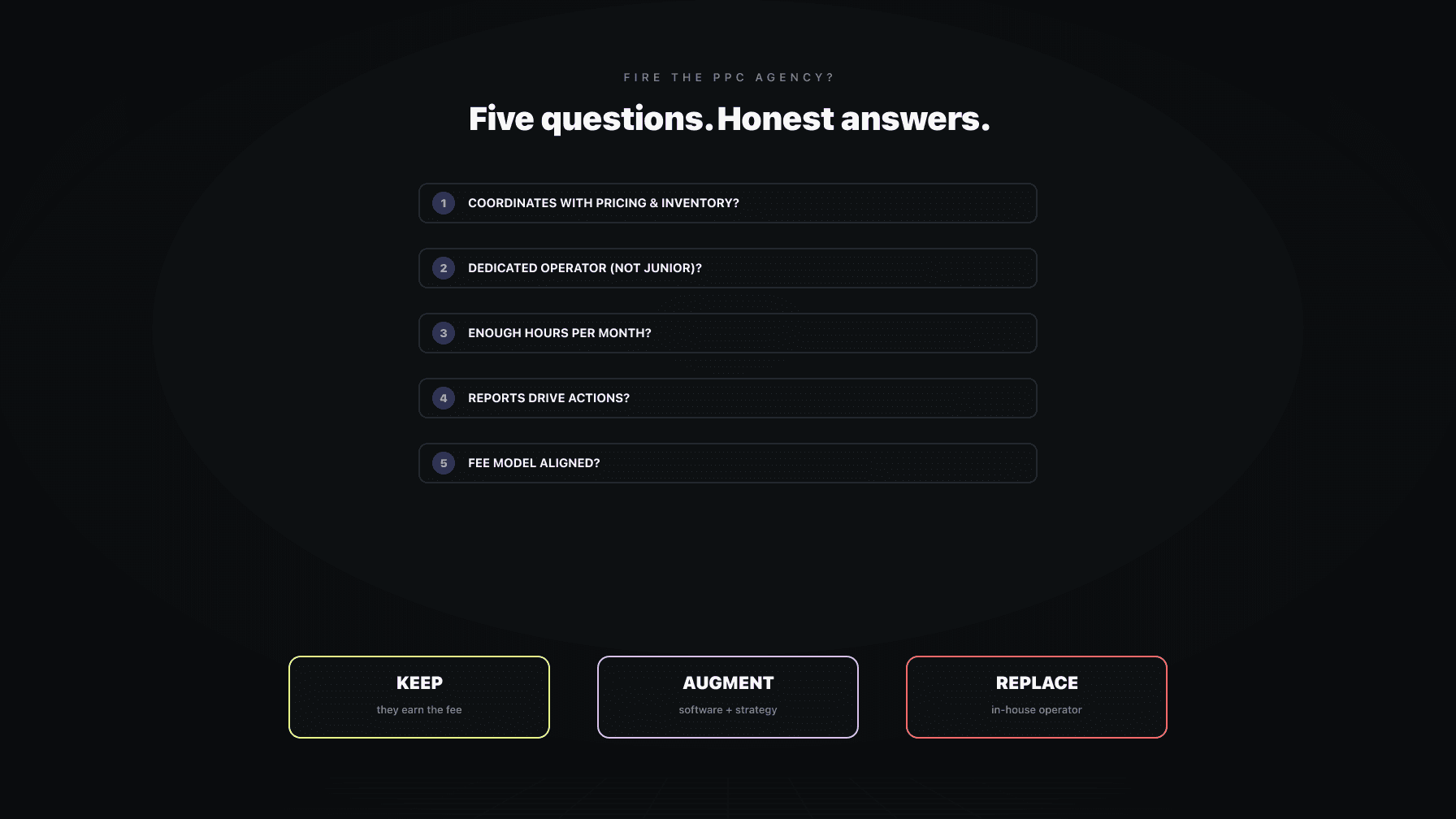
If your agency runs PPC and you handle the rest, an operating system can replace the PPC agency engagement and keep the rest of your stack. If your agency runs everything, the operating system is the path to bringing operations in-house with one operator. Either way, the question is whether the agency adds strategic value or just operational labor. Operational labor is what the operating system replaces.
No. A general-purpose LLM connected to Seller Central is a chatbot with API access. It does not have shared state, specialized models, guardrails, audit logs, or Mission Control. It can answer questions and take simple actions. It cannot run the operational layer of an Amazon brand. The DIY approach gets the demo right and the production wrong.