We onboard in small cohorts. May cohort is open. Apply now →
Profasee Ultra
ULTRA

Get Started

Ultra Overview

See how pricing, PPC, inventory, and execution work together.

How It Works

How Ultra plugs in and gets to work.

Why Ultra

Replace your agency, software, and next hire.

Capabilities

Automations

Workflows Ultra runs across your business.

Integrations

Connect your tools, channels, alerts, and data sources.

Mission Control

Watch every task, approve the close calls, ship the rest.

Control

Safety

Set the rules, approvals, and limits behind every action.

Agent Memory

Every decision saved. Every result measured. Audit any day, forever.

Ultra Managed

Want us to run it with you? We can.

Platform Tour

Turn one team into ten

See how Ultra connects pricing, PPC, inventory, and execution so your team gets 10x more done.

See Ultra in action

Live AI Employees

COO & StrategistClaudiaIncluded

Keeps the team aligned and flags what changed.

PPC ManagerMarko

Cuts wasted spend and keeps bids moving.

Pricing SpecialistOracle

Protects margin and moves price with context.

Demand PlannerBruno

Catches stock risk early and keeps reorders on track.

Coming Soon

Catalog AuditorBrett

Finds listing issues quietly killing conversion.

Launch SpecialistAbe

Launches new ASINs with the right copy, price, and PPC.

Add output, not headcount

See how Ultra gives your team more output across pricing, PPC, and inventory without adding headcount.

See if you qualify

Real Results

PF Harris24X ROI

24X ROI on the first 15 SKUs and $215K in annualized profit lift.

MESS Brands$18K/mo

$18K in monthly profit and 30% lift from smarter repricing.

Junipermist46X ROI

46X ROI with roughly $95K in annualized profit and less pricing guesswork.

Wall Charmers$90K/yr

$90K annualized profit with hands-off repricing and 30% lift.

View all case studies

More Proof

Wall of Love

Video testimonials, reviews, and proof clips.

Compare

Ultra vs. repricers, agencies, and hiring.

Want results like this in your account?

If you want more profit and more output from the same team, apply to see whether Ultra is a fit for your catalog.

Apply now
Pricing
Apply Now

Platform

  • Ultra Overview
  • How It Works
  • Why Ultra

Capabilities

  • Features
  • Automations
  • Integrations
  • Mission Control
  • AI Spend Intelligence

Control

  • Safety
  • Agent Memory
  • Ultra Managed

AI Employees

  • COO & Strategist
  • PPC Manager
  • Pricing Specialist
  • Demand Planner
  • Catalog Auditor
  • Launch Specialist
  • All AI Employees

Proof

  • Wall of Love
  • All Results
  • PF Harris
  • MESS Brands
  • Junipermist
  • Wall Charmers
  • Compare

Solutions

  • Amazon PPC Software
  • Amazon Advertising Software
  • Amazon Repricer
  • Dynamic Pricing Tool
  • Price Tester

Ultra For

  • Agencies

Compare Repricers

  • All Repricer Comparisons
  • Profasee vs Aura
  • Profasee vs AZSellerKit
  • Profasee vs BQool
  • Profasee vs Feedvisor

Compare PPC

  • All PPC Comparisons
  • Profasee vs Pacvue
  • Profasee vs Perpetua
  • Profasee vs PPC Agencies
  • Profasee vs Hiring In-House

Company

  • About
  • Partners
  • Affiliate Program

Resources

  • Blog
  • Glossary
  • Nugget Friday Newsletter
  • 2026 State of AI on Amazon

Get Started

  • Pricing
  • ROI Calculator
Apply Now
Amazon Verified PartnerGet 400% more doneQuickstart in minutes
Profasee Ultra
ULTRA

AI employees that run your Amazon business while you sleep.

Amazon SPN CertifiedAmazon Ads Verified Partner

Nugget Friday Newsletter

The e-commerce strategies of tomorrow. All in your inbox today.

© 2026 Profasee Inc. All rights reserved.

  • Terms of Service
  • Privacy Policy
  • Do Not Sell or Share
  • Usage Policy
  • Service Credit Terms
  • Cookie Policy
  • Security
  • Subprocessors
  • DMCA
  • Accessibility
  • SMS Terms
  • Sitemap
Should You Fire Your Amazon PPC Agency? [2026… | Profasee
← Back to blog
AI Operating System

Should You Fire Your Amazon PPC Agency? An Operator's Honest Decision Framework

Chad Rubin

Chad Rubin

May 10, 2026 · Updated May 11, 2026 · 12 min read

Operator notes by email

Short, opinionated takes on AI agents, Amazon PPC, pricing, and inventory. No fluff. About once a week.
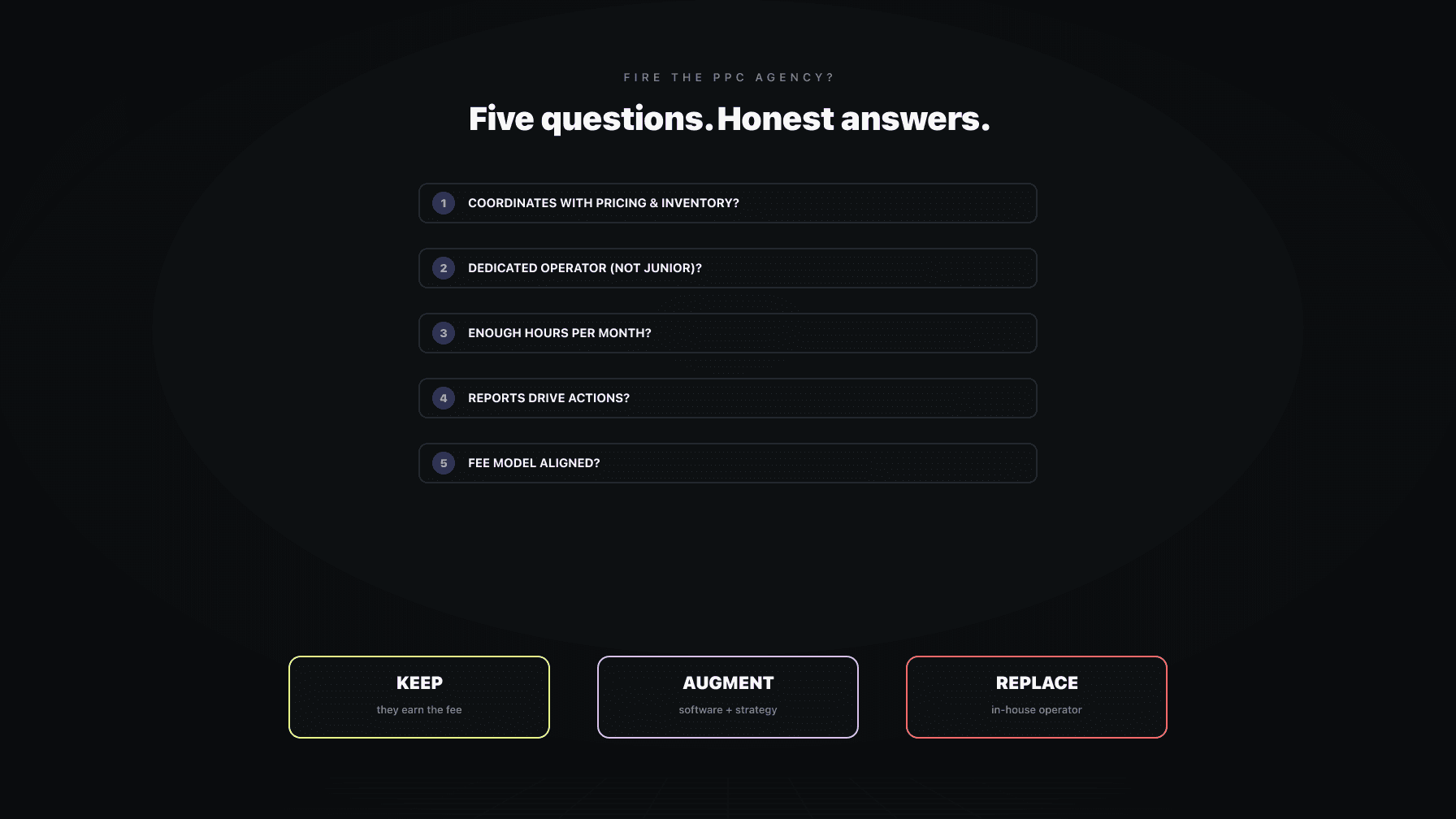
A decision tree diagram showing five fork points (do they coordinate with pricing, do they have an operator, what is the per-account hour count, are reports actionable, what is the fee model) leading to keep, replace, or augment outcomes
  1. Key takeaways
  2. What an Amazon PPC agency actually does in 2026 (the real work vs the autopilot work)
  3. The five fork points in the decision tree
  4. Fork 1: Do they coordinate with your pricing and inventory teams, or is PPC siloed?
  5. Fork 2: Do you have a real account operator there, or is it a junior pulling reports?
  6. Fork 3: How many hours per month are they actually spending on your account?
  7. Fork 4: Are their reports actionable, or are they screenshots of dashboards you could pull yourself?
  8. Fork 5: What is the fee model (percentage of spend, retainer, performance), and is it aligned with your goals?
  9. When the answer is keep your agency (and what to ask for)
  10. When the answer is replace with software plus an operations lead
  11. When the answer is augment (use software for tactical, agency for strategic)
  12. How to run the transition without breaking momentum
  13. How Profasee Ultra fits the in-house path
  14. Related reading
  15. FAQ
  16. When should I fire my Amazon PPC agency?
  17. Is Amazon PPC software cheaper than an agency?
  18. What does an Amazon PPC agency actually do that I cannot?
  19. How do I bring Amazon PPC management in-house?
  20. Can AI replace an Amazon PPC manager entirely?
  21. Do I need an operations lead if I use Amazon PPC software?
  22. What is a fair Amazon PPC agency fee in 2026?

I have been on both sides of this. I have hired agencies, fired agencies, run PPC in-house, and built software that competes with the agencies I used to write checks to. When a brand owner asks me whether they should fire theirs, I do not give the easy answer. There is no easy answer.

Most agencies still do real work. A handful are coasting on auto-bidding tools and a slick PDF deck. The trick is figuring out which one you have, and then deciding whether the work is worth what they charge in a year where AI handles more of the tactical layer than it did twelve months ago.

This is not a hit piece. I have referred friends to agencies this year and I will probably do it again. What I want to give you is the same checklist I would run on my own account if I were paying somebody outside my four walls to manage seven figures of ad spend.

Read this if you are paying anywhere from 5 to 15 percent of ad spend, or a flat retainer that has crept north of 5 figures a month, and you cannot tell anyone in plain English what you are getting back.

Key takeaways

  • Most agency fees in 2026 fall into two buckets: percentage of ad spend (commonly 5 to 15 percent) or a flat monthly retainer. Either way, the question is the same: what work, specifically, is on the other end of that invoice?
  • The line between "agency" and "auto-bidding tool with a human reading the dashboard" has gotten very blurry. Five fork points will tell you which one you have.
  • The biggest gap is almost never inside PPC. It is the lack of coordination between PPC, pricing, and inventory. Most agencies are not staffed to fix that.
  • Replacing an agency with software alone is a mistake. Replacing an agency with software plus an internal operations lead is usually the right call for brands doing 1M to 50M.
  • Augmenting (software for tactical, agency for strategic) is the most underrated path. It cuts cost without losing the strategic brain.
  • Run any transition in parallel for at least one full inventory cycle. Do not cancel the agency on a Friday and turn the lights off on Monday.

What an Amazon PPC agency actually does in 2026 (the real work vs the autopilot work)

Some of it is real work that is hard to replicate. Some of it is autopilot work that decent software does for a tenth of the cost.

The real work, the part agencies still earn their fee on:

  • New product launch sequencing: which keywords to rank on, in what order, how aggressively to bid for the first 60 days.
  • Competitive intelligence: noticing a category leader dropped price 8 percent and rewriting your bid strategy around it.
  • Brand strategy on Sponsored Brands and DSP.
  • Account-level escalations with Amazon support.

From reading to action

See what Profasee Ultra would do on your account.

If the framework above sounds familiar, your Amazon account is probably carrying the same drag. Apply and we will show what Marko, Oracle, and Bruno would change in your first week.

Starts in read-only modeApplication-only onboardingGuardrails before action
Book a demoKeep reading

Explore Profasee Ultra

AI Employees

Meet the team

Compare

See how we stack up

Results

$82M+ profit unlocked

Chad Rubin

Chad Rubin

Founder & CEO, Profasee

LinkedInX (Twitter)
Years on Amazon
15+
Own Brand
Think Crucial
Founded
Skubana
Co-founded
Prosper Show

Ran a 7-figure Amazon brand for a decade. Founded Skubana (acquired). Co-founded Prosper Show. 15+ years on Amazon.

More from the blog

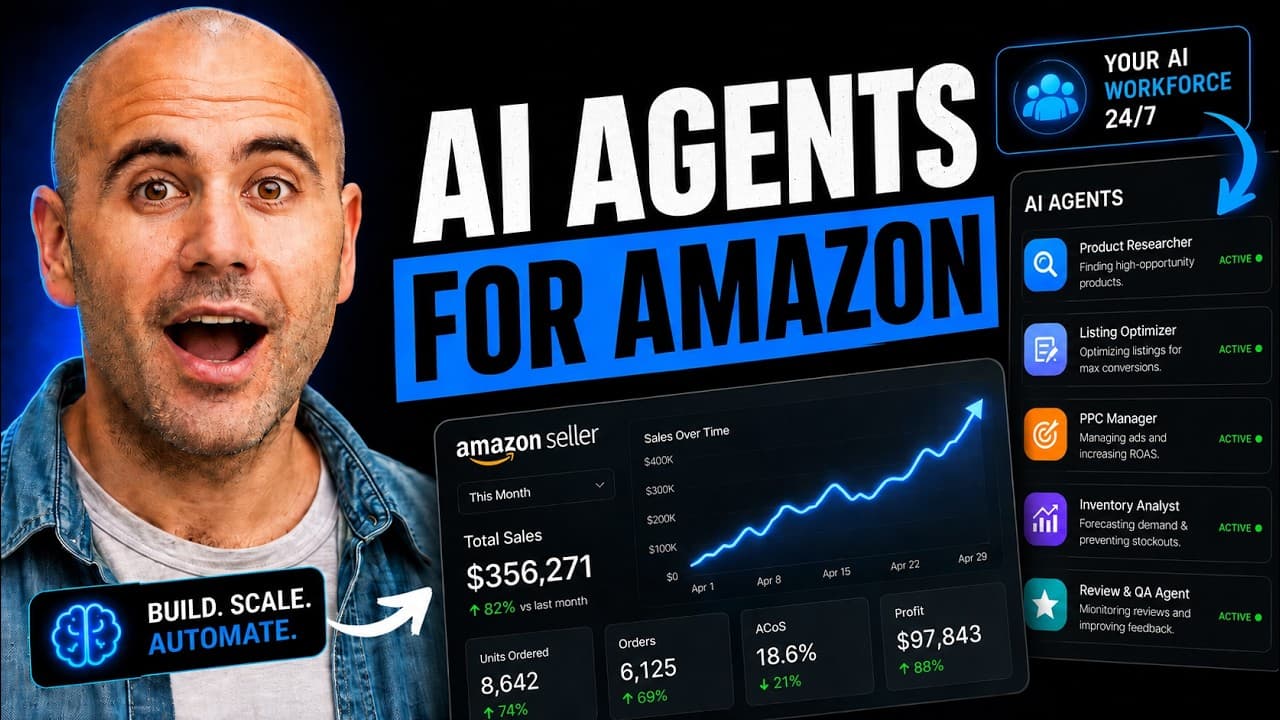
Chad Rubin standing next to a screenshot of the Profasee Ultra dashboard showing Amazon Seller stats and a list of active AI agents (Product Researcher, Listing Optimizer, PPC Manager, Inventory Analyst, Review and QA Agent)

May 11, 2026

Watch: AI Agents That Run an Amazon Business 24/7 (Profasee Ultra Demo)

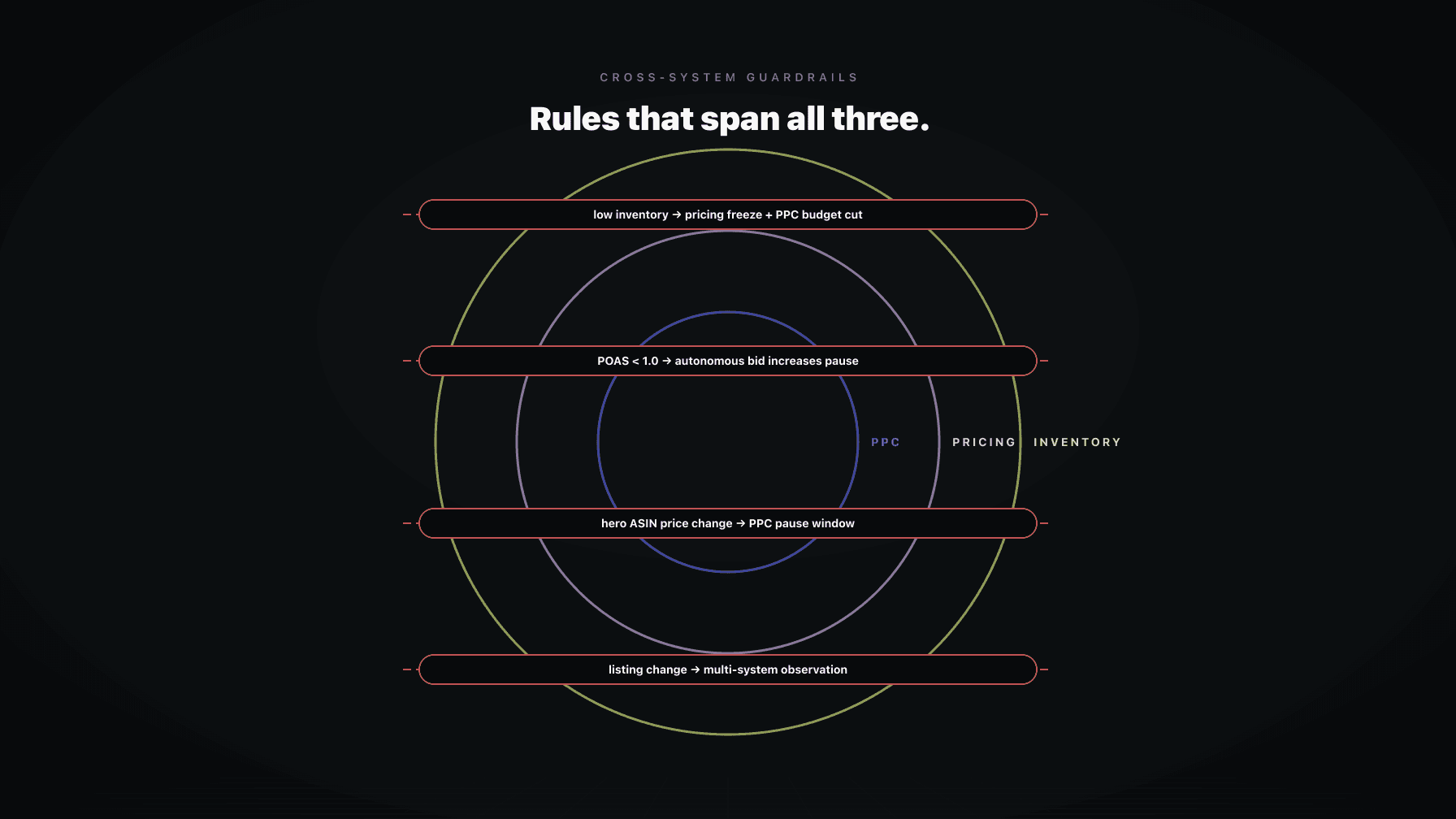
Three concentric rings labeled pricing, PPC, and inventory with cross-system guardrail rules drawn as lines spanning all three rings, illustrating the trust layer

May 9, 2026

Guardrails Across Pricing, PPC, and Inventory: The Trust Layer for AI on Amazon

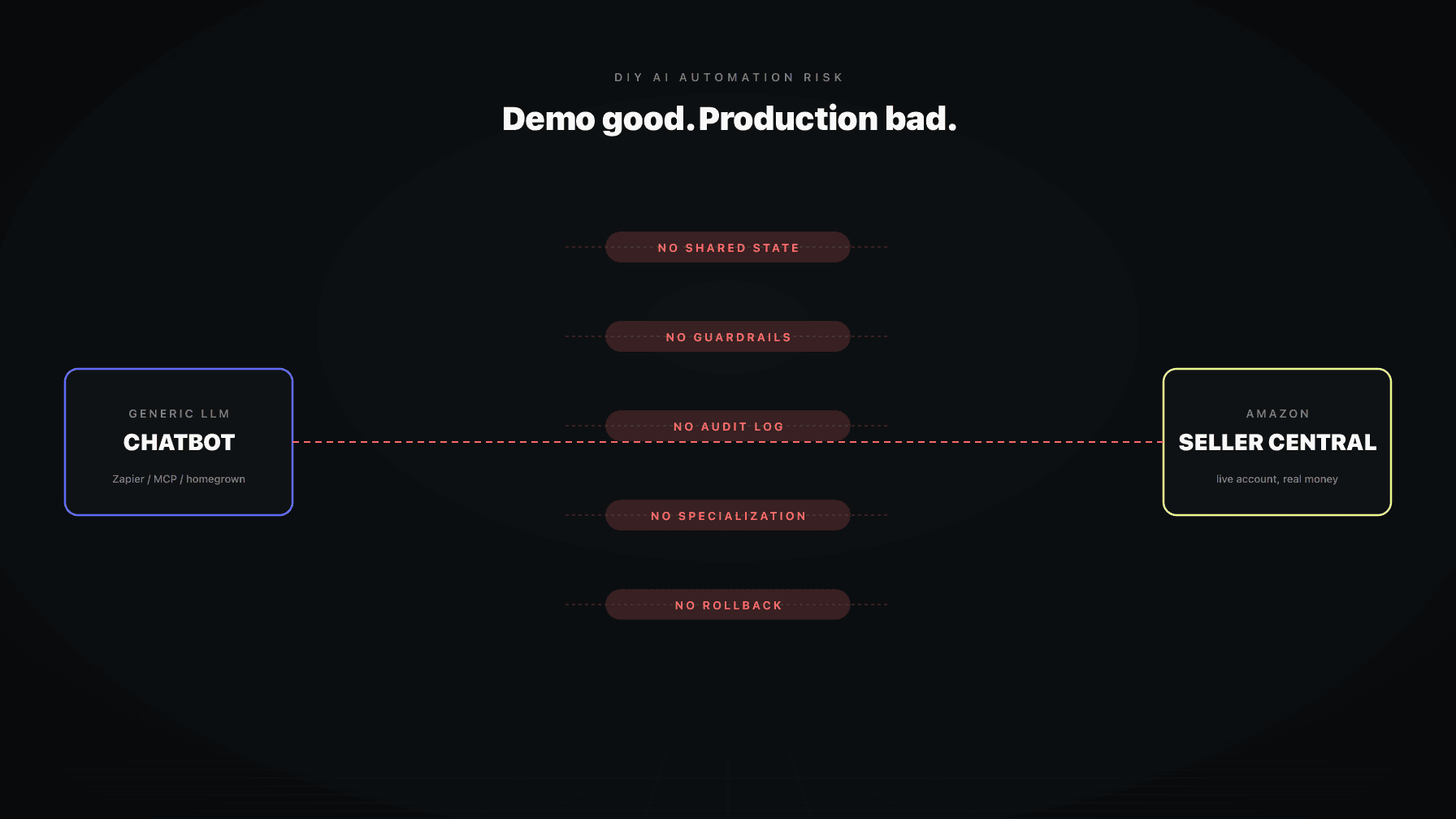
A diagram of a generic AI agent connected by a thin wire to Seller Central with five red warning labels (no shared state, no guardrails, no audit log, no specialization, no rollback)

May 9, 2026

Why DIY AI Automation Is Risky for Amazon Sellers

Ready to put AI to work on your Amazon business?

Join the brands that replaced agencies and tools with AI employees.

Apply Now
  • Translating quarterly business goals (margin, share, inventory clearance) into a campaign architecture.
  • The autopilot work, quietly automated for years:

    • Bid adjustments based on placement, time of day, and ACoS targets.
    • Negative keyword harvesting.
    • Budget reallocation between campaigns pacing hot or cold.
    • Dayparting and bid modifiers.
    • Campaign duplication and structure cleanup.

    If 80 percent of what your agency is doing lives on the second list, you do not need an agency. You need software and somebody on your team who can read the output. If the work is genuinely on the first list, you have a different decision to make.

    "Since onboarding, our POAS and ROAS have both improved, driven by a much more disciplined, data-led approach to bidding and budget allocation."
    Richard Quigley, Profasee customer

    The five fork points in the decision tree

    Here is the decision framework I run when I am evaluating whether an outside team is still worth the spend. Five fork points. Each one has a clean answer. At the end you will land in one of three buckets: keep, replace, or augment.

    1. Do they coordinate with your pricing and inventory teams, or is PPC siloed?
    2. Do you have a real account operator there, or is it a junior pulling reports?
    3. How many hours per month are they actually spending on your account?
    4. Are their reports actionable, or are they screenshots of dashboards you could pull yourself?
    5. What is the fee model, and is it aligned with your goals?

    Run all five. Do not stop at the first red flag and fire on impulse. The point is to see the whole picture.

    Fork 1: Do they coordinate with your pricing and inventory teams, or is PPC siloed?

    This is the one almost everyone gets wrong, including me when I was hiring agencies.

    PPC, pricing, and inventory are the same problem. If your price moves up 6 percent because your supplier raised costs, conversion rate drops, ACoS climbs, and campaigns start burning budget on impressions that will not convert. If inventory drops below 4 weeks of cover, you should be pulling back on top-of-funnel spend. If you launch a 15 percent off promotion, you should be leaning in harder.

    Most agencies do not touch pricing. They do not touch inventory. They will tell you they "coordinate" but what they mean is they got a Slack message from your ops team three days after the price change.

    Ask: when was the last time they made a bid adjustment because of a price change or inventory event, not because of an ACoS movement? If they cannot give you a specific example from the last 30 days, PPC is siloed. That is the single biggest argument for moving to a system where pricing, PPC, and inventory share the same operating brain.

    Fork 2: Do you have a real account operator there, or is it a junior pulling reports?

    When you signed the contract, you probably met a senior person. Maybe a founder. They were sharp. You felt good.

    Six months in, who is actually touching your account? If you do not know, that is your answer.

    Senior PPC operators are expensive. Agencies cannot put one on every account unless your spend is genuinely large. What happens in many shops is a junior gets handed your account along with twelve others. They run a weekly checklist. The senior person shows up on the QBR call to make it feel premium.

    Ask for the name of the person doing the actual work this week. Ask how many other accounts they manage. If the answer is "12" and your spend is "average for the agency," your account is not getting senior-operator attention. It is getting checklist attention, and checklists can be automated for a fraction of what you are paying.

    Fork 3: How many hours per month are they actually spending on your account?

    Ask your agency for a rough estimate of monthly hours on your account. Most will not give you a clean number because they are uncomfortable with the math.

    Run the math yourself. A 7,000 dollar retainer at 8 hours a month is 875 dollars an hour. There are very few PPC operators worth that.

    Hour count alone is not the disqualifier. What matters is hours-to-outcomes. If 6 of those 8 hours are strategic work you could not replicate (launches, competitive moves, rebuilds) you may be getting your money's worth. If 6 of those 8 hours are clicking buttons an automation could click, you are not.

    Fork 4: Are their reports actionable, or are they screenshots of dashboards you could pull yourself?

    Pull your last three monthly reports. Read them like you have never seen the account before.

    Bad reports: "ACoS was 24 percent, down 2 percent. Sponsored Products spend was up 8 percent. Top performer was X." That is a description. They are reading you the dashboard.

    Good reports: "We pulled spend off ASINs 7, 11, and 14 because conversion dropped after a competitor cut price. We moved 18 percent of that budget into ASINs 3 and 9 where you have a 4-week inventory buffer and margin advantage. Recommend we stay on this stance until competitor pricing normalizes."

    The good version tells you what they decided, why, and what they recommend next. Short. Specific. Not trying to look impressive. If your reports are mostly the first version, you are paying for theater.

    Fork 5: What is the fee model (percentage of spend, retainer, performance), and is it aligned with your goals?

    Three common fee structures, each with a hidden incentive.

    Percentage of ad spend (commonly 5 to 15 percent). The agency makes more when you spend more. Fine when you are growing. It quietly punishes the agency for pulling spend back to protect margin. They will not say this out loud. The model is what it is.

    Flat monthly retainer. Predictable for both sides. The hidden incentive is autopilot, because every hour they put in lowers their effective rate.

    Performance-based (tied to TACoS, ACoS, or revenue). Sounds great, almost never works cleanly. The tied metric is usually ACoS or revenue, neither of which captures profit, inventory health, or category position. An agency hitting an ACoS target while your inventory rots is technically winning.

    None of these are evil. They are incentive structures. Match the incentive to the goal you actually have. If your goal is profit not revenue, every fee structure on this list misses, and you should be running PPC closer to in-house.

    When the answer is keep your agency (and what to ask for)

    Keep your agency when:

    • Forks 1 through 4 mostly pass. They coordinate with pricing and inventory, they have a real operator on your account, the hour count is reasonable, and the reports are decisions not screenshots.
    • They have done genuinely hard launch or rebuild work for you in the last 12 months that you could not have done yourself.
    • Your spend is large enough that a senior operator can be dedicated to your account.

    If you are keeping them, use this framework as leverage in your next renewal conversation. Ask for:

    1. A named senior operator with a published hour commitment.
    2. Monthly reports written as decisions, not dashboards.
    3. A written process for how they coordinate with your pricing and inventory data.
    4. A move from percentage-of-spend to a hybrid retainer plus performance bonus tied to a metric you actually care about (profit or contribution margin).

    You will be surprised how many agencies will agree to all four. The good ones want this conversation. They are tired of being grouped with the autopilot shops.

    When the answer is replace with software plus an operations lead

    Replace your agency when:

    • Forks 1 through 4 mostly fail. Siloed from pricing and inventory, no real senior operator, low hour count, theatrical reports.
    • The strategic work you are paying for has not actually happened in 6 to 12 months. You are renewing on inertia.
    • The fee is large enough that you could hire a competent in-house operations lead and pay for software for less than what you are sending to the agency.

    The mistake people make is replacing the agency with software alone. Software does not have a brain that decides what to launch, what category position to chase, or whether to push share or protect margin. Software executes. An operator decides.

    The right replacement for most brands doing 1M to 50M is software plus one internal operations lead. The lead does not have to be a senior PPC manager. They need to be a generalist operator who can read AI recommendations, override what looks wrong, and translate quarterly business goals into automation rules. Dramatically cheaper than a full management agency, and far more aligned with your business because they are inside it.

    For the longer treatment, see the no-employee Amazon business and AI operating system posts.

    "We've been working with Profasee for over a year, using both their Repricer and PPC services. Their team is responsive, flexible, and thoughtful in the way they support each account."
    Lexi Matthews, Profasee customer

    When the answer is augment (use software for tactical, agency for strategic)

    This is the most underrated path and almost nobody talks about it.

    Augment when:

    • Your agency is genuinely strong at the strategic work (forks 1 and 2 pass, fork 4 passes).
    • The autopilot work (most of fork 3) is the bulk of what you are paying for, and it is what you want to take back.
    • You are not ready, willing, or staffed to bring everything in-house in one move.

    Software handles bid adjustments, negative keyword harvesting, budget reallocation, dayparting, and the rest of the autopilot list. Your agency keeps the strategic seat: launches, rebuilds, Sponsored Brands and DSP, competitive intelligence, and the QBR conversation.

    Renegotiate the fee. Either a 30 to 50 percent discount on the old retainer, or off percentage-of-spend entirely onto a smaller strategic retainer plus a project fee for launches.

    If they are honest, they will not fight you. The good ones know the autopilot work is going to software either way. They want the strategic seat. The bad ones fight because the autopilot fee was keeping the lights on.

    How to run the transition without breaking momentum

    Whether you are replacing or augmenting, do not cancel on Friday and switch on Monday. Run in parallel for at least one full inventory cycle, ideally 60 to 90 days.

    1. Connect the software in read-only mode first. Let it observe for 30 days. See what it would do before it does anything.
    2. Pick one stable campaign group with predictable conversion. Let the software run it live with low caps. Compare against a matched group still on the agency.
    3. Roll forward category by category. Do not flip the whole account at once. If something breaks, you want to know which segment broke.
    4. While this happens, write down the strategic work the agency is actually doing. That becomes your scope of work for augment or your hiring spec for in-house.
    5. Decide at day 60 or 90 based on data, not on how the agency is making you feel about the transition.

    The trust ladder post walks through how to hand tasks off to AI agents safely. Do not skip the trust steps. Brands that go from zero to fully automated in a week are the same brands coming back six weeks later wanting their agency back.

    How Profasee Ultra fits the in-house path

    The autopilot work on the second list at the top of this post is what Marko, our PPC manager AI employee, handles inside Profasee Ultra. Bid adjustments, negative keyword harvesting, budget reallocation, dayparting, structure cleanup, search term mining. The difference is coordination. Marko is not running PPC in a silo. He reads from the same memory as Oracle (pricing) and Bruno (demand planning).

    That coordination is what fork 1 is about. When Oracle moves price up to protect margin, Marko sees it and pulls back top-of-funnel spend on the affected ASINs. When Bruno flags an ASIN heading into stockout in 4 weeks, Marko reduces aggression. Most agencies cannot deliver this because they do not have a seat at the pricing or inventory table.

    Mission Control gives your operations lead the surface to run it. You see what Marko is recommending. Approve, override, or step back. Every decision logged. The trust ladder is real and visible.

    See the PPC manager AI employee, Amazon PPC software, and pricing pages. If you want to see whether your catalog is a fit, apply here and we will tell you honestly. We have turned brands away because they were better off staying with their agency another quarter.

    Related reading

    • The AI operating system for Amazon brands
    • The no-employee Amazon business
    • The AI agent adoption trust ladder
    • DIY AI automation risks for Amazon sellers
    • Cross-system guardrails for Amazon automation
    • The AI Amazon PPC management playbook
    • Amazon PPC campaign roles
    • Best Amazon PPC software

    FAQ

    When should I fire my Amazon PPC agency?

    Run the five fork points: coordination with pricing and inventory, presence of a real senior operator on your account, monthly hours, report quality, and fee model alignment. If three or more fail, replace or augment. If most pass, renegotiate the contract using the framework as leverage. Do not fire on impulse. Run any transition in parallel for 60 to 90 days.

    Is Amazon PPC software cheaper than an agency?

    Software alone is almost always cheaper than a full management agency, often by 60 to 80 percent. But software alone is not a fair comparison. The right comparison is software plus one internal operations lead versus the agency. For most brands doing 1M to 50M, that combined cost is still meaningfully less than what they are paying an agency, with better coordination across pricing and inventory.

    What does an Amazon PPC agency actually do that I cannot?

    The real work is launch sequencing, competitive intelligence, brand strategy on Sponsored Brands and DSP, account-level escalations with Amazon, and translating business goals into campaign architecture. Bid adjustments, negative keyword harvesting, and budget reallocation are autopilot work that does not need an agency in 2026. If 80 percent of your invoice is autopilot work, you are overpaying.

    How do I bring Amazon PPC management in-house?

    Hire one operations lead (a generalist operator, not a senior PPC manager), give them software that handles the tactical layer, and run a 60 to 90 day parallel transition with your existing agency. Roll software forward category by category. Do not flip the whole account at once. The operator's job is to set the goals, read recommendations, override what looks wrong, and translate quarterly business strategy into automation rules.

    Can AI replace an Amazon PPC manager entirely?

    AI can replace the tactical layer of a PPC manager, which is most of the day-to-day work. AI cannot replace the operator who decides what to launch next, what category position to chase, or how to weigh margin against share. The honest answer in 2026 is that the role is shrinking, not disappearing. One operator with strong AI tooling can do what a small team did three years ago.

    Do I need an operations lead if I use Amazon PPC software?

    Yes. Software without a human operator is the most common failure mode. Software executes, the operator decides. The operator does not need to be a senior PPC specialist. They need to be a generalist who can read the AI's output, spot when something looks wrong, and connect quarterly business goals to the rules the software runs by.

    What is a fair Amazon PPC agency fee in 2026?

    Common ranges are 5 to 15 percent of ad spend or a flat monthly retainer. The fairness question is not really about the dollar amount. It is about what work the fee actually covers. A 15 percent fee can be a steal if the agency is doing genuine strategic work and coordinating across pricing and inventory. A 5 percent fee can be a ripoff if it is paying for autopilot work that software does for a fraction of the cost. Match the fee to the work, not to a benchmark.