Chad Rubin
May 4, 2026 · Updated May 11, 2026 · 12 min read
Operator notes by email
Short, opinionated takes on AI agents, Amazon PPC, pricing, and inventory. No fluff. About once a week.
Margins on Amazon are not what they were five years ago. Referral fees, FBA storage, inbound placement, ads, returns, the long tail of program fees: each one has crept up while average selling prices stayed flat or fell. A 22% margin business at the SKU level becomes a 9% business at the P&L level once you load in the team.
The first instinct is to add people. Hire a PPC manager. Hire an inventory planner. Hire an analyst to pull reports. That worked when ad spend was 8% of revenue and pricing was something you set once a quarter. It does not work in 2026. The work is too repetitive, too cross-system, and moving too fast for a human to do well at the volume Amazon now demands.
The lean Amazon brand of 2026 runs with three or four humans instead of fifteen. The operational layer (PPC, pricing, inventory, listing maintenance, reporting) is run by AI agents that share data and make coordinated decisions. The humans concentrate on what humans are still uniquely good at: brand, creative, customer relationships, and the edge cases the agents flag.
This is not a thought experiment. It is happening now, and the operators who figure it out first will compound an advantage the rest of the category will not close by hiring harder.
Amazon margins compressed in three directions at once. Fees went up. Ad cost went up because more sellers are bidding on the same keywords. Average order values went down because shoppers got pickier and competitors got cheaper. The brand that was netting 22% in 2019 is netting 11% in 2026 on the same SKUs.
When a P&L compresses like that, the line items that look discretionary get cut first. Most of the time that is headcount. The problem is the work does not go away. PPC still has to run. Pricing still has to move. Inventory still has to land in the right FCs. So the work gets squeezed onto fewer people, who burn out or cut corners. Cutting corners on Amazon shows up two months later in BSR drift, suppressed listings, and out-of-stocks.
From reading to action
If the framework above sounds familiar, your Amazon account is probably carrying the same drag. Apply and we will show what Marko, Oracle, and Bruno would change in your first week.

Ran a 7-figure Amazon brand for a decade. Founded Skubana (acquired). Co-founded Prosper Show. 15+ years on Amazon.
Join the brands that replaced agencies and tools with AI employees.
The brands that figured this out early did not just cut headcount. They restructured the work. They asked: of the forty things this team does in a given week, how many require human judgment, and how many are pattern-matching against rules and data? On most teams, 60% to 70% of the weekly work is pattern-matching. That is the part an AI agent can run.
I have watched a lot of brand owners try to solve operational pain by hiring. It almost never works the way the org chart promises. Three reasons.
First, the hiring market for skilled Amazon operators is brutal. The good PPC managers are running their own agencies. The good inventory planners are at brands that pay above market. You hire who you can find, and then you spend six months training them on your catalog and tribal knowledge.
Second, by the time the new hire is productive, your business has changed. New SKUs, new competitors, new ad placements. A human PPC manager managing 200 SKUs is operating at the limit of what they can hold in their head, with stale information from yesterday's bulk file.
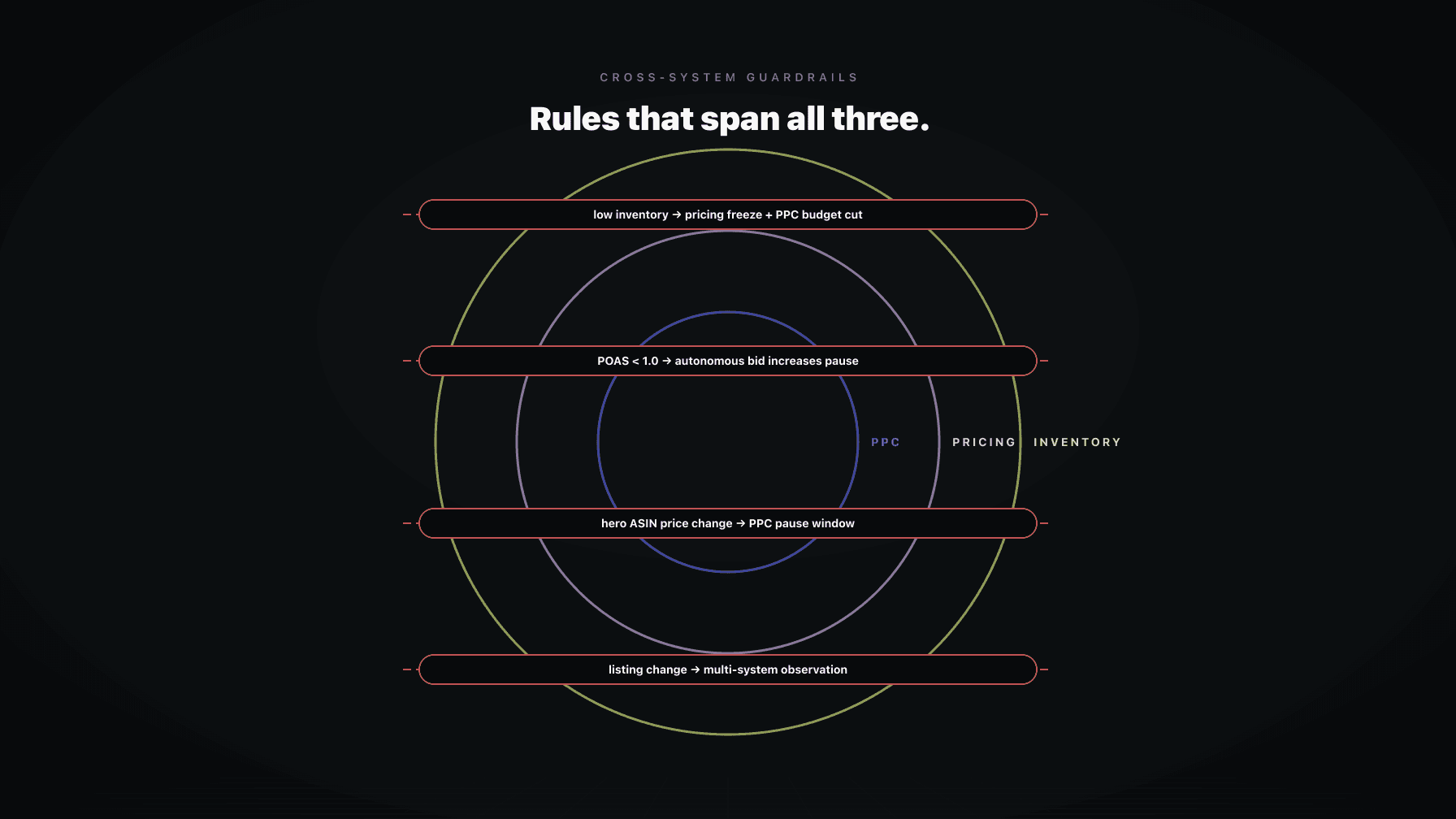
Third, the work is cross-system. Pricing decisions affect ad ROAS. Inventory levels affect bid strategy. Listing changes affect conversion which affects everything else. A human team handles this with weekly meetings and Slack threads. An AI operating team handles it because the agents share state in real time.
There is a narrow case where hiring is still right. If the work is genuinely creative (brand, customer research, product development), hire. If it is repetitive and rule-bound, do not.
Here is the honest scope of what AI agents are running well in 2026, in production, on real catalogs:
PPC management. Bid optimization across match types, search term harvesting, negative keyword application, budget pacing, dayparting, campaign structure on new SKUs, ASIN targeting. The agent runs every hour and reconciles against the pricing and inventory state of every SKU.
Pricing. Demand-aware repricing, not the race-to-the-bottom kind. The agent looks at conversion rate, BSR, ad spend, inventory weeks of cover, and competitor pricing, and sets a price that maximizes contribution margin instead of just velocity.
Inventory and demand planning. Forecasts that update with each day of new sales data, reorder triggers that account for lead time variance, inbound placement, and the cross-check against ad spend (you do not want to dump $8,000 of ads into a SKU that is going to stock out in eleven days).
Reporting. The weekly business review that took an analyst eight hours every Friday now runs itself and surfaces only the variances that need a human eye. Not a dashboard. A short written narrative of what changed and why.
Listing maintenance. Catalog audits for suppressed listings, missing attributes, image compliance, A+ drift, variation theme problems. The agent fixes what it can and queues the rest for the human.
Each one is a job that used to require a person or part of a person, now better done by an agent that has full data and runs continuously.
The agents do not run everything. The things humans still own are concentrated and high-leverage:
Strategy. Which categories to enter. Which SKUs to discontinue. Which markets to expand to. Whether to push DTC harder. Which channels to add. The agent can give you the data to make the call. The call is yours.
Brand and creative. What the brand stands for, what the photography looks like, what the voice sounds like, what the next product launch is. AI tools help with execution but the creative direction is human work.
Customer relationships. The wholesale buyer. The journalist. The big retailer who wants a meeting. The supplier in the factory who needs to be looked in the eye. None of that is going to AI agents.
Edge cases. The agent escalates when it is unsure or when something is outside its operating envelope. A suppression you have never seen before. A pricing decision that conflicts with a wholesale agreement. A demand spike that does not match any historical pattern. The human looks at it, decides, and the agent learns.
Oversight and judgment. Approving the agent's bigger moves. Reading the weekly narrative and asking "why did pricing pull back on this SKU?" Catching when the agent is wrong, because it sometimes will be.
That is real work, and it is work that pays off more per hour than the operational pattern-matching the agents took over.
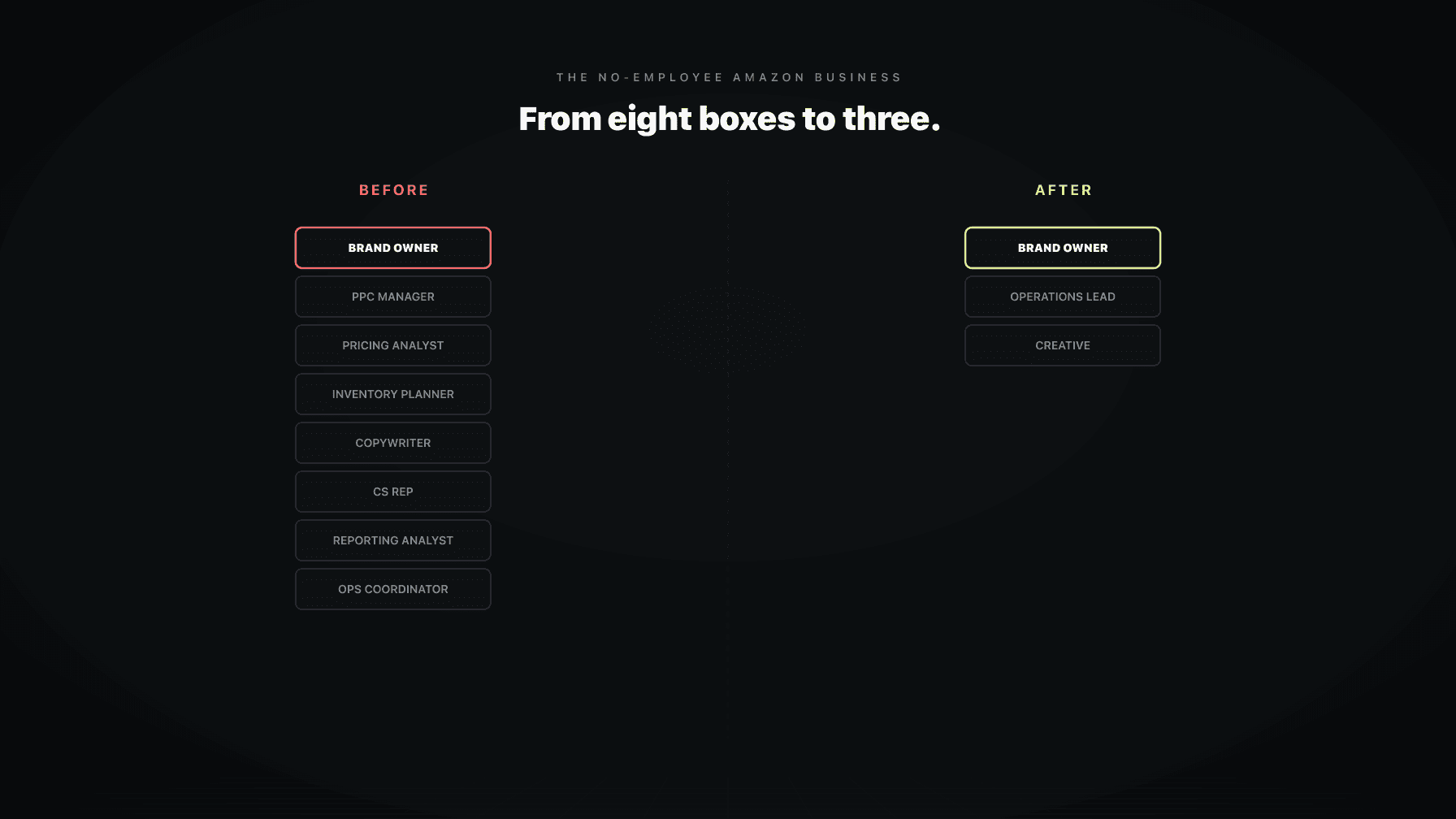
Here is what a $5M to $15M Amazon brand can look like in 2026:
That is three full-time humans for a brand that used to need eight to twelve. The savings are real, but the bigger benefit is speed. Three people who trust their tools and each other can move faster than twelve people coordinating in Slack.
I am not saying every brand should run this way tomorrow. I am saying this is the shape the next decade points toward, and the brands that move first will have a structural cost advantage their competitors cannot match by hiring.
The brands that try to remove humans entirely run into trouble. The agents are good, not perfect. When they make mistakes you need a human paying attention.
Oversight in a lean brand is concentrated in three places:
The mistake operators make is thinking "AI agent" means "no human in the loop". The right model is "the human in the loop is doing higher-leverage work". Oversight does not disappear. It moves up.
Run the math on a typical 7-figure brand:
That is $17,500 to $38,000 per month, or $210,000 to $456,000 per year, before benefits and taxes. For a brand doing $5M, that is 4% to 9% of revenue.
An AI operating team handles those functions at a fraction of that, with full coverage instead of partial coverage, and without the management overhead. The dollar savings are real. The bigger savings are second-order: less coordination cost, less hiring cost, and the ability to redeploy budget into product, creative, and inventory (the things that actually move the business).
I have seen the rip-the-bandaid version of this transition fail more than once. The pattern is consistent.
Mistake 1: Firing the team before the agents are dialed in. The agents need a few weeks of supervised running before you trust them with full authority. Skip the supervised phase and you get outages you did not see coming.
Mistake 2: Picking tools that do not talk to each other. A PPC tool that does not know inventory state. A pricing tool that does not know ad spend. The point of AI agents is that they share state. If they do not, you have not bought the future, you have bought another dashboard.
Mistake 3: Treating it as cost-cutting only. The brands that get the most out of this transition reinvest the savings into product, creative, and inventory. That is what compounds.
Mistake 4: Hands-off too early. The human in the loop is doing higher-leverage work, but they are still in the loop. Brands that disappear from their own ops for three months come back to a mess.
Mistake 5: Underestimating change-management on the team. Humans whose roles are changing need to know what they will own going forward. Done well, your best operators stay and own more. Done poorly, they leave.
The transition from a traditional team to a lean AI-native operation is best done in phases, not in one weekend. Here is the rough sequence I have seen work:
Phase 1 (weeks 1-4): Agents run alongside humans, no authority. The agent generates recommendations. The human reviews and approves. You are calibrating the agent against the way your business actually runs and catching the cases where its defaults do not match your reality.
Phase 2 (weeks 5-12): Agents run with bounded authority. The agent acts within defined limits (price changes within X%, bid changes within Y%, reorder approvals up to Z dollars). Bigger moves still escalate. You are building trust and watching the metrics.
Phase 3 (months 4-6): Agents run the operational layer. Authority bounds are wider. The human reviews the weekly narrative and handles escalations. The team that used to do this work has either moved up to higher-leverage roles or moved on.
Phase 4 (month 7 onward): Lean operating mode. Three to four humans, an AI operating team, and the org chart that gets you the cost structure and decision speed of 2026.
Each phase should be a deliberate decision, not a drift. And each phase needs a way to roll back if something is going sideways. The operators who get this right are the ones who treat it like a real change-management project, not a tooling switch.
The most underrated benefit of going lean is not the cost savings. It is the speed.
A brand with three humans and an AI operating team makes decisions in hours. A brand with twelve humans makes decisions in weeks. The twelve-person org needs a meeting. The meeting needs preparation. The data is not consolidated, so someone has to pull it. By the time the meeting happens, the situation has changed.
The lean brand does not have that drag. The data is consolidated by default because the agents share state. The owner sees a narrative on Monday morning and makes a call by Monday afternoon.
This compounds. Faster decisions mean faster learning. Over a year, the lean brand laps the heavier brand on metrics that matter: contribution margin per SKU, BSR trajectory, repeat purchase rate.
That is the real prize. Not the headcount savings. The speed.
Profasee Ultra is the AI operating team for Amazon brands that want to run this way.
It is not four separate tools that you stitch together. It is one operating layer with four named agents that share data and coordinate decisions:
The human operator sits in Mission Control, where the four agents report up. You see the weekly narrative, the daily escalations, and the monthly strategy view. You make the calls the agents cannot. You stay in the loop where it matters and out of it where it does not.
If you are sizing this against your current stack, the pricing page lays out where Profasee Ultra fits. If you are ready to talk through whether your brand is the right shape for this kind of transition, apply here and we will have an honest conversation.
In the literal sense, no. There is always a human owner making strategic decisions, and almost always at least one operations lead. The "no-employee" framing is shorthand for "no operational headcount". The repetitive operational work (PPC, pricing, inventory, reporting, listing maintenance) can run on AI agents. The strategic, creative, and oversight work stays human.
Bid optimization across match types, search term harvesting, negative keyword application, budget pacing, dayparting, campaign structure on new SKUs, ASIN targeting, and the weekly write-up of what changed and why. The agent runs every hour with full data on price and inventory state. Where a human PPC manager checks 30 high-spend SKUs on Tuesday and runs out of time, the agent runs every SKU every cycle.
Strategy (CEO / owner level), brand and creative direction, customer relationships (wholesale, press, retailers, suppliers), and operational oversight on top of the AI agents. Specialist functions like accounting, legal, and supply chain stay outsourced or fractional.
Most 7-figure brands spend $210,000 to $456,000 per year on the headcount and tools the AI operating team replaces, before benefits and taxes. A common pattern is 3% to 6% of revenue back to the P&L, plus faster decisions that compound into better margin over time.
Not obsolete, but shifting. Agencies that compete on operational execution (running ads, repricing, pulling reports) are getting squeezed because the agents do that work better and cheaper. Agencies that compete on strategy, creative, and senior-level judgment are still valuable. The future agency is smaller, more senior, and charges for thinking, not for clicks.
Four phases. Phase 1 (weeks 1-4): agents generate recommendations, humans approve everything. Phase 2 (weeks 5-12): agents act within bounded authority, bigger moves escalate. Phase 3 (months 4-6): agents run the operational layer, humans review the weekly narrative and handle escalations. Phase 4 (month 7+): lean operating mode.
The most common failure is going hands-off too early. Brands that buy agents and disappear from their own operations for three months come back to drift: pricing that walked off a cliff, inventory that overshot, listing changes nobody caught. The right model is not "set and forget". It is humans concentrated on the highest-leverage work, agents running everything else, and a real review cadence in between.