Chad Rubin
May 11, 2026 · 6 min read
Operator notes by email
Short, opinionated takes on AI agents, Amazon PPC, pricing, and inventory. No fluff. About once a week.
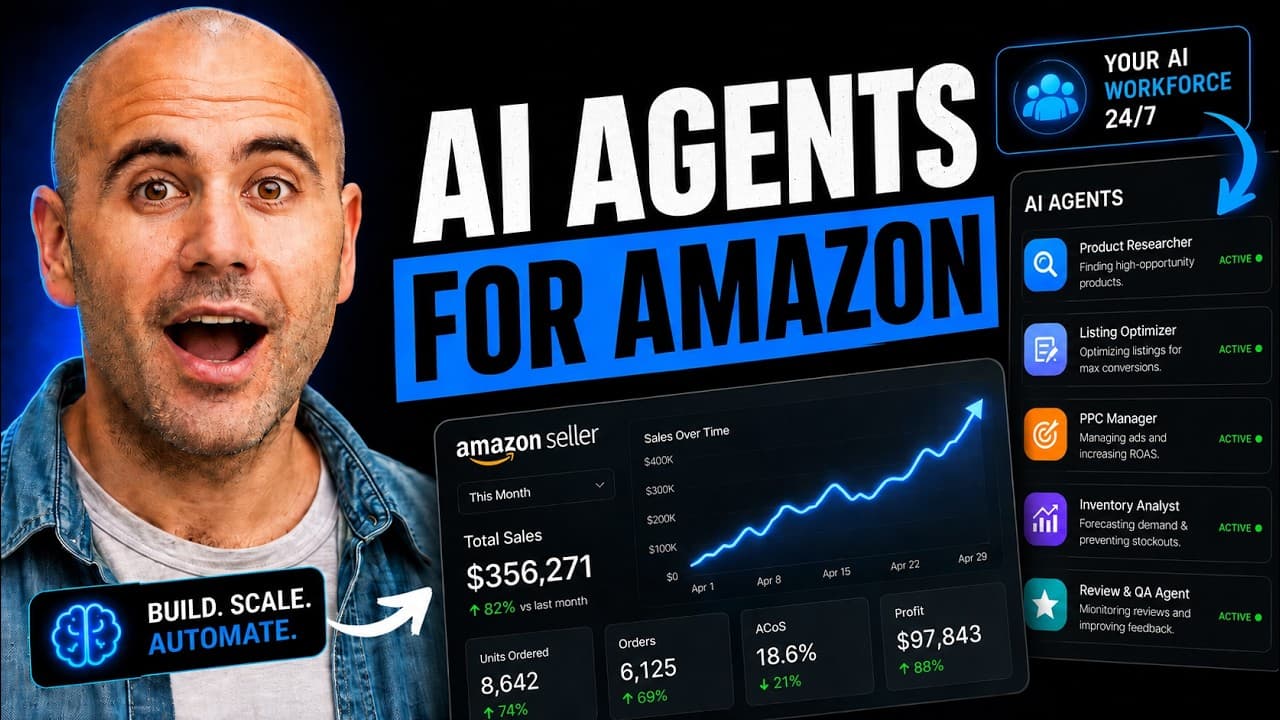
If you are managing Amazon PPC by hand, paying an agency $3,000 to $10,000 a month, or running software that was built in 2020, the way you operate your account is about to feel like a fax machine.
Not ChatGPT. Not a copilot. Not a wrapper around someone else's API. A coordinated team of specialized agents that share state, respect guardrails, and execute on Amazon while you sleep.
I just published a 6-minute walkthrough of what we have been building at Profasee. It is the platform I am running on my own brand, Think Crucial, right now. This post is the operator's notes on the demo, with timestamps and the framework underneath what you are seeing on screen.
[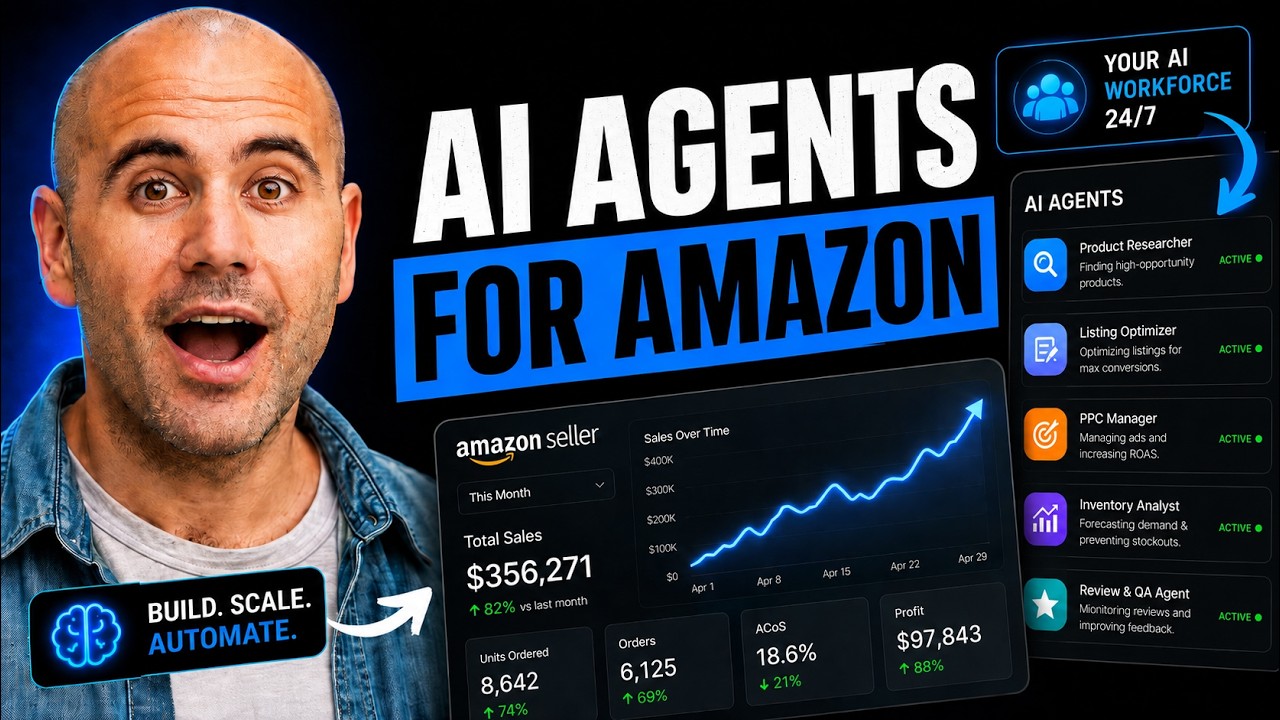](https://www.youtube.com/watch?v=h0lj3AM6T7Y)
Watch the full walkthrough on YouTube →
## Key takeaways >- The three ways most brands run PPC today (DIY, agency, or expensive employee doing data entry) all assume a human in the loop for every decision. That assumption is now obsolete.- A new generation of LLM agents can act, remember, and coordinate with each other through the Seller Central API. This is call, response, and do, not call and response.- Profasee Ultra is an org chart of specialized AI agents: Claudia coordinates, Marko runs PPC, Oracle handles pricing, Bruno covers demand planning, and the roster keeps growing.- The number-one concern with AI in a paid-ads account is mistakes. Hard-stop guardrails on bids, ACoS, daily change percentages, and break-even logic prevent the $5,000 versions of those mistakes.- You start in observation mode (the AI watches and recommends), promote to Ask Me First (you approve every action), then graduate to Handle It (autonomous within guardrails). Three discrete trust levels, no leap of faith.
From reading to action
If the framework above sounds familiar, your Amazon account is probably carrying the same drag. Apply and we will show what Marko, Oracle, and Bruno would change in your first week.

Ran a 7-figure Amazon brand for a decade. Founded Skubana (acquired). Co-founded Prosper Show. 15+ years on Amazon.
Join the brands that replaced agencies and tools with AI employees.
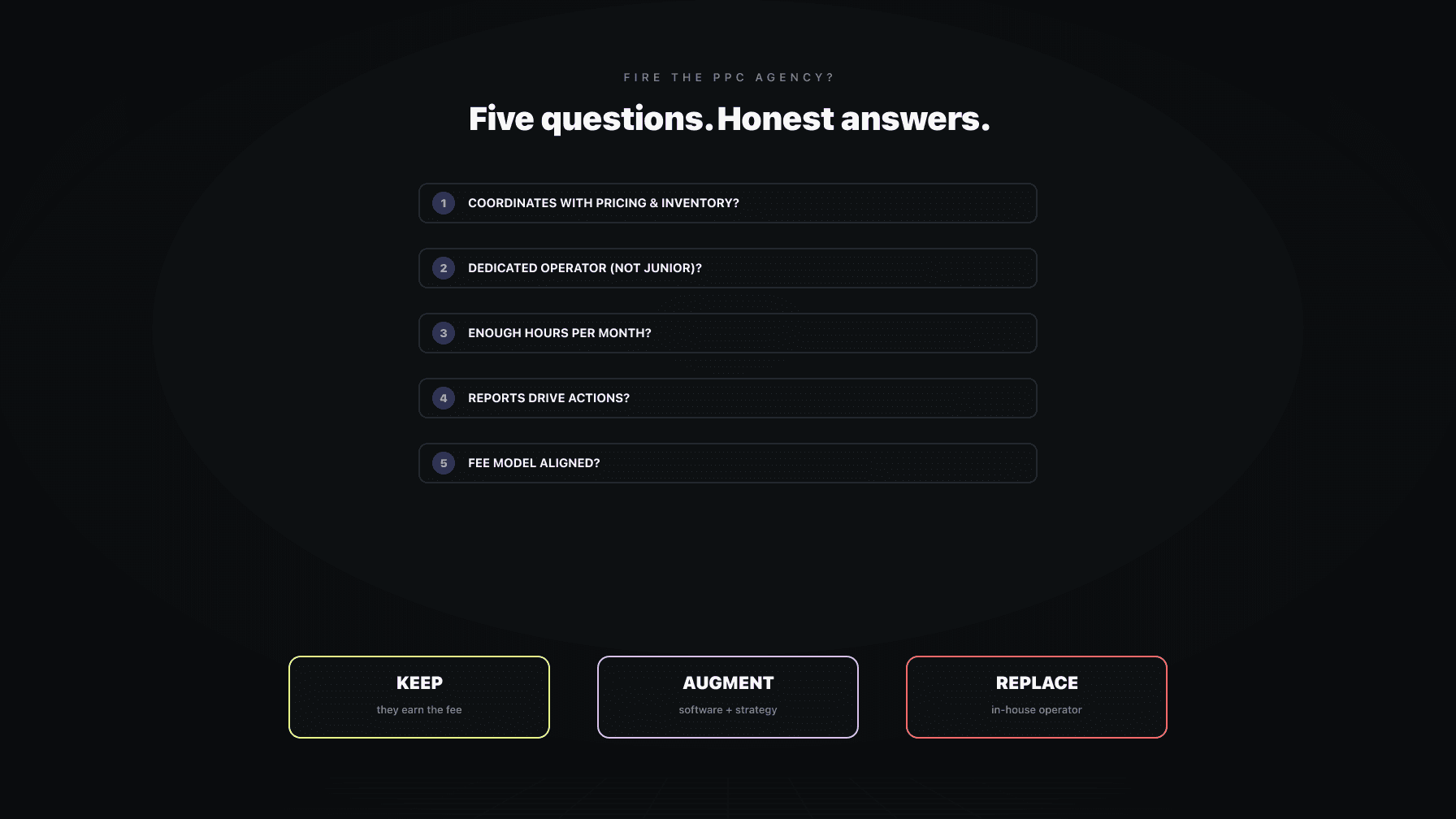
The thing every existing PPC operating model has in common is the implicit human-in-the-loop assumption. An agency manager looks at reports. An in-house operator opens campaigns in Seller Central. The 2020-era software waits for a human to approve a recommendation. That worked when the underlying intelligence was a heuristic.
The intelligence has changed. Modern LLM-based agents can read the full state of an account, propose specific actions with reasoning attached, and execute under explicit constraints. The human cost of being in the loop for every decision is now the bottleneck, not the safety layer. The agencies that survive this shift will be the ones doing strategic and creative work, not the ones doing tactical PPC labor.
The demo shows the part of this that most people miss when they think about AI agents on Amazon. It is not one big AI doing everything. It is a coordinated team.
Marko is the PPC specialist. He makes bid decisions, mines search terms, and pauses wasted spend. Oracle handles pricing. Bruno covers demand planning and inventory health. Claudia sits above them and routes the work.
We name them on purpose. Marko has a title (PPC Manager), a scope (your ad account), a manager (Claudia, the COO), a budget (your spend ceiling), and a KPI (POAS, not impressions). You hire him the way you hire a person. You can also fire him by flipping back to observation mode. The org chart is the product.
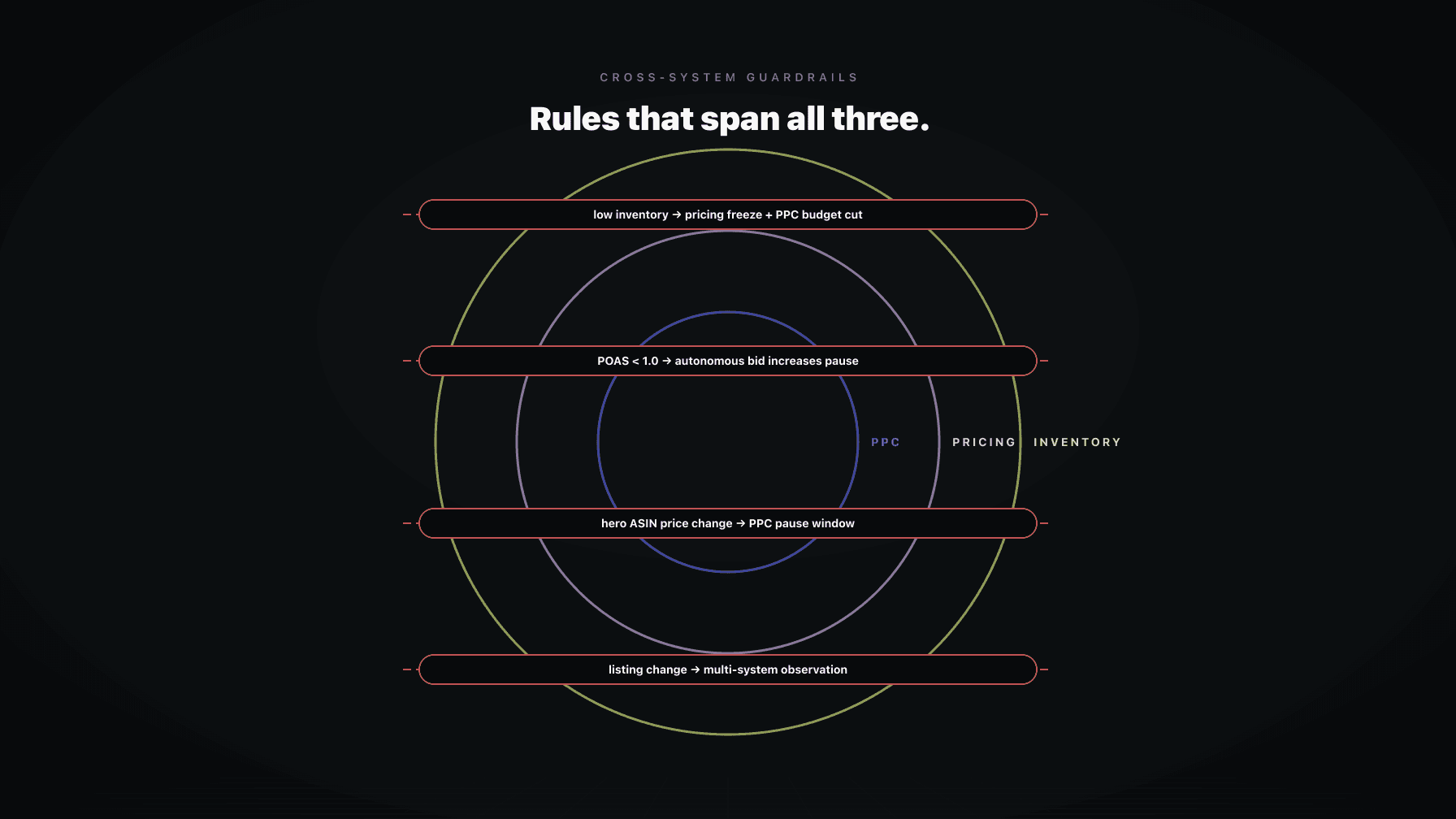
When Bruno sees days of cover dropping on a hero ASIN, Oracle freezes price cuts on that SKU and Marko pulls back ad spend. None of those reactions happens through human Slack messages or weekly meetings. The agents share state through the platform. That coordination layer is the actual product, not any individual agent. The pillar post on this framework walks through why coordinated agents beat stacked tools.
Agents can't go rogue. The platform's answer to AI mistakes is hard stops, not advice.
The most common pushback I hear on autonomous AI in a paid-ads account is: what happens when it makes a mistake? AI is confidently wrong sometimes. That is real. The fix is enforcement, not hope.
The list from the demo: min bid, max bid change per day, ACoS cap, daily spend ceiling, break-even logic, cost-per-click thresholds. The agent cannot bid you into negative margin because the floor math will not allow it. The agent cannot blow your budget overnight because the daily change percentage caps movement. The guardrails post covers how these rules span pricing, PPC, and inventory together, not just one tool at a time.
The trust ladder is built into the onboarding, not bolted on after. Step one is a demo so we can confirm Ultra fits your account shape. Step two is observation mode: the agents watch, build a model, propose actions, but touch nothing. Step three is promotion to live, either Ask Me First or full Handle It. No long-term contract. You can pause autonomous mode at any time. The full adoption framework lives here.
If you want to skip ahead and see Marko working against your live data, book a demo.
Profasee Ultra is an AI operating system for Amazon brands. It is a coordinated team of specialized agents that handle PPC, pricing, inventory, and adjacent workstreams, sharing state through a central platform and operating under explicit guardrails. The video demo shows the agents working live on a real account.
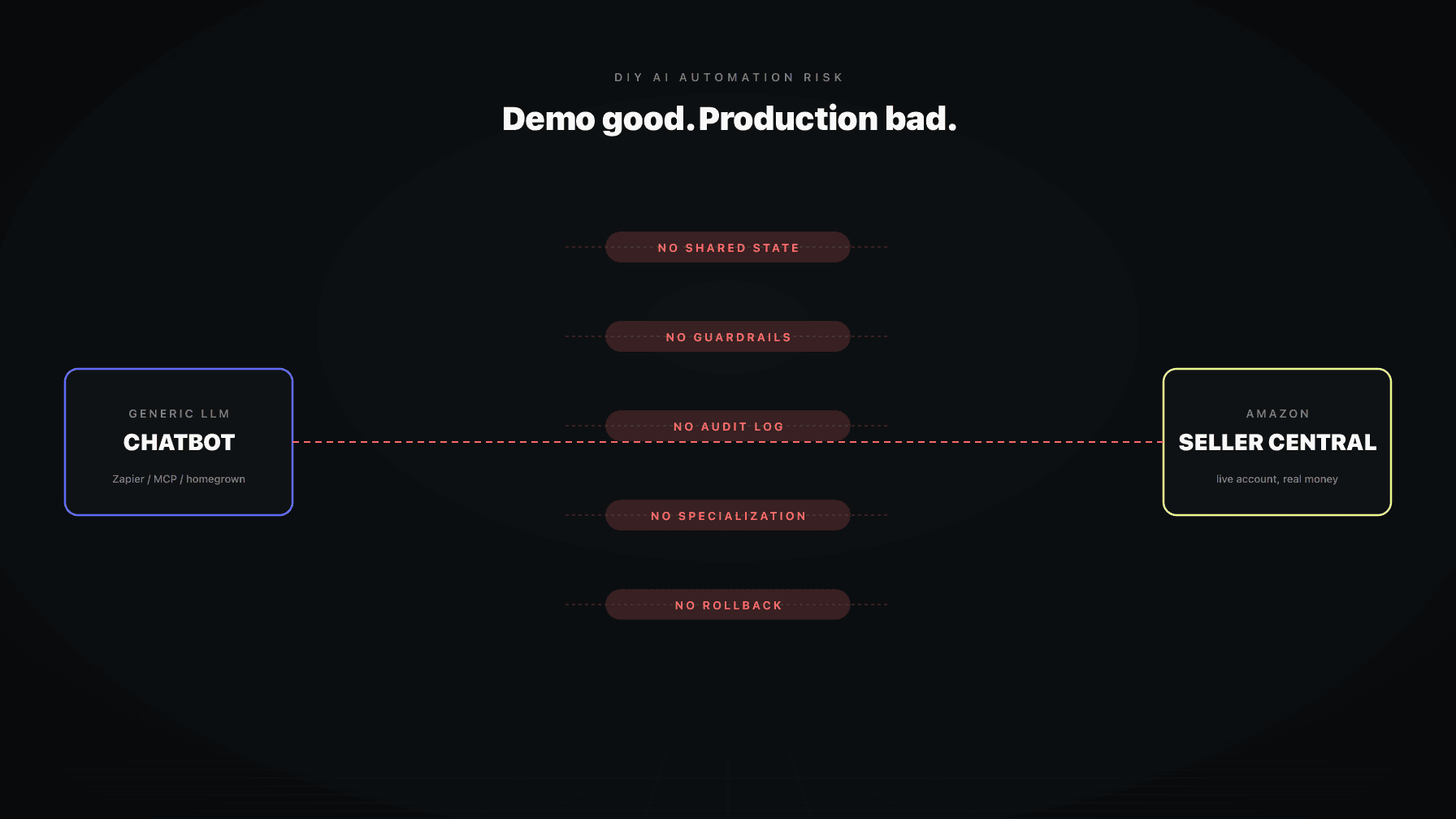
A general-purpose LLM you wire up to Seller Central is a chatbot with API access. It has no shared state between decisions, no specialization, no audit log, no guardrails, and no rollback. Profasee Ultra has all of those by design. The framework comparison is in the DIY AI automation post.
Specialized AI agents inside Ultra. Claudia coordinates and routes work. Marko handles PPC: bids, search-term mining, wasted-spend cleanup. Oracle handles pricing decisions within your margin guardrails. Bruno covers demand planning and inventory state. More agents are coming online.
Two trust levels on the adoption ladder. Ask Me First means the agent proposes every action and you approve before anything executes. Handle It means the agent executes autonomously within your guardrails and you review on a cadence. Most accounts start in Ask Me First and graduate to Handle It once trust is built.
Guardrails. Min bid, max bid change per day, ACoS cap, daily spend ceiling, break-even logic, cost-per-click thresholds. The platform enforces these as hard stops. The agent cannot bid you into negative margin or blow the daily budget because the math will not let it.
Book a demo. We confirm fit, set up observation mode so you can watch the agents work without any actions firing, then promote to live when you are ready. No long-term contract.