Chad Rubin
April 17, 2026 · Updated May 11, 2026 · 10 min read
Operator notes by email
Short, opinionated takes on AI agents, Amazon PPC, pricing, and inventory. No fluff. About once a week.
The fastest way to reduce your Amazon ACoS is not what most guides tell you. It is not negative keywords. It is not bid adjustments. It is not dayparting. The most powerful ACoS lever is one that no PPC tool controls: your price.
A 10% price increase on a high-converting ASIN can drop ACoS by 15-20% while increasing profit per unit. A price decrease on a product with strong conversion potential can improve ad conversion rates enough to cut cost per acquisition in half. The math works in both directions, but only if your PPC tool knows the price changed.
That is the problem. Your PPC tool does not know.
I spent a decade managing PPC for my own Amazon brand before building Profasee. The most expensive lesson was realizing that my PPC team and my pricing strategy operated on completely different calendars. By the time the PPC bids adjusted to a price change, I had already burned thousands in wasted spend.
This guide shows you the math behind pricing-driven ACoS reduction, why standalone PPC tools miss it, and how to coordinate the two functions so they stop working against each other.
Key Takeaways
ACoS = Ad Spend / Ad Revenue
That is it. Two variables. Every ACoS optimization guide focuses on reducing the numerator (ad spend) through bid adjustments, negative keywords, and campaign restructuring. Almost nobody talks about increasing the denominator (ad revenue) through pricing.
Here is a concrete example.
Scenario A: Current state
From reading to action
If the framework above sounds familiar, your Amazon account is probably carrying the same drag. Apply and we will show what Marko, Oracle, and Bruno would change in your first week.

Ran a 7-figure Amazon brand for a decade. Founded Skubana (acquired). Co-founded Prosper Show. 15+ years on Amazon.
Head-to-head comparisons between Profasee and the tools most Amazon sellers already use.
Join the brands that replaced agencies and tools with AI employees.
Scenario B: Price increase to $29.99 (20% increase)
Even with a 10% drop in conversion rate from the higher price, ACoS improved from 40% to 37%. And profit per unit went up by $5.00.
But here is where it gets interesting. A smart PPC manager would see the higher margin at $29.99 and realize they can now bid more aggressively on high-converting keywords while still hitting profit targets. The higher price funds better ad placements, which drives more clicks and potentially more sales volume.
That is the coordination loop. Price goes up, margin improves, bids can increase on strong keywords, placements improve, sales velocity holds or grows. ACoS drops AND total profit increases.
No standalone PPC tool runs this loop because no standalone PPC tool knows your price changed.
Search "how to reduce ACoS on Amazon" and you will find dozens of guides. They all recommend the same tactics:
These are all valid. But they share a blind spot: they only manipulate the ad spend side of the equation. They assume your price is fixed.
Your price is not fixed. It should not be. Amazon's algorithm rewards products that convert well at prices that generate profit. A product priced too low bleeds margin on every ad-driven sale. A product priced too high converts poorly, which wastes ad spend on clicks that do not convert.
The optimal price is not a single number. It is a function of your current inventory level, your competitive position, your margin targets, and what your PPC campaigns are doing right now.
Marcus runs a supplements brand with 45 SKUs. His PPC agency (charging $8,500/month) had his ACoS down to 22%. Impressive on paper. But his average margin per unit was only $3.40 because his agency optimized ACoS by pushing volume on his lowest-priced products.
When he started coordinating pricing with PPC through Profasee, Oracle raised prices on his top 10 ASINs by 8-15%. ACoS went up slightly to 24%. But profit per unit jumped to $5.80, and total profit increased 34% in 60 days. His agency had been optimizing the wrong metric.
The lesson: ACoS is not a goal. Profit is the goal. ACoS is just one input.
When a product converts well at its current price (conversion rate above category average), there is usually room to increase the price without proportional conversion loss. A 15% price increase might only reduce conversion by 5%, netting a significant ACoS improvement.
When to use: Products with strong reviews (4.3+), limited direct competition, or unique features that justify premium pricing.
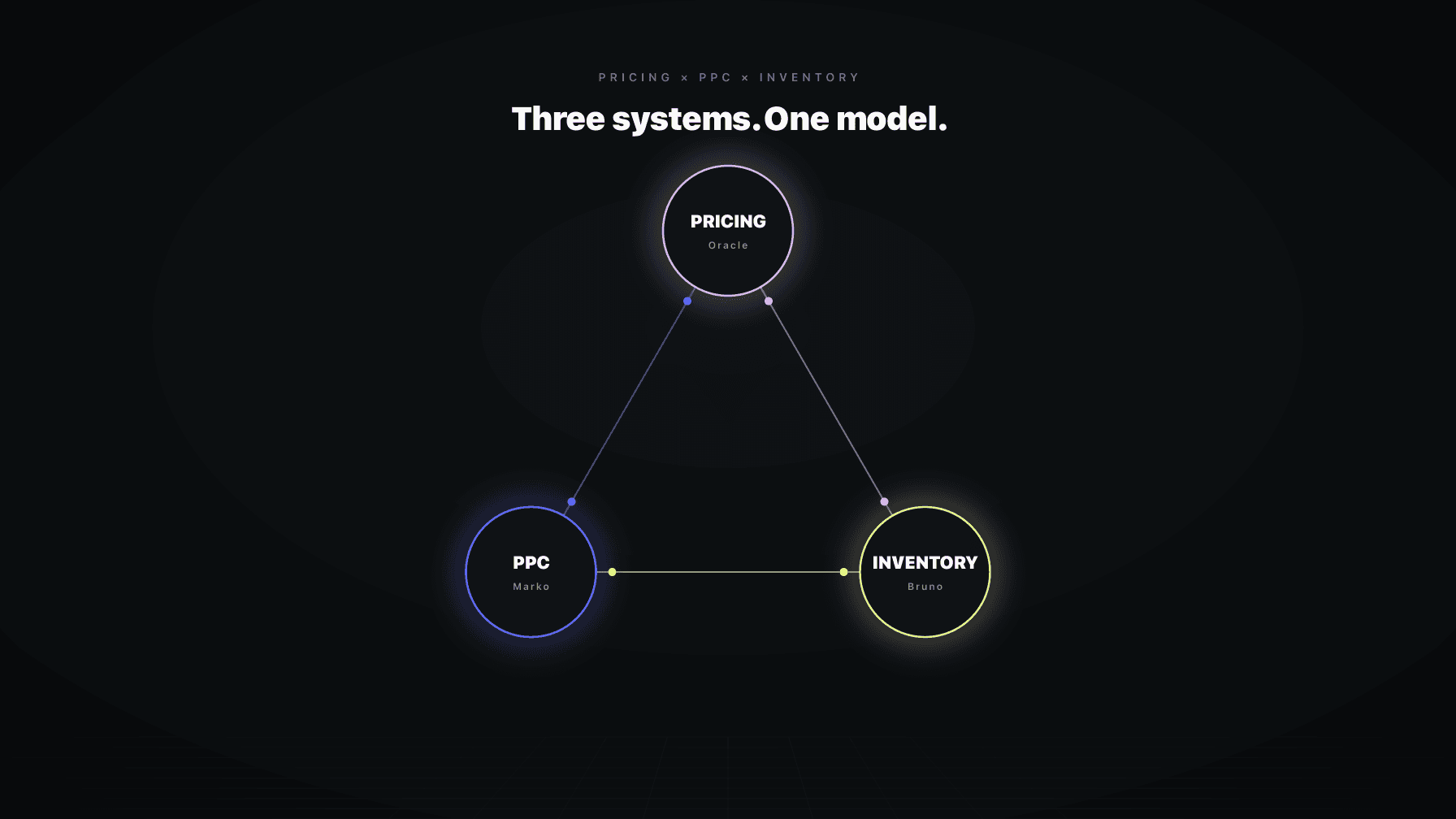
The coordination requirement: When Oracle raises the price, Marko needs to know immediately. Higher price means higher margin per sale, which means Marko can afford to bid more aggressively on the best keywords. Without this signal, Marko keeps running the same conservative bids calibrated to the old, lower margin.
Sometimes ACoS is high because the price is too high relative to competitors, tanking conversion rate. Every click costs money, and low conversion means you are paying for clicks that do not convert.
A strategic price decrease can improve conversion rate enough to reduce cost per acquisition even though the revenue per sale drops.
When to use: Products where your conversion rate is significantly below category average, suggesting price resistance.
The coordination requirement: When Oracle drops the price, Marko needs to recalculate. Lower margin per unit means bids need to tighten to maintain profitability. But if conversion rate improves, the math might actually support maintaining or even increasing bids on certain keywords.
This is the lever nobody discusses. When inventory is running low, the smart move is often to raise the price slightly to slow velocity and extend stock life. But if your PPC tool does not know inventory is low, it keeps running aggressive campaigns on a product you are about to run out of.
The wasted spend is not just the ad dollars on the last 50 units. It is the ranking damage from going out of stock, the 2-3 weeks to restock, and the recovery campaign you will need to run afterward.
When to use: Any ASIN within 3 weeks of stockout based on current velocity.
The coordination requirement: Bruno (demand planner) detects stockout risk. Oracle raises price to slow velocity. Marko reduces ad spend to match. All three happen automatically, within minutes. No human needs to spot the signal, log into three different tools, and manually coordinate the response.
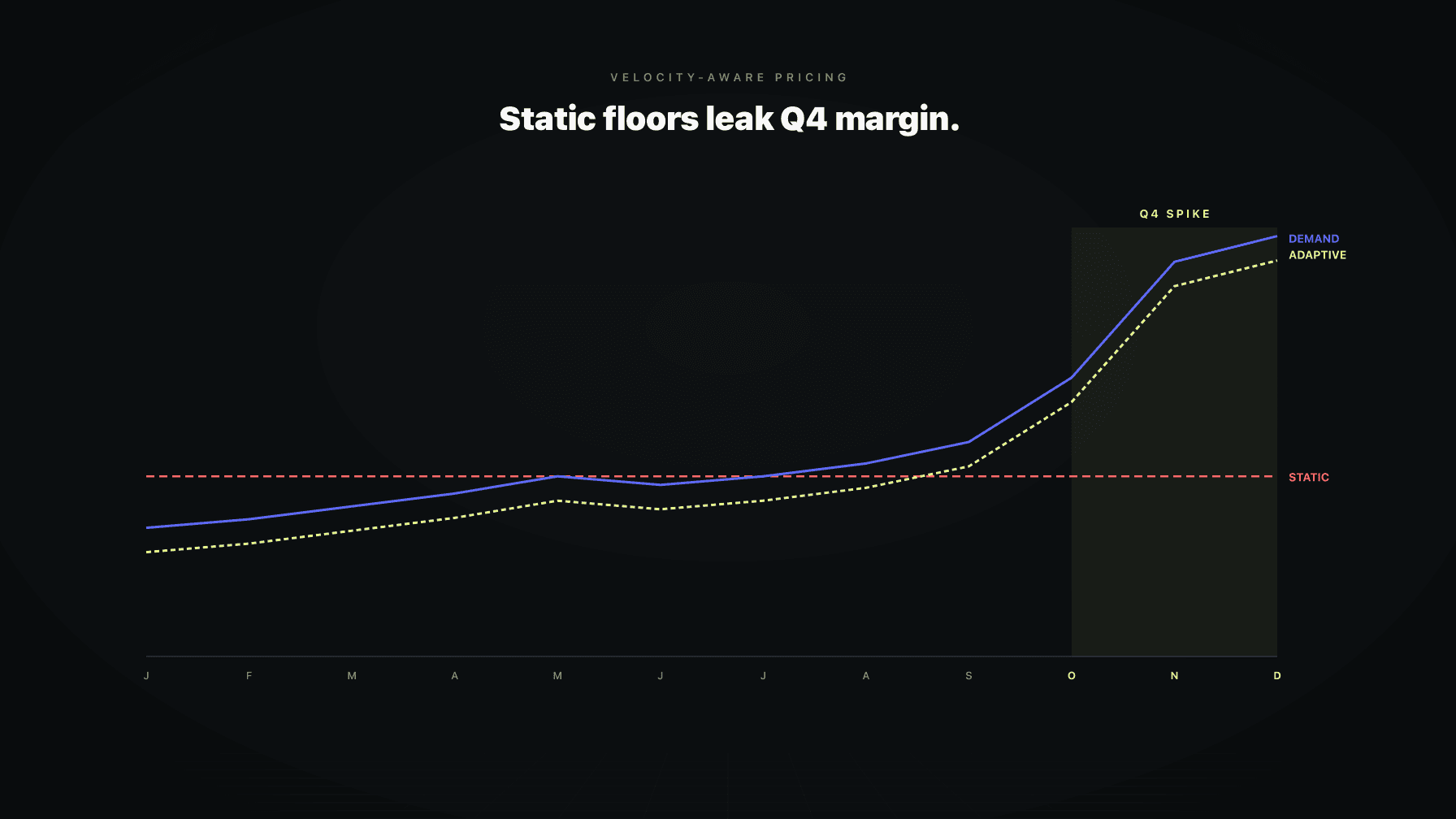
Prime Day, Black Friday, back-to-school, seasonal transitions. Each event creates a pricing opportunity that affects PPC economics. A 20% promotion on Prime Day should come with a corresponding bid strategy: higher bids during the deal window (because conversion rate spikes), lower bids after the deal ends (because regular-price conversion drops temporarily).
When to use: Any promotional event or seasonal price change.
The coordination requirement: Most sellers adjust prices for events but forget to adjust bids. Or they adjust bids but too late, after the price has already changed. The lag between pricing action and PPC reaction is where money leaks.
When a competitor drops their price by 30%, your conversion rate will decline. Your ACoS will spike. If your PPC tool does not know why conversion dropped (because it does not see competitor prices), it will try to compensate by adjusting bids, which is the wrong response. The right response is a coordinated pricing adjustment.
When to use: Highly competitive categories where competitor price moves directly affect your conversion.
The coordination requirement: Oracle monitors competitive pricing. When a significant shift happens, Oracle adjusts your price based on margin targets (not blind matching). Marko adjusts bids to reflect the new conversion expectations. The response is coordinated, not sequential.
Let me show you what this costs in practice.
Month 1: Price change without PPC coordination
Day 1: Oracle (or your repricer) raises price on your best ASIN from $22.99 to $27.99. Day 1-7: Your PPC tool (Perpetua, Pacvue, whatever) keeps running the same bids. ACoS drops mechanically because revenue per sale increased. Your PPC tool sees lower ACoS and thinks everything is great. Day 7-14: Conversion rate starts declining as the higher price creates some buyer resistance. Your PPC tool sees conversion drop and starts increasing bids to compensate. This is the wrong response. The right response is to hold bids steady and let the higher margin offset the lower conversion. Day 14-21: Your PPC tool has now increased bids by 15-20% chasing the same conversion rate at a price point that naturally converts lower. Ad spend is up. ACoS is climbing back toward where it was before the price change. Day 21-30: You have spent the entire month's ad budget increase on a bid increase that was not necessary. The price change should have netted you $3,200 in additional profit. Instead, $2,100 of that went to higher ad costs because your PPC tool fought the price change instead of adapting to it.
Net result: $1,100 profit improvement instead of $3,200. The coordination gap cost you $2,100 in one month on one ASIN.
Multiply that across 50 SKUs and 12 months. That is the coordination tax.
When Oracle changes a price on any ASIN, Marko knows within minutes. Here is the sequence:
This happens automatically, 24/7, across every ASIN. No human needs to spot the price change, calculate the new margin, and manually update bids in a separate tool.
That is the difference between AI tools and AI employees that work as a team.
If you are not ready to switch platforms, you can still capture some of this value manually:
Pull the last 90 days of data for your top 10 ASINs. For each one, plot price changes against ACoS changes. Look for the pattern: when price went up, did ACoS drop? When price dropped, did conversion improve enough to justify the lower margin?
Most sellers have never looked at this data together because it lives in two different tools.
Most sellers set a flat ACoS target (say, 25%) across all products. This is wrong. A product with 60% margin can afford 35% ACoS and still be profitable. A product with 20% margin needs ACoS under 15%.
Recalculate your ACoS targets for each ASIN based on current margin. Then update them every time the price changes.
At minimum, set up an alert that notifies you (or your PPC manager) every time your repricer changes a price by more than 5%. Then manually adjust PPC bids for that ASIN within 24 hours.
This is the manual version of what Marko and Oracle do automatically. It works, but it requires discipline and it does not scale past 20-30 ASINs.
When your PPC tool reports a 22% ACoS, ask: "At what price?" If the price has dropped 15% since last month, that 22% ACoS is costing you more profit per sale than a 28% ACoS at the higher price.
ACoS without margin context is a vanity metric.
Every ACoS optimization guide will teach you to pull the same levers: negative keywords, bid adjustments, campaign structure, listing optimization. These work. They are necessary. But they are all on one side of the equation.
The other side of the equation, the revenue side, is controlled by your price. And your price is the most powerful ACoS lever you have.
The problem is not that sellers do not know this. The problem is that the tools are separated. Your repricer changes the price at midnight. Your PPC tool does not find out until it notices conversion patterns shifting days later. By then, you have already lost money.
Coordinated pricing and PPC is not a nice-to-have. It is the difference between optimizing a metric (ACoS) and optimizing the thing that actually matters (profit).
Every day your PPC tool does not know what your repricer just did is a day you are leaving money on the table.
Does raising my price always reduce ACoS? Mechanically, yes, if conversion rate stays constant. In practice, a significant price increase may reduce conversion rate enough to offset the ACoS improvement. The key is finding the price point where conversion rate decline is less than proportional to the price increase. A 15% price increase with only a 5% conversion drop is a clear win for both ACoS and profit.
Should I lower my price to improve ACoS? Only if your conversion rate is significantly below category average, suggesting price resistance. A lower price can improve conversion rate enough to reduce cost per acquisition. But the math only works if the improved conversion more than offsets the lower revenue per sale. Run the numbers before cutting price.
How fast should PPC bids adjust after a price change? Ideally within hours, not days. Every hour your bids are calibrated to the wrong margin is wasted optimization. Profasee's AI employees adjust within minutes. If you are doing this manually, set a same-day response target for any price change over 5%.
What is a good ACoS target? There is no universal answer. Your ACoS target should be derived from your margin. If your contribution margin is 50%, you can afford up to 45% ACoS and still profit. If your margin is 20%, you need ACoS under 15%. Most sellers set flat ACoS targets that ignore margin differences between products.
Can I coordinate pricing and PPC without switching tools? Partially. You can set up manual alerts for price changes and adjust bids within 24 hours. This captures some of the benefit but does not scale past 20-30 SKUs and requires daily discipline. Full coordination requires tools that share data in real time.