Chad Rubin
April 14, 2026 · Updated May 11, 2026 · 13 min read
Operator notes by email
Short, opinionated takes on AI agents, Amazon PPC, pricing, and inventory. No fluff. About once a week.
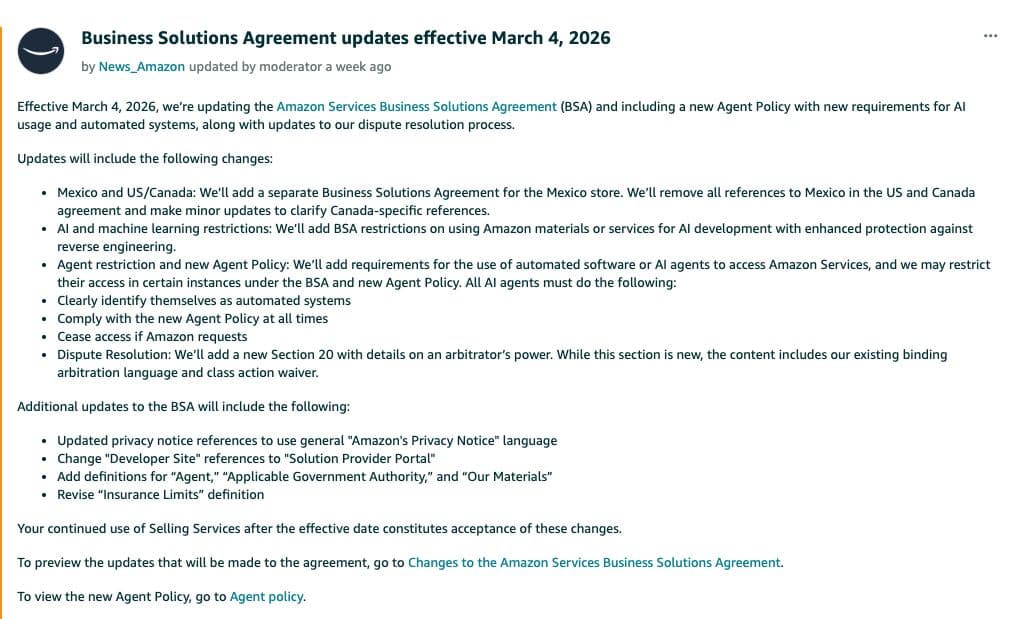
Amazon's March 2026 AI Agent Policy requires all automated seller tools to register through SP-API, maintain 12-month audit trails, self-identify as automated systems, and get human authorization for high-impact actions like price changes over 20% within 24 hours. The 90-day transition window has closed. Enforcement is active.
If you are using any AI tool, repricer, PPC automation, or listing software on your Amazon account, this policy applies to you. Not to the tool provider. To you. Your account is on the line.
As someone who has been building AI automation for Amazon sellers for years, and as an Amazon Approved Service Provider listed in the Amazon App Store, my first reaction when this policy dropped was relief. Amazon is finally drawing a clear line between tools that play by the rules and tools that scrape, hack, and hope nobody notices.
My second reaction was concern, because most sellers I talk to have no idea what their tools are actually doing under the hood.
This guide breaks down what the policy says, what it means for your specific tools, and exactly what you need to do right now.
Key Takeaways
Before we get into the details of Amazon's policy, step back and see the pattern.
Amazon invested $4 billion into Anthropic. They are building their own agentic Seller Assistant. They are pouring billions into AI infrastructure. And in the same breath, they are tightening control over which AI gets to operate on their marketplace.
They are not alone.
eBay banned all third-party AI shopping agents effective February 20, 2026. Their updated user agreement explicitly prohibits buy-for-me agents, LLM-driven bots, or any end-to-end flow that attempts to place orders without human review. eBay also announced plans to build its own AI shopping agent.
From reading to action
If the framework above sounds familiar, your Amazon account is probably carrying the same drag. Apply and we will show what Marko, Oracle, and Bruno would change in your first week.

Ran a 7-figure Amazon brand for a decade. Founded Skubana (acquired). Co-founded Prosper Show. 15+ years on Amazon.
Join the brands that replaced agencies and tools with AI employees.
Meanwhile, OpenAI's ChatGPT now reaches 900 million weekly active users who can buy products without ever visiting a marketplace.
Three platforms. Three moves. Same pattern: block outside AI, build your own.
Every marketplace is racing to become the AI layer between your brand and the buyer. Whoever controls the AI agent controls product discovery. And product discovery is worth more than the transaction.
Amazon spent 20 years training sellers to optimize for its search algorithm. Now it is investing billions into AI that could bypass search entirely.
The old game was optimizing for search. The new game is showing up when AI agents go shopping for your customer.
That is the context for everything that follows. Amazon's Agent Policy is not just a compliance update. It is Amazon drawing the lines for who gets to participate in the AI-powered marketplace.
Until March 2026, Amazon's seller policies addressed automation in broad strokes. The rules were vague enough that almost anything operating through an API could claim compliance. Tools that scraped Seller Central, automated browser sessions, or bypassed rate limits operated in a gray area.
That gray area is gone.
Amazon updated its Business Solutions Agreement (BSA) with a dedicated Agent Policy section that explicitly addresses AI-driven automation for the first time. The update defines what an AI seller agent is, what it can and cannot do, how fast it can act, what data sources it can use, and when human oversight is mandatory.
The policy defines an "AI seller agent" as any system that makes or executes decisions affecting a seller account without real-time human input for each action. This is broad by design. It captures everything from simple repricers to sophisticated multi-step agents.
Amazon also added BSA restrictions on using its materials or services for AI development with enhanced protection against reverse engineering. And a new Section 20 overhauls dispute resolution with binding arbitration and a class action waiver.
If you sell on Amazon, your continued use of Selling Services after March 4 counts as acceptance of these changes. There was no opt-out. Amazon gave sellers roughly two weeks between announcement and enforcement.
All automated seller actions must flow through registered SP-API applications with an application ID linked to a verified developer account.
What this means: Your tools need to operate through Amazon's official APIs. Not through browser automation. Not through Seller Central scraping. Not through any unauthorized access method.
What is prohibited:
Technically compliant agents operating without registration are treated as unauthorized access. The registration is not optional.
What to ask your tool providers: "What is your SP-API application ID?" If they cannot answer this immediately, you have a problem.
Profasee Ultra operates exclusively through registered SP-API and Amazon Ads API applications. As an Amazon Approved Service Provider listed in the Amazon App Store, our API access and developer credentials have been vetted by Amazon directly.
Amazon now classifies automated actions into three tiers with escalating requirements:
Tier 1: Routine Operations (Minimal Restrictions)
Tier 2: Moderate Impact (Rate Limiting + Audit Logging)
Tier 3: High Impact (Human Authorization Required)
The 20% daily price change threshold is the provision most sellers are asking about. Automated price changes that exceed 20% within a 24-hour window now require documented human authorization before execution. Manual price updates through Seller Central are not subject to this cap, but automated tools are.
This matters for sellers running aggressive repricing strategies during Prime Day, Black Friday, or seasonal transitions. If your repricer drops prices by 25% at midnight, it needs your documented approval first.
Profasee's Trust Ladder handles this naturally. Our AI employees (Marko, Oracle, Bruno) already classify every action by impact level. Tier 3 actions are automatically routed to a human approval queue. You get a notification, review the proposed change with the reasoning behind it, and approve or reject with one click. This is not a retrofit. It is how the system was designed from day one.
Every automated action needs a retrievable audit log containing:
This is not just a nice-to-have transparency feature. Amazon can request these logs. If your tool cannot produce them, your account is at risk.
What this means practically: Tools that show you a dashboard of "changes made" but cannot export a detailed log with timestamps and reasoning are not compliant. You need granular, machine-readable audit trails.
Every action taken by a Profasee AI employee is logged with full context: what changed, why it changed, what data informed the decision, and what the expected outcome was. These logs are exportable, searchable, and retained indefinitely. This is the same transparency that makes our 72-hour rollback possible. You cannot undo what you cannot trace.
AI agents accessing Amazon Services must:
Amazon retains the right to revoke access at any point. This is not new for API access in general, but formalizing it for AI agents specifically signals that Amazon is prepared to enforce it aggressively.
The policy did not arrive in a vacuum. On March 9, 2026, a federal court blocked Perplexity's Comet shopping agent from accessing Amazon accounts. The ruling drew a distinction that every Amazon seller needs to understand.
Perplexity's Comet was an AI-powered browser that would log into your Amazon account (with your permission) and make purchases on your behalf. Amazon sued, arguing that user permission does not equal platform authorization.
The court agreed. Judge Chesney found that access "with the Amazon user's permission" is legally distinct from access "with authorization by Amazon." Just because you gave a tool your login does not mean Amazon authorized that tool to operate on its platform.
This ruling has direct implications for seller tools. If your repricer or PPC tool accesses your account through browser automation rather than SP-API, user permission is not a defense. The platform's authorization matters.
The case is currently on appeal (Perplexity filed with the Ninth Circuit on April 1, with Amazon's response due April 22), but the preliminary ruling is clear: tools need Amazon's blessing, not just yours.
This is exactly why working with Amazon Approved Service Providers matters. Profasee's listing in the Amazon App Store is not a badge. It is verification that Amazon has reviewed and approved our access to their platform.
Sellers are right to notice the tension here. Amazon runs Rufus, an AI shopping assistant with over 300 million users that autonomously recommends products, answers questions, and drives purchase decisions. Amazon's "Buy for Me" feature uses AI to purchase products from other retailers on the customer's behalf.
Amazon is aggressively deploying AI agents on the buyer side while restricting them on the seller side.
This is not unique to Amazon. It is the playbook every major platform is running right now. Amazon, eBay, and Shopify are all racing to own the AI agent layer. The platforms that control the agent control which products get discovered, recommended, and purchased.
For sellers, this means two things:
First, the rules are the rules. Whether you agree with the power dynamics or not, operating outside the Agent Policy puts your account at risk. The Amazon v. Perplexity case proves that Amazon will litigate to protect its platform boundaries.
Second, the sellers who adapt fastest win. Every marketplace policy change creates winners and losers. The sellers who already use compliant, transparent AI tools do not need to change anything. The sellers using gray-area scrapers and unauthorized automation are scrambling.
The Agent Policy at least creates clear, enforceable rules that apply equally to all third-party tools. Without rules, bad actors using scrapers and unauthorized automation would have an advantage over tools playing by the book. The policy levels that playing field.
Make a list of every tool, extension, software, or service that interacts with your Amazon account. Include:
Send each tool provider this email:
Amazon explicitly recommends asking vendors for written confirmation. Do it.
Any tool that:
...is a liability on your account. Replace it with an Amazon Approved Service Provider.
Even compliant tools need proper configuration. Review:
For Tier 3 actions, you need documented human authorization. This means:
If your tools handle this automatically (like Profasee's Trust Ladder, where Tier 3 actions are escalated for human approval by default), verify that the documentation meets Amazon's requirements.
Most AI tools are scrambling to retrofit compliance. Profasee was designed for it.
Here is what being an Amazon Approved Service Provider means in practice:
SP-API native. Every AI employee (Marko for PPC, Oracle for pricing, Bruno for inventory, Brett for listings) operates exclusively through Amazon's SP-API and Ads API. No browser automation. No scraping. No unauthorized endpoints. This has been our architecture since day one, not a response to the March 2026 policy.
Audit trail built in. Every action every AI employee takes is logged with timestamp, reasoning, input data, and outcome. These logs are exportable on demand. We retain them indefinitely, exceeding Amazon's 12-month minimum.
Progressive autonomy. Our Trust Ladder (observe, recommend, act with guardrails, act with review, full trust) maps directly to Amazon's tier system. Tier 3 actions are automatically escalated. Sellers set their own guardrails. The failure state is always "the employee does nothing."
72-hour rollback. Any automated action can be reversed with one click. You cannot undo what you cannot trace, and our audit trail makes every action traceable.
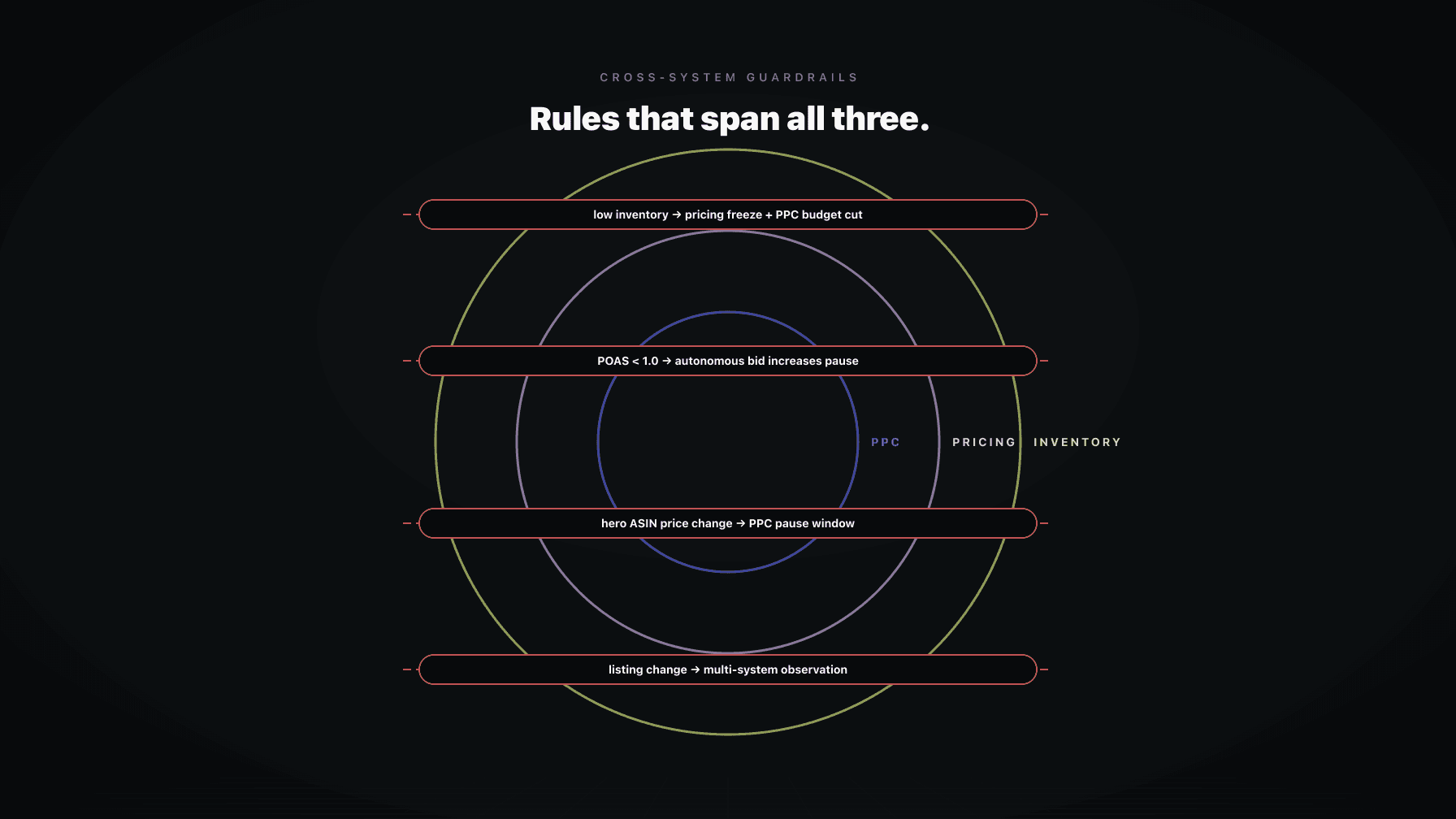
Coordinated compliance. Because Profasee's AI employees share context, compliance is coordinated too. When Oracle approaches the 20% price change threshold on an ASIN, Marko automatically adjusts ad strategy to match. When a Tier 3 action is escalated, Claudia (the COO) includes it in your morning brief with full context. No other platform coordinates compliance across pricing, PPC, and inventory simultaneously.
This is not a marketing claim. It is architecture. You can verify our listing in the Amazon App Store.
Most affected. The 20% daily threshold hits aggressive repricing strategies hardest. If your repricer makes large automated price swings during sales events or competitor disruptions, it now needs human authorization checkpoints.
Compliant approach: Set automated repricing within a reasonable band (say, 15% daily max) and require approval for anything larger. Use repricing tools that can flag when a proposed change would exceed the threshold and route it for approval.
Moderately affected. Bid adjustments and budget changes fall under Tier 2 (audit logging required). Most reputable PPC tools already log changes, but verify that the logs meet Amazon's format requirements.
Watch for: Tools that make large budget reallocations (shifting 50%+ of daily budget between campaigns) may trigger Tier 3 scrutiny depending on interpretation.
Bulk operations are the concern. Creating or modifying more than 500 listings at once requires human authorization. If you use tools for catalog management across large SKU counts, verify they have approval workflows.
Least affected. Inventory sync and basic forecasting fall under Tier 1 with minimal restrictions. This is one area where Amazon explicitly grants permissive treatment.
Amazon's Agent Policy is version 1.0. It will evolve. Based on the pattern Amazon follows with policy rollouts:
Short-term (Q2-Q3 2026): Expect enforcement actions against the most obvious violators: tools using browser automation, unregistered apps, and scrapers. Amazon will make examples.
Medium-term (2026-2027): The tier system will likely get more granular. Expect new action categories, adjusted thresholds, and potentially per-category rules (supplements vs. electronics may have different limits).
Long-term: Agent-to-agent protocols. As AI agents become standard on both the buyer and seller side, Amazon will create formal frameworks for how they interact. Rufus on the buy side. Seller agents on the operations side. The marketplace becomes an agent-mediated ecosystem.
The sellers who invest in compliant, transparent AI architecture now will not have to scramble every time Amazon updates the rules. The sellers who chose tools based on "does it work?" without asking "how does it work?" will face recurring compliance crises.
Amazon's AI Agent Policy is not a restriction on AI. It is Amazon defining the rules of engagement for the AI-powered marketplace.
Every major platform is making the same move: controlling which AI agents get to operate, how they behave, and what data they can access. The old game was optimizing for search. The new game is showing up when AI agents go shopping for your customer. And to play that game, your tools need to be on the right side of the rules.
If you are using AI tools on your Amazon account, audit them now. Ask the five questions. Get written confirmation. Replace anything that cannot answer clearly.
Your account is your business. The tools you connect to it should earn trust the same way you would expect a new employee to: start supervised, prove competence, earn autonomy gradually, and always leave a paper trail.
Profasee Ultra was built for exactly this moment. Amazon Approved Service Provider. SP-API native. Full audit trails. Progressive autonomy. Compliant by architecture, not by afterthought.
Does Amazon's AI Agent Policy apply to simple repricers? Yes. The policy defines an "AI seller agent" as any system making or executing decisions without real-time human input. Automated repricers that change prices without per-change human approval fall under this definition. They need SP-API registration, audit logging, and must respect the 20% daily threshold for automated price changes.
What happens if my tool is not compliant? Amazon can revoke API access, suspend the tool's operations on your account, or in severe cases, take action against your seller account directly. You are responsible for the tools connected to your account, even if the non-compliance is the tool provider's fault.
Is the 20% price change rule per ASIN or account-wide? The 20% threshold applies to individual automated price changes within a 24-hour period. If an ASIN's price changes by more than 20% through automated means in a single day, it requires documented human authorization. Manual changes through Seller Central are not subject to this limit.
Do I need to do anything if I only use Amazon's built-in tools? Amazon's own tools (Automate Pricing, Campaign Manager) are inherently compliant since they are first-party. If you only use Amazon's built-in tools, the Agent Policy does not require additional action from you. It primarily governs third-party tools.
How can I verify if my tools are Agent Policy compliant? Ask your tool provider for their SP-API application ID, a sample audit log export, and their written compliance statement for the March 2026 Agent Policy. Any provider that cannot produce these documents within 48 hours is likely not compliant. Amazon specifically recommends getting written vendor confirmation. You can also check if they are listed as an Amazon Approved Service Provider.
Is Profasee compliant with the Amazon AI Agent Policy? Yes. Profasee is an Amazon Approved Service Provider listed in the Amazon App Store. All AI employees operate through registered SP-API and Amazon Ads API applications. Every action is logged with full audit trails. High-impact actions are routed through human-in-the-loop controls via the Trust Ladder. This compliance is architectural, not retrofitted.
What is the difference between Amazon's Agent Policy and the Perplexity ruling? The Agent Policy governs seller-side automation tools (repricers, PPC tools, listing software). The Perplexity case addressed buyer-side AI agents accessing Amazon accounts. Both establish the same principle: operating on Amazon's platform requires Amazon's authorization, not just user permission. Working with Amazon Approved Service Providers ensures you have that authorization.