We onboard in small cohorts. April cohort is open. Apply now →
Profasee Ultra
ULTRA
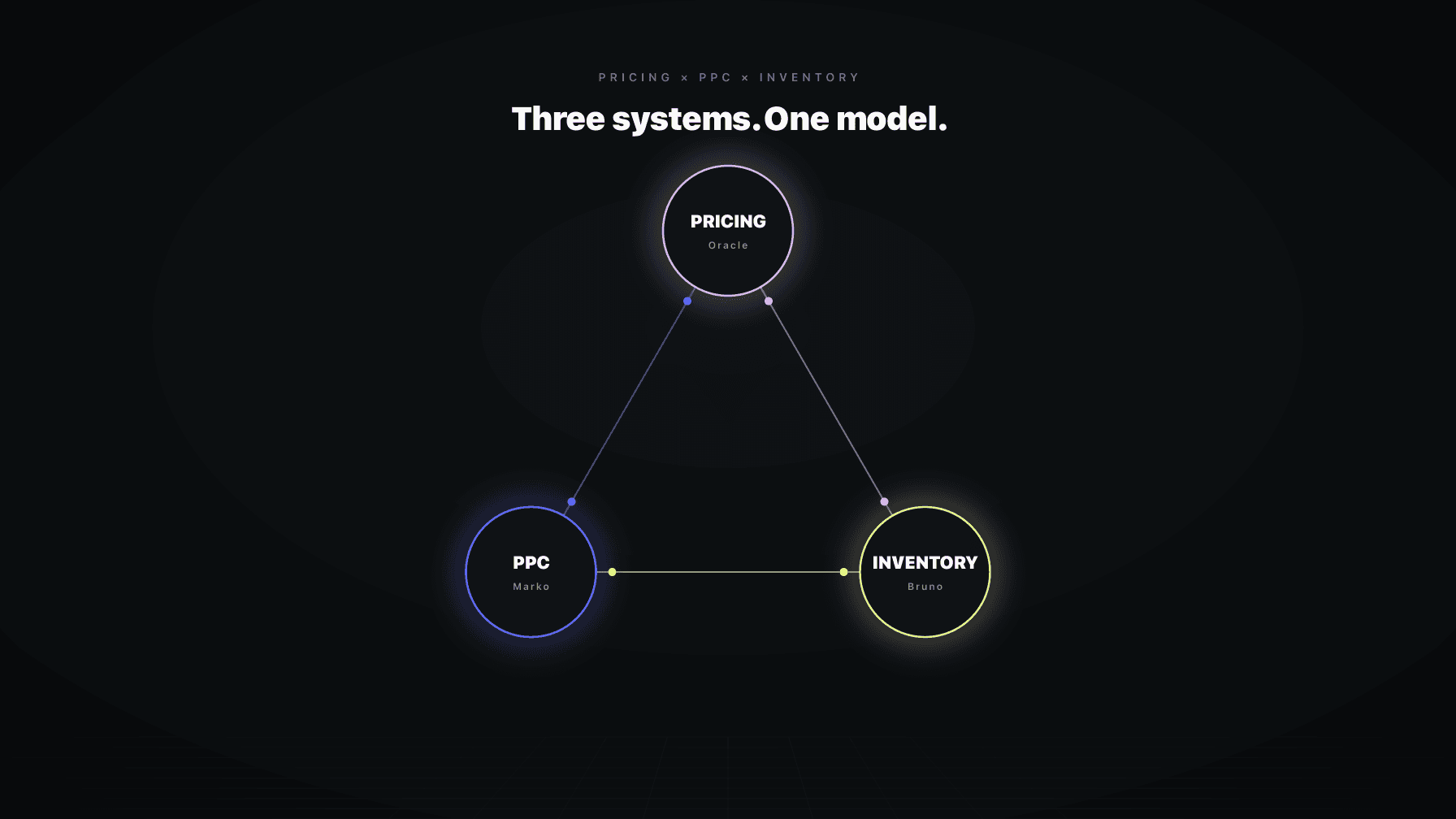
Amazon PPCMarko

Campaign management for bids, budgets, placements, search terms, and spend control.

Amazon Pricing SoftwareOracle

Private-label pricing with better signals, hard guardrails, and explainable recommendations.

Demand PlanningBruno

Forecast demand, flag stock risk, and coordinate around inventory pressure before it hurts performance.

Listing OptimizationBrett

Audit titles, content, variations, and listing issues that quietly drag conversion.

Strategy & OpsClaudia

Coordinate the team, surface what changed, and keep operators aligned across the account.

ResultsCompareROI CalculatorPricing
Apply Now

Platform

  • AI Employees
  • Features
  • Ultra Managed
  • Why Agents
  • How It Works
  • Workflow Automations
  • Safety
  • ROI Calculator
  • Pricing
  • Apply Now

Solutions

  • Amazon PPC Software
  • Amazon Advertising Software
  • Amazon Repricer
  • Dynamic Pricing Tool
  • Price Tester

Ultra For

  • Agencies

Results

  • All Results
  • Wall Charmers
  • PF Harris
  • Terran
  • Speedy Press

Compare Repricers

  • Profasee vs Aura
  • Profasee vs AZSellerKit
  • Profasee vs BQool
  • Profasee vs Feedvisor
  • Profasee vs Informed
  • Profasee vs Repricer
  • Profasee vs RepricerExpress
  • Profasee vs Seller Snap
  • Profasee vs Trellis

Compare PPC

  • Profasee vs Pacvue
  • Profasee vs Perpetua
  • Profasee vs PPC Agencies
  • Profasee vs Hiring In-House

Company

  • About
  • Partners
  • Affiliate Program
  • Blog
  • Glossary
  • Privacy Policy
  • Cookie Policy
  • Terms of Service
  • Sitemap
Profasee Ultra
ULTRA

AI employees that run your Amazon business while you sleep.

Amazon SPN CertifiedAmazon Ads Verified Partner

Nugget Friday Newsletter

The e-commerce strategies of tomorrow. All in your inbox today.

Apply Now

© 2026 Profasee Inc. All rights reserved.

PPC That Prints Profit: When Bids and Prices Work Together | Profasee
← Back to blog
Uncategorized

PPC That Prints Profit: When Bids and Prices Work Together

Chad Rubin

Chad Rubin

March 3, 2026 · Updated April 4, 2026 · 5 min read

PPC That Prints Profit: When Bids and Prices Work Together

Amazon PPC has moved from “turn on Sponsored Products and hope” to a performance system that blends real shopper intent, measurable outcomes, and automation. In a marketplace where visibility is rented through auctions, the brands that scale profitably treat PPC as an operating discipline: they structure campaigns with intent, manage bids and budgets with rigor, and close the loop using attribution and retail fundamentals—especially pricing. This article breaks down what PPC is, what strong PPC management looks like, why it matters more than ever, and how combining PPC + pricing creates compounding gains in efficiency and margin. It also highlights how Profasee helps unify pricing strategy with growth levers so you’re not optimizing ads in a vacuum.

What PPC Is on Amazon (and Why It’s Not Just “Ads”)

PPC (pay-per-click) is Amazon’s auction-based advertising system, where you pay when a shopper clicks your ad. The main formats include:

  • Sponsored Products (keyword + product targeting; bottom-funnel)
  • Sponsored Brands (search banner + video; mid-funnel discovery)
  • Sponsored Display (retargeting and contextual placements; mid-funnel)
  • Amazon DSP (programmatic display/video; upper funnel, broader audiences)

The important distinction: PPC isn’t just traffic—it’s controlled demand capture. When done right, it doesn’t merely buy sales; it buys visibility, data, and momentum that can lift organic rank and stabilize growth.

Why PPC Management Matters (More Than Most Sellers Think)

The “set it and forget it” version of PPC still exists—and it still loses money quietly.

PPC management matters because Amazon ads are a live marketplace:

  • Competitors change bids daily.
  • Conversion rates fluctuate with price, reviews, inventory, and seasonality.
  • Search terms shift as customer language evolves.
  • Amazon’s algorithms reward relevance and performance.

If you don’t actively manage PPC, you end up with:

  • Budget wasted on broad, non-converting queries
  • Overbidding on terms that can’t convert due to price or listing weakness
  • Underfunding profitable campaigns that could scale
  • Rising ACOS driven by conversion drops you didn’t catch early

PPC is one of the few levers you can pull immediately to influence growth—but it only works reliably when it’s managed like a system.

PPC Management: What “Good” Actually Looks Like

Strong PPC management is not one big optimization move. It’s a cadence.

1) Clean Campaign Architecture

Get more posts like this

Weekly insights on AI, Amazon operations, and profit optimization.

Explore Profasee Ultra

AI Employees

Meet the team

Compare

See how we stack up

Results

$82M+ profit unlocked

Chad Rubin

Chad Rubin

Founder & CEO, Profasee

Ran a 7-figure Amazon brand for a decade. Founded Skubana (acquired). Co-founded Prosper Show. 15+ years on Amazon.

More from the blog

The Ultimate Guide to Amazon Price Optimization for Private Label Brands

Dec 5, 2025

The Ultimate Guide to Amazon Price Optimization for Private Label Brands

Amazon Brand Management: Turning Marketplace Chaos into Profitable Control

Nov 21, 2025

Amazon Brand Management: Turning Marketplace Chaos into Profitable Control

P

Apr 12, 2026

Best AI Tools for Amazon Sellers in 2026

Ready to put AI to work on your Amazon business?

Join the brands that replaced agencies and tools with AI employees.

Apply Now

The goal is control: knowing what’s working, why it’s working, and how to scale it.

A practical structure:

  • Separate brand vs non-brand
  • Separate prospecting vs retargeting
  • Segment by match type (broad/phrase/exact) for search control
  • Separate hero ASINs from long-tail ASINs
  • Use product targeting (ASIN/category) intentionally—not as a catch-all

2) Ongoing Search Term Mining

This is where winners are found and waste is cut:

  • Promote converting queries into exact match
  • Add non-converters as negatives
  • Identify “expensive curiosity clicks” (high CTR, low CVR) and stop funding them

3) Bid + Budget Control Based on Marginal Returns

Good managers optimize for the next dollar:

  • Raise bids where incremental spend produces incremental profit
  • Lower bids where you’re paying more for the same sales
  • Shift budget to campaigns with the best marginal ROAS / lowest CPA

4) Retail Readiness Checks (Because Ads Don’t Fix Weak Listings)

Before increasing spend, confirm:

  • Main image is competitive
  • Price is credible for the category
  • Reviews and star rating are not a conversion blocker
  • Inventory is stable (no scaling into stockouts)
  • A+ content and variation setup (when relevant) support conversion

5) A Weekly Operating Rhythm

A simple, effective cadence:

  • Daily: pacing checks, spend spikes, conversion drops, out-of-stock alerts
  • Weekly: search term harvesting, negatives, bid tuning, placement adjustments
  • Monthly: restructure, creative tests, expansion strategy, attribution review

The Metrics That Matter (and What They’re Missing)

Most teams watch ACOS and ROAS. That’s necessary, but not sufficient.

Core PPC KPIs:

  • CPC (cost per click)
  • CVR (conversion rate)
  • ACOS / ROAS
  • TACOS (total ad spend as % of total revenue)
  • New-to-brand (where available)
  • Share of voice / impression share (when available)
  • Contribution margin at ASIN level (after fees + ads)

The missing metric in most PPC programs: profitability per click, not just “sales per click.”

If you don’t tie ads back to contribution margin, you can “improve ROAS” while still shrinking profit.

Why PPC and Pricing Should Be Managed Together

Here’s the simplest truth on Amazon: your price influences your conversion rate, and conversion rate influences your ad costs.

That creates a feedback loop:

  • A better price (or perceived value) → higher CVR
  • Higher CVR → Amazon’s algorithm rewards you with better placement efficiency
  • Better efficiency → lower effective CPA / ACOS
  • Lower ACOS → more room to scale spend profitably
  • More volume → stronger organic rank and more stable sales

Pricing and PPC are not separate systems. They are two sides of the same growth engine.

What Happens When You Optimize PPC Without Pricing

You often end up brute-forcing bids to compensate for weak conversion:

  • “Let’s bid higher to win more auctions”
  • Meanwhile CVR is down because you’re overpriced or competitors are running coupons
  • Result: CPC rises, ACOS climbs, TACOS creeps, profit gets squeezed

What Happens When You Optimize Pricing Without PPC

You might find a “great” price point—but fail to capture demand:

  • You’re competitively priced, but not visible on core queries
  • Organic rank doesn’t move because velocity is capped
  • Result: price is right, but growth is slow

The best teams align both:

  • Price supports conversion
  • PPC captures demand efficiently
  • Profit targets remain intact

Practical “PPC + Pricing” Plays That Work

Play 1: Fix Conversion Before You Raise Bids

If: CPC is rising and ACOS is worsening

Check: price index vs competitors + promo environment

Move: adjust price (or add a controlled promo) before increasing bids

Why: improving CVR is usually cheaper than paying more per click

Play 2: Raise Price When PPC Is Printing Profit

If: a set of exact-match keywords are consistently profitable and volume-capped

Move: test small price increases (3–7%) with tight guardrails

Why: you can expand contribution margin per unit without killing volume

Play 3: Use Pricing to Defend During Competitive Promo Surges

If: competitors launch aggressive coupons and you see conversion dip

Move: decide if you match temporarily or hold price and narrow PPC to highest intent

Why: sometimes the best move is not to chase unprofitable volume

Play 4: Inventory-Aware PPC + Pricing

If: stockout risk rises

Move: raise price within guardrails and reduce PPC to preserve inventory

Why: selling out too early can cost more than the “extra sales” are worth

Where Profasee Fits: Unifying Pricing With Growth Levers

Managing PPC profitably at scale requires more than bid tweaks—it requires coordination with conversion drivers, especially price. Profasee helps teams build a more systematic approach by making pricing dynamic and data-driven so your ads aren’t fighting against a price that’s out of sync with the market.

How that helps PPC outcomes in practice:

  • Improved conversion stability: better-aligned pricing supports stronger CVR, which directly improves PPC efficiency.
  • Margin-aware decisioning: dynamic pricing with guardrails helps protect contribution margin so PPC scaling doesn’t turn into unprofitable revenue.
  • Faster response to market shifts: when the competitive environment changes, pricing adjustments can reduce the need to overbid just to maintain volume.

Net effect: instead of optimizing PPC and pricing separately (and accidentally causing conflict), you’re running a system where price supports conversion and PPC captures demand efficiently—the combination that compounds.

PPC Management Checklist

If you want PPC to be predictable (not stressful), make sure you have:

  • Clear campaign structure (by intent, match type, and funnel stage)
  • Weekly search term harvesting + negative hygiene
  • Bid strategy tied to contribution margin, not vanity ROAS
  • Budget shifting based on marginal returns (not habit)
  • Retail readiness checks (price, reviews, listing quality, inventory)
  • Pricing + PPC coordination (shared targets, shared dashboards)
  • Guardrails to prevent scaling into low-margin chaos

Frequently Asked Questions

Why is PPC management important on Amazon?

Because Amazon is an auction and the marketplace changes constantly. Without active management, spend drifts into waste and profitable opportunities remain underfunded.

Is ACOS the most important metric?

It’s important, but it’s not the goal. The goal is profitable growth—track TACOS and contribution margin so PPC decisions align with real business outcomes.

How do PPC and pricing work together?

Price impacts conversion rate; conversion rate impacts ad efficiency. Coordinating PPC and pricing is one of the fastest ways to improve profitability without relying on bigger budgets.

Can automation replace PPC managers?

Automation can handle execution at scale, but strategy still matters—campaign structure, testing, guardrails, and alignment with inventory and pricing.

If you want, I can also rewrite this into a tighter, publish-ready version with a stronger hook, a “what to do this week” action plan, and a short Profasee section that feels helpful—not salesy.