Chad Rubin
April 17, 2026 · Updated May 11, 2026 · 10 min read
Operator notes by email
Short, opinionated takes on AI agents, Amazon PPC, pricing, and inventory. No fluff. About once a week.

Traditional Amazon repricers are built for wholesale sellers competing against 5-15 other sellers on the same listing. Their job is to win the Buy Box by undercutting the competition. If you sell private label, that is the wrong problem. You already own the Buy Box. Your repricing challenge is completely different: finding the price that maximizes profit given your inventory, ad spend, competitive dynamics, and demand curve.
Every "best Amazon repricer" list is dominated by tools built for wholesale: BQool, Seller Snap, Aura, RepricerExpress. They compete on how fast they can react to competitor price changes. Speed matters when ten sellers are racing to the bottom on the same listing. It does not matter when you are the only seller on yours.
I built Think Crucial (a private label brand) to seven figures on Amazon. I tried every repricer on the market. They all solved the wrong problem for my business. When I built Profasee, the first thing I changed was the fundamental question: not "what price wins the Buy Box?" but "what price maximizes profit across my entire operation?"
This guide explains why private label repricing is fundamentally different from wholesale repricing, what your pricing strategy should actually optimize for, and why the repricer you are probably using is leaving money on the table.
Key Takeaways
Wholesale sellers buy branded products from manufacturers and resell them on Amazon. Multiple sellers list the same ASIN. Only one gets the Buy Box (the "Add to Cart" button). The Buy Box rotates among eligible sellers based on price, fulfillment method, seller metrics, and account health.
From reading to action
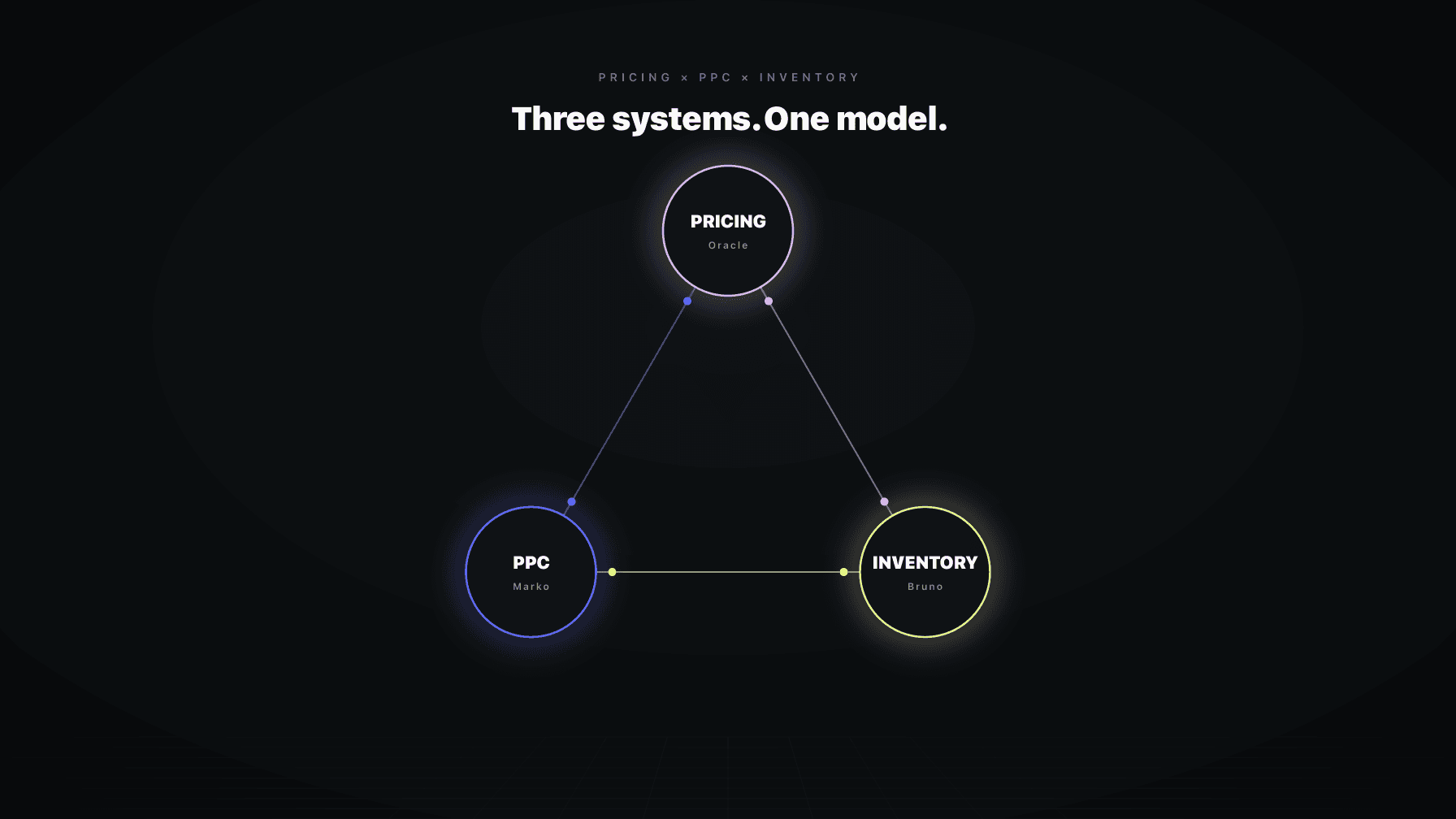
If the framework above sounds familiar, your Amazon account is probably carrying the same drag. Apply and we will show what Marko, Oracle, and Bruno would change in your first week.

Ran a 7-figure Amazon brand for a decade. Founded Skubana (acquired). Co-founded Prosper Show. 15+ years on Amazon.
Join the brands that replaced agencies and tools with AI employees.
For wholesale sellers, repricing is a competitive game:
Traditional repricers like BQool, Seller Snap, Aura, and RepricerExpress are built for this game. They monitor competitor prices every few minutes and adjust yours automatically. Seller Snap uses game theory to find cooperative pricing strategies. BQool uses rule-based automation. Each tool competes on speed and intelligence within this single dimension.
If you sell wholesale, these tools work. They solve the right problem.
But if you sell private label, the Buy Box is not your problem. You ARE the only seller on your listing (or should be, after dealing with hijackers). The Buy Box is yours by default. Racing to undercut a competitor that does not exist is not just unnecessary. It actively destroys your margins.
Private label pricing is a profit optimization problem, not a competitive positioning problem. Your price should be a function of:
How much does your conversion rate change when you change your price? This varies by product, category, and season. A premium supplement with strong reviews might lose only 3% conversion on a 15% price increase. A commodity kitchen gadget might lose 20% conversion on the same increase.
Most repricers do not measure demand elasticity. They do not even try. They react to competitor prices (which you may not have) or follow static rules you set.
Oracle learns your demand curve over time. It tests small price increments, measures conversion response, and builds a model of what your specific product can support at each price point.
Your optimal price changes based on how much inventory you have and how fast it is selling.
High inventory, slow velocity: Price should decrease to accelerate sellthrough and avoid long-term storage fees. But not so much that you sacrifice margin unnecessarily.
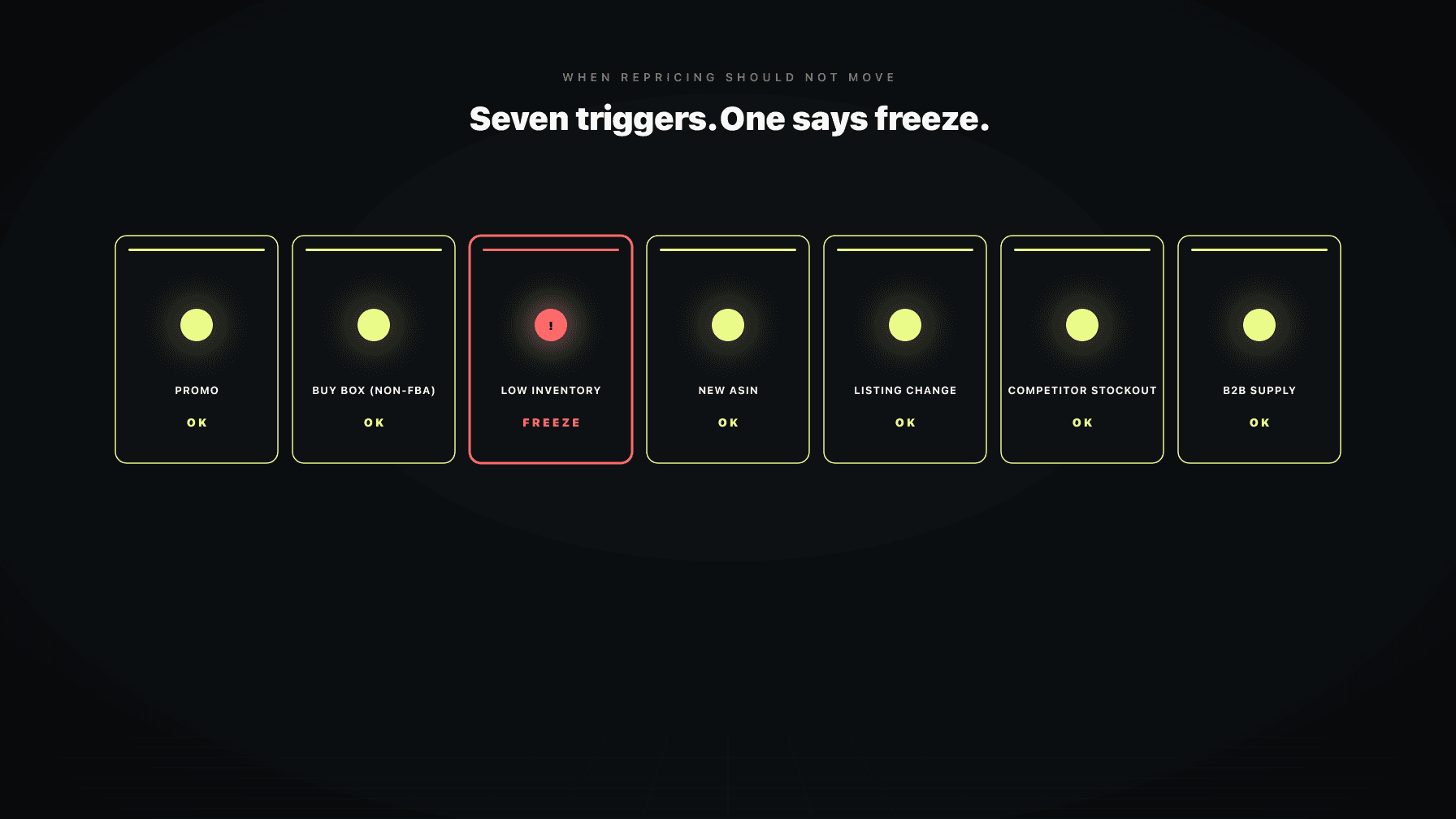
Low inventory, high velocity: Price should increase to slow velocity and extend stock life until the next shipment arrives. Going out of stock on Amazon is catastrophic for ranking. A 10% price increase that prevents a stockout is worth far more than the margin you give up.
Healthy inventory, steady velocity: Price should optimize for maximum profit per unit within the conversion rate sweet spot.
Traditional repricers do not know your inventory level. They do not know when your next shipment arrives. They cannot adjust pricing to prevent stockouts or accelerate slow-moving inventory.
Bruno (Profasee's demand planner) monitors inventory levels and velocity in real time. When stock pressure changes, Bruno signals Oracle, and Oracle adjusts pricing accordingly. This coordination prevents the two most expensive private label mistakes: stocking out on a winner and sitting on a loser.
Your price directly affects your PPC profitability. Higher prices increase your margin per sale, which means you can afford higher bids on strong keywords. Lower prices improve conversion rate but reduce margin, requiring tighter bids.
No traditional repricer considers your ad spend when setting prices. They do not know what you are spending on PPC, which keywords are driving sales, or how a price change will affect your ACoS.
When Oracle changes a price, Marko (Profasee's PPC manager) adjusts bids within minutes to reflect the new margin. This coordination loop is why Profasee sellers see ACoS improvements alongside pricing improvements, not trade-offs between the two.
Private label sellers do have competitors. They are not selling the same ASIN, but they are selling in the same category. When a competitor launches a 30% off promotion, your conversion rate will drop even though your price did not change.
The right response is not to match their price. The right response is to evaluate whether a temporary adjustment makes sense given your margin, inventory, and ad strategy. Sometimes the answer is to hold price and reduce ad spend during the competitor's promotion. Sometimes it is a modest price adjustment with bid increases to capture the traffic they are paying to bring to the category.
Traditional repricers either cannot see competitor prices (because competitors are on different ASINs) or they react by matching, which is the wholesale playbook applied to the wrong situation.
Oracle monitors competitive pricing within your category but uses it as one signal among many, not the primary driver. Your price is set by your margin targets, not someone else's promotion schedule.
The most common mistake is also the simplest. You launch at $24.99, validate that it "works," and leave it there for six months. Meanwhile, your COGS changed, Amazon fees increased (the April 2026 fuel surcharge added 3.5%), your competitor landscape shifted, and seasonal demand patterns moved.
A price that was optimal in January is leaving money on the table by April.
The fix: Price should be dynamic, adjusting weekly or more frequently based on real signals. Not random changes, but data-driven adjustments within a defined range.
I see this constantly. A private label seller signs up for Seller Snap or BQool because they read a "best repricer" article that recommended it. They set rules: "Stay within $1 of the lowest competitor." But they are the only seller on their listing. The repricer has nothing to react to, so it either does nothing (wasted subscription) or it tracks competitors on different ASINs and adjusts price based on products that are not directly comparable.
The fix: If you sell private label, you need a pricing tool built for demand-curve optimization, not Buy Box competition. Ask your repricer: "Does this tool price based on my profit targets, or based on competitor prices?"
Conversion drops. Panic. Cut the price. But the conversion drop was not caused by pricing. It was caused by a competitor launching a sponsored brand video ad that stole clicks. Or a listing hijacker showing up with a lower price. Or Amazon's algorithm demoting your listing due to an inventory issue.
Cutting price treats the symptom, not the cause. And it often makes things worse by reducing margin on every sale during a period when your listing needs more investment (better ads, listing improvement, hijacker removal), not less.
The fix: Before adjusting price, diagnose the conversion drop. Is it price-driven (test with a small price reduction on a subset of traffic) or listing-driven (check for hijackers, listing suppressions, review changes)?
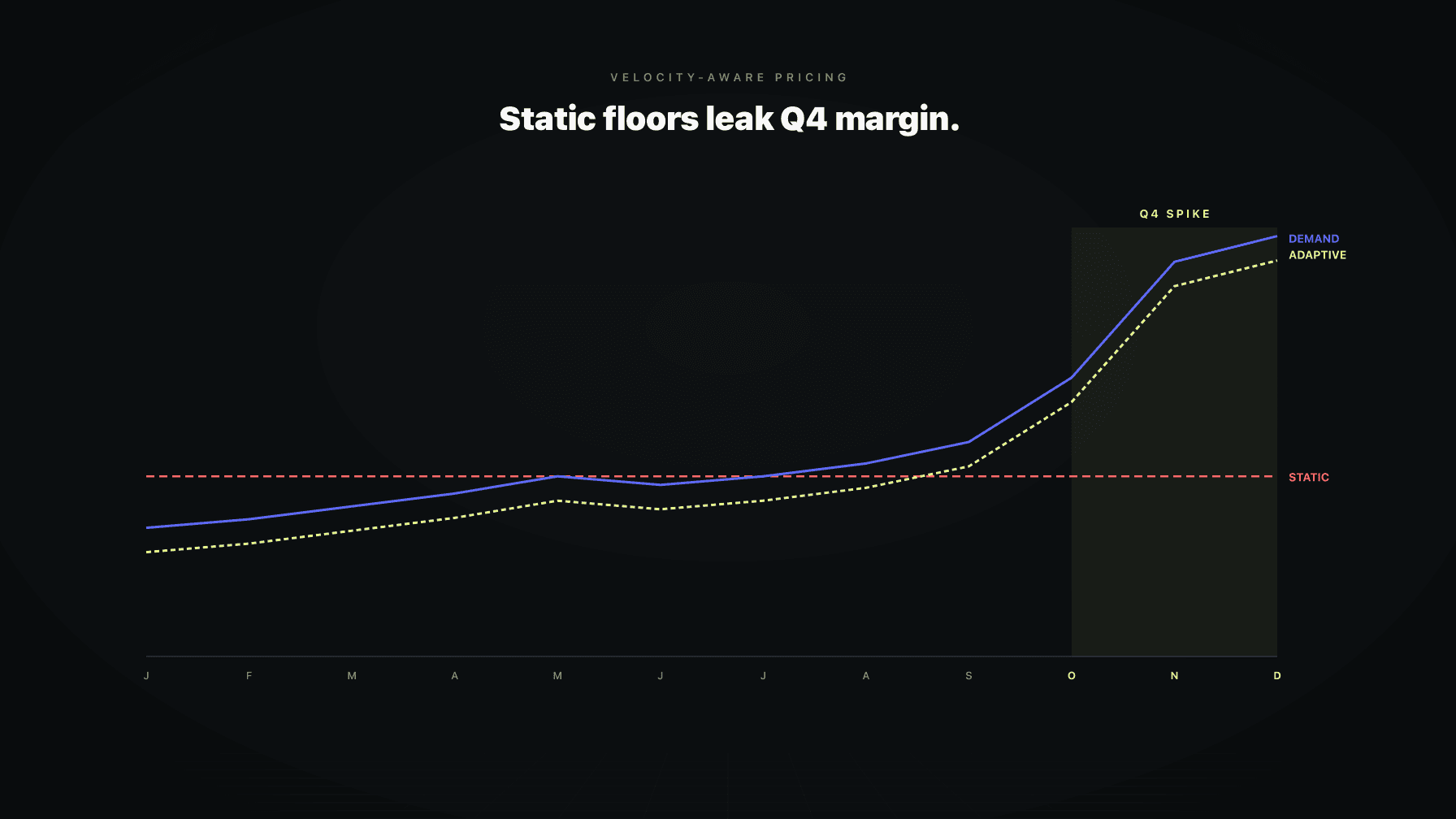
Private label sellers consistently underprice during peak demand: Q4 holiday season, Prime Day, back-to-school. When demand surges, the optimal price is higher because buyers are less price-sensitive and conversion rates increase even at higher prices.
Wholesale sellers cannot raise prices during peaks because they would lose the Buy Box. Private label sellers can and should.
The fix: Build seasonal pricing rules that increase prices during known high-demand windows. Oracle does this automatically using historical demand patterns and real-time conversion data.
This is the most expensive mistake and the one no repricer addresses. You raise your price by 15%. Your margin improves. But your PPC bids are still calibrated to the old margin. You are running conservative bids when you can now afford aggressive ones on your best keywords.
Or the reverse: you cut your price by 10% to move inventory. Your margin drops. But your PPC bids do not tighten. You are now losing money on ad-driven sales because the bids assume a margin that no longer exists.
The fix: Every price change should trigger a bid recalculation. This requires your pricing tool and your PPC tool to share data, which is exactly what Profasee's coordinated AI employees do.
Here is how Oracle differs from traditional repricers across the dimensions that matter for private label:
Pricing basis:
Decision inputs:
Speed priority:
Coordination:
Failure mode:
Guardrails:
If you are shopping for a repricer, ask these questions:
1. What data does it use to set prices? If the answer is only "competitor prices and your rules," it is a wholesale tool. Private label repricing needs COGS, fees, inventory, ad spend, and conversion data.
2. Does it coordinate with your PPC tool? If not, every price change creates a PPC optimization gap. You will spend days manually adjusting bids after every price move.
3. Does it factor in inventory levels? If not, it cannot prevent stockouts through pricing or accelerate slow inventory. These are core private label challenges.
4. Can it learn your demand curve? Rule-based repricing (if X then Y) cannot optimize price across a demand curve. You need a system that tests, measures, and adapts.
5. Does it comply with Amazon's AI Agent Policy? As of March 2026, automated price changes exceeding 20% in 24 hours require documented human authorization. Your repricer needs to handle this or you risk compliance issues. Read the full policy breakdown.
The repricing tools most Amazon sellers use were built for a problem most Amazon sellers do not have. If you are selling private label, you are not competing for the Buy Box. You are optimizing a demand curve across pricing, PPC, inventory, and competitive dynamics simultaneously.
Traditional repricers solve 20% of this problem (competitive positioning) and ignore the other 80% (profit optimization, inventory coordination, PPC alignment, demand elasticity).
The result is sellers leaving 10-15% of their potential profit on the table because their pricing tool cannot see the rest of their business.
Every day your repricer makes a pricing decision without knowing your inventory level, your ad spend, or your margin target is a day you are settling for a good price when the optimal price was available.
Can I use a traditional repricer for private label if I set the right rules? You can set price floors and ceilings, but rule-based repricing cannot optimize across demand elasticity, inventory pressure, and PPC economics. You will constantly be updating rules manually to account for signals the tool cannot see. It works at small scale (under 20 SKUs) but breaks down as your catalog grows.
How is Oracle different from Amazon's built-in Automate Pricing? Amazon's Automate Pricing is a basic rule engine: match lowest price, stay above a floor, stay within a range. It does not factor in your COGS, margins, inventory levels, or ad spend. It is free and useful for wholesale Buy Box competition, but it is not designed for private label profit optimization.
What if I am the only seller but still lose the Buy Box? This happens when Amazon itself is selling the product, when you have FBM alongside FBA offers, or when your account health metrics drop. In these cases, Buy Box strategy matters. But even then, the pricing decision should be profit-aware, not just position-aware. Oracle handles both scenarios.
How often should private label prices change? It depends on your category velocity and competitive dynamics. High-velocity products (100+ units/day) benefit from daily optimization. Lower-velocity products (5-20 units/day) can optimize weekly. The key is that changes should be data-driven, not random. Small, frequent adjustments outperform large, infrequent ones.
Does dynamic pricing hurt my brand perception? Amazon shoppers do not track your price history the way B2B buyers do. Price fluctuations of 5-15% are normal and expected on Amazon. As long as you stay within a reasonable range and do not trigger Amazon's pricing policy violations, dynamic pricing improves margins without brand damage.