Chad Rubin
June 4, 2026 · 14 min read
Operator notes by email
Short, opinionated takes on AI agents, Amazon PPC, pricing, and inventory. No fluff. About once a week.
The daily review keeps you alive. The weekly review keeps you in shape. Those are two different jobs, and most sellers run them as one blurry habit that does neither well.
I have run a 7-figure Amazon brand for over a decade. The thing nobody tells you when you start is that the account does not break in a single dramatic moment. It drifts. Campaigns that should have been merged stay separate. A hero ASIN quietly loses share to a tail product nobody is watching. Price creeps a dollar below where it should sit, and nobody catches it because the daily check is busy putting out fires. Drift is slow and it is structural, and the only thing that catches it is a recurring loop built specifically to look at structure.
That loop is the weekly review. It is 45 minutes. Not 45 minutes when you feel like it. Forty-five minutes on the same day, every week, with the same agenda in the same order. The discipline is the agenda, not the duration. The decisions that belong here are too important to make on the fly during a daily fire drill, and too frequent to wait for the monthly. Campaign roles, hero versus long-tail attention, search-term promotion and negation, pricing posture, inventory health, catalog hygiene. None of those are emergencies. All of them compound.
This is the operator's structural cadence. Below is exactly what to look at, in what order, and what to do when something is off. If you want the bigger picture on how daily, weekly, and monthly fit together, read Amazon operations mission control first. This piece lives one level down: the weekly loop, in detail.
Each cadence has a job, and the failure mode is always the same: one cadence trying to do another's work. When the daily review tries to make structural decisions, you get reactive thrash. You merge a campaign on a Tuesday because one day looked bad, then unwind it Thursday when it recovers. When the monthly review tries to catch structural drift, you discover three weeks too late that a campaign has been bleeding because nobody promoted its winners out.
From reading to action
If the framework above sounds familiar, your Amazon account is probably carrying the same drag. Apply and we will show what Marko, Oracle, and Bruno would change in your first week.

Ran a 7-figure Amazon brand for a decade. Founded Skubana (acquired). Co-founded Prosper Show. 15+ years on Amazon.
Join the brands that replaced agencies and tools with AI employees.
The weekly loop sits in the gap. It is frequent enough that drift never accumulates past a week, and slow enough that you are reacting to a trend instead of a single day's noise. Seven days of data smooths out the weekend dip, the random Tuesday spike, the one-off competitor stockout. You are looking at shape, not points.
Structure means the decisions that change how the account is organized. Which campaign holds which keyword. Which products get budget and attention. Where your price sits relative to the market. How much inventory is in the pipe. These are not knobs you touch every day. They are the scaffolding everything else hangs on, and scaffolding has to be inspected on a schedule or it rots quietly.
The reason this loop is hard to keep is that nothing in it is ever urgent. Nothing screams. A campaign that should have been split does not page you at 2am. That is exactly why it needs a fixed slot. Urgent things get done because they are loud. Important things get done because they are scheduled.
Every ad type on Amazon has a role. Sponsored Products does the heavy lifting on conversion-ready demand. Sponsored Brands defends your brand term and introduces your catalog at the top. Sponsored Display works retargeting and competitor conquesting. When you set the account up, you assigned each type a job. The weekly review is where you ask, one type at a time, whether it is still doing that job.
This is not the same as asking whether each type is profitable in isolation. A defensive Sponsored Brands campaign on your own brand term might look expensive on a last-click basis and still be doing its job, which is keeping competitors off your name. The question is structural: is the role intact, or has the campaign drifted into doing something you never asked it to do.
Pull the seven-day numbers by campaign type. Spend, sales, ACOS, and the share of total spend each type holds. Then ask the structural questions. Is Sponsored Products carrying the conversion load it should? Has Sponsored Display crept up in spend without a matching role to justify it? Is Sponsored Brands still defending, or has it sprawled into broad discovery terms that belong somewhere else? For a deeper breakdown of how to assign and police these roles, see Amazon PPC campaign roles.
When a type has drifted from its role, you have a structural decision to make, and the weekly review is the right place to make it because you have a week of data and you are calm. Note it, make the change, and move on. Do not let it bleed into a daily reaction.
Not every ASIN deserves the same treatment. Your heroes, the handful of products that drive most of the revenue, warrant aggressive attention and the lion's share of budget. Your long-tail products warrant efficiency and maintenance, not growth spend. Conflating the two is one of the most common ways accounts quietly underperform.
The weekly review is where you check that attention is actually flowing where you decided it should. Pull revenue and ad spend by ASIN. Sort by revenue. Look at the top of the list and the long tail separately. The question is simple: are the heroes getting the support that matches their role, and are the tail products being held to an efficiency standard rather than a growth standard?
What you are watching for is the slow inversion. A tail product gets a lucky run, spend creeps up to chase it, and three weeks later it is consuming hero-level budget on tail-level revenue. Or a hero stalls because attention drifted elsewhere and nobody noticed the support flattening. Neither shows up in a daily check. Both show up clearly in a weekly look at the shape of the catalog.
When the picture is off, the fix is a budget and attention reallocation, which is a structural change. You shift support back toward the heroes or you put the tail back on an efficiency leash. You do it once, deliberately, in the weekly slot, and you let it run for a week before you judge it again.
This is the section most sellers skip, and skipping it is why their campaigns get expensive over time. Inside your broad and auto campaigns, search terms are constantly proving themselves. Some convert reliably. Some spend with nothing to show. The weekly job is to act on both, every week, so it never becomes a backlog.
Promote the winners. A search term that has proven it converts does not belong buried inside a broad campaign where you cannot control its bid. Pull it out into its own exact-match structure where you can fund it properly and bid it precisely. This is how good campaigns get built: not by guessing keywords up front, but by harvesting the ones the market already validated.
Negate the waste. A search term that has spent a meaningful amount across enough clicks with no conversions is not going to surprise you. Negate it. The reason to do this weekly rather than monthly is compounding. A wasteful term left live for four weeks burns four times the budget of one caught in week one. Small negations done on schedule are worth more than a big cleanup done occasionally.
Set yourself a simple threshold so this is mechanical rather than agonized. Enough clicks to be statistically real, enough spend to matter, zero or near-zero conversions. Anything that clears the bar gets negated. Anything that proves itself gets promoted. The weekly review is not the place to deliberate every term. It is the place to apply the rule and move.
Price is structural, and most sellers treat it as either set-and-forget or panic-react. Both are wrong. Set-and-forget means you wake up a dollar below where you should be because cost crept and you never adjusted. Panic-react means you chase a competitor's temporary discount to the bottom and train your buyers to wait for sales. The weekly review is where price gets the calm, structural treatment it deserves.
Two things to check. First, drift. Has your price moved away from where you intended it to sit, whether through a repricer running unchecked, a promotion that never got turned off, or a margin assumption that no longer holds because cost changed? Second, competitive shifts. Has the competitive set around your hero ASINs moved in a way that changes your posture, a new entrant undercutting, a competitor going out of stock, a category-wide move on price?
The point of checking weekly is to make pricing a posture decision, not a reflex. A competitor dropping price for three days is noise. A competitor holding a new lower price for a week is a signal, and now you decide whether to match, hold, or differentiate. You make that call once, with a week of context, instead of reacting to it daily.
Pricing posture is also the area where automation earns its keep, because the inputs change constantly and the right response is rarely the obvious one. If you run a pricing agent, the weekly review is where you confirm its posture matches yours. More on the agent angle below, and on the dedicated tooling at Amazon pricing software.
Inventory is the structural decision with the longest lead time and the highest cost of being wrong. Run out of a hero and you lose rank, sales, and the momentum it took months to build. Overstock a slow mover and you eat storage fees and tie up cash. Neither problem announces itself on a daily basis. Both are visible weekly if you look.
Two lists every week. First, what is approaching reorder. Anything with a cover window short enough that you need to act now to avoid a stockout given your supplier lead time. The weekly cadence matters here because reorder decisions have to happen before the daily check would even register a problem. By the time daily sees low stock, it is often too late to reorder cleanly.
Second, what is overstocked and needs clearing. Products sitting on more cover than they will sell through before fees pile up. The weekly review is where you decide the clear-out tactic: a markdown, a promotion, a deal, or a removal. Deciding weekly means you act while there is still runway, instead of liquidating in a panic when storage fees have already eaten the margin.
Inventory health connects directly to the pricing and hero-versus-tail work. A hero approaching reorder is a different decision than a tail product approaching reorder, and a clearance markdown is a pricing posture move. The weekly review is where these threads come together, which is the whole point of having one structured loop instead of six disconnected checks.
Listings rot. Amazon strips a bullet, a title gets truncated, an image fails compliance, a variation breaks, a suppressed listing slips through. None of it is catastrophic in a single day. All of it costs conversion if it sits. The weekly review includes a hygiene spot-check, not a full audit, but a quick pass over the things that quietly break.
Check your hero listings first, because that is where damaged content costs the most. Are the main images live and compliant? Is the title intact and not truncated on mobile? Are the bullets and A+ content present? Is the variation family connected the way it should be? Are any of your listings suppressed or showing a content warning you missed?
This is a spot-check, not a deep audit, because a deep catalog audit belongs in the monthly cadence. Weekly, you are catching the recent breaks before they cost a full month of degraded conversion. The discipline is to look at the same handful of high-value listings every week so a problem never lives more than seven days.
When you find something, fix it or queue it immediately. The trap is noting a broken listing and letting it sit because it is not urgent. It is not urgent. It is important, and important is what the weekly loop exists to protect.
If you run AI agents on the account, and increasingly operators do, the weekly review changes shape slightly. The agents are making the moment-to-moment moves: adjusting bids, repricing, flagging inventory, harvesting search terms. They do not get tired and they do not skip the boring negations. What they do not have is your judgment about the business as a whole.
So the weekly review becomes a sanity check. You are not redoing the agents' work. You are reviewing the structure they produced and asking one question: do their decisions match what I would have decided. Where they match, you leave it alone. Where they drifted, you retune the guardrails so next week's decisions land where you want them.
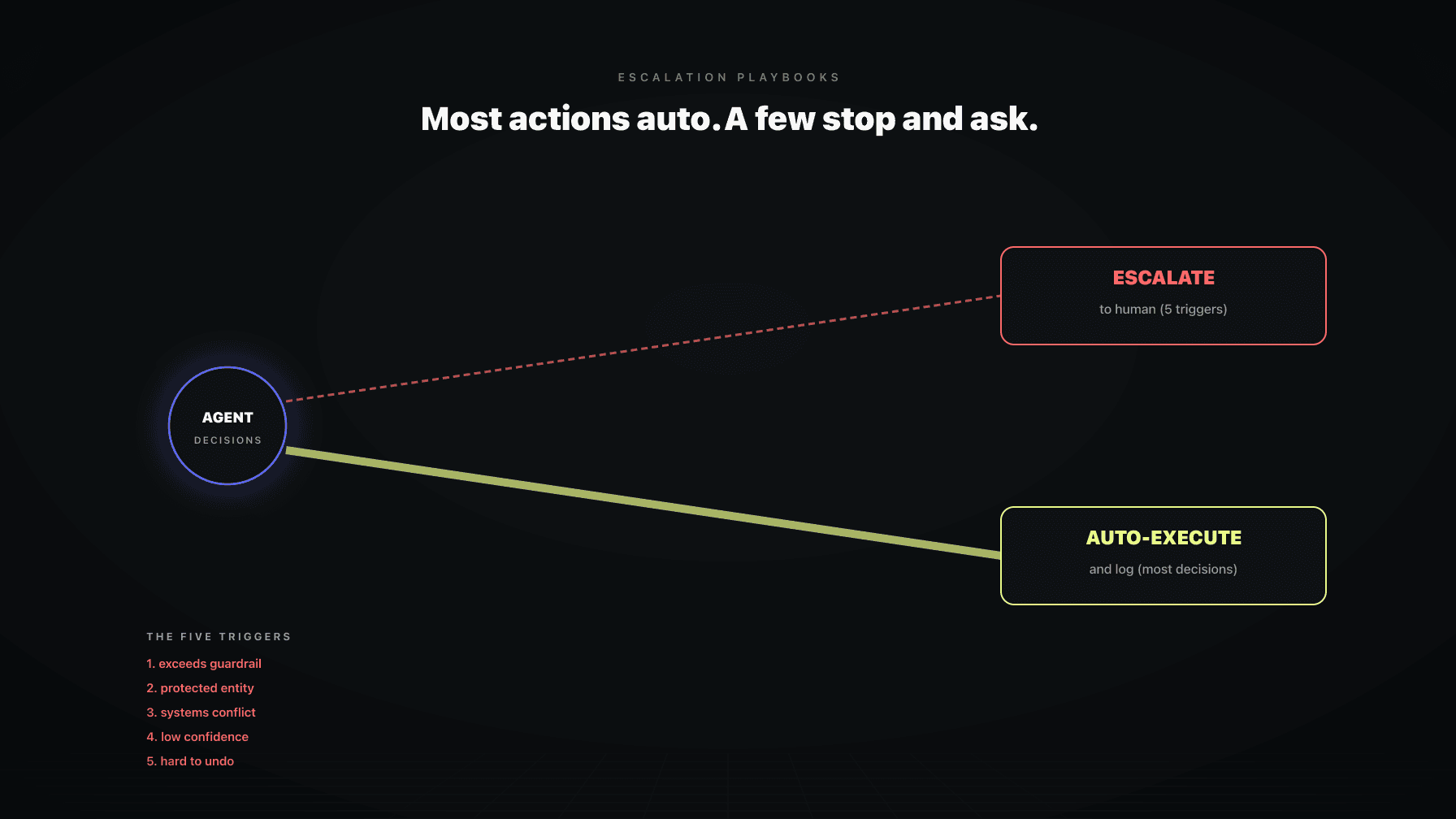
This is the same discipline as reviewing a capable human team. You set the rules, the approvals, and the limits, then you check the output against your intent. An agent that has been bidding a touch too aggressively on a tail product is not a failure. It is a tuning opportunity you catch in the weekly slot before it compounds. The agents handle the volume. You handle the judgment. For how to structure the handoff when an agent hits a decision it should not make alone, see Amazon AI escalation playbooks.
The thing to resist is either extreme. Do not rubber-stamp everything because the agents are usually right, and do not micromanage every move because then you have not actually delegated anything. Review structure, not every action. Retune where the pattern is off, not where a single decision looks odd.
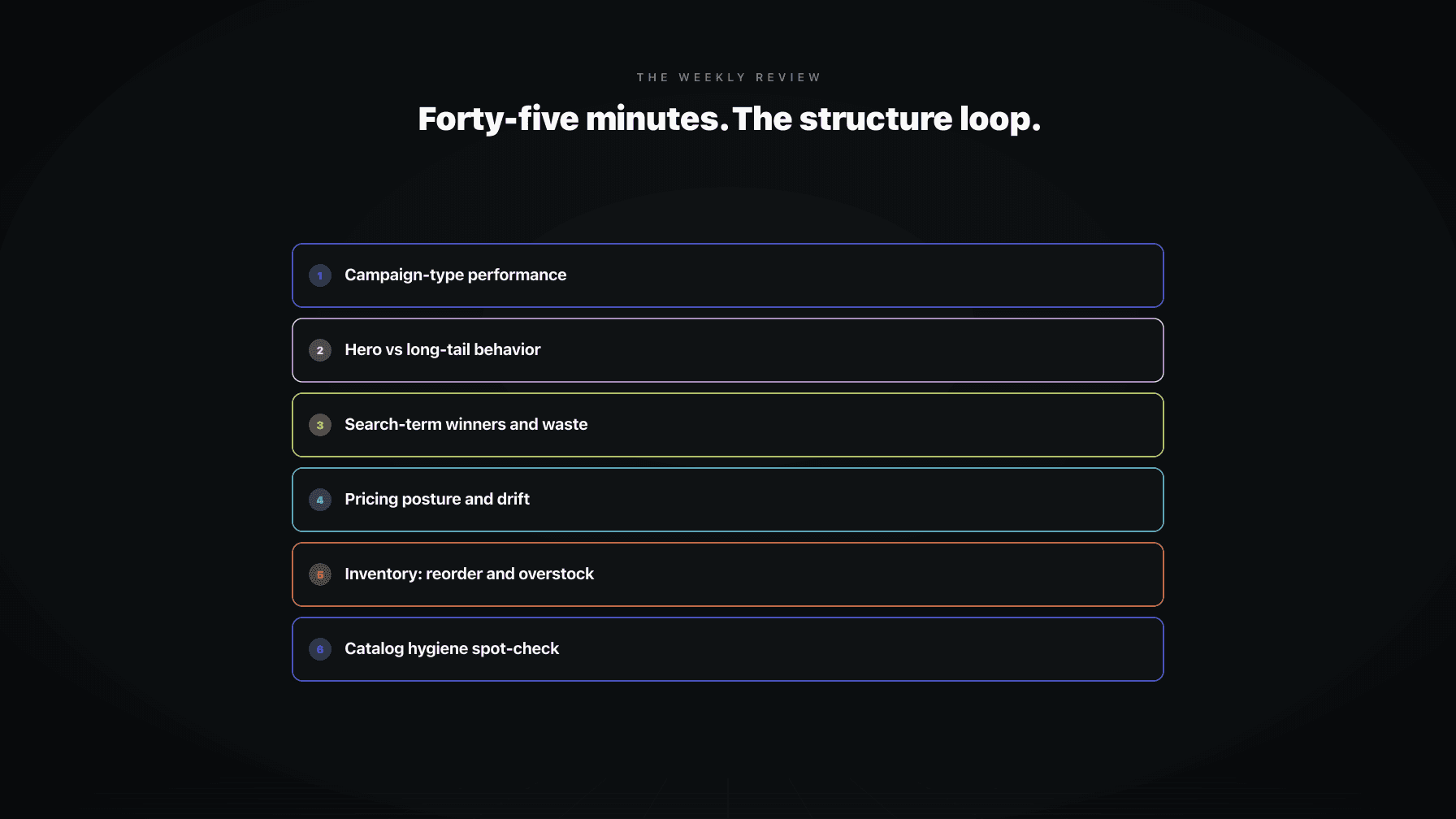
Here is the loop, in the order I run it, with rough time. Same order every week so it becomes muscle memory.
Forty-five minutes. The first time it will take ninety because you are building the views. By week four it is genuinely 45 because the data is in the same place, the thresholds are set, and you are pattern-matching instead of calculating. The agenda is the discipline. The duration is the result.
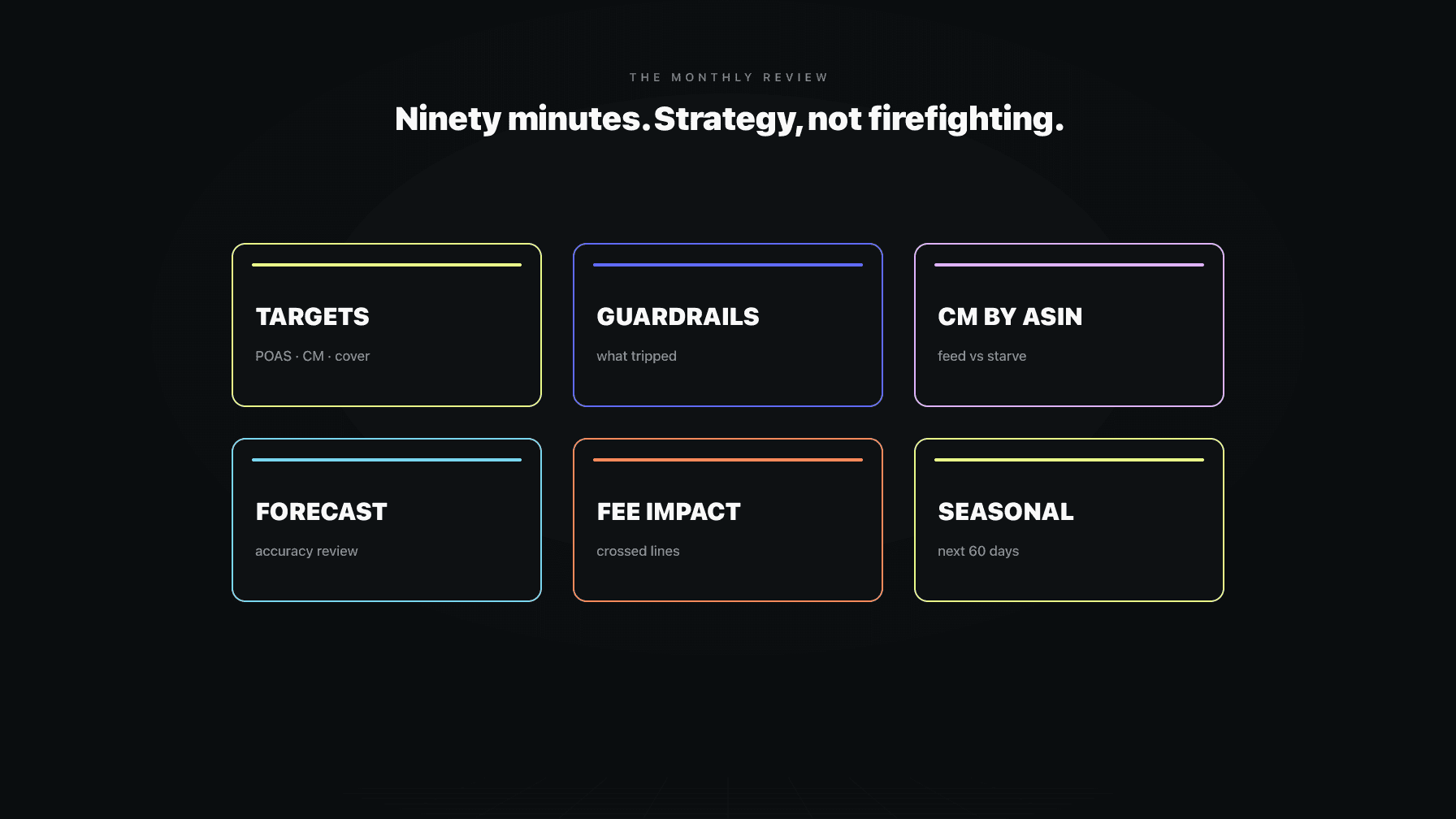
The weekly review executes. It does not strategize. When something surfaces weekly that is too big for a weekly decision, it escalates to the monthly review, where you have the time and the wider lens to handle it.
A campaign type drifting once is a weekly tune. A campaign structure that has been fighting its role for a month is a monthly rebuild. A single price posture call is weekly. A category-wide repositioning of your whole catalog is monthly. A search term to negate is weekly. A realization that your whole keyword harvesting threshold is wrong is monthly. The rule is simple: weekly handles the instance, monthly handles the pattern.
This separation is what keeps both loops honest. Monthly identifies and decides the big structural moves, weekly executes the steady maintenance, and daily survives the day. When weekly tries to make monthly's calls, you thrash. When monthly tries to do weekly's maintenance, drift accumulates for thirty days before anyone catches it. Keep the escalation clean and both cadences stay sharp. The full monthly agenda lives in Amazon monthly review strategy, and the daily loop in Amazon daily review routine.
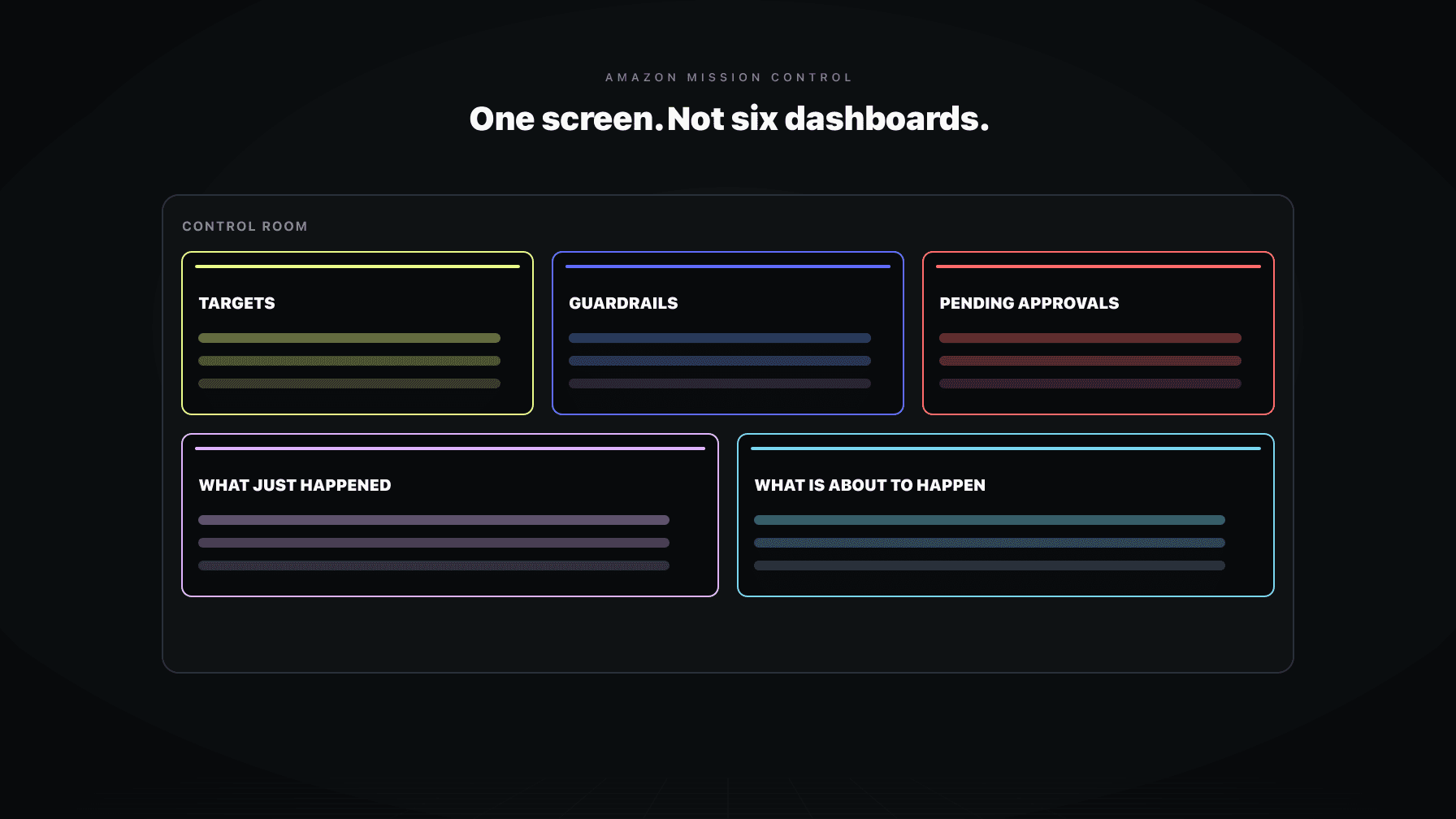
The hardest part of the weekly loop is not the decisions. It is getting every input onto one screen so the 45 minutes is review and not data gathering. That is the problem Profasee was built to solve.
Every agent's context lives in one place. The PPC numbers by campaign type, the hero-versus-tail revenue split, the search terms ready to promote or negate, the pricing posture against the competitive set, the inventory cover, the catalog flags. You open the mission control dashboard and the entire structural picture is already assembled, with the agents' decisions from the past week laid out alongside it.
Your job in the weekly review becomes what it should be: review structure, confirm the agents' moves match your judgment, and tune where they drifted. The PPC manager has already harvested winners and negated waste all week. The pricing agent has held posture against competitive moves. You are checking their work against your intent, not redoing it. Set the rules, approve the close calls, retune the guardrails, done. The depth on the PPC side lives in Amazon PPC software.
That is the promise of running the account this way. The agents handle the volume that used to eat your week. The weekly review goes back to being 45 minutes of operator judgment instead of three hours of spreadsheet assembly. See pricing for how it works, or apply if you want to run your account this way.
Six structural areas. Campaign-type performance (is each ad type doing its job), hero versus long-tail attention (is budget flowing where you decided), search terms (promote winners, negate waste), pricing posture (drift and competitive shifts), inventory health (reorders and overstock), and catalog hygiene (a spot-check on your hero listings). If you run agents, add a sanity-check on their decisions against your judgment.
About 45 minutes once you have the views built and your thresholds set. The first few will run longer because you are assembling data. By week four it settles, because you are pattern-matching against a familiar layout instead of calculating from scratch. The fixed agenda is what gets you to 45 minutes. Without it the review either sprawls or gets skipped.
Daily owns survival: catching anomalies, stockouts, account health flags, and anything on fire. Weekly owns structure: campaign roles, budget allocation, search-term promotion and negation, pricing posture, inventory planning. Daily reacts to single-day events. Weekly acts on seven-day trends. When daily tries to make structural decisions you get reactive thrash, so keep the two loops separate.
Pull seven-day numbers by ad type: spend, sales, ACOS, and each type's share of total spend. Then ask whether each type is still doing the job you assigned it. Sponsored Products carrying conversion, Sponsored Brands defending, Sponsored Display retargeting. Look for drift, where a type has crept into work it was never meant to do, and make the structural correction once, calmly, in the weekly slot.
Two. Drift, meaning your price has moved away from where you intended it to sit through a repricer, an old promotion, or a margin assumption that no longer holds. And competitive shifts, meaning the competitive set around your hero ASINs has moved in a way that changes your posture. The weekly cadence lets you treat price as a posture decision rather than a daily reflex to competitor noise.
Tune where the pattern is off, not where a single number looks odd. Weekly is the right cadence for adjusting bids, budgets, and agent guardrails based on a seven-day trend. It is the wrong cadence for wholesale strategy changes, which belong in the monthly review. The rule of thumb: weekly handles the instance, monthly handles the pattern. Retune the steady stuff weekly and escalate the big rethinks.
Review the structure they produced, not every individual action. Pull up the week's decisions, bid changes, repricing, negations, harvests, and ask one question: do these match what I would have decided. Where they match, leave it alone. Where they drifted, retune the guardrails so next week lands where you want. You handle judgment, the agents handle volume. Do not rubber-stamp and do not micromanage.