Chad Rubin
April 22, 2026 · Updated May 11, 2026 · 11 min read
Operator notes by email
Short, opinionated takes on AI agents, Amazon PPC, pricing, and inventory. No fluff. About once a week.

The best AI tools for Amazon sellers in 2026 are Profasee Ultra (coordinated AI employees), Helium 10 (research and listing suite), Seller Snap (repricing), Perpetua (PPC automation), and SmartScout (market intelligence).
But here is the truth most "best of" lists will not tell you: stacking five separate AI tools creates the same problem you had before AI existed. Your repricer still does not know your PPC budget. Your PPC tool still does not know your inventory is running low. You just automated the chaos.
I ran a 7-figure Amazon brand for a decade. I used every tool on this list at some point, some of them simultaneously.
What I learned is that the real cost of AI tools is not the subscription. It is the three hours you spend every morning trying to coordinate what they all did overnight.
This guide breaks down the best AI tools for Amazon sellers by category, with honest takes on what each one actually does well, where it falls short, and whether the "AI" label is marketing or substance. If you want the short version of where coordinated AI employees fit in that landscape, here is how Profasee Ultra works.
Key Takeaways
Tool | Starting Price | PPC | Repricing | Inventory |
|---|
From reading to action
If the framework above sounds familiar, your Amazon account is probably carrying the same drag. Apply and we will show what Marko, Oracle, and Bruno would change in your first week.

Ran a 7-figure Amazon brand for a decade. Founded Skubana (acquired). Co-founded Prosper Show. 15+ years on Amazon.
Join the brands that replaced agencies and tools with AI employees.
Listings
Coordinated |
|---|
$299/mo | ✅ | ✅ | ✅ | ✅ | ✅ |
Helium 10 | $229/mo | ✅ | ❌ | ❌ | ✅ | ❌ |
$250/mo | ❌ | ✅ | ❌ | ❌ | ❌ |
$695/mo | ✅ | ❌ | ❌ | ❌ | ❌ |
$500/mo | ✅ | ❌ | ❌ | ❌ | ❌ |
Jungle Scout | $49/mo | ❌ | ❌ | ✅ | ✅ | ❌ |
SmartScout | $49/mo | ❌ | ❌ | ❌ | ✅ | ❌ |
"Coordinated" means the tool shares data with other functions (PPC + pricing + inventory + listings) and reacts to their decisions automatically. No other tool on this list does this.
Before we compare tools, let's clear something up. Most Amazon seller tools that claim to be "AI-powered" are running basic rule-based automation with a machine learning layer on top. That is not the same as an AI that reasons about your business. For reference, Amazon itself has shipped a genuine LLM-backed AI in Rufus, its AI shopping assistant with 300M+ users — that is what real AI looks like on the buyer side. Most seller-side "AI" is still catching up.
There are three levels of AI in seller tools right now:
Level 1: Rules with data. You set the rules. The tool follows them. "If competitor price drops below X, match it." This is what most repricers do. It is automation, not intelligence.
Level 2: Pattern recognition. The tool learns from historical data and adjusts without manual rules. Seller Snap's game theory repricing and Helium 10's Adtomic bid suggestions fall here. Better, but still isolated to one function.
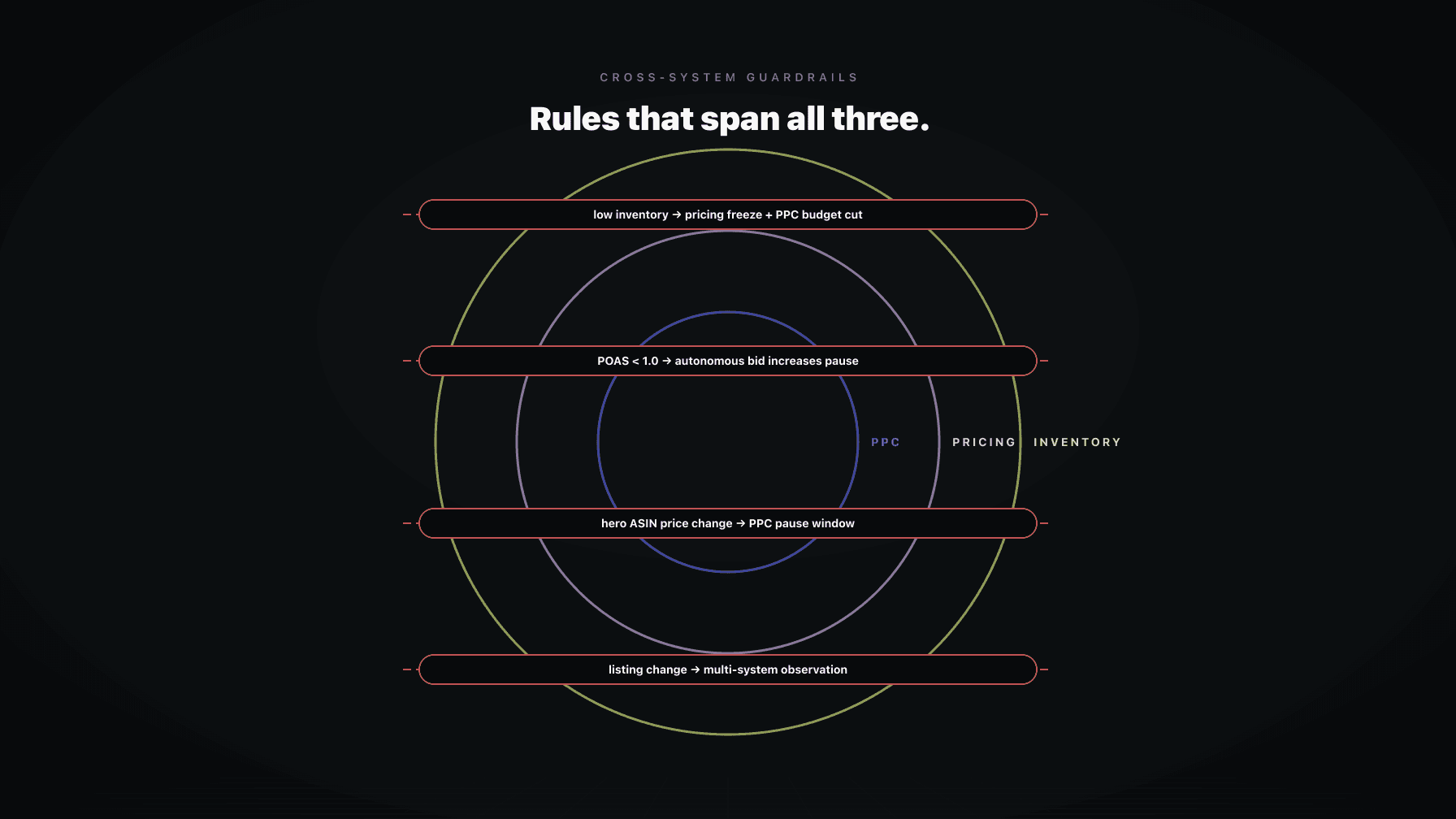
Level 3: Coordinated reasoning. The AI understands your business context across multiple functions and makes decisions that account for pricing, PPC, inventory, and listings simultaneously. When inventory runs low, ad spend automatically pauses on that ASIN. When price goes up, bids adjust to the new margin. This is where Profasee Ultra sits.
The difference matters because Level 1 and Level 2 tools create a new problem: you become the human middleware connecting five AI tools that do not talk to each other.
Here is a common scenario: your repricer raises prices on a top ASIN to capture margin, but your PPC tool keeps running the same ad budget for that product. ACoS spikes because the PPC tool has no idea the price just changed. By the time you catch it, you have burned through ad spend that never needed to happen.
That is the coordination problem. And it is what separates AI tools from AI employees.
Best for: Amazon sellers who want PPC management that actually knows their margins and inventory.
Pricing: $399/mo
What Marko does differently: Marko is not a PPC dashboard. He is an AI employee who owns bids, budgets, placements, and search terms, but makes every decision with full visibility into your pricing, inventory, and catalog data.
When Bruno (the demand planner) flags that an ASIN is running low on stock, Marko automatically reduces ad spend on that product. When Oracle raises a price, Marko adjusts bids to reflect the new margin. No other PPC tool does this because no other PPC tool has access to the rest of your operations.
The difference shows up when inventory gets tight. A standalone PPC tool will keep scaling spend on a product that is converting well, even if you are two weeks from stocking out. Marko sees the inventory signal from Bruno and pulls back automatically. That is the difference between a PPC tool and a PPC employee.
Best for: Sellers spending $10K+/mo on ads who want hands-off AI bid optimization.
Pricing: Starts at $695/mo (for up to $10K monthly ad spend)
What it does well: Perpetua's machine learning engine requires zero manual intervention once configured. It optimizes across Sponsored Products, Brands, and Display in line with Amazon's own advertising strategy guidance, with goal-based automation. After merging with Sellics, it became one of the most sophisticated PPC platforms available.
What to consider: At $695/mo minimum, it is built for sellers with significant ad spend. Like most standalone PPC platforms, it focuses on ad performance without visibility into your pricing, inventory, or margin data. Those connections would need to be managed manually. See the full Profasee vs Perpetua comparison for how coordination changes the cost picture.
Best for: Enterprise brands and agencies managing large Amazon advertising portfolios.
Pricing: Typically 3-4% of ad spend with a ~$500/mo minimum
What it does well: Cross-retailer support (Amazon, Walmart, Instacart). Advanced budget management, dayparting, and competitive insights. The reporting is best-in-class for large accounts.
What to consider: Priced for enterprise and larger accounts. Pacvue focuses on advertising, so pricing and inventory coordination would need to be handled through other tools. We break down the tradeoffs in the Profasee vs Pacvue comparison.
Best for: Amazon sellers who want repricing tied to their actual business context.
Pricing: $349/mo
What Oracle does differently: Oracle does not just react to competitor prices. It adjusts pricing based on profit targets, demand signals, inventory pressure, and what your PPC campaigns are doing.
If inventory is running low, Oracle can raise prices to slow velocity and prevent a stockout. If a competitor drops their price, Oracle evaluates whether matching makes sense given your current margin structure, not just your Buy Box position.
Oracle replaces tools like BQool ($500/mo), Aura ($500/mo), RepricerExpress ($300/mo), and Informed.co ($500/mo), but costs less because it does not need to be a standalone business. Even Amazon's own Automate Pricing only covers rule-based repricing — it does not factor in PPC spend, inventory runway, or your margin after ad costs. Oracle does. It is part of a coordinated team.
Best for: High-SKU sellers (500+) who want AI repricing without price wars.
Pricing: $250-$800/mo depending on SKU count
What it does well: Seller Snap uses game theory instead of simple rule-based repricing. Rather than just matching or undercutting competitors, it finds cooperative strategies that protect margins for everyone. It tracks competitor prices by the minute and adjusts accordingly.
What to consider: Seller Snap focuses exclusively on repricing. Pricing decisions are made without visibility into your ad spend, inventory levels, or margin data from other systems. Pricing scales with SKU count, so larger catalogs pay more.
Best for: Sellers who want inventory forecasting that actually talks to their PPC and pricing.
Pricing: $299/mo
What Bruno does differently: Bruno monitors sales velocity, inventory risk, reorder timing, and stock pressure. But the real value is what happens next.
When Bruno detects a stockout risk, Marko automatically reduces ad spend on that ASIN. Oracle can adjust pricing to slow velocity. Claudia (the COO) flags it in your morning brief. The entire team reacts to one signal.
With standalone forecasting tools, you get the alert. With Ultra, the entire team acts on it automatically.
Best for: Sellers who need dedicated inventory management and demand forecasting.
Pricing: Varies (now part of Carbon6 suite)
What it does well: SoStocked forecasts demand up to 12 months ahead, factoring in seasonality, trends, and promotions. ProfitFlow (their companion tool) provides forward-looking profit strategies.
The reorder alerts and purchase order generation save real time.
What to consider: Now part of the Carbon6 suite. SoStocked focuses on inventory forecasting and does not have direct connections to your PPC or repricing tools. Acting on a stockout warning still requires manual coordination with your other systems.
Best for: Established sellers who need deep keyword research, listing optimization, and market intelligence in one suite.
Pricing: Starter ($39/mo), Platinum ($99/mo), Diamond ($229/mo), Enterprise (custom)
What it does well: Helium 10 covers more ground than any other single tool. Cerebro for reverse ASIN lookups, Magnet for keyword research, Listing Builder with AI suggestions, and Adtomic for basic PPC management.
The Diamond plan includes everything most sellers need.
What to consider: Helium 10 is a research and optimization suite. It helps you find opportunities and write better listings. For operational tasks like repricing, inventory forecasting, or cross-function coordination, you will need additional tools alongside it.
Adtomic handles basic PPC management within the suite. For sellers who want deeper PPC automation, a dedicated PPC platform may be a better fit.
Best for: New and mid-size sellers focused on product research accuracy and supplier sourcing.
Pricing: Starter ($49/mo), Growth Accelerator ($79/mo), Brand Owner + CI ($399/mo)
What it does well: Jungle Scout has the highest product research accuracy in the market at 84-86%. Their supplier database is genuinely useful for sourcing. The Opportunity Finder surfaces profitable niches with real data behind it.
What to consider: Jungle Scout focuses on research and sourcing. For operational tasks like PPC automation, repricing, or inventory forecasting, you will need additional tools alongside it.
Best for: Brand discovery, niche research, and competitive intelligence at an affordable price point.
Pricing: Starts at $29/mo
What it does well: SmartScout's Traffic Graph is something no other tool offers. It visualizes Amazon's "frequently bought together" data to show how customer traffic flows between products. This reveals market dynamics that keyword tools miss entirely. At $29/mo, it is an excellent addition to any stack.
What to consider: SmartScout is a research tool, not an operational platform. Use it alongside your execution tools for market intelligence.
Here is the math that most "best AI tools" articles will not show you:
The typical AI tool stack for a serious Amazon seller:
Plus the 3+ hours per day you spend coordinating what they all did.
Profasee Ultra with full team:
Similar price. But no coordination tax. No 3-hour mornings. You get a 5-minute brief in Slack and one dashboard. See the full Profasee pricing breakdown — or run your own numbers in the ROI calculator.
The question is not which individual tool has the best AI. The question is whether you want to be the human middleware connecting five disconnected AI tools, or whether you want AI employees that already work as a team.
Amazon updated its Business Solutions Agreement in March 2026 with formal requirements for AI agents operating on the platform. The policy defines an "AI seller agent" as any system that makes or executes decisions affecting a seller account without real-time human input for each action.
This matters because it captures everything from simple repricers to sophisticated multi-step agents. The 90-day transition window has closed. Enforcement is active.
If you are using AI tools that automate actions on Seller Central, verify they comply with Amazon's new Agent Policy. Tools that operate through official SP-API and Ads API channels (like Profasee) are compliant. Tools that scrape Seller Central or use unauthorized browser automation are not.
There is no single "best" tool. The right choice depends on your stage and priorities:
If you are just starting out ($10K-$30K/mo revenue): Start with Jungle Scout or Helium 10 Starter for research. Manual PPC management is fine at this scale. You do not need AI repricing yet.
If you are growing ($30K-$100K/mo revenue): This is where tool stacking starts to hurt. You need PPC automation and repricing, but managing 3-4 tools burns time. Consider whether a coordinated platform like Ultra makes more sense than adding another standalone tool.
If you are scaling ($100K+/mo revenue): You should not be spending 3 hours a day in Seller Central. At this scale, the coordination problem costs real money. Every uncoordinated decision between PPC, pricing, and inventory is margin left on the table.
At this level, the coordination gap is expensive. When your repricing tool raises prices on your top ASINs, conversion rates change. If your PPC tool or agency does not know about the price change, they keep optimizing bids against stale conversion data. ACoS looks great on paper while actual profit drops.
With Ultra, Marko, Oracle, and Bruno coordinate every decision. When a price changes, bids adjust automatically. When inventory gets tight, spend pulls back before you waste budget. The lift comes not from any single AI being smarter, but from all of them working together instead of in silos.
The best AI tools for Amazon sellers in 2026 are genuinely impressive in their individual domains. Helium 10 for research. Seller Snap for repricing. Perpetua for PPC. Each one is better than doing it manually.
But the era of stacking five separate AI tools is ending. Amazon's own AI Agent Policy recognizes that AI systems are making real decisions on seller accounts. The question is whether those decisions should be coordinated or isolated.
If you are happy being the human coordinator between your AI tools, the options above are solid. If you want AI employees that already work as a team and never miss a signal between pricing, PPC, inventory, and listings, that is what Ultra was built for.
Every day you operate with disconnected tools is a day your competitors' coordinated systems are learning and yours are not.
Amazon's built-in tools (Dynamic Canvas, Enhance My Listing, Seller Assistant) are free and improving fast. ChatGPT and Claude are useful for listing copy and data analysis. For paid tools, SmartScout at $29/mo offers the best value for market research.
Yes, as long as they operate through Amazon's official SP-API and Ads API. Amazon's March 2026 Agent Policy now requires AI tools to identify themselves and comply with specific automation requirements. Check that your tools are compliant before connecting them.
Individual tools range from $29/mo (SmartScout) to $800+/mo (Seller Snap, Perpetua). A full stack of standalone tools typically costs $1,500-$2,000/mo. Coordinated platforms like Profasee Ultra range from $299/mo (single employee) to $1,595/mo (full team).
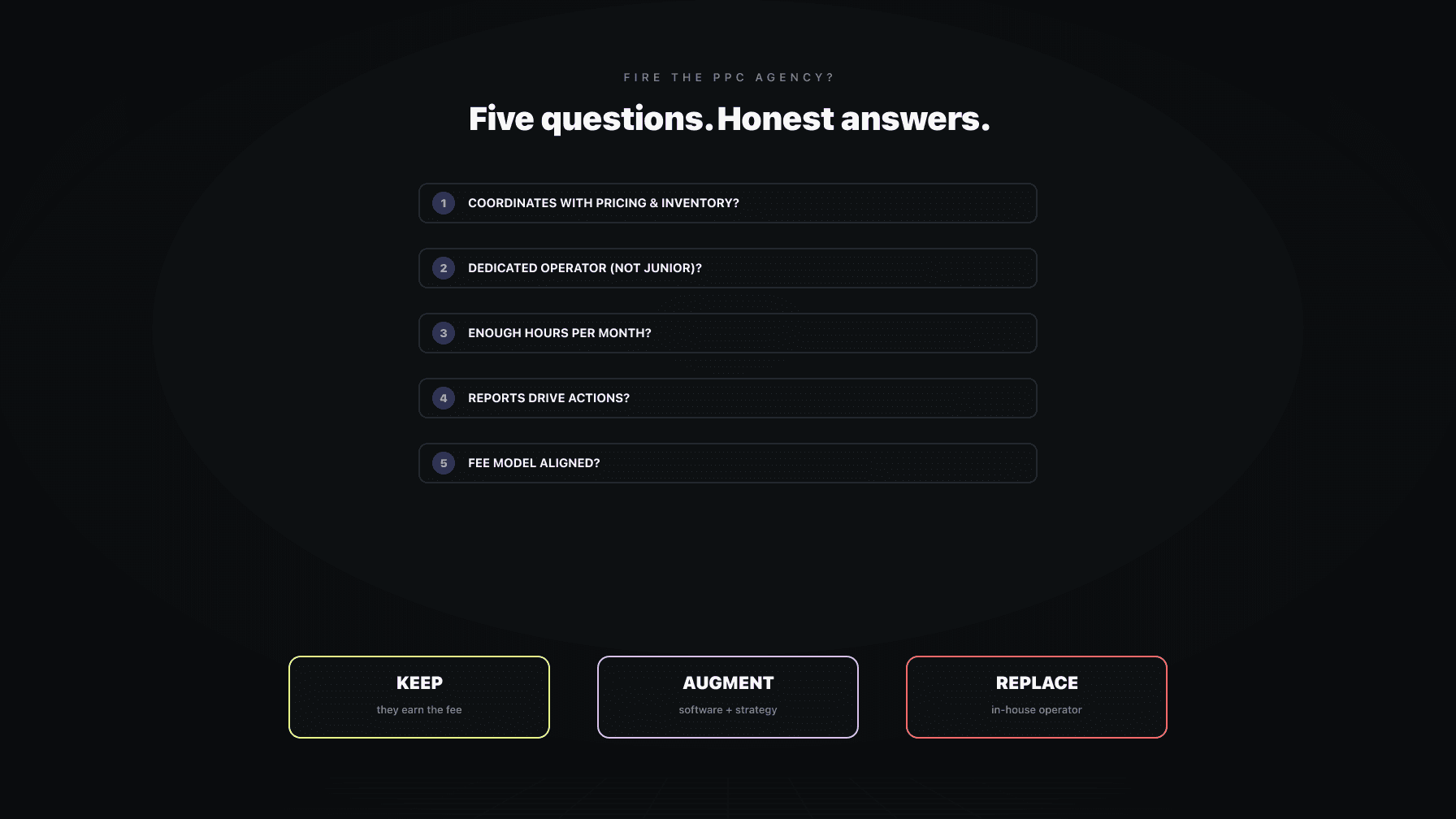
Increasingly, yes. AI PPC tools like Marko ($399/mo) can match or exceed what most agencies deliver at $8K-$15K/mo, with full transparency into every decision. Many sellers run AI alongside their agency in observe mode first to compare results before switching.
AI tools automate a single function (repricing, PPC, listings) and require you to coordinate between them. AI employees own an operational domain and coordinate with each other automatically, sharing data across pricing, PPC, inventory, and listings in real time.