Chad Rubin
May 14, 2026 · 12 min read
Operator notes by email
Short, opinionated takes on AI agents, Amazon PPC, pricing, and inventory. No fluff. About once a week.
Most sellers find out the forecast was wrong on a Tuesday afternoon, when the hero ASIN flips from "In Stock" to "Currently unavailable." By then the damage is already moving. PPC keeps spending against a buy box that is not winnable. S&S customers get their first failed renewal. BSR starts its slide. Competitors notice within hours.
A hero stockout is an asymmetric loss. The visible cost (the units you did not ship) is the smallest line on the bill. The invisible cost is the rank reset, the review aging, and the algorithm trust you spent eighteen months building. You can buy the inventory back. You cannot buy the rank back at the same speed.
Hero ASINs deserve different rules. The same days of cover target that works for a mid-tier SKU is reckless on a product that funds your business. The same PPC budget cap that protects margin on a launch can drain two weeks of inventory in a weekend. The same promo that lifts a slow mover can vaporize a hero overnight.
This is the defensive playbook. Higher targets. Bigger buffers. Earlier triggers.
If lost sales were the only cost, the math would be easy. Multiply daily units by days out of stock, subtract the inventory you did not have to buy. Sellers who run that calculation conclude stocking out occasionally is fine. The calculation is wrong.
The actual cost has four parts.
Rank reset. BSR is velocity ranking. When you stop selling, rank decays, and the decay is not linear. A hero at BSR 250 does not slide to 500 over a week. It can slide to 4,000 or worse, because the products that took your spot are reinforcing while yours collapses. When you come back, you climb from wherever you landed.
Review aging. Reviews come in while you have order momentum and stop when you stop shipping. The review mix on your detail page ages. Newer competing products with fresher reviews look more relevant to the shopper and the algorithm. Conversion drops. CTR drops. The compound effect on unit economics shows up two months later.
From reading to action
If the framework above sounds familiar, your Amazon account is probably carrying the same drag. Apply and we will show what Marko, Oracle, and Bruno would change in your first week.

Ran a 7-figure Amazon brand for a decade. Founded Skubana (acquired). Co-founded Prosper Show. 15+ years on Amazon.
Join the brands that replaced agencies and tools with AI employees.
Algorithm trust. Whether Amazon explicitly penalizes stockouts (the official line and field experience do not always agree), the system treats inconsistent availability as a risk signal. Sponsored Brands placements, badge eligibility, and recommended bids all shift around a SKU that has flickered out more than once.
Customer cost. S&S customers who experience a missed delivery cancel at higher rates. New customers who clicked an ad and hit "Currently unavailable" do not come back. The CAC on the next sale to that person is effectively infinite.
Protect the heroes harder than your spreadsheet says you need to. The carrying cost is insurance on the asset that funds the business.
Sellers confuse "best seller" with "hero." Best seller is unit count. Hero is dependency. The question is which SKUs your business cannot survive losing for a month.
Three axes.
Revenue concentration. Pull the last 90 days of sales by ASIN, sort descending, calculate cumulative percentage. Any SKU that takes you past 50% cumulative is in the hero zone. Any single SKU above 15% is a hero regardless of count.
Contribution margin concentration. Re-run on gross contribution margin. The order shifts. Some high-revenue SKUs contribute little margin due to fees, returns, or PPC dependency. The intersection of high revenue and high margin is your real hero list.
Replaceability. If this SKU went to zero for 30 days, what fraction of sales would be picked up by other SKUs in your catalog versus lost to competitors? Heroes have low replaceability. That is what makes them dangerous.
Most brands have three to seven heroes. Some have one. If you have more than ten, you have not segmented. The point is to find the SKUs that get defensive treatment and accept that the rest get standard rules.
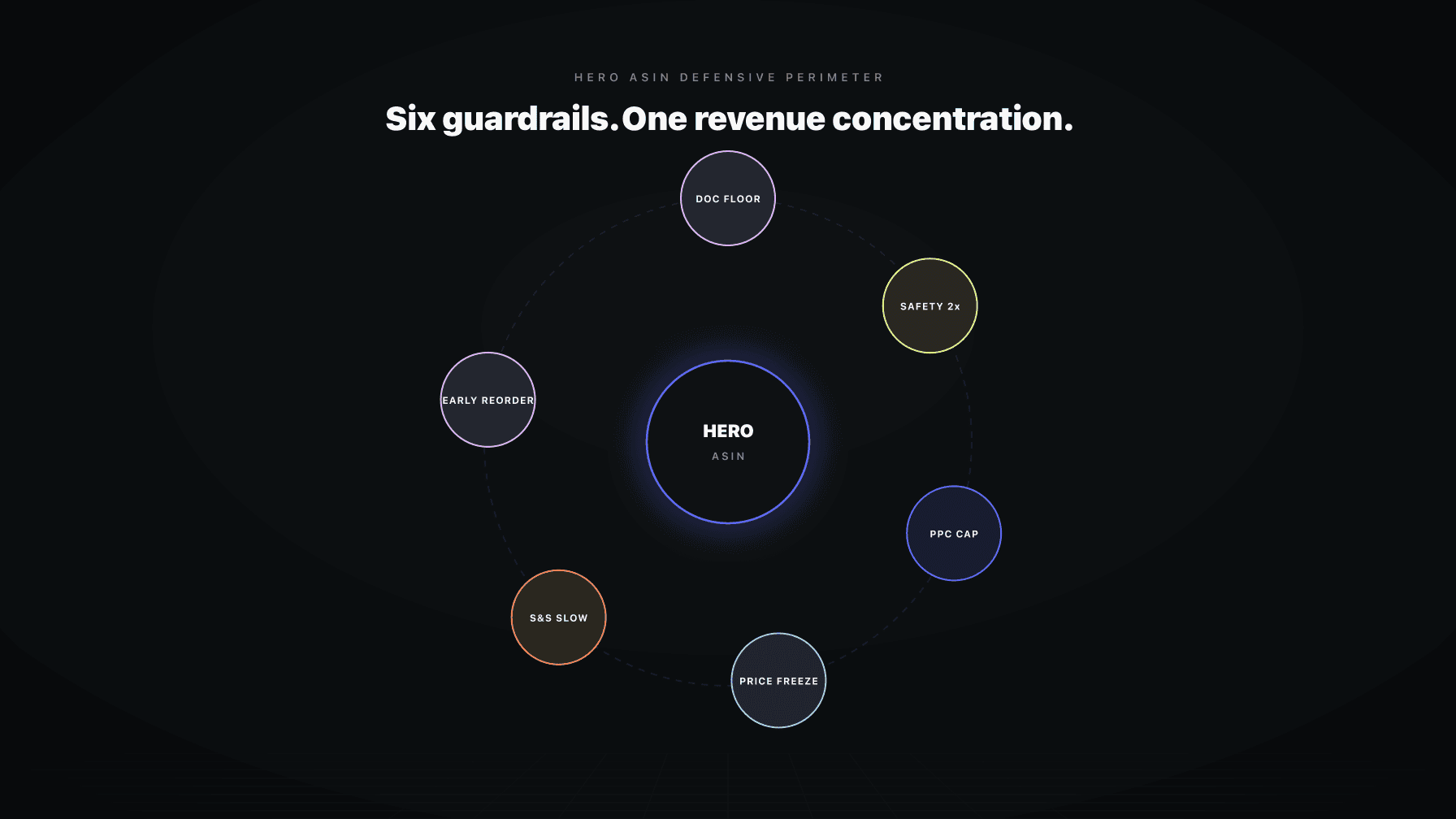
Once the hero list is locked, the rules change. Defaults for the rest of the catalog get overridden by stricter defensive defaults.
Three principles.
Higher targets. Minimum days of cover on a hero is higher. The reorder point hits earlier. The safety buffer is fatter. If your standard target is 60 days, the hero target is 90 or more.
Bigger buffers. Lead time is a distribution with a tail. On normal SKUs you plan to the mean. On heroes you plan to the 90th or 95th percentile. Production delays, port congestion, customs holds, and the FBA receive queue all have tails. Heroes are where you pay for the tail.
Earlier triggers. The condition that fires action (place a PO, freeze a promo, pull PPC budget) fires earlier on a hero. You are buying time to react before the situation becomes unrecoverable.
The next five sections are the specific triggers.
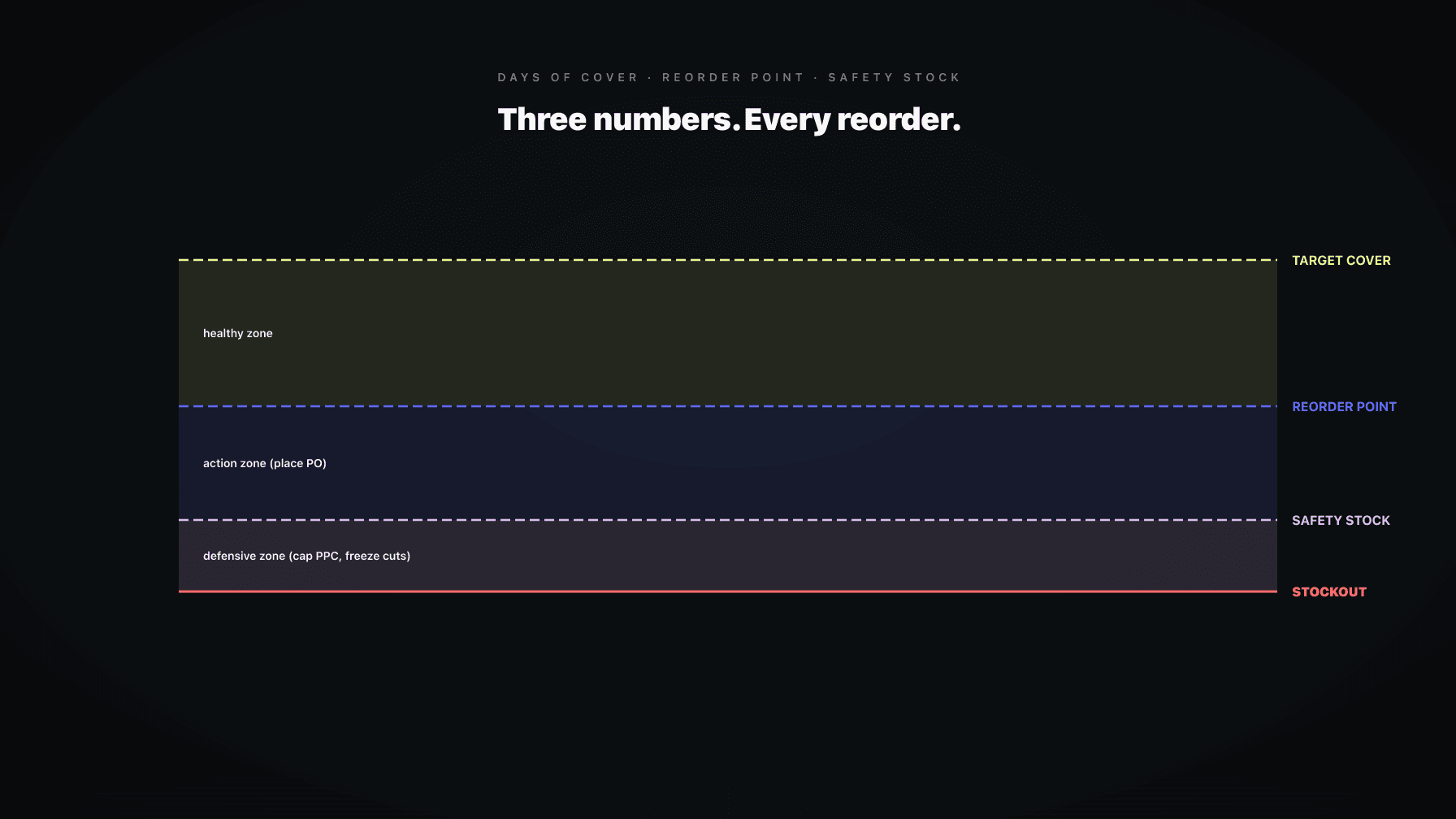
Days of cover answers "how long until I run out at current velocity." On heroes, the floor is the line below which defensive rules activate.
A starting point: 45 days of cover at FBA is the freeze line. Below 45, no inventory cuts, no promo activations, no aggressive PPC. Below 30, active pullback on demand. Below 15, hard defensive posture across every system. These numbers calibrate to lead time. Sellers with 90-day lead times need higher floors. Sellers with 30-day domestic runs can run tighter.
The floor is not a number you watch. It is a trigger that other systems read. When the hero crosses the 45-day line, the rule set fires automatically: PPC bids step down, promotions pause, price drops suspend. The response is automatic, not "we will discuss this at the Monday meeting."
This is where most sellers lose. They see the days of cover drop, they note it, and they keep running the PPC and promo cadence they set the prior month. By the time the conversation happens, the SKU is at 14 days of cover and there is nothing to do except watch it stock out.
Reorder point on a normal SKU is mean daily velocity times mean lead time plus a small safety stock. Reorder point on a hero is the same formula with a larger safety multiplier and a longer lead time assumption.
Take your historical lead times for that supplier over the last 12 months. Sort them. Use the 90th percentile, not the mean. If your supplier ships in 30 days on average but had one 55-day run, plan to 55. Tail-event lead time during a normal forecast creates the exact stockout you are trying to prevent.
The hero safety multiplier sits 1.5x to 2.5x above what you carry on mid-tier SKUs. If a normal SKU carries 14 days of safety stock, a hero carries 21 to 35. This is expensive. It is also cheaper than the rank reset.
Practical rule: reorder when current days of cover is less than 90th-percentile lead time plus hero safety multiplier. If lead time at the 90th percentile is 50 days and safety is 30, you reorder at 80 days of cover, not 60. Earlier than you want. That is the point.
PPC is the system that destroys hero inventory fastest, because it spends in real time and the inventory picture lags. A hero on thin cover with full PPC budget can lose two weeks of stock in a weekend.
The rule is tiered to days of cover.
At 60+ days: run PPC normally. Aggressive top-of-search, normal bids, normal budgets.
At 45 to 60 days: step down. Top-of-search modifier off. Bid multipliers flattened. Sponsored Brands capped. Slow velocity 10 to 20% without losing the buy box.
At 30 to 45 days: defensive PPC. Bids dropped 25 to 40%. Sponsored Display prospecting pulled. Daily budgets cut to maintenance. You are not chasing growth. You are protecting cover.
At 15 to 30 days: minimum-spend. Defend branded and hero keywords only. No prospecting, no Sponsored Brands, no aggressive bidding. The campaign exists only to keep competitors from cheaply taking the placement.
Below 15 days: PPC paused on that ASIN. Every paid click that converts is a click that accelerates the stockout and pays Amazon for the privilege.
This kind of coordination is hard to do by hand. Days of cover changes by the hour, PPC settings live in a different tool. The rule has to fire automatically, or it does not fire.
Price is the second-fastest way to destroy hero inventory, because a price cut multiplies velocity. A hero on thin cover that gets a 10% price cut can run out a week earlier than the forecast assumed.
Defensive price rule: as days of cover drops, the floor rises. The price you accept gets higher, not lower. Promotions on the hero freeze below the 45-day line. Lightning Deals, Best Deals, coupons, and S&S discount tier increases all lock out.
Counter-intuitive move: raise the price as cover thins. A 3 to 5% increase at 30 days of cover slows velocity enough to buy several days of stock and lifts margin on the units you do ship. On a true hero with strong reviews and rank, the buy box holds through a modest increase.
Mistake to avoid: do not run a planned promotion when cover is below the freeze line. Calendars are set weeks in advance. The hero might have been at 80 days when you planned the promo and at 35 days when it fires. Check the promo calendar against current cover every time. Anything below the freeze line is canceled.
S&S is a long-term flywheel and a short-term liability. Today's subscribers create scheduled demand that fires every month or two for the next year. That demand is predictable. It is also non-discretionary at fulfillment: if you are out of stock, those customers experience a failed delivery and a subset cancel.
Two-part defensive rule on heroes.
Slow acquisition when cover drops. The S&S discount tier that drives the most new subscriptions also drives velocity into the program. Below the freeze line, step the discount down (10% to 5%, for example). Existing subscriptions continue. New subscribers come in slower.
Protect existing subscriptions. The S&S base is the demand you most want to fulfill, because those are the customers most likely to cancel after a missed delivery. Model the S&S delivery schedule for the next 30 days, reserve inventory for those deliveries, and let discretionary new-customer demand absorb the shortfall. PPC and price can shut down discretionary demand. S&S deliveries cannot be shut down without canceling the subscriber.
Order of operations: kill discretionary demand first, protect subscription demand second, accept slower acquisition during the defensive window.
Defensive rules reduce the probability of a hero stockout. They do not eliminate it. Suppliers miss dates, freight gets stuck, demand spikes faster than rules can respond. When the hero goes out anyway, recovery starts the day inventory is back at FBA.
The first 14 to 28 days back are relaunch, not normal operations.
Front-load paid traffic. Bids go above normal on hero keywords to re-establish velocity so BSR climbs. Spending into rank recovery is rational because algorithm trust funds future organic sales. PPC efficiency will look bad. That is the cost.
Hold the price. Customers buying through recovery are pent-up demand. They are not price-sensitive. Discounting leaves margin on the table and lowers the anchor before organic velocity returns.
Restart S&S acquisition. The discount tier you lowered goes back to normal, or temporarily higher, to rebuild the base.
Reset reviews. Compliant inserts, follow-up requests, and post-purchase email go aggressive on the recovery cohort.
Audit the failure mode. Was the forecast wrong? Was the lead time tail longer than the safety multiplier? Did PPC fail to throttle? Each has a different fix. Without the audit, the next stockout looks identical.
Most inventory software treats every SKU as if it has the same risk profile. Same reorder math, same safety multiplier, same global forecast confidence interval.
That is wrong for the same reason a portfolio manager does not allocate the same standard deviation to every position. SKUs that fund the business carry asymmetric downside. The math has to reflect it.
Three fixes.
Tiered defaults. The system must support tiered rules by SKU class: hero, mid-tier, long tail. Each tier gets its own days of cover floor, lead time percentile, safety multiplier, and trigger thresholds.
Cross-system coordination. The days of cover signal must fire actions in PPC, pricing, and S&S, not just reorder. Tools that stop at "reorder when X" leave the hardest part to the seller, which means the rule does not fire when it needs to.
Probabilistic forecasting. A point forecast is not enough on a hero. The forecast must produce a distribution: P50, P90, P95. The defensive plan runs to P90 demand and P90 lead time, not the mean. Most legacy tools forecast the mean and call it done. That is the math that produces the stockout.
Without tiered defaults, cross-system coordination, and probabilistic forecasts, the heroes are exposed regardless of how good your spreadsheets look.
Profasee's inventory AI, Bruno, runs the defensive playbook by default on heroes. Bruno tags hero ASINs by revenue concentration, margin concentration, and replaceability, and applies tier-specific defaults: higher days of cover floor, 90th-percentile lead time planning, larger safety multipliers, earlier reorder triggers. Defaults are visible and editable.
When the days of cover signal crosses a hero threshold, Bruno coordinates with Marko (PPC) and Oracle (pricing). Marko steps PPC bids and budgets down on the tiered schedule. Oracle freezes promotions, locks the price floor, and steps the S&S discount tier down. The defensive posture activates across systems on the same data, without anyone switching tools.
When a hero stocks out, the recovery playbook fires when inventory returns. Marko ramps PPC into rank recovery. Oracle holds price and restarts the S&S discount. Bruno audits the failure mode and updates the safety multiplier for the next cycle.
The point is not that automation replaces judgment. The point is that on SKUs that fund your business, the rules have to fire when they need to fire, on whichever day that happens. Manual systems miss the trigger more than they catch it.
More on how the AI employees coordinate: Demand Planner, PPC Manager, Pricing. Full inventory product: Amazon Inventory Management. Pricing. To check whether your heroes are exposed, apply here.
A hero is a SKU your business cannot afford to lose. Identify them with three analyses: cumulative revenue concentration (SKUs that get you to 50% of revenue), contribution margin concentration (re-run on margin), and replaceability (if this SKU went to zero for 30 days, would other SKUs absorb the demand or would it go to competitors). Most brands have three to seven heroes. Any single SKU above 15% of revenue is a hero regardless of count.
Starting point: 90 days at FBA, with a 45-day freeze line where defensive rules fire. Calibrate to lead time. If your 90th-percentile lead time is 60 days, the floor goes higher. If you run 30-day domestic production, you can run tighter. The principle: the floor is high enough that you can react before it turns into a stockout.
Treat the first 14 to 28 days back as a relaunch. Front-load PPC into hero keywords above normal bid levels to rebuild velocity and rank. Hold price. Do not discount in the recovery window. Restart S&S acquisition at normal or temporarily elevated tier. Get aggressive on review generation through compliant follow-up. Audit the failure mode and update the rules so it does not repeat.
Tier the response. 60+ days: run normally. 45 to 60 days: step down top-of-search and Sponsored Brands. 30 to 45 days: drop bids 25 to 40% and pull Sponsored Display prospecting. 15 to 30 days: defensive branded and hero keywords only. Below 15 days: pause PPC on that ASIN. The rule fires automatically on the days of cover signal, not through Monday meetings.
1.5x to 2.5x what you carry on mid-tier SKUs. If a normal SKU carries 14 days of safety stock, a hero carries 21 to 35. Plan against the 90th percentile of historical lead time, not the mean. The carrying cost is insurance on the asset that funds your business. Cheaper than the rank reset.
Two moves. Slow new S&S acquisition before the stockout by lowering the discount tier when days of cover crosses the freeze line. Protect existing subscriptions by modeling the S&S delivery schedule for the next 30 days and reserving inventory for those deliveries. Kill discretionary PPC and promo demand first. After recovery, restart S&S acquisition at normal or temporarily elevated tier to rebuild the base.
FBM as a stockout bridge works if you can ship from a 3PL or your own warehouse at competitive Prime-eligible speeds and your account is in good standing for Seller Fulfilled Prime. The trigger is usually when FBA will run out before the next shipment arrives. FBM keeps the listing live, preserves BSR momentum, and protects S&S customers from a failed delivery. The cost is lower margin and slower fulfillment. As a defensive measure on a hero, the trade is usually worth it. As permanent posture, FBM has separate trade-offs.