Chad Rubin
May 31, 2026 · 14 min read
Operator notes by email
Short, opinionated takes on AI agents, Amazon PPC, pricing, and inventory. No fluff. About once a week.
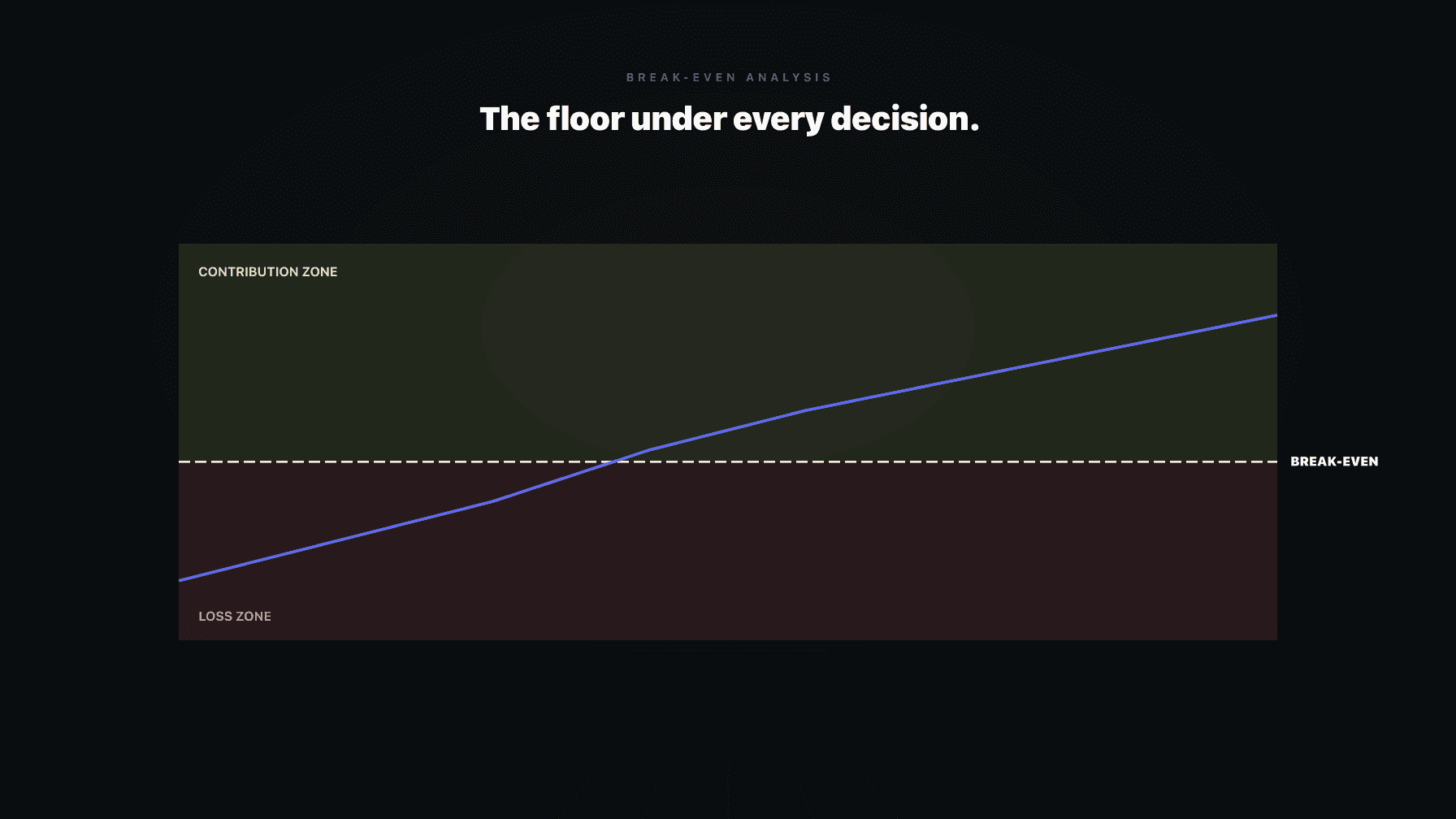
Break-even is the floor under every decision you make on Amazon. It sits beneath pricing, beneath PPC bids, beneath every promotion you green-light. Cross it and you are paying customers to take your product. Stay above it and you have, at minimum, covered your costs. That is the entire job of break-even: it tells you where the cliff is.
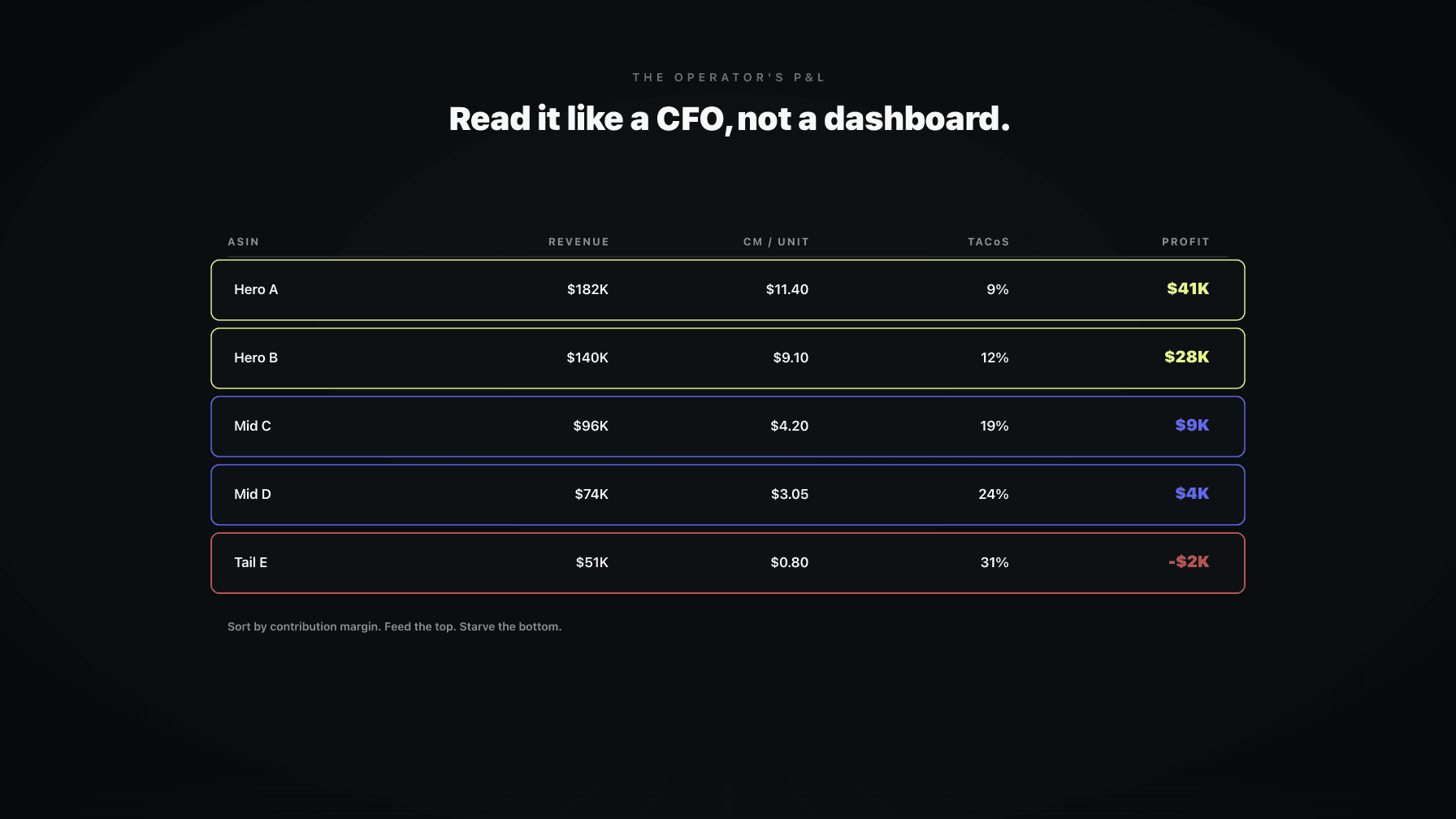
Here is the problem. Most operators cannot name their break-even per ASIN. They can quote a gross margin off a spreadsheet that is a year old. They can tell you what they paid the factory. But ask them the actual price below which a sale destroys money, after fees, returns, storage, and the ad cost of acquiring that order, and they go quiet. If you cannot name the number, you are guessing where the cliff is. And guessing where the cliff is means you find it the expensive way, by walking off it.
A repricer with the wrong floor is worse than no repricer. A PPC campaign with no break-even ACoS in mind is a budget with no brakes. A promotion run without knowing the break-even is a discount that might be a customer-acquisition investment or might be a slow leak, and you will not know which until the quarter closes. None of these tools is the problem. The missing number underneath them is.
This post is the operator math for break-even on Amazon. Not the textbook version where break-even is just COGS plus the FBA fee. The version that includes the costs that actually move, with worked examples using illustrative numbers so you can swap in your own. By the end you will know how to calculate break-even price, break-even ACoS, and how to keep both current as fees and costs shift underneath you.
From reading to action
If the framework above sounds familiar, your Amazon account is probably carrying the same drag. Apply and we will show what Marko, Oracle, and Bruno would change in your first week.

Ran a 7-figure Amazon brand for a decade. Founded Skubana (acquired). Co-founded Prosper Show. 15+ years on Amazon.
Join the brands that replaced agencies and tools with AI employees.
Break-even is the point where contribution margin equals zero. One more dollar of price above it and you start contributing to fixed costs and profit. One dollar below it and the unit is sold at a loss before a single overhead dollar is covered.
The trap is treating break-even as the price below which you stop selling. That is not what it is. Break-even is the price below which selling another unit destroys money. Those sound the same. They are not. Plenty of sellers keep listings live at prices that lose money on every order because the dashboard shows revenue and the brain registers revenue as good. Revenue without margin is theater.
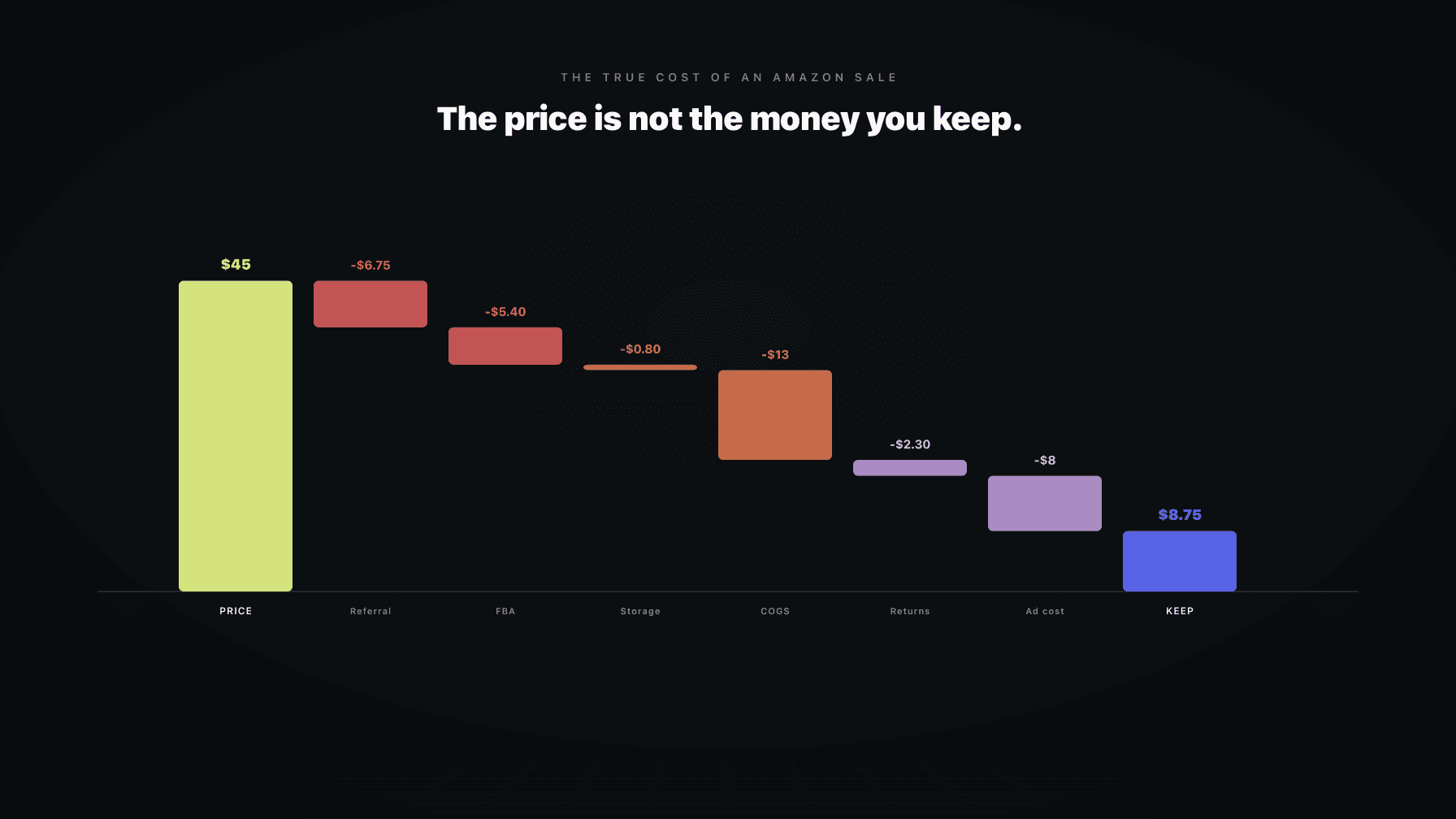
On Amazon specifically, break-even is harder to pin down than in most channels because the cost stack is deep and some of it is variable. You have the obvious line items (product cost, the FBA fulfillment fee, the referral fee). Then you have the ones that hide: returns and the reimbursement gap on them, monthly storage, long-term storage surcharges, the per-unit cost of inbound freight and prep, and the advertising spend it takes to generate the order in the first place. Leave any of those out and your break-even is fiction. A pretty fiction, but fiction.
If you want the full anatomy of what one Amazon sale actually costs, the true cost of an Amazon sale breakdown lays out every line item. For this post, assume you have those numbers and we will turn them into a usable floor.
Break-even price is the selling price at which contribution margin per unit hits zero. The structure:
Break-even price = (per-unit variable costs) / (1 − referral fee percentage)
The referral fee is a percentage of price, which is why it cannot just be subtracted as a flat number. It scales with whatever price you set, so it belongs in the denominator. Everything else is a per-unit dollar cost.
Here is a worked example with illustrative numbers. Imagine a product with the following per-unit costs:
That is $13.95 in per-unit variable cost before the referral fee. Now the referral fee. Assume a 15% referral category.
Break-even price = $13.95 / (1 − 0.15) = $13.95 / 0.85 = $16.41
So $16.41 is the price at which this unit contributes exactly zero, with no advertising attached. Sell at $16.41 and Amazon takes its 15% referral ($2.46), you cover your $13.95 of variable cost, and you walk away with nothing. Sell at $16.40 and you are paying for the privilege.
Notice what is not in that number yet: advertising. If a meaningful share of your orders come through PPC, the ad cost per unit raises your effective break-even. That is the bridge to the next number, which is where break-even gets genuinely useful. For the underlying margin mechanics, the contribution margin per unit guide is the companion to this section.
Break-even ACoS is the advertising cost of sale at which an ad-driven order contributes exactly zero. It is the most useful number in the entire account, and almost nobody calculates it.
The formula is short:
Break-even ACoS = contribution margin percentage (before ad spend)
That is it. If, at a given price, every unit contributes 30% of its price to margin before any advertising, then your break-even ACoS is 30%. Spend 30% of the sale price to acquire that order and the order nets zero. Spend more and the order loses money. Spend less and the order is profitable.
This single number turns PPC from a vibe into arithmetic. Without it, sellers stare at ACoS reports and ask, "Is 28% good?" The honest answer is: it depends entirely on your break-even ACoS. If your break-even ACoS is 35%, then 28% is profitable and you might even have room to bid harder. If your break-even ACoS is 22%, then 28% means every one of those ad-driven orders is bleeding, and the cleaner the campaign looks (high spend, high "efficiency") the faster it bleeds.
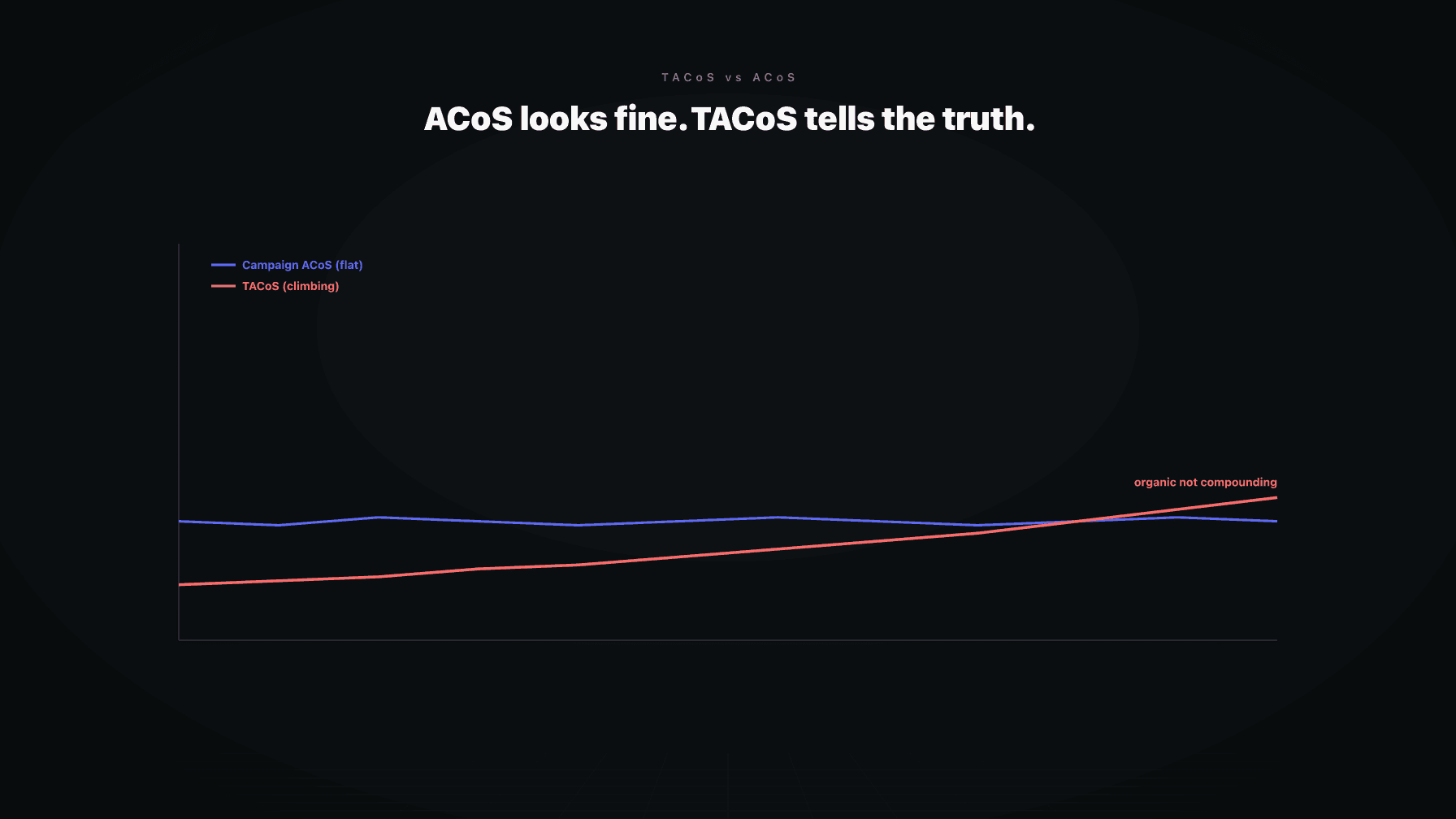
Break-even ACoS also reframes the relationship between price and ad tolerance. Raise your price and your contribution margin percentage goes up, which lifts your break-even ACoS, which lets you bid harder and win more placement profitably. Drop your price and the opposite happens: your break-even ACoS shrinks and your ads suffocate. Price and PPC are not two departments. They are one system. This is why total advertising cost of sale matters at the account level too, covered in TACoS explained.
Take the same product, now priced for sale rather than at the floor. Say you list it at $24.99.
Start with the contribution margin before advertising:
Now the contribution margin percentage:
$7.29 / $24.99 = 29.2%
So break-even ACoS at a $24.99 price is roughly 29%. That means you can spend up to about $7.29 per ad-attributed order ($24.99 × 0.292) before the order goes underwater. Any bid that produces orders at an ACoS under 29% adds money. Any campaign averaging above 29% is a loss generator dressed up as growth.
Now watch what a price change does. Raise the price to $27.99. Referral fee climbs to $4.20, variable cost stays at $13.95, contribution before ads becomes $9.84, and contribution margin percentage rises to 35.2%. Your break-even ACoS just jumped from 29% to 35%, and your maximum profitable spend per order went from $7.29 to roughly $9.85. A $3 price increase bought you six points of ad headroom. That is the kind of compounding that makes pricing and PPC inseparable, and it is the math behind the operator line that a 1% price change moves contribution by far more than 1%.
The most common floor error is setting it at COGS plus the FBA fee and calling it safe. That floor is wrong in both directions of the cost stack. It ignores the referral fee scaling with price, and it ignores returns, storage, freight, and advertising. A seller who floors a repricer at "cost plus fulfillment" is floored well below true break-even and does not know it.
A correct floor starts at break-even price and then adds a minimum contribution margin on top. You do not want your repricer driving price down to the exact break-even, because exact break-even means you do all the work, carry all the risk, tie up all the capital, and contribute zero. That is not a floor. That is volunteering.
So the operator floor is: break-even price plus your minimum acceptable contribution per unit. If your break-even is $16.41 and you require at least $3 of contribution per unit even in your most aggressive defensive scenario, your repricer floor is $19.41, not $16.41 and certainly not the $13.95-ish "cost plus FBA" number. The full mechanics of setting floors and ceilings, including how a defensive floor differs from a profit-target ceiling, are in repricing floor and ceiling math.
A floor below true break-even is the most dangerous setting in your account precisely because it feels like a system. It runs automatically, it looks like discipline, and it loses money on every order it touches. A repricer with a wrong floor is worse than no repricer, because no repricer at least makes you look at the price by hand.
If break-even ACoS is your ceiling on ad efficiency, it is also your translation tool for bids. The maximum profitable cost per acquisition on an ad-driven order is your contribution dollars before advertising. Spend up to that number and the order breaks even on the ad. Spend less and the order profits.
From the worked example, the maximum profitable ad spend per order at a $24.99 price was about $7.29. That figure, not a gut feeling, is what should anchor your bids. If your conversion rate on a keyword is 10%, then ten clicks produce one order, and your maximum profitable cost per click on that keyword is $7.29 / 10 = $0.73. Bid above $0.73 on that term and, at that conversion rate, the orders it produces lose money.
Most sellers bid by watching ACoS after the fact and nudging. The operator move is to derive the maximum profitable bid from break-even ACoS and conversion rate before the spend happens. It also tells you when a keyword is simply unwinnable at a profit: if the market clearing bid for a term is $1.50 and your math says $0.73 is your ceiling, you do not "optimize" that campaign. You stop bidding on that term, or you raise price to lift your break-even ACoS enough to afford it. This is the discipline an automated PPC manager is supposed to enforce, and it can only enforce it if break-even ACoS is fed in correctly.
Promotions are where break-even gets ignored most casually. A 20% off coupon stacked on top of a price that already carried a thin margin can punch straight through break-even without anyone noticing, because the discount looks like a marketing line and break-even lives in a different spreadsheet.
Run the math before the promo, not after. Take your selling price, subtract the promo discount, recompute contribution margin at the discounted price, and check it against break-even. If a $24.99 product goes to $19.99 with a coupon, recompute: referral on $19.99 is $3.00, variable cost is still $13.95, so contribution drops to $3.04, or 15.2%. The product is still above break-even, but barely, and there is now almost no room for ad spend on top. Layer a PPC push onto a deep promo and you can easily drive the blended order below break-even while the dashboard shows a glorious spike in units.
Sometimes going below break-even on a promo is the right call. Clearing aging inventory before a long-term storage surcharge hits is a legitimate reason to take a controlled loss. So is a launch push or a ranking defense. The rule is simple: below break-even is allowed when it is a decision with a known per-unit cost and a defined end date. It is never allowed as an accident, which is what it usually is.
Here is the part that bites operators who set break-even once and forget it. Amazon moves your costs without telling you in any way that reaches your pricing logic.
A referral fee category gets reclassified. An FBA fulfillment tier gets re-bracketed because your product crossed a dimensional weight threshold. A storage rate goes up for the Q4 months. A fuel and inflation surcharge gets layered on. Each of these raises your true break-even, and none of them sends a signal to your repricer or your bid manager. Your floor is now too low and your break-even ACoS is now too high, and every order that runs against the stale numbers leaks a little.
The damage is quiet and cumulative. A 40-cent FBA fee increase on a product doing a few thousand units a month is over a thousand dollars of contribution gone, every month, silently, until someone notices the margin drift in the P&L two quarters later and cannot explain it. The cause was a fee change that moved break-even and a pricing system that never recalculated. Keeping the Amazon P&L honest depends on break-even being recomputed every time a cost input moves, and the inputs move more than you think.
Break-even is not a number you compute at launch and engrave. It is a live number that drifts every time any input changes, and the inputs change constantly: COGS as you re-order at new factory pricing, freight as ocean rates swing, FBA and referral fees as Amazon adjusts them, return rates as your mix and quality shift, storage as your inventory ages.
Set a cadence. Recalculate break-even quarterly at the absolute slowest. Recalculate it immediately on any of these triggers: a new COGS from a purchase order at a different price, any Amazon fee change announcement, a freight rate change, a measurable shift in return rate, or a product dimension change that could move the FBA tier. The cadence is the discipline. Treat break-even like an audit item, not a one-time calculation, and refresh the worked numbers on the same schedule you refresh your unit economics.
The operator who recalculates on a cadence catches fee drift in week one. The operator who set it and forgot it catches it in the quarterly review, after the leak has been running for ninety days.
Launches are the one place where selling below break-even is part of the plan, not a failure. You want velocity and reviews early, which means aggressive pricing and aggressive bidding, which means orders that lose money on purpose to buy ranking and social proof.
The discipline is to make the loss deliberate and bounded. Before launch, decide three things: the per-unit loss you are willing to absorb, the total budget that loss represents (per-unit loss times target units), and the date the window closes. "We will run $4 below break-even per unit for the first 600 units or 45 days, whichever comes first, for a maximum planned investment of $2,400" is a launch plan. "We are pricing low and bidding hard to get going" is not a plan, it is a hole.
The reason break-even matters even during a deliberate loss is that it is the measuring stick. You can only know you are $4 under break-even per unit if you have computed break-even correctly. Sellers who launch without knowing their break-even cannot tell the difference between a $4 deliberate investment and a $9 accidental hemorrhage. The launch loss should converge back toward break-even-plus-margin on a schedule, and break-even is the line you are converging back to.
Break-even only protects you if it is wired into the systems making decisions in real time, not sitting in a spreadsheet you open quarterly.
Profasee Oracle floors price at break-even plus your minimum contribution margin, recomputed against live fee and cost inputs, so the repricer can never drive price into the loss zone. The floor is not a static dollar value you typed in once and forgot. It moves as your costs move, which is the only way to avoid the silent fee-drift leak described above. That is the difference between Amazon pricing software that protects margin and a repricer that just chases the buy box. The same logic powers the pricing AI employee.
Marko, the PPC side, caps bids at your break-even ACoS, derived from the current contribution margin at the current price. Because price and break-even ACoS are linked, Marko's ceiling moves automatically when Oracle moves price. Raise price, gain ad headroom, bid harder where it pays. The two systems share one underlying truth: contribution margin, and the break-even points it produces.
If you want a system that holds the floor and the ad ceiling for you instead of recalculating by hand, see pricing and how Profasee works or apply to work with us.
Break-even is the selling price at which a unit contributes exactly zero, after all variable costs: product cost, inbound freight and prep, the FBA fulfillment fee, the referral fee, a returns allowance, and storage. Above it you contribute to overhead and profit. Below it you lose money on every order. It is the floor under pricing, PPC, and promotions, which means if you cannot name it per ASIN you are guessing where the cliff is.
Break-even ACoS equals your contribution margin percentage before ad spend. Take your selling price, subtract the referral fee and all per-unit variable costs to get contribution dollars, then divide by the selling price. If a unit contributes 29% of its price before advertising, your break-even ACoS is 29%. Spend exactly 29% of the sale price to acquire an ad-driven order and that order nets zero. Spend less and it profits. Spend more and it loses.
Break-even price is a dollar figure: the price at which a unit contributes zero with no advertising attached. Break-even ACoS is a percentage: the share of the sale price you can spend on ads before an ad-driven order contributes zero. Break-even price floors your repricer. Break-even ACoS caps your bids. They come from the same contribution math but answer two different questions, one about pricing and one about PPC.
No. Your floor should be break-even plus a minimum contribution margin. Setting the floor at exact break-even means the repricer can drive price to the point where you do all the work and carry all the risk for zero contribution. The floor should guarantee a minimum profit per unit even in your most aggressive defensive scenario, so it sits above break-even by whatever minimum margin you require.
Only when it is a deliberate, bounded decision: a product launch buying velocity and reviews, a ranking defense, or clearing aging inventory ahead of a long-term storage surcharge. In each case, decide the per-unit loss, the total budget that loss represents, and the date the window closes before you start. Below break-even is fine as a known investment with an end date. It is never fine as an accident, which is what an unmanaged promo or stale floor usually produces.
They raise it silently. A referral category reclassification, an FBA tier re-bracket, a storage rate hike, or a fuel and inflation surcharge all increase your per-unit cost and therefore your break-even, and none of them sends a signal to your repricer or bid manager. Your floor becomes too low and your break-even ACoS becomes too high, and orders leak against the stale numbers until the margin drift shows up in the P&L a quarter or two later.
Quarterly at the slowest, and immediately on any trigger: a new COGS from a purchase order at different pricing, an Amazon fee change, a freight rate swing, a measurable shift in return rate, or a product dimension change that could move the FBA tier. Treat break-even as a live audit item, not a one-time launch calculation. The operator who recalculates on a cadence catches fee drift in week one. The one who set it and forgot it catches it after ninety days of leakage.