Chad Rubin
May 29, 2026 · 12 min read
Operator notes by email
Short, opinionated takes on AI agents, Amazon PPC, pricing, and inventory. No fluff. About once a week.
Most sellers live inside campaign ACoS. They open the advertising console, see a number in the low twenties, and decide the account is healthy. The campaigns are profitable, the bids are working, the spend is converting. Nothing in that view tells them the business is sliding. That is the trap. Campaign ACoS is a tactical number. It tells you whether a campaign is efficient at the moment you look. It does not tell you whether the business is getting healthier or sicker over time.
TACoS is the number that does. Total ACoS divides your ad spend by your total revenue, not just the revenue your ads generated. That one change in the denominator turns a tactical metric into a strategic one. ACoS asks whether your ads are efficient. TACoS asks whether they are still necessary. Those are different questions, and the gap between them is where most brands quietly lose ground.
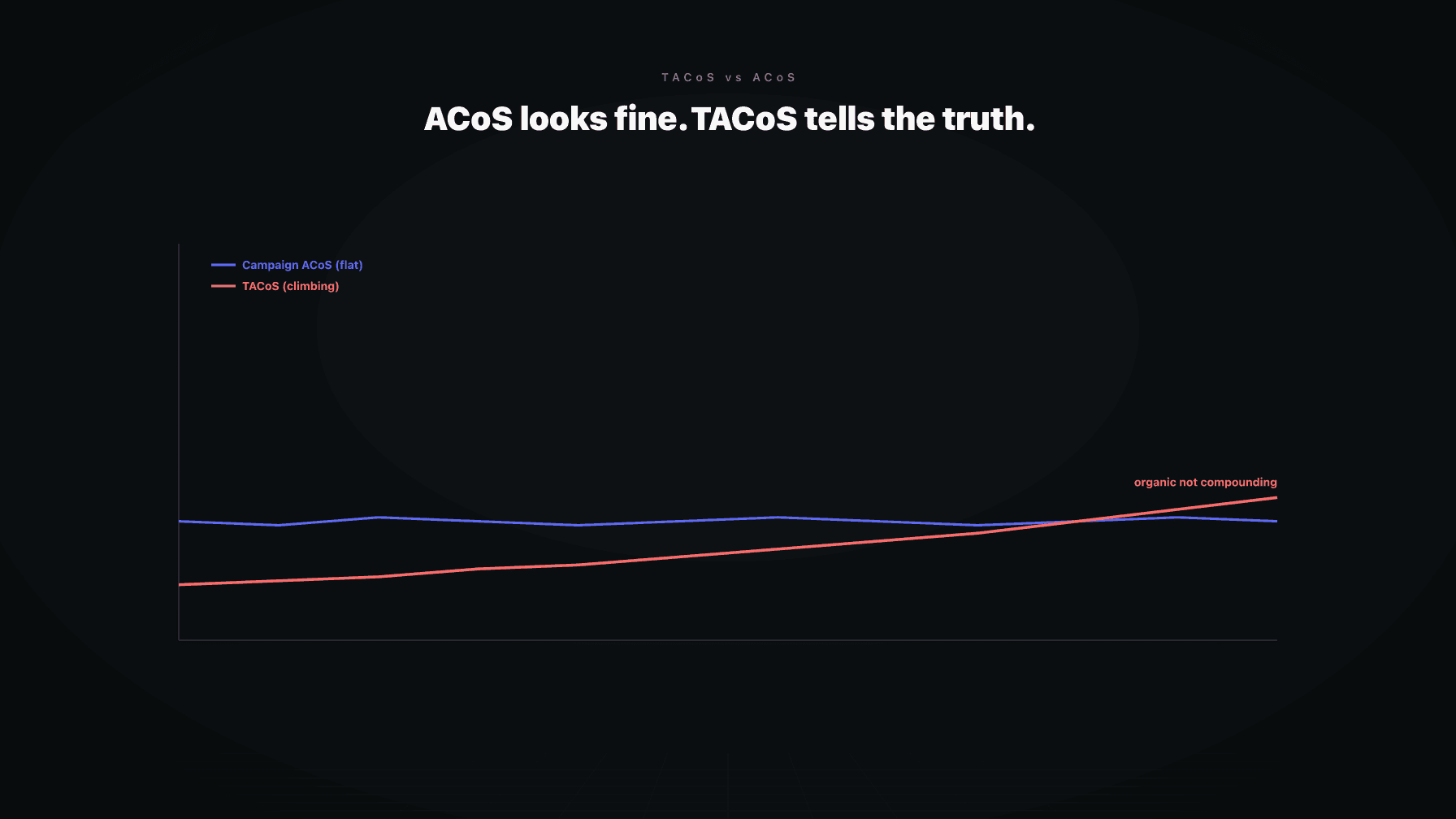
Here is the failure mode in one sentence. Your campaign ACoS can sit at 22% for six straight months while your TACoS climbs from 8% to 15%, which means your organic sales are eroding and your ads are working harder every month to hold the same topline. The ads look fine. The business is not. The only metric that shows it is the one most sellers never track.
This guide is the operator framing I use to read TACoS. It is not a benchmark hunt. There is no single magic number. TACoS is a trend you read against where a product sits in its lifecycle and what its margin can absorb.
## Key takeaways >- Campaign ACoS divides ad spend by ad-attributed sales. TACoS divides ad spend by total sales. The denominator is the whole point.- ACoS is tactical (is this campaign efficient right now). TACoS is strategic (is the business getting healthier or more dependent on ads over time).- Campaign ACoS can hold steady for months while TACoS climbs, which means organic sales are eroding and ads are doing more of the work.- There is no single good TACoS. The right number depends on lifecycle stage (launch, growth, mature) and the contribution margin the product can absorb.- A falling TACoS over months on a mature ASIN means ad spend is buying organic rank that holds without paying for it again. A rising one is an early warning, usually a rank, listing, competitor, or price problem.- TACoS only makes sense read next to contribution margin. A low TACoS on a thin-margin product can still lose money.
ACoS is ad spend divided by ad-attributed sales. If you spend $1,000 on ads and those ads drive $4,000 in sales, your ACoS is 25%. It answers one question: of the sales my ads directly caused, how much did I pay. Useful for tuning a campaign, useless for judging the business, because it has no idea your organic sales exist.
TACoS is ad spend divided by total sales, organic and paid combined. Same $1,000 in spend. But if your total sales were $10,000 (the $4,000 from ads plus $6,000 organic), your TACoS is 10%. The number got smaller because the denominator got bigger, and the bigger denominator is the truth. It includes the sales you did not pay for.
From reading to action
If the framework above sounds familiar, your Amazon account is probably carrying the same drag. Apply and we will show what Marko, Oracle, and Bruno would change in your first week.

Ran a 7-figure Amazon brand for a decade. Founded Skubana (acquired). Co-founded Prosper Show. 15+ years on Amazon.
Join the brands that replaced agencies and tools with AI employees.
That is the entire insight. ACoS measures the efficiency of the spend you can see. TACoS measures the role advertising plays in the whole business, including the part that runs without you paying per click. When organic is strong, TACoS sits well below ACoS. When organic is weak, TACoS climbs toward ACoS, because you are paying for nearly everything you sell. ACoS can be perfect on a dying product. TACoS cannot hide that.
The math is simple. The reading is not.
```
ACoS = ad spend / ad-attributed sales
TACoS = ad spend / total sales (organic + paid)
```
Take an ASIN at $40 a unit. In a steady month it does $50,000 in total sales: $15,000 from ads, $35,000 from organic. The seller spent $3,300 on ads to get the $15,000.
Campaign ACoS is $3,300 / $15,000, which is 22%. Looks healthy. TACoS is $3,300 / $50,000, which is 6.6%, lower because organic is carrying 70% of the revenue. This is what a strong product looks like: the gap between ACoS and TACoS is wide.
Now hold ACoS constant and watch organic erode. Six months later, same ASIN, same 22% ACoS, same $40 price. But organic has slipped to $20,000 and the seller is leaning harder on ads. Ad-attributed sales are now $25,000, ad spend is $5,500 (still 22% ACoS), total sales $45,000. TACoS is $5,500 / $45,000, which is 12.2%. The campaign number did not move. TACoS nearly doubled, and the topline dropped despite spending more.
Nothing in the advertising console flagged this. The ACoS report was green all six months. The only number that caught it was the denominator, which includes the organic sales bleeding out from under the account. That is why you watch the TACoS trend, not just its level.
Campaign ACoS is a snapshot of efficiency on the sales ads touched. It is blind to two things that decide whether you actually make money: your organic sales and your margin.
Start with organic. ACoS does not know whether organic is rising, flat, or falling, because organic sales are not in its math. You can hold a perfect ACoS while organic quietly collapses, and the only symptom inside the ad console is that you keep needing more spend to hit the same sales. Sellers read that as "scale up the campaigns" when the right read is "my organic rank is gone and I am renting sales I used to own."
Then margin. A 22% ACoS is wildly profitable on a 45% margin product and underwater on an 18% one. Same number, opposite outcome. ACoS does not carry margin, so it cannot tell you which case you are in. The number hits, the cash does not.
Put the two together and you get the situation that ruins quarters. Margin is thin, organic is slipping, ACoS holds at target, and the operator keeps spending in because the dashboard says the campaigns are fine. They are fine, as campaigns. The business around them is not. TACoS connects the spend to the whole revenue base, so it is the first place erosion shows up while you can still act on it.
TACoS only means something against where a product sits in its life. The same number is good news in one stage and an alarm in another.
At launch, TACoS should be high. You have little or no organic rank, so almost every sale comes from ads. A launch TACoS of 25%, 35%, even 50% is normal and often correct. You are buying velocity and reviews to earn rank you do not have yet. The question is not "is TACoS low." It is "is TACoS falling," because that fall is the proof the ad spend is converting into organic position.
In growth, TACoS should be trending down. Organic rank is building, the denominator is growing faster than spend, and each month a larger share of revenue comes for free. If TACoS is flat or rising here, the spend is not building rank that sticks.
At maturity, TACoS should be low and stable. The product has established rank, organic carries most of the revenue, and ads play a defensive role. A mature ASIN running a 5% to 9% TACoS is doing what it should. Watch not the level but any sustained climb, because on a mature product that almost always means something underneath has broken.
A healthy TACoS trend is a downward slope over months, not a low number on a single day. You launch high, it falls through growth, and it settles into a low stable band at maturity. That curve is the proof that your ad spend bought organic rank and the rank is holding without you paying for it again.
The wide gap between ACoS and TACoS is the other tell. On a healthy product, campaign ACoS might run 20% to 25% while TACoS sits at 6% to 9%. That gap is your organic engine, and the wider it is, the less dependent the business is on the ad account. The product you want is the one where you could cut ad spend modestly and watch total sales barely move. That is an ad spend that built something instead of renting it.
This is the alarm you want to catch, because it fires early. On a mature product with established rank, a sustained TACoS climb is almost never an advertising problem. The climb means the denominator is shrinking, which means organic sales are slipping, which means something upstream of the ad account changed.
The usual suspects, in rough order. Organic rank slipped, often after a stockout dropped your velocity and the algorithm reassigned your position. A competitor moved in on your main keywords. Your listing degraded: a hijacked title, lost A+ content, a buy box you no longer own, a review average that dipped under a threshold shoppers screen on. Or price moved against you and conversion fell.
Rising TACoS is valuable because of timing. Revenue is a lagging signal. By the time the topline visibly drops, you have already lost weeks of rank, and rank is far harder to win back than to defend. TACoS turns up before revenue turns down, because you start spending more to defend the same sales before the defense fails. Treat a sustained climb on a mature ASIN as a trigger to look at rank, listing, competitors, and price, not as a reason to bid harder.
There is no single good TACoS. The question usually means the asker wants a benchmark to grade against instead of a business to read. The honest answer is a range that depends on stage and margin. As rough operating bands, illustrative and not gospel:
Two cautions. They bend hard with margin: a 40%-plus margin product can run a higher TACoS at every stage and still print cash, while a thin-margin product has to run leaner everywhere. And they bend with strategy: if you are defending a category-leader position against a funded competitor, a temporarily higher mature TACoS can be the right call. The number is a reading, not a rule. Set the target against the product's job and its margin, not someone else's screenshot.
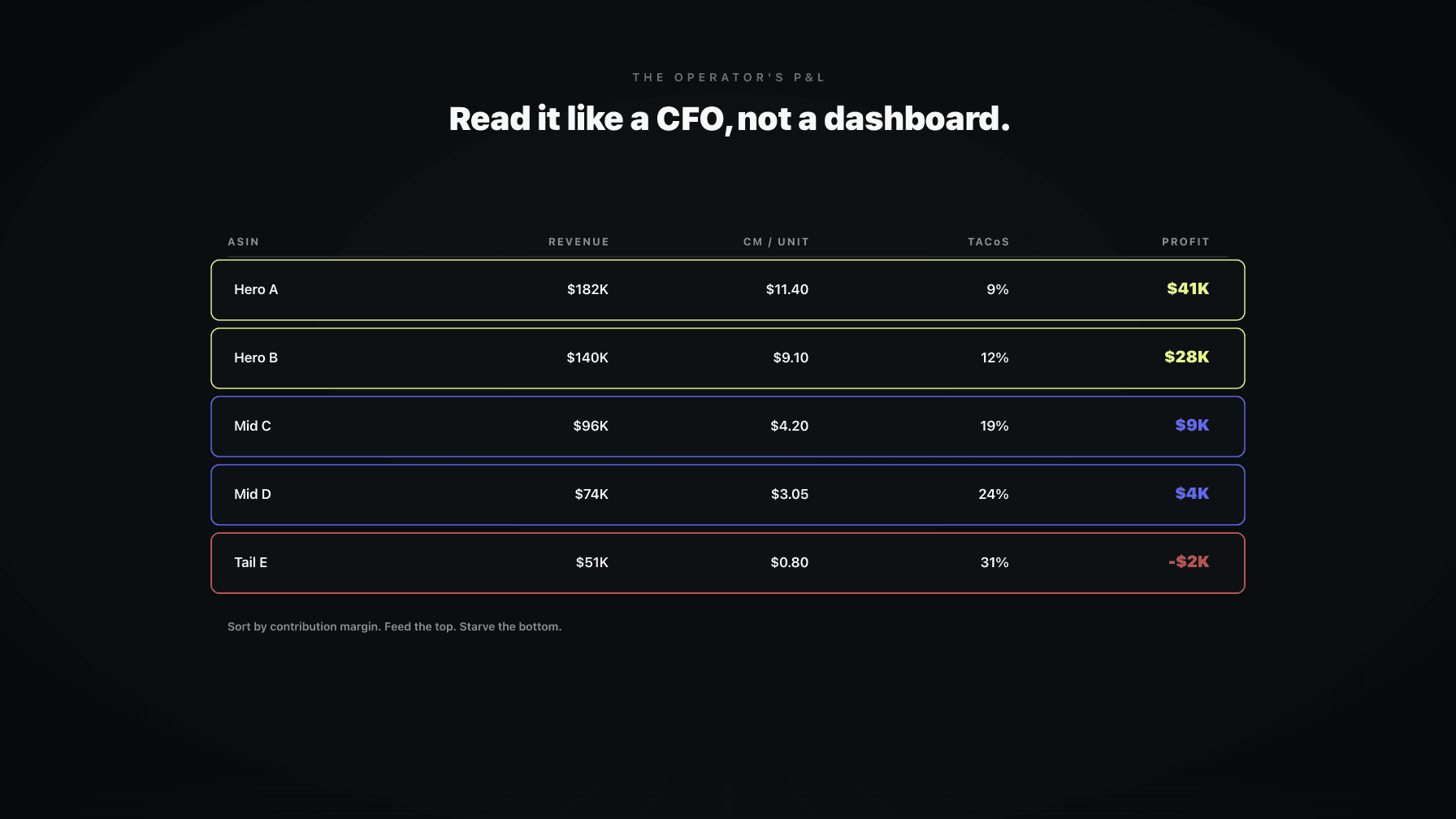
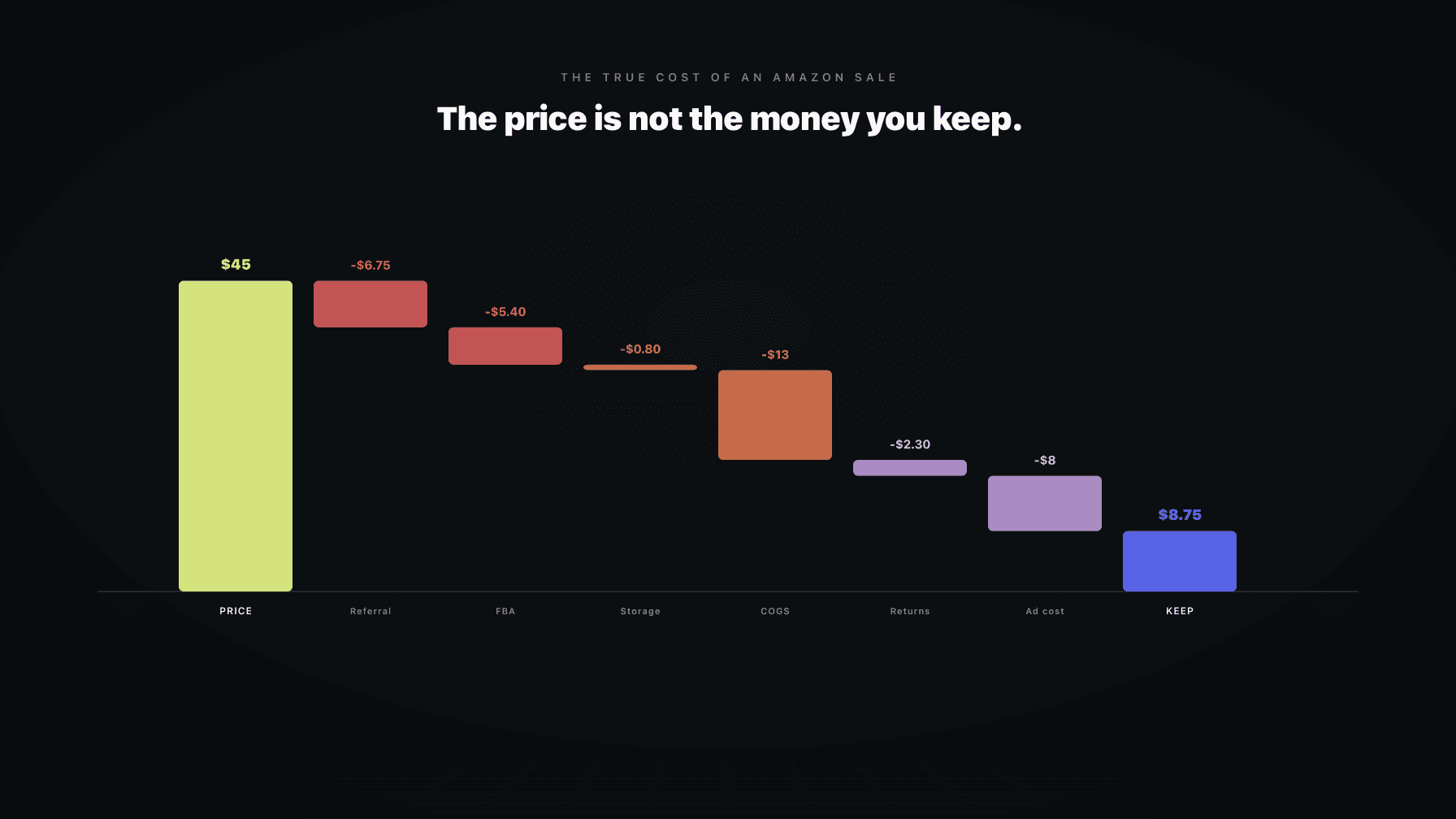
TACoS without margin is half a number. It tells you how much of your revenue goes to ads, not whether what is left covers your costs. Two products with an identical 10% TACoS can sit on opposite sides of profitable, because contribution margin per unit (what survives after referral fee, FBA fee, landed COGS, returns reserve, and ad cost) decides whether 10% to ads is a rounding error or the difference between making money and not. A fat margin can carry a higher TACoS and still keep profit. A thin one gets erased by even a modest TACoS.
So read them together, per ASIN, every month. A falling TACoS with a healthy margin is compounding. A rising TACoS with a thin margin is on a clock. You cannot see either from the campaign ACoS report, which is why accounts look fine right up until the quarterly P&L says otherwise.
The wrong way to lower TACoS is to slash ad spend. Spend is the numerator, so cutting it drops the ratio for a month. But on most products, ad spend is also defending rank, rank feeds organic, and organic is the denominator. Cut too hard and organic falls faster than spend, so TACoS climbs back up while your topline shrinks.
The right way is to grow the denominator and tighten the numerator at the same time:
Done this way, TACoS falls because the business got healthier, not because you starved it.
A few mistakes show up over and over.
Treating a low TACoS as automatic success. A low TACoS on a thin-margin product can still lose money, and one that comes from cutting spend a product needed is a warning, not a win.
Chasing a single benchmark. A launch product and a mature product should look completely different. Grading them against the same number makes you overspend on the mature one and starve the launch.
Reading the level instead of the trend. A 12% that was 7% three months ago is an alarm. A 12% that was 20% three months ago is a product working its way to maturity. Same number, opposite stories.
Confusing TACoS and ACoS. ACoS judges a campaign. TACoS judges the business. Account reviews go sideways when someone reports one and the room hears the other.
Bidding harder when mature TACoS rises. The climb is usually a rank, listing, competitor, or price problem. More spend just raises TACoS faster while the issue keeps eating organic.
These misreads happen because the metrics live in different tools and on different timelines. ACoS is in the ad console, organic sales are in business reports, margin lives in a spreadsheet, price sits somewhere else. By the time a human stitches them together, the trend is weeks old.
Marko, the PPC manager we built at Profasee, reads them together. It does not optimize campaign ACoS in isolation, because campaign ACoS is the number that hides the problem. It watches the TACoS trend and the contribution margin per unit at the same time, per ASIN, so a rising TACoS on a mature product gets flagged as the early warning it is rather than buried under a green ACoS report. And because Marko coordinates with pricing instead of treating it as someone else's job, it can move bids and price as one decision, the part that grows the organic denominator instead of renting more sales. The full approach is in our AI Amazon PPC management playbook; the target side is in our breakdown of target POAS vs ACoS.
To see how it runs against your account, the Amazon PPC software page lays it out, pricing is straightforward, and you can apply.
TACoS, or Total Advertising Cost of Sales, is your total ad spend divided by your total sales, organic and paid combined. Unlike campaign ACoS, which only counts the sales your ads directly caused, TACoS measures advertising's role in the entire business. A low, stable TACoS means most of your revenue is organic; a rising one means ads are doing more of the work to hold the same topline.
The denominator. ACoS is ad spend divided by ad-attributed sales, so it answers whether a campaign is efficient. TACoS is ad spend divided by total sales, so it answers whether the business is getting more or less dependent on ads. ACoS can look perfect on a product that is quietly dying. TACoS shows that erosion early, because falling organic sales push the ratio up.
There is no single good number. It depends on lifecycle stage and margin. A launch product can run 20% to 50% or higher and still be correct. A mature product should sit around 5% to 10% and stay stable. The trend matters more than the level: a falling TACoS over months is the sign you want.
Because your organic sales are slipping. ACoS only measures the sales ads touched, so it can hold steady while organic erodes underneath it. As organic falls, your total sales (the TACoS denominator) shrink, so TACoS climbs even though every campaign still hits its target. On a mature ASIN this usually means a rank, listing, competitor, or price problem, so check those before you spend more.
Grow the denominator, do not just cut the numerator. Slashing ad spend drops the ratio for a month but often damages rank, which shrinks organic and pushes TACoS back up. Instead, raise conversion (better main image, title, A+ content, and a price matched to value), prune terms and ASINs that spend without converting, pull back on keywords you already own, and coordinate price with bids.
Yes, and treating them the same is a common mistake. A new product should run a high TACoS by design while you watch for the downward slope that proves ad spend is buying organic rank. A mature product should run a low, stable TACoS because organic carries most of its revenue. Grading both against the same benchmark makes you overspend on the mature one and underfund the launch.
No. A low TACoS on a thin-margin product can still lose money, because TACoS does not carry your margin. A low TACoS that came from cutting spend a product needed is a warning, not a win, because organic rank will follow the spend down. Always read TACoS next to contribution margin per unit. The number alone is half the picture.