Chad Rubin
June 26, 2026 · 11 min read
Operator notes by email
Short, opinionated takes on AI agents, Amazon PPC, pricing, and inventory. No fluff. About once a week.
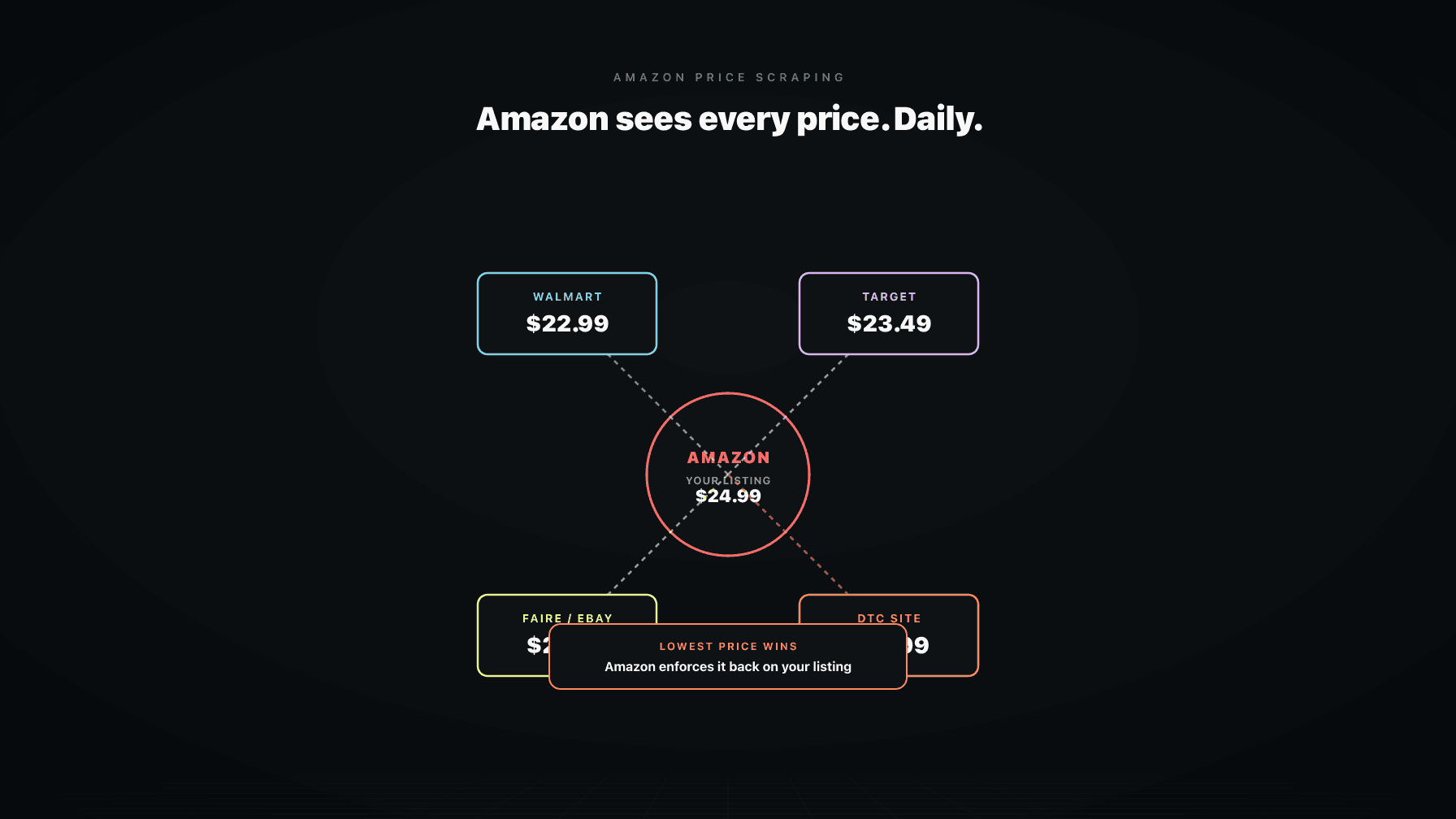
Amazon does not advertise its scraping behavior. They do not need to. Anyone who has run an Amazon brand for 12 months has seen the consequences. A Walmart promo runs Tuesday, and by the following Monday the Buy Box on Amazon is gone with no warning, no email, no obvious cause inside Seller Central. Or worse, the rank on the hero ASIN drifts down two pages over six weeks and nobody on the team can explain it.
The cause is almost always the same. Amazon scraped a lower price somewhere else, decided your Amazon listing was overpriced relative to the rest of the internet, and took action.
This is not a conspiracy theory. It is documented in Amazon's own seller help pages, it shows up in the "Fair Pricing Policy" notifications operators get every week, and it is observable in any decent rank-tracking tool if you line up the dates. The problem is that Amazon describes it in vague legal language and most operators read past it. The reality is a continuous, automated, machine-learning-driven pricing surveillance system that watches your brand everywhere you sell.
This post is what an operator needs to know about how the scraping actually works, what Amazon does with the data, and what to do about it. If you have ever wondered why the same SKU that sells fine on Walmart is suddenly invisible on Amazon, the answer is in the next 2,500 words. For the strategic case for staying single-channel or fixing pricing across channels, see the multi-marketplace Amazon trap and the off-Amazon without breaking margins deep dives.
Amazon's competitive pricing engine pulls from more places than most operators realize. It is not just other Amazon sellers and it is not just the obvious large retailers. The inputs fall into three buckets.
Other large marketplaces. Walmart.com is the heaviest signal. Amazon's systems crawl Walmart product pages constantly, and the match rate is high because Walmart's catalog uses UPCs that line up with Amazon's catalog one-to-one for the majority of branded CPG, consumables, supplements, beauty, and hardline categories. Target.com is next, with a slightly looser match rate because Target's catalog has more private label and exclusives that do not have an Amazon equivalent. eBay listings get pulled too, but only Buy It Now listings with a fixed price, not auctions. Faire and Etsy get partial coverage, mostly when a product has a clear UPC or when the brand name on the listing matches a registered Amazon brand. Newegg, Home Depot, Lowe's, Best Buy, and category-specific marketplaces (Chewy for pet, Sephora and Ulta for beauty, Wayfair for furniture) all feed in for the categories they dominate.
DTC sites. This is the input most brands forget about. Any Shopify storefront, BigCommerce site, or custom brand site that lists your product with a publicly visible price is fair game. Amazon does not need permission to scrape a public price tag on a public URL, and they do. Your own brand.com site is the most common trigger here. If you put a 15 percent off sitewide promo on your DTC site, Amazon sees it. They will not always act on a temporary promo, but the price snapshot is in their system.
From reading to action
If the framework above sounds familiar, your Amazon account is probably carrying the same drag. Apply and we will show what Marko, Oracle, and Bruno would change in your first week.

Ran a 7-figure Amazon brand for a decade. Founded Skubana (acquired). Co-founded Prosper Show. 15+ years on Amazon.
Join the brands that replaced agencies and tools with AI employees.
Authorized reseller sites. If your distributors or authorized resellers sell on their own websites, those prices get pulled too. This is how brands get blindsided by a single rogue reseller running a clearance sale on their site and triggering Buy Box suppression on the brand's own Amazon listing.
The product matching is done with a combination of signals: UPC is the strongest, parent brand match plus title similarity is next, and image hash matching is the tiebreaker. The match does not need to be perfect. Amazon's algorithm will flag a "likely same product" even when one listing says "12-pack" and the other says "case of 12," or when the image on Walmart is the lifestyle shot and the image on Amazon is the white-background shot. False positives happen, and the burden of proof to fix them sits with the seller.
The scraping is continuous. There is no batch job that runs once a week. Amazon's competitive pricing infrastructure is closer to a real-time price index, refreshed constantly across millions of products with priority weighting for high-velocity SKUs.
For a high-volume ASIN doing more than 100 units a day, the off-Amazon price refresh is effectively daily. For a mid-velocity ASIN, it is every two to three days. For a long-tail ASIN doing a few units a week, it may be weekly. But "the long-tail ASIN nobody is watching" is not the SKU that gets you in trouble. The hero ASIN is the one Amazon is watching closely, and that is the one that gets flagged within 24 to 72 hours of an off-channel price change.
The "Amazon does not know about your Walmart promo for a few weeks" theory you hear from some agencies is wrong. It was wrong five years ago and it is more wrong now. Amazon knows within days. The lag operators perceive is not detection lag, it is action lag. Amazon detects fast and then waits to see if the off-channel price holds before pulling the trigger on the Buy Box or the rank.
This is where it gets concrete. When Amazon decides a listing is "not competitively priced" against off-marketplace data, three things can happen. Sometimes one, sometimes all three in sequence.
The first and friendliest action is an automated email from Amazon. It usually reads close to this:
"We've found a similar item on another retailer's website at a lower price. To remain competitive, you may want to consider lowering your price. If you do not adjust your price, your offer may not be eligible to be the Featured Offer."
The language varies. Sometimes it says "Fair Pricing Policy," sometimes "Marketplace Fair Pricing," sometimes "Pricing Health." The mechanism is the same. The email names the ASIN, sometimes shows the competing price, and gives you a window to act. The window is usually 7 to 14 days, not 30, despite what older blog posts say.
This is the only action Amazon takes that is visible. You get an email. If you have email filtering and the notification went to the wrong inbox, you may miss it entirely.
This is the silent killer. If you do not match the off-channel price within the window, the Buy Box quietly disappears from the listing. Your offer is still there. The product page still loads. The product is still in search. But the "Add to Cart" button is replaced with "See All Buying Options," and conversion craters by 60 to 90 percent overnight.
There is no notification when this happens. You have to notice it in the listing itself or in a third-party Buy Box tracker. Many operators do not catch it for days. By the time they figure it out, they have lost a week of sales, and the recovery is not automatic. You have to either lower the Amazon price to match, raise the off-channel price, or appeal. The appeal process is slow and the success rate is mediocre.
Buy Box suppression specifically tied to off-Amazon pricing does not show up as a separate field in any seller dashboard. It is folded into the general "your offer is not eligible to be the Featured Offer" status, with no breakdown of why. This is the single most underdiagnosed cause of sudden sales drops that operators blame on PPC, algorithm changes, or competition.
This is the slow killer and the worst of the three. Amazon's search algorithm uses price competitiveness as a ranking input. A listing flagged as overpriced relative to off-Amazon comps will slowly lose rank, even if the Buy Box is still intact and no notification email has been sent.
The mechanism is not a binary switch. It is a gradual reweighting. Your conversion rate stays roughly the same, your reviews stay the same, your ad spend stays the same, but the organic rank on your three or four head keywords drifts from page one to page two over four to six weeks. Most operators do not connect the rank drop to the off-channel pricing because the timing is delayed 30 to 60 days from when the off-channel price first changed. They start blaming PPC, blaming a competitor's new launch, blaming the algorithm. The real cause is upstream and invisible.
This is why brands obsessed with Amazon pricing strategy and the floor and ceiling math of repricing without coordinating off-channel prices end up with worse outcomes than brands who simply hold a single price everywhere. The repricer is doing its job perfectly. The damage is coming from Walmart.
Here is the typical pattern for a single off-Amazon price drop. The dates are real-world averages across the brands we have watched over the last few years.
Day 0. Your off-Amazon price drops. Could be your DTC site, could be a distributor running a clearance, could be Walmart matching a competitor automatically. The price hits Walmart.com or your Shopify storefront.
Day 1 to 3. Amazon's scraper picks it up. The new lower price enters Amazon's competitive pricing data store. Nothing visible happens yet.
Day 3 to 7. If the price gap is large enough (typically more than 5 to 10 percent below your Amazon price) and the ASIN is high velocity, Amazon may send a pricing notification email. Not every flagged ASIN gets an email. Many go straight to action.
Day 7 to 14. If you have not matched the price on Amazon or raised the off-channel price, the Buy Box gets suppressed. This is when daily revenue on the SKU drops by 60 to 90 percent. It is also when the operator first notices something is wrong.
Day 14 to 30. If the off-channel price gap persists, Amazon's algorithm starts deprioritizing the listing in search. The rank drift begins.
Day 30 to 60. Organic rank degradation becomes visible in rank tracking tools. Sessions on the listing drop. Conversion may even improve (because the few people still finding the listing are higher-intent), but absolute revenue is down significantly.
Day 60 plus. If the off-channel price gap is still there, the listing settles into a new, lower-rank equilibrium. Recovering from this takes weeks of holding price parity, sometimes longer.
The operator pain shows up at day 30 plus. The cause was at day 0. This is the disconnect that makes off-channel pricing the most expensive blind spot in Amazon operations.
There are four ways to stop the scraping from hurting you. Pick one. Mixing them creates more problems than it solves.
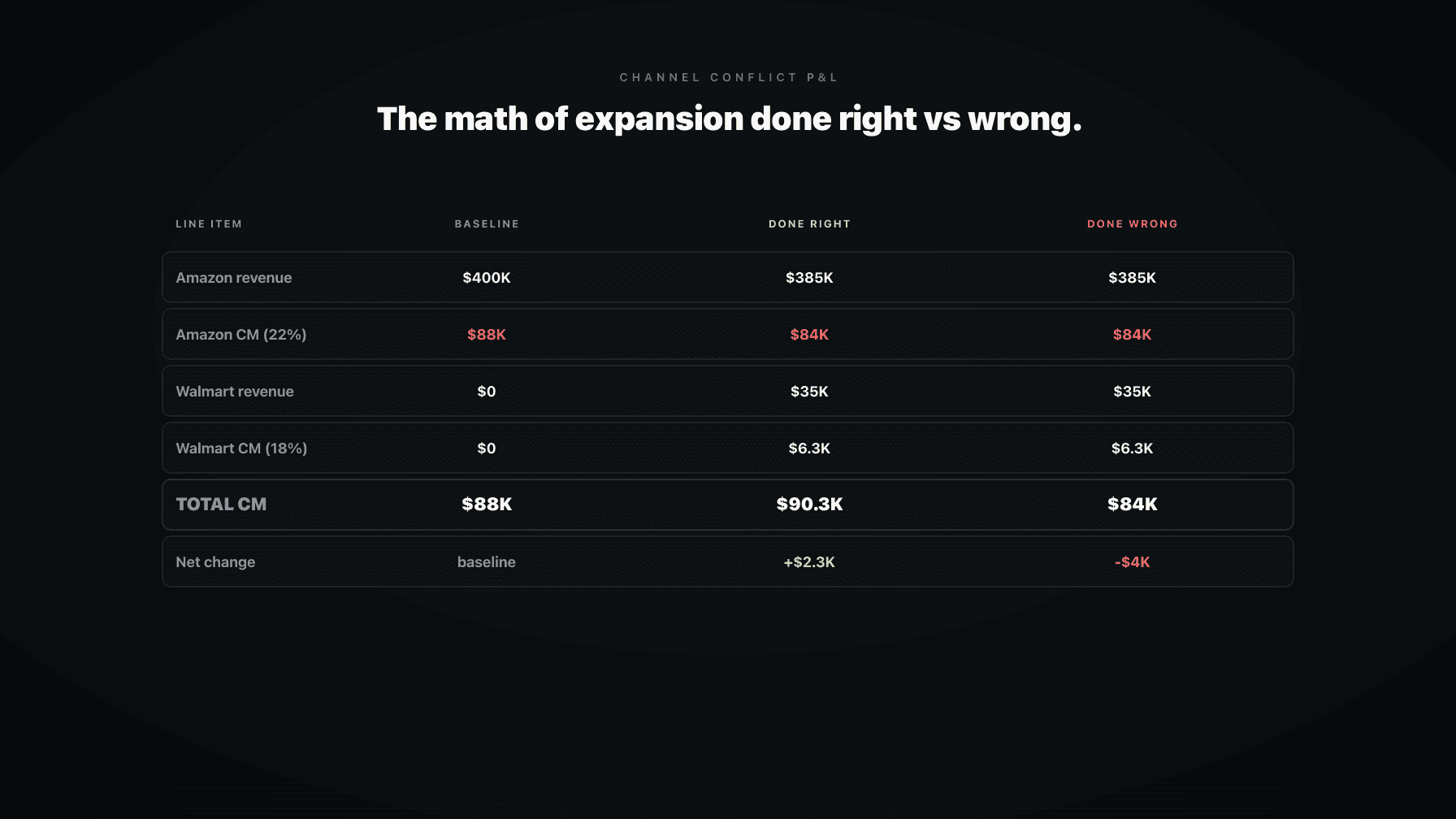
1. Identical prices everywhere. The simplest path. Your Walmart price, Target price, DTC price, and Amazon price are the same to the penny, including promos. This is hard to coordinate manually and almost impossible at scale, but it eliminates the scraping problem entirely. Most brands cannot do this because their margin structures on each channel are different, and that is a real problem covered in the channel conflict math post.
2. Different UPC per channel. Use a different UPC on Walmart than on Amazon. This breaks the strongest matching signal. Amazon's secondary matching (image, title, brand) may still catch some products, but the match confidence is lower and action is less likely. This is the path most experienced brands end up on for SKUs they want to sell off-Amazon. The cost is operational complexity: separate UPC inventory, separate forecasting, separate listings.
3. Different pack size per channel. Sell the 10-pack on Amazon and the 12-pack on Walmart. Different UPCs, different titles, different unit-price math. Amazon's scraper will still flag it sometimes, but the per-unit price math gives you a defensible appeal. This is also a cleaner DTC survival playbook move because the customer experience is differentiated, not just the SKU.
4. Different brand per channel. The nuclear option. A separate brand for Walmart, a separate brand for DTC, a separate brand for Amazon. Same factory, same product, different brand identity. This works and many private label operators do it, but it triples the marketing cost and only makes sense at scale.
The wrong answer is "we will just be careful." Careful does not survive a Walmart category manager forcing a price cut on you, a distributor running an unauthorized promo, or your own DTC team running a flash sale they did not coordinate with the Amazon team. The scraping never sleeps. Your defense cannot rely on attention.
A human operator with a spreadsheet cannot win this game. The reason is not intelligence. It is bandwidth.
To run this defense manually, you would need to monitor every channel's pricing continuously, model what Amazon's scraping will do given any proposed off-channel change, and either approve or block the change before it goes live. Across a 200-SKU catalog with five channels each, that is 1,000 price points being watched daily. A human cannot do that. A human checks once a week, misses two cycles, and gets a Buy Box suppression notification the operator did not see coming.
An AI agent does this differently. It watches every channel's pricing on a continuous loop. When a proposed change comes in (your DTC team wants to run a promo, Walmart's automatic matching engine just dropped your price 8 percent), the agent simulates what Amazon's scraper will see, predicts the action Amazon will take, and either approves the change with a rationale or blocks it with a specific reason. This is what we mean by the AI operating system for Amazon brands versus a single-function pricing tool.
A standalone repricer, no matter how good, only sees the Amazon side. It can hit any floor or ceiling you give it on Amazon, but it has zero visibility into Walmart or your DTC site. The repricer's floor was set assuming a Walmart price that no longer exists. The agent's floor moves automatically when Walmart moves. That is the difference, and it is the entire reason cross-channel pricing is one of the first jobs we hand to AI inside a brand.
If you are running an Amazon brand with off-channel exposure and you have ever been blindsided by Buy Box suppression you could not explain, this is the problem we solve. Apply here and we will walk through your specific channel mix.
Yes. Amazon's competitive pricing infrastructure includes Walmart.com, Target.com, eBay Buy It Now listings, and most major US retailers with public product pages. UPC matching is the primary signal, with brand and image matching as secondary signals. This is not theory, it is observable in any pricing notification email Amazon sends that references "another retailer's website."
Continuously, with priority weighting by ASIN velocity. High-volume ASINs see refresh cycles inside 24 to 72 hours after an off-channel price change. Lower-velocity ASINs may take a week. The "Amazon takes weeks to notice" idea is outdated and wrong for any SKU that matters to your P&L.
Sometimes. Amazon sends "Marketplace Fair Pricing" or pricing-health notification emails when an off-channel price gap is large enough on a high-velocity ASIN. Not every flagged ASIN gets an email. Many go straight to Buy Box suppression with no warning. Check your notification preferences in Seller Central and make sure pricing alerts route to an inbox somebody actually reads.
This is rare but it happens. The dominant pattern is penalty for being higher on Amazon than elsewhere. The reverse (higher elsewhere, lower on Amazon) generally does not trigger negative action, but it also does not earn you any goodwill. Amazon does not reward you for being the cheapest channel, it only punishes you for being the most expensive.
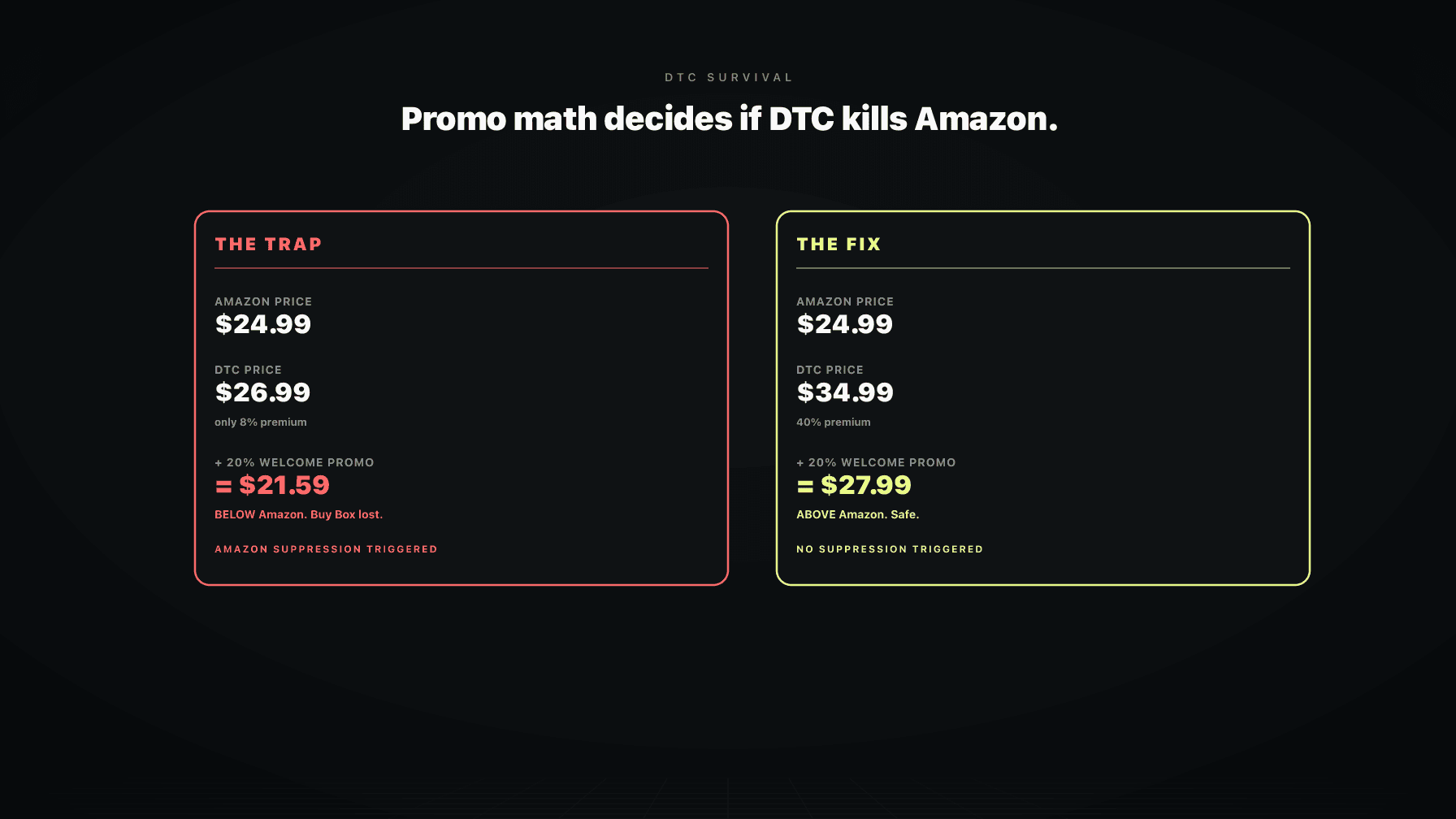
Yes, if your DTC site is public and indexable. Shopify storefronts, BigCommerce sites, custom brand sites all get scraped if Amazon's systems can match the product to an existing ASIN. This is why running a 20 percent off sitewide DTC promo is one of the fastest ways to lose the Amazon Buy Box. See the five percent rule on channel-slave brands for the broader math on this.
Yes. Different UPCs, different pack sizes, or different brand names per channel all break the matching signal Amazon uses to flag off-channel pricing. Different UPC is the cleanest. Different pack size is the most defensible if you ever need to appeal. Different brand is the strongest defense but the most operationally expensive.
For a hero ASIN, typically inside 24 to 72 hours. A 48-hour flash sale on Walmart may end before Amazon's automated action triggers, but the price snapshot is in Amazon's system and a repeat pattern over a few weeks will trigger Buy Box action. Flash sales are not safe just because they are short. The detection is faster than most operators assume.
If you want a clear picture of your channel exposure and how Amazon's scraper is reading your brand right now, apply here. We will walk through your specific situation.