Chad Rubin
June 27, 2026 · 12 min read
Operator notes by email
Short, opinionated takes on AI agents, Amazon PPC, pricing, and inventory. No fluff. About once a week.
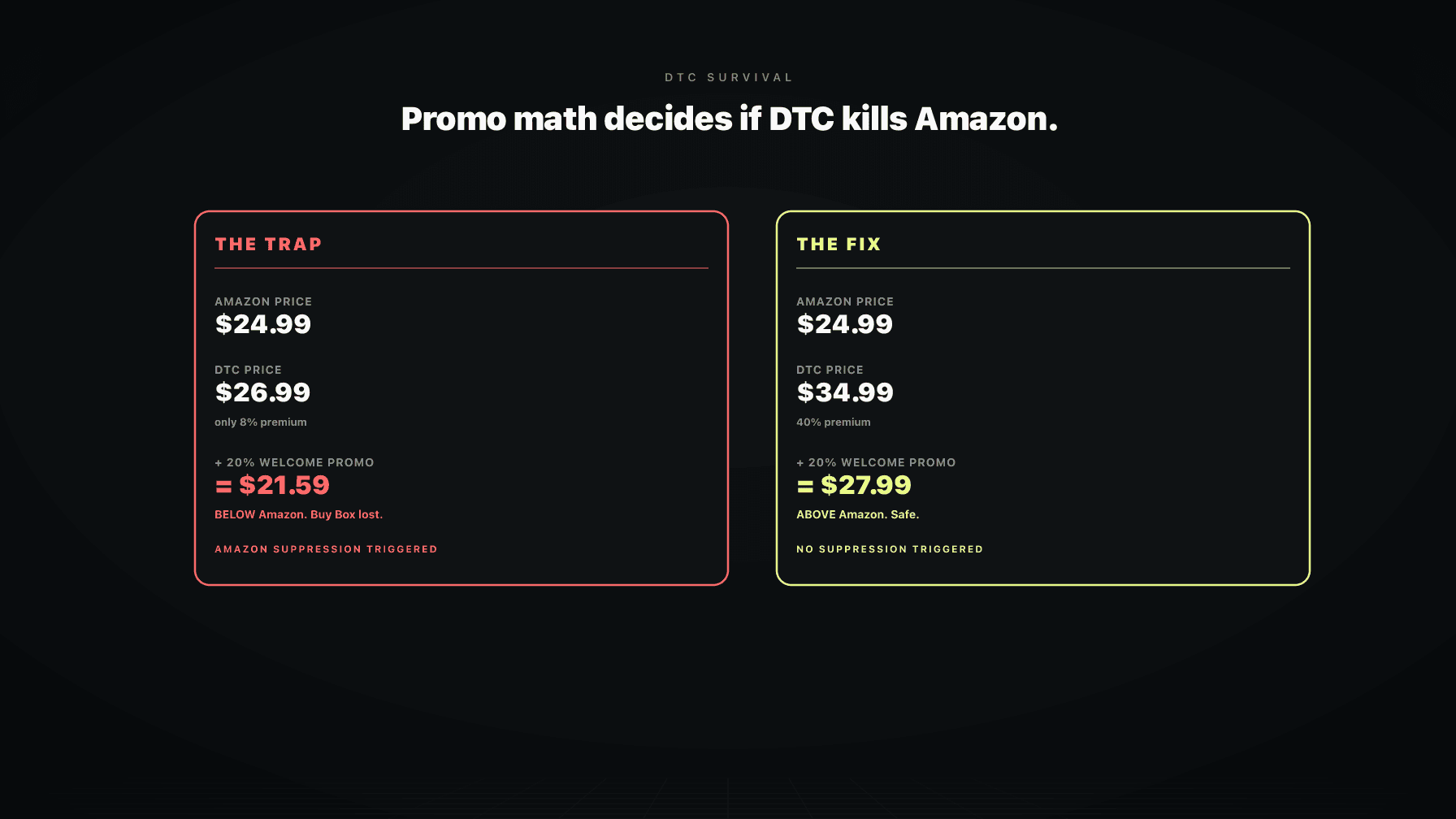
Every Amazon brand that tries to expand off-Amazon learns the same lesson in the same painful order. You list on Walmart. You price competitively for Walmart's environment. Three days later your Amazon Buy Box drops because Amazon's price scraper matched your UPC across channels and decided your Amazon listing is "not competitively priced." You just paid for a Walmart launch with Amazon revenue.
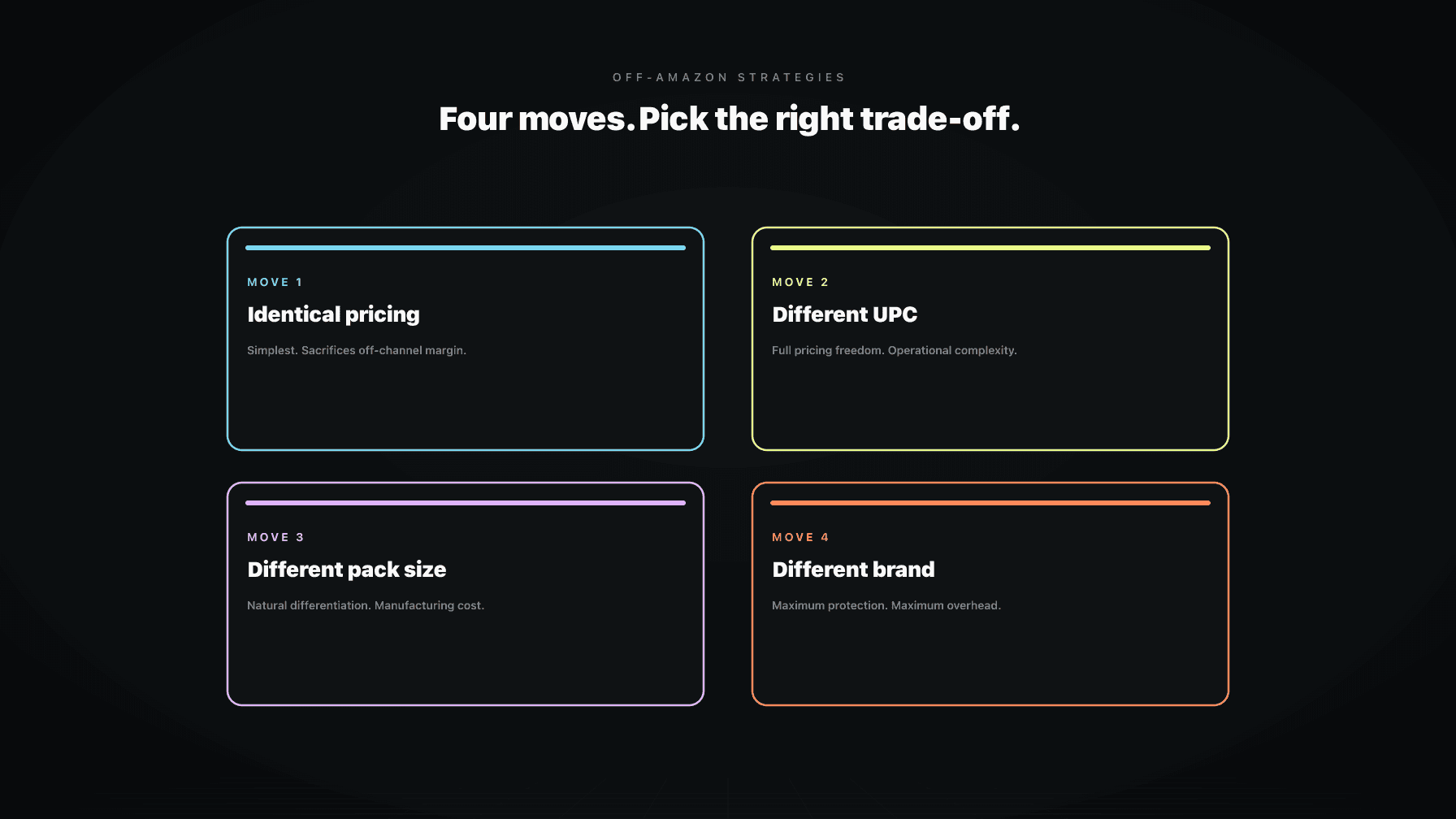
There are exactly four structural moves that get you out of this trap. Not tactics. Not workarounds. Structures. Each one fixes the price-scraping problem in a different way, and each one carries a different operational cost.
Move 1 is identical pricing across every channel. Simple. Defensive. Leaves money on the table.
Move 2 is different UPC per channel. Same physical product, two SKUs, two listings, two prices. Operational complexity goes up. Price flexibility goes from zero to full.
Move 3 is different pack size per channel. Amazon gets a 3-pack, Walmart gets a 2-pack. Different SKUs because they actually are different products. Natural differentiation. Manufacturing complexity goes up.
Move 4 is different brand per channel. Two companies on paper, two packaging systems, two marketing engines. Maximum protection because Amazon's systems cannot connect the two. Maximum overhead because you are running two brands.
Pick the wrong move for your situation and you either leave 40% of your off-Amazon margin behind or you blow up your Amazon Buy Box trying to be cute. Pick the right one and your off-Amazon channel becomes accretive instead of a tax on your Amazon P&L.
The decision depends on three things: how big the off-Amazon opportunity actually is, how much operational complexity your team can absorb, and how much the margin differential between channels really matters at your scale. The rest of this post is the operator's guide to each move, with the structures, the math, and the specific operational steps. If you are still in denial about whether this trap is real, start with the multi-marketplace Amazon trap and how Amazon price-scrapes Walmart and Target.
The simplest move. Pick one price per product. Hold it on Amazon, Walmart, Target, your DTC site, every retail partner. Never let any channel sell below that price. Never let any channel sell above it.
Mechanically this means: one MSRP per SKU, baked into your distributor agreements, baked into your retail contracts, enforced via MAP policy. Your repricer holds the price on Amazon. Your Walmart Pro Seller dashboard holds the price on Walmart. Your distributor agreements forbid any retailer from underpricing. If a retailer breaks MAP you cut them off.
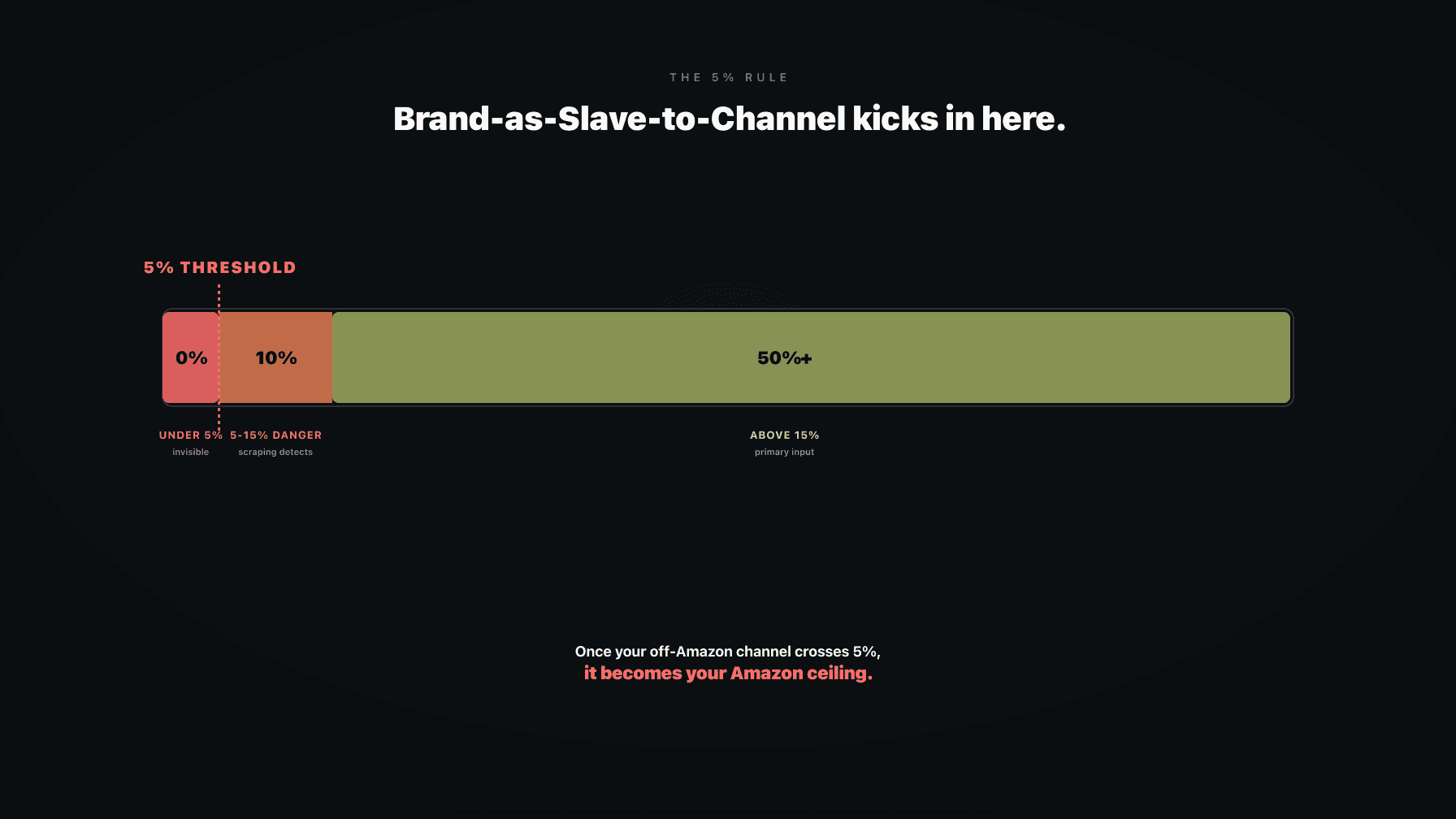
When this works: defensive expansion only. You are not trying to win Walmart. You are trying to not lose Amazon. The off-Amazon channel exists because your buyer asked for it, or because a wholesale account wants the SKU, or because you are establishing the listing in case Walmart's customer base shifts toward your category. The off-Amazon channel is under 10% of total revenue. Your brand has fewer than 100 SKUs so MAP enforcement is operationally possible.
From reading to action
If the framework above sounds familiar, your Amazon account is probably carrying the same drag. Apply and we will show what Marko, Oracle, and Bruno would change in your first week.

Ran a 7-figure Amazon brand for a decade. Founded Skubana (acquired). Co-founded Prosper Show. 15+ years on Amazon.
Join the brands that replaced agencies and tools with AI employees.
Trade-offs are real. Walmart's fee structure is lower than Amazon's. If your Amazon price is $24.99 and your unit economics work, your Walmart price at $24.99 is leaving money on the table because Walmart takes a smaller cut. You could price at $22.99 on Walmart and earn the same margin while being more competitive in Walmart's environment.
You are also less price-competitive than the Walmart natives. Walmart shoppers compare prices against Walmart's other listings, not against Amazon. Holding Amazon prices on Walmart means you sell fewer units. The trade-off is intentional. You are buying Amazon stability with Walmart volume.
Pricing math example. You sell a $24.99 supplement on Amazon. Amazon's fees and FBA take roughly 35% of revenue, leaving $16.24 before COGS. Your Walmart listing at $24.99 has fees closer to 15%, leaving $21.24 before COGS. Your Walmart margin is dramatically better on a per-unit basis. But Walmart shoppers will buy your competitor at $19.99 over you at $24.99. You sell maybe 30% of the units you would sell at a Walmart-competitive price. The math still works defensively because your Amazon channel does not get suppressed and that channel is 80% of your revenue.
Move 1 is the right answer for brands where Amazon is so dominant in the revenue mix that protecting it is the entire game. If your operational capacity is limited and your off-Amazon channel is small, this is the move. See the 5% rule for off-channel revenue for the threshold math.
The move that gives you full price flexibility without changing the physical product. Same product comes out of the same manufacturing line. You apply different SKU labels and different UPCs to the units destined for different channels.
The mechanics: register two separate UPCs through GS1. Assign UPC A to your Amazon channel inventory, UPC B to your Walmart channel inventory. Label cartons and units accordingly. Amazon's catalog has UPC A only. Walmart's catalog has UPC B only. Two listings, two prices, two inventory positions.
Amazon's price-scraping system matches by UPC, by ASIN content, by image, by product title. Different UPC alone is not bulletproof. But combined with slightly different product titles ("Acme Pro 12oz Cleaner" on Amazon, "Acme Professional 12oz Cleaner" on Walmart) and different primary images (different angle, different background), you remove the matching signals Amazon uses. The Buy Box stays.
When this works: your off-Amazon channel is real, not just defensive. You have margin to gain from pricing Walmart correctly. Your team can handle 2x SKU complexity. Your 3PL can split inventory by destination. Your demand forecasting can split forecasts by channel.
Trade-offs are operational, not strategic. You now forecast demand for two SKUs that are physically identical. You hold two inventory pools that cannot be reallocated without relabeling. Your manufacturing run is the same, but your finishing and labeling adds a step. Your 3PL has to maintain physical separation between Amazon-destined and Walmart-destined inventory.
The UPC structure that works in practice: do not buy UPCs in tiny batches from a reseller. Register a GS1 company prefix so you control the full UPC range. Assign UPCs in a structured way that lets your team identify channel at a glance. One common pattern: Amazon UPCs end in even numbers, Walmart UPCs end in odd numbers, DTC UPCs end in 9. Your warehouse can sort visually.
Example. Your manufacturing line produces 10,000 units of a 12oz cleaner per run. Amazon labeling applies UPC 859500001234 to 7,000 units. Walmart labeling applies UPC 859500001235 to 3,000 units. Same product, same factory, same QA. Amazon listing prices at $24.99. Walmart listing prices at $21.99. Amazon's price scraper cannot match UPC 859500001234 to anything on Walmart because UPC 859500001234 does not exist on Walmart. Your Buy Box holds. You picked up $2 in price flexibility on Walmart and earned the channel-specific margin Walmart's fee structure allows.
The risk is your wholesale distributor. If a Walmart-bound distributor gets their hands on inventory carrying Amazon's UPC and sells it through their Walmart account, the system collapses. Distributor agreements have to specify UPC by channel. Audit your distributor's UPC submissions monthly.
Once Move 2 is in place, your repricer and your pricing logic have to know the difference. The pricing models in our pricing playbook work per UPC, not per product family.
The move that gives you natural product differentiation. Amazon's catalog sees a 3-pack. Walmart's catalog sees a 2-pack. These are different products by every metric Amazon's systems can measure: different UPC, different weight, different title, different images, different SKU.
The mechanics: take your base unit and configure it into multiple pack sizes at the finishing stage. The 3-pack goes to Amazon. The 2-pack goes to Walmart. Singles go DTC. Each configuration has its own UPC, its own packaging design, its own listing.
When this works: products that pack naturally. Supplements (60-count vs 90-count). Household consumables (3-pack vs 2-pack of cleaner). Personal care (single vs duo vs trio). Food and beverage (4-pack vs 6-pack). The pack-size logic has to read as natural to the consumer. A 3-pack on Amazon and a 2-pack on Walmart for laundry detergent makes sense. A 3-pack on Amazon and a 2.5-pack on Walmart does not.
Trade-offs are in manufacturing and warehousing. You now run multiple finishing configurations. Your 3PL stores multiple pack types. Your demand forecasting splits across pack sizes per channel. Your shipping logistics handle different carton dimensions and weights. The pack-size SKU count compounds with your color and size variants. If you had 10 base SKUs and three pack sizes, you now manage 30 SKUs in inventory. Plan your variation parent ASIN strategy accordingly so your Amazon catalog does not fragment review counts.
Pricing math example. Your base unit costs $4 to manufacture, sells for $9.99 in DTC singles. The 3-pack on Amazon retails at $27.99. Per-unit price: $9.33. The 2-pack on Walmart retails at $19.99. Per-unit price: $10.00. Visible price points on each channel are different. Per-unit value to the consumer is roughly equivalent, with Amazon slightly cheaper on a per-unit basis as the bulk discount you would expect.
Amazon's price-scraping algorithm compares your $27.99 Amazon listing to your $19.99 Walmart listing and finds they are not the same product. They have different UPCs. Different weights. Different titles. Different images. The scraper does not flag a violation because there is no violation. You are selling two different SKUs.
The hidden advantage of Move 3 is that consumers self-select by channel intent. Amazon buyers who want bulk get the 3-pack. Walmart buyers who want to try the product get the 2-pack. Your average order value per channel is optimized to the channel's buyer behavior, not held hostage by a price-matching algorithm.
The hidden cost is that any product launch on a new channel now requires a new pack configuration decision, new packaging design, new manufacturing setup. Move 3 is a permanent operational change, not a one-time setup.
The maximum-protection move. Your Amazon business is one brand: Acme. Your Walmart business is a different brand: Northwood. Different legal entities (often), different packaging, different parent UPC ranges, different web domains, different customer service email, different marketing.
The mechanics: create a separate brand from scratch. Register the trademark. Register a separate GS1 company prefix so the entire UPC range is distinct. Design separate packaging that shares no visual DNA with the original brand. Build a separate website. Run separate marketing. The two brands look like two companies to the outside world because operationally they should be two companies internally.
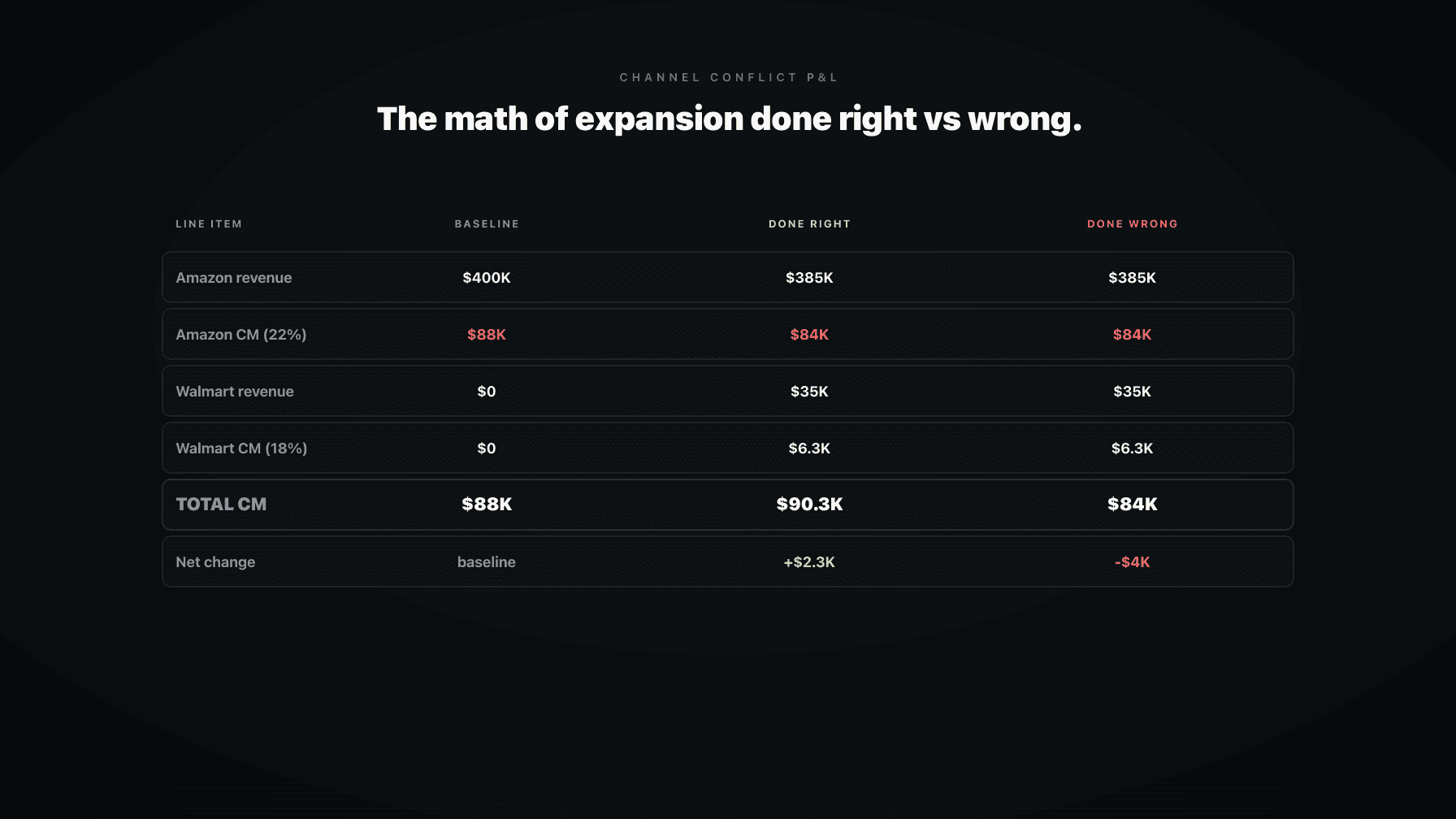
When this works: brand at $5M+ per year in Amazon revenue, planning to grow off-Amazon to meaningful scale (not 5%, but 30%+ of total revenue). You have the team and capital to run two brand operations in parallel. You have the strategic conviction that off-Amazon is not a side project. See the channel conflict math for when this becomes inevitable.
Trade-offs are real overhead. Two brands means two marketing engines, two creative teams (or one team servicing two clients internally), two customer service operations, two sets of reviews to manage, two sets of social channels, two product roadmaps. The economies of scale you got from running one brand evaporate at the brand-management layer.
The protection is unmatched. Amazon's matching systems use brand name, brand-registered trademarks, packaging imagery, product title, UPC range, and seller account history. A separate brand on Walmart shares zero of these signals with your Amazon brand. The price scraper does not find a match because there is no match to find. You can price the Walmart brand for Walmart, run Walmart-specific promotions, build a Walmart-specific product mix, and your Amazon Buy Box is structurally insulated.
When NOT to use Move 4: small brand under $5M revenue, single-product-line brand, founder-only or two-person operation. The overhead of running two brands kills small operations. You will end up with two mediocre brands instead of one strong brand. A small brand expanding to Walmart should use Move 1, 2, or 3 depending on capacity. See the DTC survival playbook for the related logic on when separate channels justify separate operations.
The second hidden cost is exit value. If you ever sell the business, two brands are harder to sell than one larger brand. Brokers and aggregators prefer concentration. Move 4 trades current-year flexibility for future-year exit complexity. Decide accordingly.
Three operator questions get you to the right move.
Question 1: what is the off-Amazon channel for? Defensive or offensive? Defensive means you are listing on Walmart because a buyer asked or because you want the listing to exist before a competitor takes it. Offensive means you are actively trying to grow Walmart revenue. Defensive answers point to Move 1. Offensive answers point to Move 2, 3, or 4.
Question 2: what is your operational capacity? Can your 3PL handle channel-specific UPC separation? Can your team forecast demand per channel? Can your finance team track P&L by channel? If the answer to any of these is no, Move 2 and Move 3 will break under operational load and you should stay on Move 1 until capacity catches up.
Question 3: what is the margin differential between channels, in dollars, at your current volume? Calculate the gap. Amazon at $24.99 with $16.24 net before COGS. Walmart at $19.99 with $17.00 net before COGS. The Walmart margin advantage per unit is $0.76. At 10,000 units per year, that is $7,600. If $7,600 does not justify the operational complexity of Move 2 or 3, stay on Move 1. If the gap is $50,000 or $200,000 per year, Move 2 or 3 pays for itself in months.
Then layer in scale. Under $5M revenue, you are in Move 1 or Move 2 territory. Between $5M and $20M, Move 2 or 3 makes sense. Above $20M and serious about off-Amazon, Move 4 is on the table.
The brands that get this wrong pick Move 4 too early (running two brands at $2M revenue and burning out) or pick Move 1 too long (leaving seven figures of channel-specific margin on the table at $30M revenue). Match the move to the stage.
Once you have picked a Move, the strategy has to be enforced across every pricing decision, every listing change, every channel update. Manually, this is where strategies break. The Walmart team raises a price without checking Amazon. The Amazon team runs a promo that drops below the Walmart MAP. The brand drifts back into a price-scraping trap by Tuesday.
The agent enforces the structure. If you picked Move 1, the agent holds identical pricing across every channel. Any proposed change on one channel triggers a synchronized change on the others. Violations get blocked before they hit the catalog.
If you picked Move 2 or 3, the agent maintains the UPC and pack-size separation. It models Amazon's price-scraping response to any proposed off-channel change before the change goes live. It flags when a wholesale distributor's listing shows up on Walmart with your Amazon UPC. It alerts when a packaging update on one channel creates a matching signal Amazon could use to connect the two.
If you picked Move 4, the agent runs two independent pricing and operational systems with no shared signal between them. Two brands, two strategies, one operator. See the AI operating system for Amazon brands for how this works under the hood.
The strategy is the structure. The agent is the enforcement layer that keeps the structure intact while you operate.
Yes. Different UPCs for the same physical product is a standard Move 2 setup. You register the UPCs through GS1, label inventory destined for each channel with the appropriate UPC, and list the product separately on each channel. Combine with slightly different titles and primary images for full protection against Amazon's matching algorithms.
Yes. UPCs identify SKUs, not products. A SKU is your internal designation for a unit of inventory tied to a channel, pack configuration, or label. Two SKUs with the same physical product but different UPCs is normal practice across consumer goods. The legal risk is in MAP enforcement and distributor agreements, not in the UPC structure itself.
Depends on the product. For shrink-wrapped multipacks, the added cost is the finishing line setup and the packaging materials. Often $0.20 to $0.80 per unit in incremental cost. For products that ship in custom boxes per pack size (supplements, beauty), the cost is higher because you need separate carton designs. Run the math against the channel margin differential. If the per-unit cost of pack-size separation is less than the per-unit margin gained from channel-specific pricing, the move pays.
Only if your Amazon revenue is above $5M, your team has the capacity to run two brand operations, and your off-Amazon growth ambition is real (planning to reach 30%+ of total revenue). Below that scale, Move 2 or Move 3 gives you most of the protection without the brand-management overhead.
The Move 2 structure collapses. Amazon's price scraper finds your Amazon UPC listed on Walmart at a different price and suppresses your Buy Box. Prevention: distributor agreements specify which UPC the distributor is authorized to sell. Audit distributor listings monthly. Cut off violators immediately. If you cannot enforce UPC discipline with your distributors, you do not actually have Move 2 in place.
Realistically 6 to 12 months from decision to first sale. Trademark registration runs 4 to 8 months. GS1 prefix registration is fast (weeks). Packaging design and production is 8 to 12 weeks. Walmart catalog setup and approval is 4 to 8 weeks once you have inventory ready. Plan the launch as a real product launch, not a side project.
Private label and white label refer to manufacturing relationships, not channel strategy. You can be private label on both Amazon and Walmart and still get caught by Amazon's price scraper if you list the same UPC at different prices. The four moves apply regardless of manufacturing model.
The strategy is the structure. Pick the right move for your stage. If you want the agent that enforces it across every pricing and listing decision, apply here.