Chad Rubin
June 29, 2026 · 12 min read
Operator notes by email
Short, opinionated takes on AI agents, Amazon PPC, pricing, and inventory. No fluff. About once a week.
Here is the story I have watched play out maybe forty times in the last decade.
Amazon brand is doing $4M a year. Margins are decent. The board, the agency, or some podcast convinces the founder that "we need to own the customer." So they spin up a Shopify site. They put the same products on it. They price them at the Amazon price because parity feels safe. The marketing hire shows up and adds a 20% welcome offer because that is what every DTC playbook says to do. They turn on Meta ads.
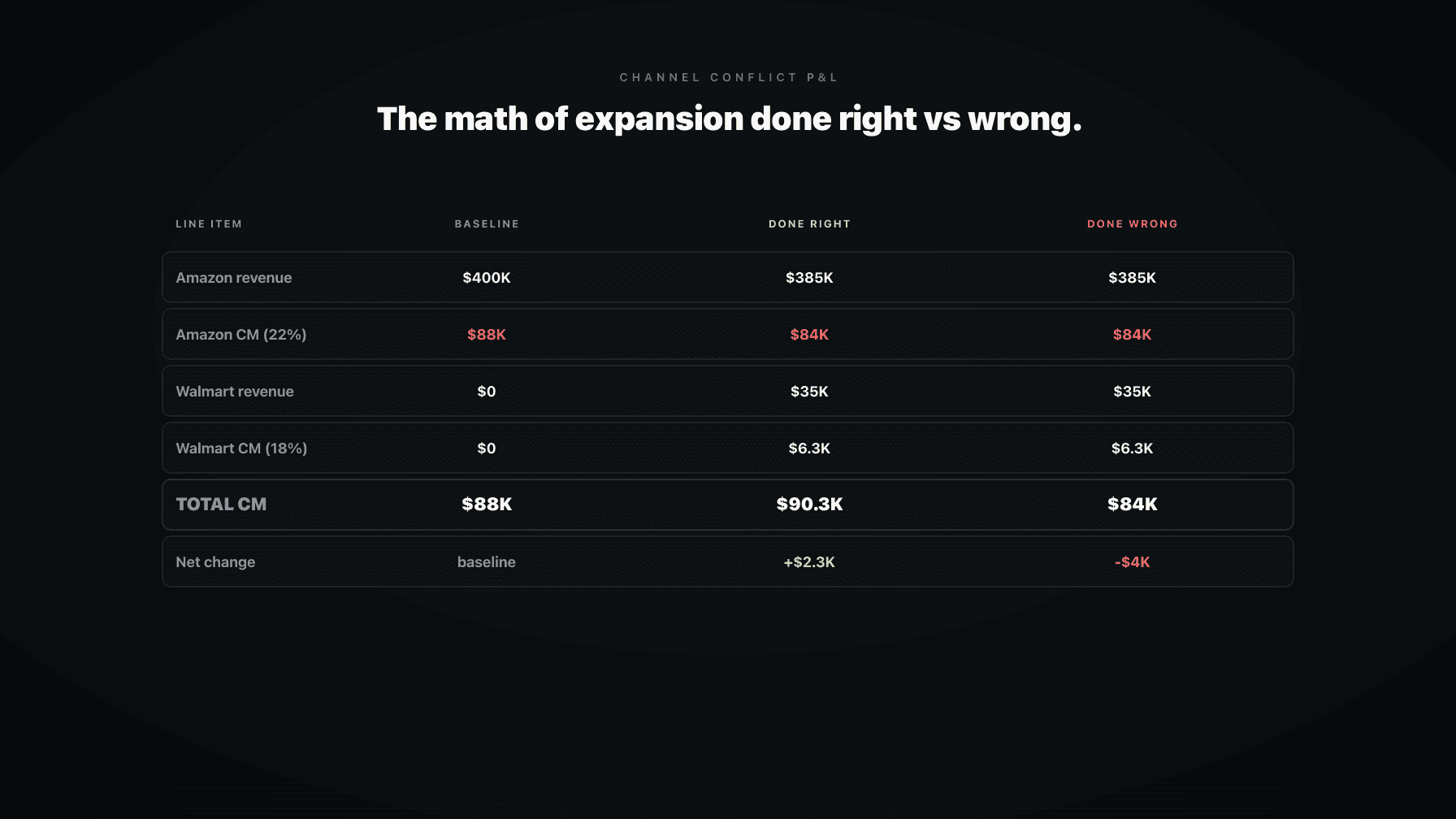
Ninety days later, the Shopify site is doing $8K a month. Cute. Meanwhile, Amazon margin has dropped by $25K a month and nobody knows why. Suppression. Buy Box loss. Featured Offer flipping. Reps cannot explain it. The brand thinks DTC is just slow to ramp and keeps spending. The actual problem is sitting in plain sight: their own Shopify site is the thing crushing their Amazon P&L.
This is the most common version of the multi-channel trap for Amazon-first brands, and almost nobody connects the two.
Amazon scrapes the open web. It scrapes your Shopify site. When the welcome offer drops your effective DTC price below your Amazon price, Amazon's algorithm reads that as your "real" price and treats Amazon's price as too high. It suppresses you. Quietly. You will not get a notification. You will just see your Amazon revenue bleed while your DTC dashboard shows a few hundred orders a month.
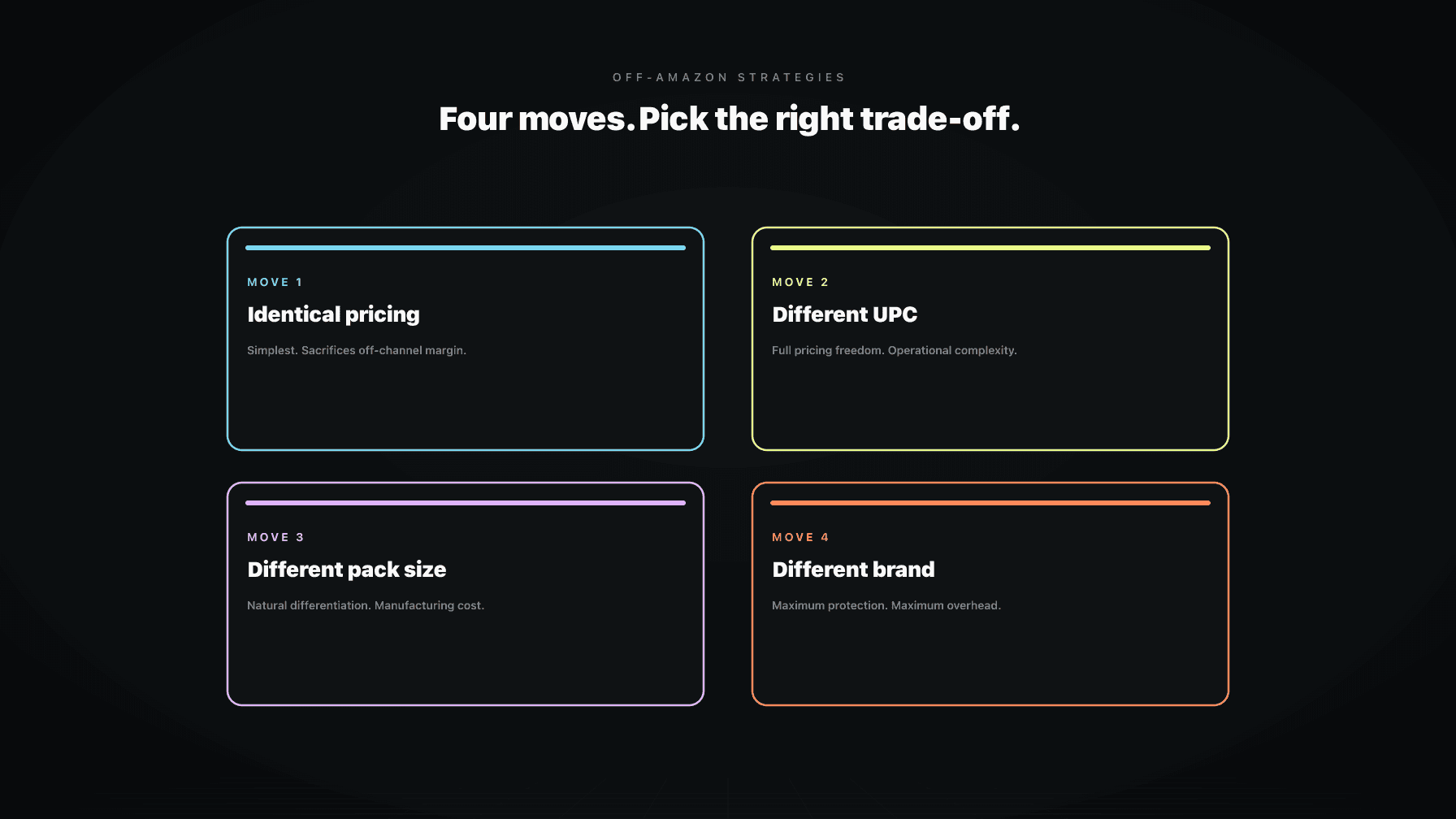
The fix is not "stop doing DTC." The fix is structural. Your DTC channel needs to be priced or constructed such that no normal promotional cycle can drop your effective web price below your Amazon price. There are exactly three ways to do that. Most brands are doing none of them.
DTC sits in a worse position than Walmart, Target, or any other marketplace when it comes to Amazon price scraping, and the reasons are structural.
Reason one: brands default to parity pricing. When an Amazon-first brand sets up a Shopify site, the instinct is to match the Amazon price. Parity feels safe. Parity feels fair to the customer. Parity is also the worst possible setup, because the moment any promotional discount, abandoned cart offer, or sale event enters the picture, the effective DTC price falls below Amazon. Parity is a floor that gets eroded the first time you run a promo. And you will run promos, because that is how DTC works.
Reason two: promo culture is baked into DTC. Shopify is built for discount codes. Klaviyo is built for abandoned cart flows. Meta ads work best with a hook. Your marketing team will run welcome offers, post-purchase upsells, birthday discounts, Black Friday, Cyber Monday, end-of-quarter pushes, friends and family, influencer codes, and free shipping thresholds. Every single one of those mechanisms drops the effective transaction price. Amazon does not allow this kind of price flexibility on its own platform, so its scraping model assumes your DTC price is the real one. Promo culture is a structural mismatch with how Amazon thinks about pricing.
From reading to action
If the framework above sounds familiar, your Amazon account is probably carrying the same drag. Apply and we will show what Marko, Oracle, and Bruno would change in your first week.

Ran a 7-figure Amazon brand for a decade. Founded Skubana (acquired). Co-founded Prosper Show. 15+ years on Amazon.
Join the brands that replaced agencies and tools with AI employees.
Reason three: same brand, same UPC, same images. The brand running Amazon and Shopify usually uses identical product names, identical UPCs, identical hero images, and identical positioning across both channels. That is exactly the signal Amazon's scraping infrastructure is built to catch. You are basically holding up a sign that says "this product on this other site is the same SKU." Amazon will find it. Amazon will compare. Amazon will act.
The brands that survive DTC alongside Amazon are the ones that break at least one of those three defaults. The brands that get suppressed are the ones that triple down on all three: parity pricing, aggressive promo culture, same UPCs and imagery.
This is why I tell operators that DTC for an Amazon-first brand is not a channel decision, it is a pricing architecture decision. You cannot bolt Shopify onto Amazon without rethinking how price works across both. And if you cannot afford to rethink pricing across both, you cannot afford to do DTC yet.
There are exactly three structural ways to run DTC alongside Amazon without strangling your Amazon margin. Pick one. Do not freelance.
Price your Shopify site materially above Amazon. Not 5% above. Not 8% above. 15% to 25% above as a baseline, more if your promo cycles are aggressive.
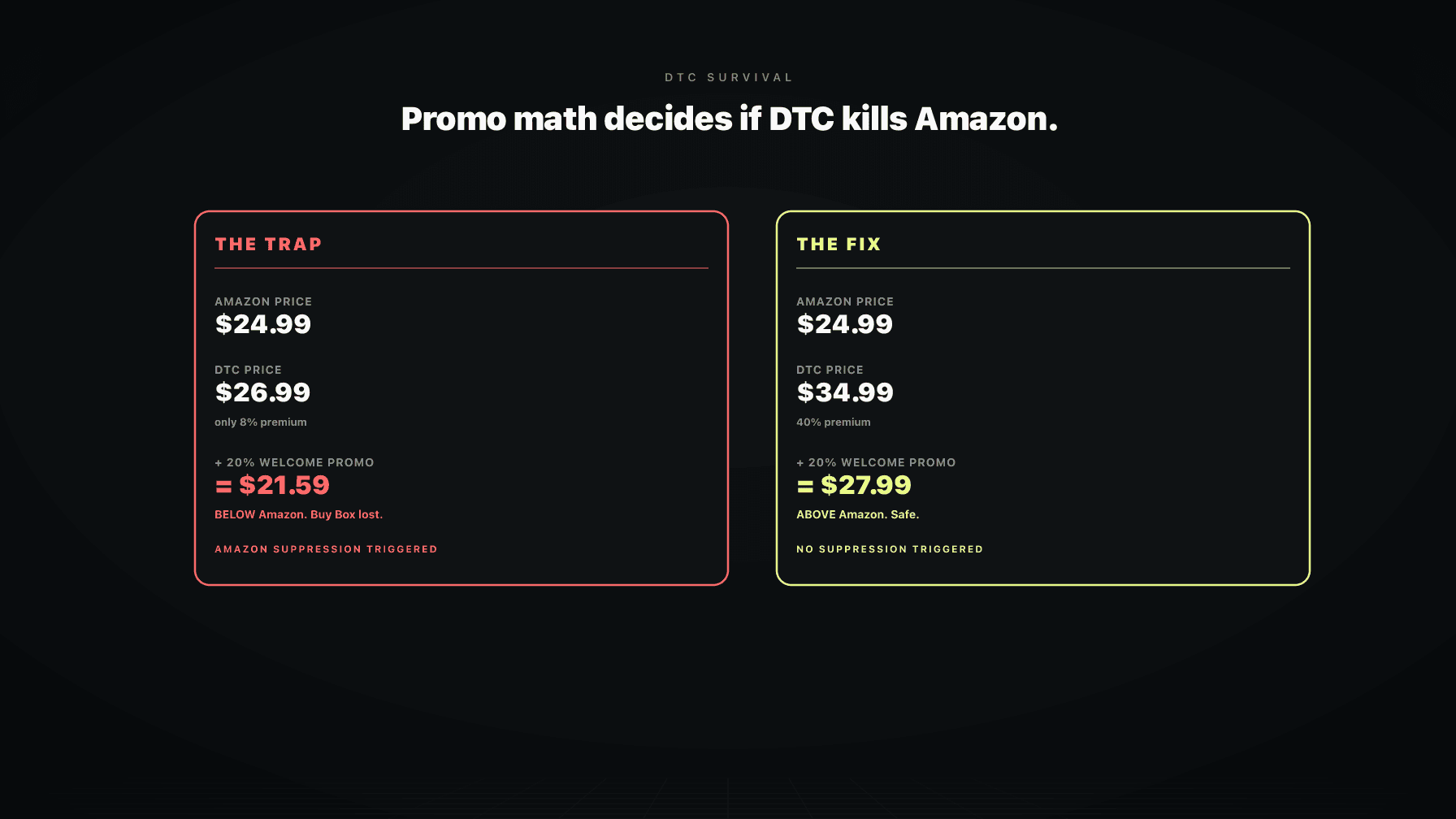
The math is simple. If Amazon is $24.99 and Shopify is $29.99, you are 20% above. When you run your 20% welcome offer, the effective DTC price lands at $23.99, basically at Amazon. That is too close. Aim higher. If Shopify is $32.99 (32% above) and you run the same 20% offer, the effective price is $26.39, comfortably above Amazon. Now Amazon's scraping sees a Shopify price that is higher than its own, and the algorithm is satisfied.
The buyer who comes to your Shopify site at premium pricing is not the bargain hunter. They are the brand-loyal customer, the gift buyer, the person who refuses to shop on Amazon, the affiliate-referred buyer. You will get fewer orders. You will get higher AOV and better data. You will not break your Amazon.
The Shopify site sells bundles, subscriptions, or larger pack sizes that do not exist on Amazon. Different UPCs. Different product titles. Different listings.
On Amazon you sell the 30-count. On Shopify you sell a 90-count bundle, a starter kit with three flavors, a 12-month subscription bundle, or a "founder's pack" with branded extras. None of these have a direct Amazon comparable. Amazon's scraper does not have a $X-per-unit comparison to make because the SKU does not exist on Amazon.
This is the operator move. You keep the brand. You keep the imagery. You change the structure of what you are selling so that the per-unit math is not directly comparable. Bundles also raise AOV. Subscriptions lock in LTV. You can run aggressive promos on these SKUs because Amazon has nothing to scrape against.
The Shopify site is a different brand entirely. Different name. Different packaging. Different positioning. Different LLC if you want to be neat about it.
The Amazon brand is "Acme Pro" at $24.99. The Shopify brand is "Acme Reserve" or "Acme Direct" at $39.99, with cleaner packaging, a founder story, and a different visual identity. Amazon's scraper crawls the Shopify site and finds an unrelated brand at a different price point. No suppression signal.
This is the cleanest structural play and also the most work. You are essentially running two brands. Most operators are not ready for that operational load. If you are doing $20M+ on Amazon, it starts to make sense. Below that, Option A or Option B is where you should be.
What does not work: parity pricing with promos, same brand, same UPC, same imagery. That is the trap. If you are currently in it, your job this week is to pick one of A, B, or C and start the migration.
Here is the operator math. Memorize it.
Scenario 1: DTC priced 25% above Amazon. Amazon: $24.00. DTC: $30.00. Welcome offer 20% off. Effective DTC: $24.00. Right at the Amazon price. Marginally safe. Not a great cushion if Amazon repricing moves you up.
Scenario 2: DTC priced 15% above Amazon. Amazon: $24.00. DTC: $27.60. Welcome offer 20% off. Effective DTC: $22.08. Eight percent below Amazon. Trap activated. Suppression risk live. This is the most common configuration I see and it is the one that wrecks the Amazon P&L.
Scenario 3: DTC priced 30% above Amazon. Amazon: $24.00. DTC: $31.20. Welcome offer 20% off. Effective DTC: $24.96. Four percent above Amazon. Safe under normal promo cycles. This is the operator's target buffer.
Scenario 4: Black Friday on a 30%-premium DTC. Amazon: $24.00. DTC: $31.20. BFCM offer 40% off. Effective DTC: $18.72. Twenty-two percent below Amazon. Disaster.
For aggressive promo windows (BFCM, end-of-year, friends and family), the premium needs to be 50% or more above the Amazon price, not 25%. If you cannot stomach pricing your DTC at 50% above Amazon, you cannot run a 40%-off promo on it without consequences. The choice is binary: either price tall enough to absorb the discount, or do not run the discount.
The 15% to 25% baseline premium is for normal monthly promo cycles. The 50%+ premium is for aggressive seasonal events. This is not a guideline. This is the math of channel-conflict P&L and Amazon scraping. Below those buffers, you are subsidizing Shopify orders with Amazon margin loss.
The operators who get this right run their DTC promo calendar through a price-coordination filter before launch. The operators who get it wrong let the marketing team set promos in isolation, then wonder six months later why Amazon is bleeding.
If I had to pick one DTC structure for an Amazon-first brand, it would be subscription. Not premium retail. Not bundles. Subscription.
Here is why subscription is the cleanest Amazon-DTC coexistence pattern.
The SKU is structurally different. A subscription is not a single-unit retail purchase. It is a recurring commitment. You are not selling a $24.99 bottle, you are selling a 12-month plan at $19.99 per shipment with locked pricing. Amazon's scraper does not treat that as comparable retail pricing because the unit of analysis is different. The subscription page does not even need to display a per-unit retail price that Amazon can grab cleanly.
Subscription pricing can be aggressive. You can offer 30% off the first shipment, 20% off ongoing, free shipping, free upgrades. None of that bleeds into Amazon's scraping the way a single-purchase 20% off does. Your effective revenue per customer over twelve months is way higher than Amazon. Your CAC is amortized across that LTV. The unit economics are different and the algorithm reads them as different.
LTV and retention destroy the CAC math. A 12-month subscriber at $19.99 per month is $239 of revenue. A one-time Amazon buyer at $24.99 is $24.99. The subscriber is worth roughly 10x in gross revenue and gives you direct email, SMS, and replenishment data. You can afford to pay real money for that customer. You cannot afford to pay real money to acquire a one-time Shopify buyer who saved $5 versus Amazon.
Replenishment is a real category. Consumables, supplements, pet, beauty, coffee, household. If your product is replenishment, subscription is the structural play. Amazon's Subscribe and Save is a weak version of this. Your own subscription program with your own data, your own retention motion, your own welcome series, and your own pricing is the strong version.
The brands that have built durable DTC channels next to large Amazon businesses have almost all done it through subscription. Not "Shopify with a 20% off welcome code." Subscription. It is the single structural pattern that gives you the LTV to justify the channel and the SKU differentiation to keep Amazon out of your scraping crosshairs.
If your product cannot support subscription, you should be very honest about whether DTC makes sense at all.
DTC is not free. It costs you Meta ad spend, Shopify subscription fees, fulfillment infrastructure, customer service tickets, and management attention. The honest question is whether the channel adds enterprise value or just adds work.
For an Amazon-first brand, DTC makes sense in three cases.
Case 1: Genuine brand-experience layer. You have a product where the brand story, the unboxing, the founder narrative, and the packaging are the actual value. Premium positioning is real. Customers will pay 30% more to buy from you direct because the experience is differentiated. This is rare. Most "premium brand experience" claims fall apart under examination. If your product is a commodity supplement in a plastic bottle, do not pretend it is Glossier.
Case 2: Subscription business. Covered above. The structural play. If you have a replenishment product, this is the case.
Case 3: International expansion where Amazon is weak. Amazon DE, Amazon UK, Amazon JP are strong. Amazon AU is fine. Beyond that, Amazon is patchy. If you sell into Brazil, India, the Nordics, the Middle East, or anywhere Amazon does not dominate, DTC can be the channel that gets you global. The risk profile is different because Amazon is not scraping your Brazilian Shopify pricing against your US Amazon listing in any meaningful way.
Everything else is rationalized risk-reduction. "We need to own the customer." "We need to diversify off Amazon." "We need to build the email list." Those instincts are not wrong, but the cure being prescribed is usually a plain-vanilla Shopify clone of the Amazon listing, which is the version that does not work. If you actually want to diversify off Amazon, do it through a structural play (subscription, sister brand, international) and read the full piece on moving revenue off Amazon without breaking margins. Do not do it through a discounted clone of your Amazon SKU.
Five steps. Take an hour. Do it this week.
For every flagged product, you have four levers: raise the base Shopify price, kill the promo, change the DTC SKU to a bundle or pack size that does not exist on Amazon, or move it to a sister brand. Pick one per product. Do not do nothing.
The brands I work with run this audit quarterly. It is part of the Amazon unit economics and steward-of-capital review cadence. DTC pricing is not a marketing decision. It is a P&L decision, and it lives at the founder or CFO level until somebody else proves they understand it.
If you are running an Amazon brand with a Shopify site and you have not connected your DTC pricing to your Amazon margin, that connection is the highest-leverage thing you will work on this quarter. The ceiling on that work is the AI operating system that watches both channels and refuses to let promos cross the wire.
If you want operators who already know this math running it for you, apply here.
Maybe. Only if you have a subscription product, a genuinely premium brand experience, or an international gap where Amazon is weak. A plain-vanilla Shopify clone of your Amazon listing usually destroys more value than it creates because of price scraping and channel cannibalization. If you cannot articulate which of those three cases you are in, you are not ready for DTC.
Baseline 15% to 25% above for normal monthly promo cycles. 30% above is the comfortable operator buffer. For aggressive seasonal events (BFCM, end-of-year), the premium needs to be 50% or more so that a 40%-off promo still lands above your Amazon price. Below 15% premium, any normal promo will trigger Amazon scraping and suppression.
Yes, if your base DTC price is high enough that the promo-adjusted effective price stays above Amazon. The trap is running promos on parity-priced DTC. Run the math before each promo launches. Effective DTC price (base minus realized discount) must stay above current Amazon Featured Offer price, ideally with a 5% cushion.
No, if you can avoid it. Bundles, subscriptions, larger pack sizes, and founder editions all give you different UPCs that Amazon's scraper cannot directly compare. Same SKU on both channels is the configuration that gets brands suppressed. Different SKUs is the cleanest structural protection against Amazon price scraping.
If you are doing under $2M on Amazon, DTC is usually a distraction. Fix Amazon first. If you must have DTC at that scale, run it as a thin brand layer with one or two products priced 25% above Amazon and no aggressive promos. Do not build a full Shopify operation until your Amazon business can spare the management attention.
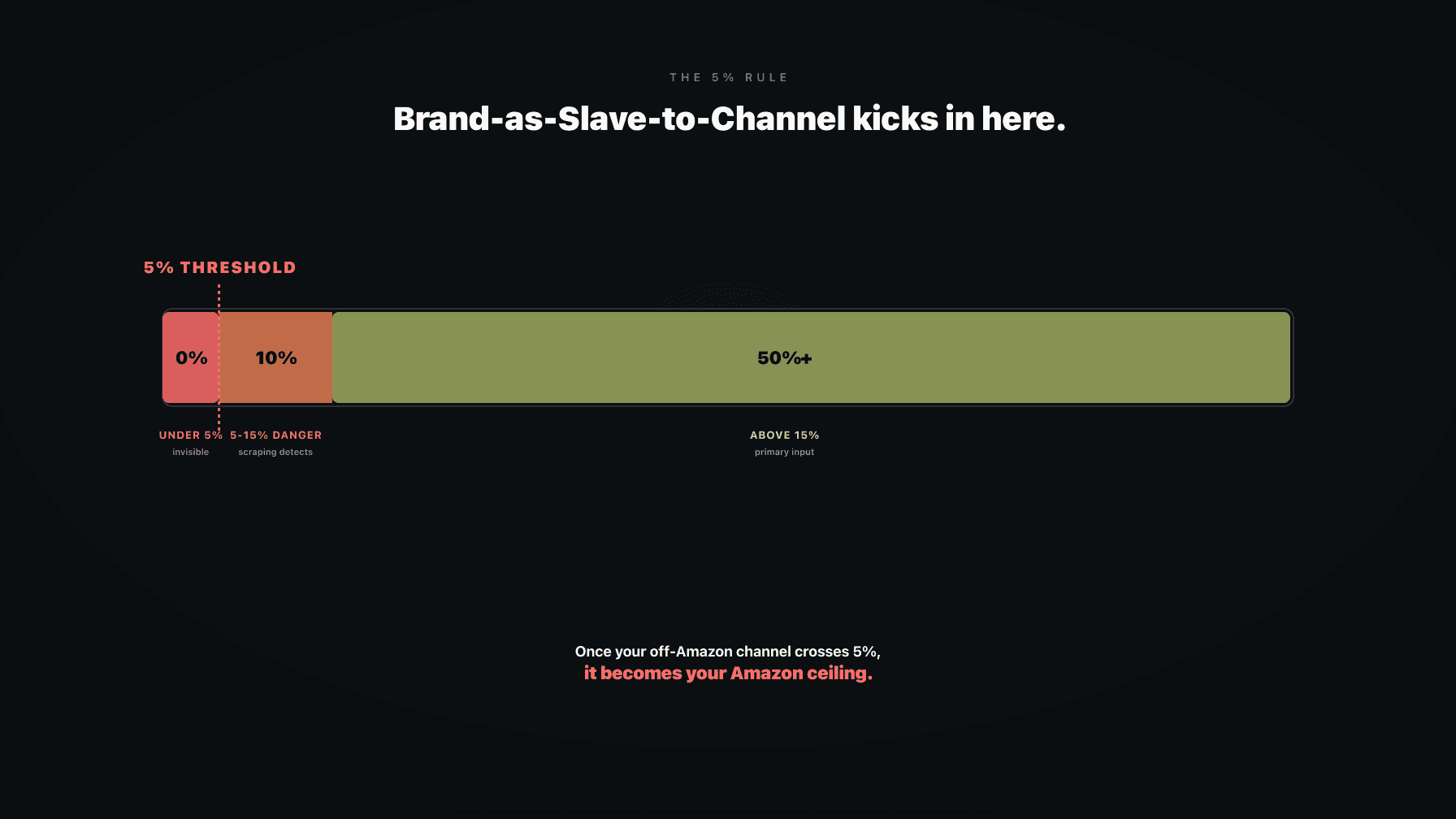
Slowly and through value, not discount. Package inserts that point to your subscription program. Replenishment emails to past Amazon buyers who opted in. A subscription offer that beats Amazon Subscribe and Save on bundle structure (not on raw price). Do not try to win the migration on price. You will lose the Amazon margin faster than you gain DTC revenue. This is the 5% rule for staying off the channel slave path in practice.
Largely yes. Subscription pricing reads as structurally different from one-time retail to Amazon's scraping models because the SKU and the buying motion are different. Subscription also gives you the LTV economics to justify the channel investment. For replenishment categories, subscription on Shopify alongside one-off retail on Amazon is the cleanest coexistence pattern that exists.
Stop running your Shopify site like it is a discount mirror of your Amazon listing. Pick a structural play. Run the audit. Or apply to have operators who already know the math run it for you.