Chad Rubin
May 21, 2026 · 12 min read
Operator notes by email
Short, opinionated takes on AI agents, Amazon PPC, pricing, and inventory. No fluff. About once a week.
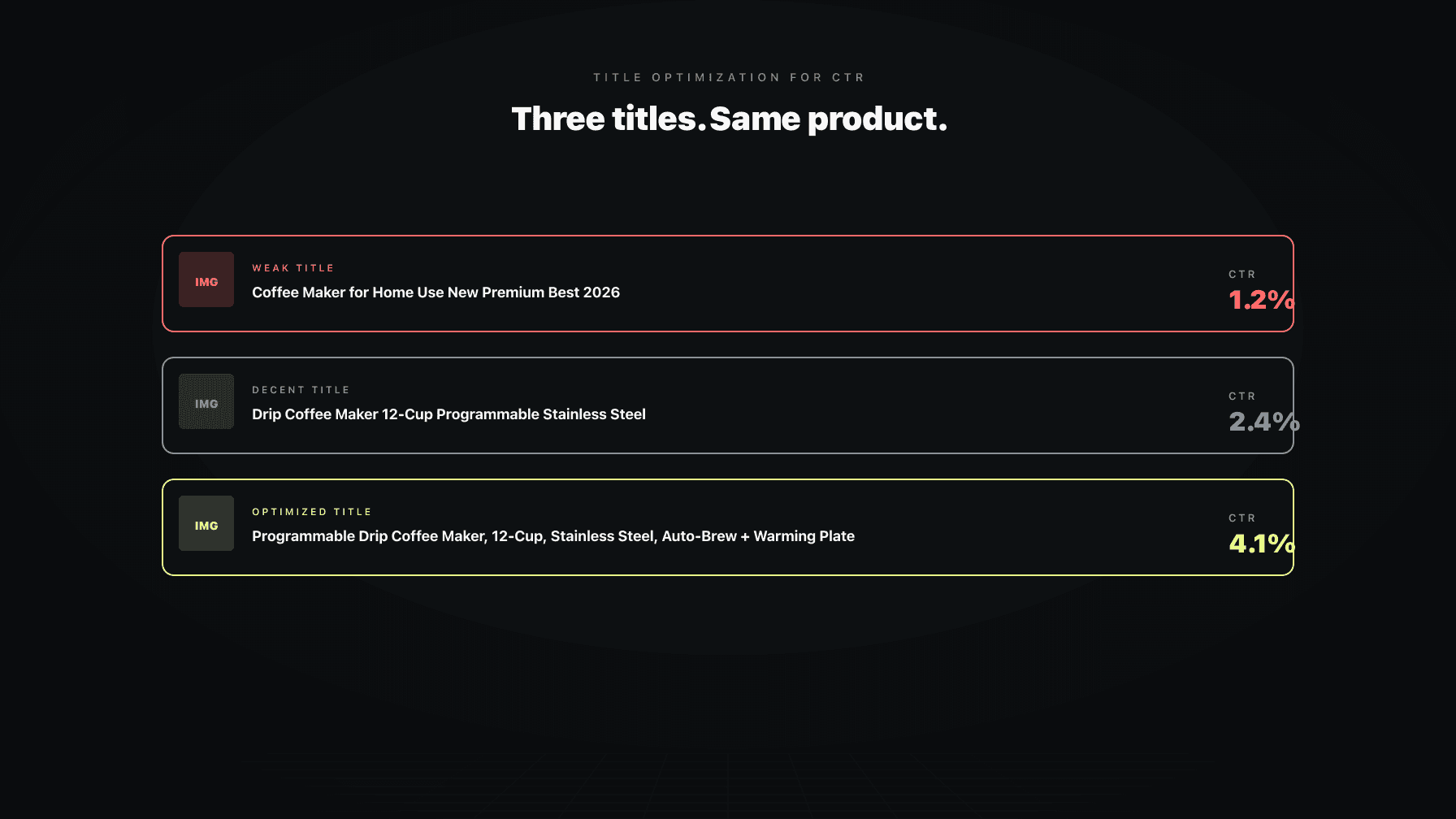
The title is the discovery layer. It has to do two jobs at once: get matched by the algorithm, and earn the click from a human scrolling on a phone. Most title rewrites get this backwards. They optimize for the brand voice, the agency's house style, the founder's preference. They do not optimize for the click.
In 2026 the click is harder to earn than it was three years ago. Mobile is over 70 percent of Amazon's traffic and the mobile thumbnail truncates titles to roughly 60 to 80 characters. Sponsored placements have pushed organic results further down the page. Rufus is rewriting how shoppers form queries.
None of that matters if your title cannot survive the first 60 characters of a mobile thumbnail. That is the rule that decides whether the next 140 characters get read at all.
This is the operator playbook for Amazon title optimization in 2026. Written for sellers who already know what a title is supposed to do and want to know what actually moves CTR. No hedging, no template downloads, no 47-step checklist.
I see sellers build elaborate scoring systems for titles. Readability score, keyword density score, brand alignment score. None of that matters. The title has one job. Earn the click.
Think about what the title actually does. Shopper types a query. Amazon returns a results page. The shopper scans thumbnails. The thumbnail is an image, a price, a star rating, and the first 60 to 80 characters of your title. Everything past the truncation point is for the algorithm, not the shopper.
From reading to action
If the framework above sounds familiar, your Amazon account is probably carrying the same drag. Apply and we will show what Marko, Oracle, and Bruno would change in your first week.

Ran a 7-figure Amazon brand for a decade. Founded Skubana (acquired). Co-founded Prosper Show. 15+ years on Amazon.
Join the brands that replaced agencies and tools with AI employees.
CTR is also the input that drives the rest of the funnel. Higher CTR means more clicks at the same impression count. More clicks at the same conversion rate means more sales, which means Amazon's ranking model gives you more impressions. The flywheel starts at the click.
Conversion is the detail page's job. Bullets, images, A+ content, video, reviews, price. The title's job ends the moment the shopper clicks. If you optimize the title for conversion, you are optimizing the wrong thing.
Open Amazon on your phone. Search for something in your category. Look at what the title actually shows. Two lines. Maybe three on a larger screen. The first line is where the click is decided.
Here is what fits in roughly 60 characters: a brand name, a product type, one specific attribute, and maybe one qualifier. That is the entire mobile thumbnail. If you spend the first 30 characters on a brand name and a tagline, you have already lost the query match.
Desktop is more forgiving (150 to 200 characters depending on width), but desktop is the minority of traffic for most categories. Even desktop shoppers scan rather than read. Eye-tracking studies show shoppers spend less than two seconds per result. They are pattern-matching, not reading.
What pattern are they matching? The query they just typed. If the shopper typed "stainless steel water bottle 32 oz" and your title says "[Brand] Premium Hydration Companion Built For Adventure," they will scroll past. The thumbnail might be beautiful, the brand might be strong. The pattern did not match.
The title is not for your brand. It is for the query. The brand earns the click after the query match earns the impression.
Front-load the primary keyword. Not in position one. In position two or three, after the brand. Amazon's style guide says brand goes first. The algorithm rewards brand-first titles. The shopper reads left-to-right and pattern-matches inside the first 60 characters.
A working structure for most categories in 2026 looks like this: Brand, primary keyword phrase, top differentiator, size or quantity, secondary attribute. That gets you a strong mobile thumbnail and leaves the back half of the title for algorithmic match.
The mistake I see most often is sellers burying the primary keyword in the middle or back of the title because they wanted the front to feel "premium." Premium is not a query. Premium is what shoppers decide on the detail page after they have clicked. Premium does not earn the click.
The second mistake is duplicating the primary keyword three times in the title because someone read a 2019 post about keyword stuffing. Amazon's algorithm has not needed keyword repetition since around 2020. Once is enough. Twice is wasted budget. Three times triggers a quality flag in some categories.
You have roughly 200 characters depending on category. Some categories cap at 150. Treat the limit as a budget.
Spend the budget on three things in order of priority: query match (primary keyword and most relevant secondary), shopper-relevant attributes (size, color, count, material, compatibility), and disambiguators that prevent wrong-click bounces (pet size, age range, voltage, model fit). Everything else is wasted budget.
What is wasted budget? Synonyms the algorithm already maps. Adjectives that do not match queries (premium, professional, luxury, ultimate, deluxe). Brand taglines. Marketing language. Filler words.
I have seen sellers spend 40 characters on the phrase "Perfect For Home And Office Use." Six words of unindexed marketing copy. If a shopper queries "home office water bottle," the algorithm will surface your listing on indexed terms in the bullets and back-end. You do not need to spend title real estate on it.
A clean way to audit: print the title and circle every word that either matches a high-volume query or describes a concrete attribute. The words you do not circle are candidates for removal. Most titles I audit have 30 to 60 characters of removable copy.
Brand voice loses. Every time. If brand voice and query match cannot coexist in the first 60 characters, the query wins and brand voice goes somewhere else.
The somewhere else is the bullets, the A+ content, the brand story module, the storefront, the post-purchase email, the insert. Six other surfaces where brand voice has room to breathe. The title is not one of them.
This is the conversation I have most often with brand teams. They want the title to feel like the brand. The title cannot afford to. It has 60 mobile-visible characters and one job. The bullets will do the brand work. The A+ will do the brand work.
If the brand insists on title language that does not match queries, the operator math is simple: lower CTR, fewer clicks, less ranking, less revenue, less brand visibility long term. The brand wins by losing the title and winning the funnel.
The primary query is not the highest volume keyword in your category. It is the query that drives the most click-weighted impressions for that ASIN. Click-weighted, not impression-weighted.
Pull Search Query Performance for the ASIN. SQP gives you impressions, click share, conversion share, and purchase share by query. Sort by click share. The keywords with the highest click share are the ones matching your listing's current click pattern.
Cross-reference SQP with Brand Analytics search frequency rank. A keyword with high SQP click share and high search frequency rank is a primary query. High click share with low search frequency rank is a niche match that may not justify title real estate.
The other input is your PPC search term reports. Look at search terms with the highest indexed conversion rate, not the highest spend. Conversions tell you which queries shoppers use when they are ready to buy.
Keyword tools that report aggregate category volume do not tell you which query earns clicks on your specific listing. The data lives in SQP and your search term reports.
Templates are starting points, not a substitute for testing. Categories pattern-match differently.
For consumables: brand, product type, flavor or variant, size or count, primary attribute.
For apparel: brand, gender or category, product type, fit or style, material. Color usually belongs in the variation, not the title.
For home goods: brand, product type, primary use case, size or capacity, material. Use case is the click-earner here.
For electronics: brand, product type, model or generation, key spec, compatibility. Compatibility is critical. The wrong-click bounce in electronics is brutal.
For supplements: brand, ingredient, dose, count, form factor. Be careful with claims. Amazon removed a lot of claim language from supplement titles in 2025 and is enforcing harder in 2026.
For pet: brand, species, life stage or size, product type, primary attribute. The species and size disambiguator should sit in the first 40 characters.
None of these are universal. Pull the top 20 organic listings for your primary query and look at the patterns. The patterns that show up in eight or more of the top 20 are the ones currently rewarded in that category.
Most title tests fail because they change too much. You change the brand position, the primary keyword, and an attribute in the same test, and you cannot tell which change moved CTR.
What to test: the first 60 characters. That is where the click is decided. Test one variable at a time. Test primary keyword phrasing (singular vs plural, with or without modifier). Test attribute placement (size before or after material). Test brand position (first vs second). Test specific differentiator language (the word that describes your category's main click-driver).
What to leave alone: the back half of the title, the algorithmic match, the keyword variations the back-end already covers. The back half does not move CTR. Changing it just creates noise in the test data.
Use Manage Your Experiments where available. Where it is not available, use a longer pre-period and post-period (four weeks minimum each) and control for seasonal and PPC changes. Most title tests need at least 14 days to show signal because impression volume needs time to stabilize after a content edit.
The other thing to leave alone: titles that are already converting at category-leading rates. If your CTR is in the top quartile for the keyword, the title is not the bottleneck. Test something else.
CTR moves on its own. Seasonal demand shifts, competitor listings change, sponsored placements rotate. Natural variance for most listings is 10 to 20 percent week over week even without any changes.
If a title test moves CTR 8 percent, you have not learned anything. If it moves 25 percent and holds for three weeks, you have learned something. If it moves 40 percent in week one and reverts in week three, you saw a transient spike.
Use a control. Either a sibling ASIN that did not get the test, or a pre-period baseline of at least 28 days. Compare against the control, not against the prior week.
Track CTR at the query level, not the listing level. Listing-level CTR is an aggregate that blends queries with very different match strengths. Query-level CTR in SQP tells you whether the test moved the queries you wanted to move. A title change can lift CTR on one query and depress it on another. The aggregate hides the trade-off.
CTR is the leading indicator. Ranking is the lagging indicator. If CTR lifted but ranking did not move in four weeks, the lift was not large enough. Re-test with a bigger swing.
Amazon enforces title compliance more aggressively in 2026 than it did in 2023. Listings get suppressed, sometimes silently, for things that used to slip through.
The current suppression triggers I see most often: special characters not on the approved list, all-caps words beyond two consecutive caps, prohibited claim language (medical claims in supplements, safety claims in juvenile products), brand name violations, category-specific length violations, and keyword stuffing patterns.
The keyword stuffing pattern that triggers suppression in 2026 is repeating the same root keyword three or more times, or chaining synonyms with no connective copy. Amazon's quality model treats it as low-quality content and either suppresses the listing or down-weights it.
The other failure mode is silent. The listing stays indexed but ranks below where it should. No notification. You discover it because impressions drop and CTR for the affected queries goes flat. Catalog audit tools catch this faster than manual review.
The fix for most suppression is short: strip the prohibited language, re-submit. Most cases resolve in 48 hours. The harder fix is the silent down-weighting, which often requires a full title rewrite.
Brett is the catalog auditor inside Profasee's AI employee team. He reads titles the way an operator reads them: as the click-earning surface, not as a brand statement.
What Brett does on titles: scans the title against the top 20 organic listings for your primary query, flags missing primary keywords or weak placement, identifies compliance triggers (prohibited language, length violations, banned characters), and proposes rewrites with CTR-impact estimates based on the gap between the current title and the patterns currently rewarded in your category. The rewrites come with reasoning, not just output.
Brett also coordinates with Marko, Profasee's PPC manager. Marko sees the actual search terms driving conversions on your PPC campaigns. Brett pulls those terms into the title audit so the organic title matches the queries already proven to convert in paid. That is the loop most title work misses. Title and PPC are optimizing for the same shopper.
The output is a rewrite proposal you approve, edit, or reject. Brett does not push changes to the catalog without sign-off. Title changes are too high-leverage to automate end to end.
See the catalog auditor page for the full audit flow, and the PPC manager page for the search term and bidding loop.
There is no universal best structure. The structure that works is the one that matches the patterns currently rewarded in your category. For most categories the working pattern in 2026 is: brand, primary keyword phrase, top differentiator, size or quantity, secondary attribute. The first 60 characters should contain the brand and the primary keyword match. Everything past 60 is for the algorithm. Pull the top 20 organic listings for your primary query and look at what eight or more of them have in common. That is the structure to start from.
Category dependent. Some categories cap at 150, some allow 200, a few up to 250. The cap is a budget, not a target. Spend characters on query match and shopper-relevant attributes. Most strong titles in 2026 are 130 to 180 characters. Hitting the cap is not a positive signal. Spending the cap well is.
Yes, in almost every category. Amazon's style guide requires it and the algorithm rewards it. The exception is when the brand name is very long or unrecognizable to the shopper. In that case the brand still goes first but should be one to two words, with the descriptor and primary keyword following immediately. The brand-first rule is consistent. What varies is how much of the first 60 characters the brand should consume, which depends on brand strength.
Pull Search Query Performance for the ASIN. Sort by click share, not impression share. Cross-reference with Brand Analytics search frequency rank. Look for queries with both high click share and high search frequency rank. Then cross-check with your PPC search term reports for queries with high indexed conversion rate. The intersection of those three sources is your primary query. Keyword tools that report aggregate category volume are not a substitute. They tell you what the category searches for, not what earns clicks on your specific listing.
The title is one of four inputs to the thumbnail. The other three are the main image, the price, and the star rating. A strong title cannot overcome a weak main image, a price far from category median, or a star rating below 4.0. Open the search results for your primary query on a phone and ask whether your thumbnail looks competitive against the top 10. Title is not always the bottleneck.
It depends what you mean by safely. AI that audits the title and proposes a rewrite with reasoning, then waits for human approval before pushing to the catalog, is safe and high-leverage. AI that auto-pushes title changes without human review is not. Title changes affect indexing, ranking, and CTR in ways that are hard to reverse cleanly. The leverage is in the audit and the proposal. Keep the human in the loop on the actual catalog change. That is how Brett works inside Profasee. Audit, propose, wait for approval, then push.
For top-revenue ASINs, test once per quarter at minimum. For mid-tail ASINs, test annually or when category patterns shift. Do not test more than one variable at a time. Do not test during seasonal swings or promotional periods where the baseline is noisy. Use Manage Your Experiments where available. Where it is not, use a 28-day pre-period and 28-day post-period with a sibling ASIN as control. Most failed title tests fail because they were too short or changed too many variables. Slow the test down and you will learn more.