Chad Rubin
May 21, 2026 · 11 min read
Operator notes by email
Short, opinionated takes on AI agents, Amazon PPC, pricing, and inventory. No fluff. About once a week.
Most brands treat Amazon listing optimization as a writing problem. Hire a copywriter. Tighten the bullets. Maybe rewrite the title in Q1. Cross your fingers and watch BSR for a week.
That worked when you had 10 ASINs and one variation each. It does not scale to 200 ASINs across 8 categories with variation parentage, regional A+ content, mobile-first image stacks, and a search algorithm that re-evaluates your relevance on every query. Listing optimization in 2026 is not a writing problem. It is a conversion-system problem.
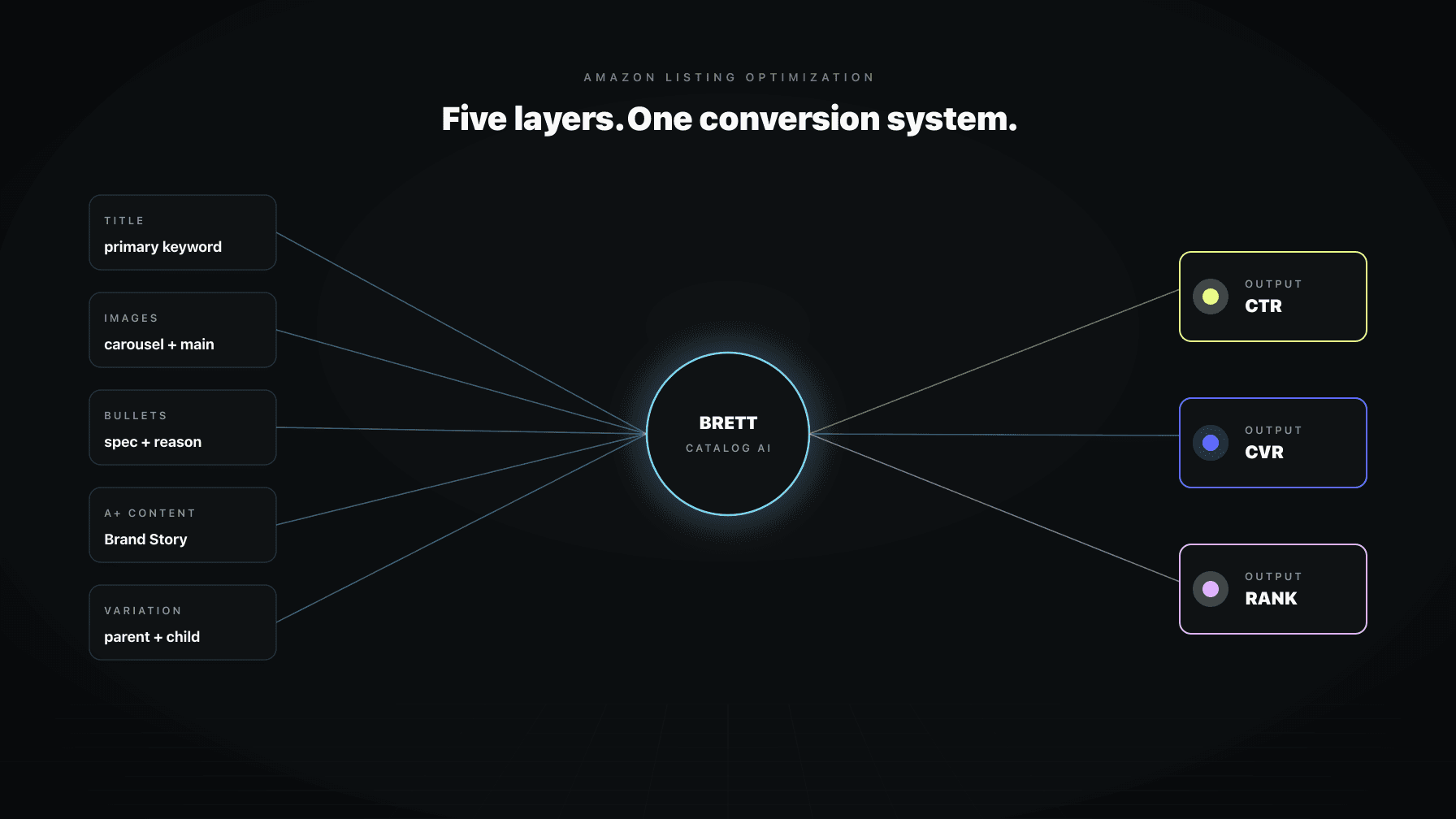
Every listing on Amazon is the product of decisions made across five layers: title, bullets, images, A+ content, and variation strategy. Each layer has its own relevance signal, its own conversion impact, and its own failure mode. Most operators improve one and assume the rest are fine. That is why the same brand has a top-1000 ASIN and a top-100,000 ASIN side by side in the same catalog. The five layers were never optimized as a system.
This playbook is the operator framework I run for myself and for the brands I work with. It assumes you have AI catalog tooling in your toolkit and need to operate it without it operating you.
## Key takeaways >- Amazon listing optimization is a conversion-system problem across five layers (title, bullets, images, A+ content, variation), not a copywriting problem on any one.- CTR drives discovery. CVR drives revenue. The two are different problems with different fixes, and most operators conflate them.- The mobile experience is the actual experience for most categories. Optimize images and title for the phone first, desktop second.- Variation parentage either consolidates rank or cannibalizes it. The wrong parent strategy turns one strong ASIN into three weak ones.- Catalog hygiene is a defensive system. The cost of a broken variation, a suppressed listing, or a missing browse node is bigger than the cost of any title rewrite.
Walk into ten Amazon brands and ask how listing optimization gets done. You will hear the same answer: "We rewrote the bullets last quarter and the BSR did not move much, so we are working on PPC instead."
That answer hides a structural problem. The brand changed one variable inside a five-variable system, did not measure what changed at the right grain, and concluded the layer did not matter. The layer mattered. The intervention was too small to read against natural variance, and the operator did not control for the other four layers moving underneath them.
Real listing optimization is closer to controlled experimentation than to creative work. Pick one layer. Hold the other four constant. Move the chosen layer in a measurable way. Read the result against a defined CTR or CVR benchmark over a defined window. That is the loop. Most brands run no loop and call the result "the algorithm being weird."
From reading to action
If the framework above sounds familiar, your Amazon account is probably carrying the same drag. Apply and we will show what Marko, Oracle, and Bruno would change in your first week.

Ran a 7-figure Amazon brand for a decade. Founded Skubana (acquired). Co-founded Prosper Show. 15+ years on Amazon.
Join the brands that replaced agencies and tools with AI employees.
Title. Drives search match and click-through rate. The title is the line a shopper sees in search results before they click. Title carries the primary keyword load Amazon uses to determine which queries you appear on. Optimize title for the query you want to win, not for the brand voice you would prefer.
Bullets. Drive on-page reassurance and conversion rate. Bullets are read by shoppers who clicked through and need to be convinced. They carry secondary keyword load and they answer the "is this for me" question. Bullets that read like ad copy convert worse than bullets that read like specs and reasons.
Images. Drive both CTR (the main image inside the search-result grid) and CVR (the supporting images on the listing page). Image stack is the single highest-leverage layer for most categories in 2026 because the mobile experience dominates and the image carousel is where mobile shoppers spend most of their attention.
A+ content. Drives CVR for shoppers who scrolled past bullets. A+ is the Brand Story and Enhanced Brand Content section. It adds visual proof, comparison tables, and brand context. It does not appear in mobile-first views as prominently as bullets, so the layer is more about conversion lift on the long-tail of comparison shoppers than about the median customer.
Variation strategy. Drives whether your reviews and rank consolidate or cannibalize. Variation parentage decides whether shoppers see all your colors and sizes under one ASIN or spread across five. The wrong parent strategy turns 1,200 reviews into 240 reviews on each of five ASINs. The right one turns five ASINs into one Buy Box magnet.
Five layers. Each one has its own driver. Optimize them in isolation and you miss the system. Optimize them as a system and the math compounds.
Click-through rate and conversion rate are different problems. They get treated as one problem because the dashboard only shows aggregate "sessions" and "units." Operators see "the listing is underperforming" and treat that as one thing. It is two.
CTR is a discovery problem. Low CTR means the shopper saw your listing in search and did not click. The fix is in title and main image, the two elements that appear before the click. Tweaking the bullets does not help. The bullets are not visible at this stage.
CVR is a conversion problem. Low CVR means the shopper clicked, landed on the page, and did not buy. The fix is in images, bullets, A+ content, price, and reviews. Rewriting the title does not help. The title already worked.
Most listing-optimization projects fail because the team rewrites the title to fix a CVR problem, or rewrites the bullets to fix a CTR problem. Diagnose first. Pick the layer that matches the problem. Then act.
Title optimization for CTR is its own deep-dive post with the operator math.
Most catalog teams still optimize for the desktop listing page. The desktop listing page is not where most shoppers live in 2026.
In every category I have seen in the last 18 months, mobile session share is 65 to 85 percent of total sessions. A+ content that takes up three screens on desktop takes up nine screens on mobile, most of which do not get scrolled. The main image takes up the top half of the mobile screen. The carousel matters more than the desktop hero. The bullets are usually collapsed behind a "See more" tap.
The defensive playbook:
The listing image optimization post covers the defensive and offensive playbooks in detail.
Variation parentage is the layer most operators get wrong by default. Amazon's variation system is a relationship: a parent ASIN holds child ASINs for color, size, count, scent, or any other dimension. Reviews accumulate to the parent. Search relevance accumulates to the parent. The wrong parent decision spreads your rank across five children that each look weak.
The right call depends on whether the dimension is a true variation or a different product. A 12-pack vs a 24-pack of the same item is a variation. A blue T-shirt vs a red T-shirt is a variation. A roast coffee vs an espresso blend that share a brand but not a use case is two different products and probably should not share a parent.
Common failures:
The variation parent ASIN strategy post walks through when to consolidate and when to split.
Catalog hygiene is the part of listing optimization most teams skip because it is not creative work. It is the highest-ROI work most catalogs need.
Hygiene includes:
A single suppressed listing on a hero ASIN can cost more revenue in a week than three months of bullet rewrites can gain. The cost is silent. The dashboard does not flash red. You only see it when you check the catalog audit report.
Seven listing audit triggers covers the audit-cadence playbook.
The operating-mode framework I use for PPC and pricing applies to catalog optimization too, with one important difference: the failure cost of a bad listing change is higher than a bad bid, because the listing change persists.
Observe. The AI scans the catalog, builds a model of what each ASIN looks like across the five layers, and flags variances. No changes taken. This is week one.
Recommend. The AI proposes specific changes with reasoning. Rewrite this title to add a missing primary keyword. Replace the main image with a higher-CTR variant. Consolidate these three children under one parent. You approve or reject in batches.
Approve. The AI sends a daily digest of proposed catalog changes. You approve all, reject some, the rest move automatically. This is where most mature catalogs should live.
Autonomous. The AI moves catalog elements within guardrails without asking. This is where the safest layers run (image stack reordering, A+ section ordering). Title, bullets, and variation parentage should require human sign-off for high-revenue ASINs even after years of autonomy. The downside is too long-lived.
Three things matter more than the rest.
1. It diagnoses CTR vs CVR separately. A tool that only shows "sessions" or "units" is not helping you fix the right layer. The good tools surface CTR benchmarks per category, CVR benchmarks per ASIN tier, and flag where the gap lives.
2. It treats variation parentage as a first-class object. Variation strategy is where most operators lose the most rank. The tool should map your parents and children, flag broken relationships, and propose consolidation or split moves with rank impact estimates.
3. It coordinates with PPC and pricing in real time. A title change shifts search relevance, which shifts what queries you appear on, which shifts what bids matter. A standalone catalog tool that does not talk to Marko cannot tell you that the new title doubled your impressions on a query you were not bidding on. Shared state is the difference.
Everything else (UI, exports, AI copywriting) is secondary. The diagnosis matters more than the cosmetics.
Failure 1: Optimizing the wrong layer for the wrong problem. Rewriting the title to fix a CVR problem. Rewriting the bullets to fix a CTR problem. Most listing-optimization projects waste effort here.
Failure 2: Ignoring mobile. Designing the listing for the desktop preview when 70 percent of sessions are mobile. Mobile sees a different version of the page, and the parts that matter are different.
Failure 3: Catalog hygiene neglect. Bullets, A+ content, and main images get attention. Suppressed listings, broken variations, missing browse nodes, and stale flat-file uploads do not. The silent failures cost more than the visible ones.
These are not edge cases. They are the median brand.
Daily review is too short for catalog work. Weekly is too noisy. Monthly is right for tactical exception handling, with a quarterly deep-audit on top.
What goes in a monthly catalog review:
This is where the operator decides next-month priorities, not where the AI makes them.
Brett is the AI catalog employee we built at Profasee. Brett does not run alone. That is the key difference from standalone listing tools.
When Marko detects a query winning impressions you do not rank for organically, Brett gets a signal to evaluate the title and bullets for that query. When Oracle raises a price, Brett re-evaluates whether the listing copy still supports the new price tier. When a listing gets suppressed, Brett surfaces it the same hour, not next month at the quarterly audit.
Coordination across catalog, PPC, and pricing is the feature. No standalone catalog tool can do it because no standalone tool has access to the other systems in real time.
Amazon listing optimization is the discipline of tuning the five conversion layers of a product detail page (title, bullets, images, A+ content, and variation strategy) so the listing wins both discovery and conversion against its category benchmark. In 2026, it is a system problem, not a copywriting problem. Optimizing one layer in isolation rarely moves the needle. Optimizing the five layers together as a system compounds.
CTR is the rate at which shoppers who saw your listing in search clicked through. CVR is the rate at which shoppers who landed on the listing converted to buy. CTR problems are fixed by title and main image. CVR problems are fixed by supporting images, bullets, A+ content, price, and reviews. Most listing optimization projects fail because the operator picks the wrong layer for the wrong problem.
Mobile first. In most categories, 65 to 85 percent of sessions are mobile. The main image, the first half-bullet, and the image carousel are what most shoppers see. Desktop A+ content matters for long-tail comparison shoppers, not the median. If your listing looks great on desktop and unreadable on a phone, you are losing the majority of shoppers.
Consolidate when the children are true variations (color, size, count, scent) of the same product. Split when the children are different products that share a brand but not a use case. The wrong call spreads reviews and search rank across five weak ASINs instead of concentrating them under one strong parent.
Catalog hygiene is the defensive work of keeping listings clean: no suppressed ASINs, correct browse nodes, intact variation themes, compliant images, valid bullets, no stale flat-file overwrites. The visible work (bullet rewrites, A+ content) gets attention. Hygiene does not. A single suppressed hero listing can cost more revenue than a quarter of bullet rewrites can gain. Run a quarterly audit at minimum.
For low-revenue ASINs and the safer layers (image stack ordering, A+ section ordering), yes. For title, bullets, and variation parentage on high-revenue ASINs, AI should propose and a human should approve. The downside of a bad listing change persists for weeks or longer, so the trust ladder for catalog should move slower than the ladder for PPC.
Monthly for tactical exception handling. Quarterly for deep audits including hygiene, mobile-first review, and variation health. Daily review creates whiplashed changes that drown signal in noise. Annual review is too slow to catch suppressions, policy changes, and competitive moves.