Chad Rubin
June 9, 2026 · 11 min read
Operator notes by email
Short, opinionated takes on AI agents, Amazon PPC, pricing, and inventory. No fluff. About once a week.
A one-star review lands on your hero SKU at 7:42 a.m. By 8:15 the founder has typed a reply, deleted it, retyped it, and sent it. The reply is a paragraph long. It uses the words "we apologize" and "please reach out to us at." It addresses the reviewer directly. And it is, almost without exception, the wrong move.
I have run 7-figure brands on Amazon for over a decade, and the single most common reputation mistake I see is this: operators respond to negative reviews emotionally, publicly, and defensively. They treat the response as a conversation with the angry buyer. It is not. The reviewer has already churned. They are not coming back to read your apology. They are not going to edit the star rating because you were nice. The audience for every public response you write is the next prospect, the shopper who is on the page right now, comparing your product to two others, and who reads the negative reviews specifically to find out what the failure modes are.
Once you accept that the audience is the next prospect and not the reviewer, the whole system changes. You stop apologizing. You stop offering refunds in public. You stop writing paragraphs. And most importantly, you stop responding to most of them, because most of them do not need a response at all. They need to be classified, routed, and turned into a defect signal that fixes the underlying problem so the next review does not get written.
That is the operator's job. This post is the framework.
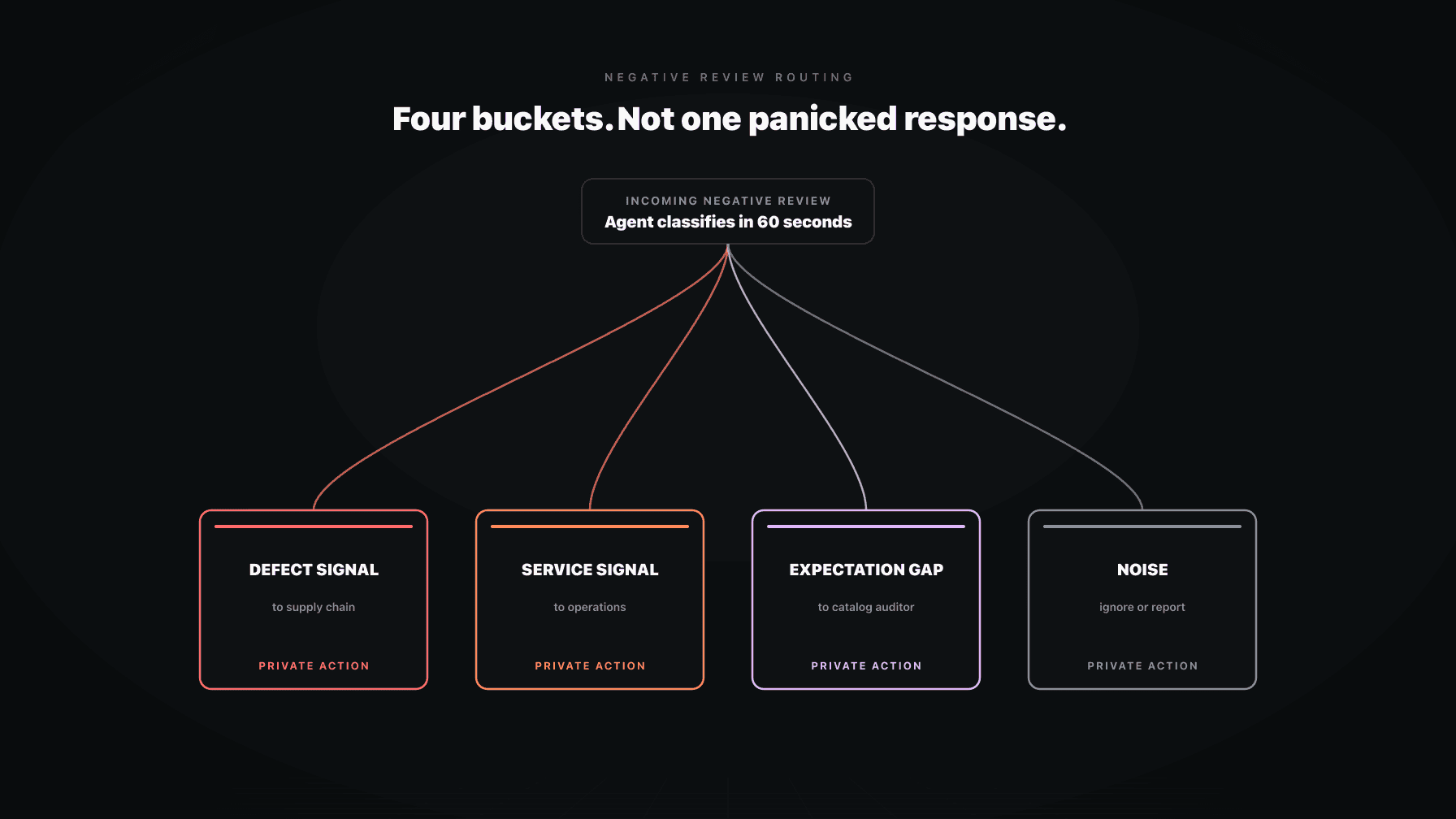
Every negative review on Amazon falls into one of four buckets. The classification step happens before any response is drafted, and it determines where the review routes inside the business.
Defect signal. The buyer received the product, used it as intended, and something failed. The seal leaked. The motor died in 14 days. The fabric pilled after one wash. The pump arrived cracked. A defect signal is a Voice of the Customer datapoint about the physical product or its packaging. It routes to the supply chain owner and, if it accumulates, to the QC team at the factory. It is the most valuable type of negative review because it tells you exactly what to fix. Three defect signals on the same failure mode in 30 days is a stop-the-line event, and I will get to that later.
Service signal. The product itself is fine, but the fulfillment experience failed. FBA shipped it in a damaged box. The wrong variant arrived. It was 11 days late. The unit was clearly a return that got restocked without inspection. If you are FBM, this is on you. If you are FBA, you still own it, but the routing is different: it goes to a Seller Central case, an inventory reconciliation, and a removal order on the affected units.
Expectation gap. The product worked exactly as designed, but the buyer expected something different. They thought it was bigger. They thought it included batteries. They thought it was dishwasher safe. They thought it was waterproof and it is only water-resistant. An expectation gap review is not a product defect. It is a listing defect. The listing failed to set the expectation correctly, and that routes to the catalog owner. This is where work pays back: every expectation-gap review is a free A/B test telling you which bullet, image, or A+ module is failing to do its job.
From reading to action
If the framework above sounds familiar, your Amazon account is probably carrying the same drag. Apply and we will show what Marko, Oracle, and Bruno would change in your first week.

Ran a 7-figure Amazon brand for a decade. Founded Skubana (acquired). Co-founded Prosper Show. 15+ years on Amazon.
Join the brands that replaced agencies and tools with AI employees.
Noise. The shipping driver was rude. The reviewer mixed up your product with a competitor's. The review is one word. The review is in the wrong language. The review is about a product they bought used on a different platform. Noise is noise. It does not route anywhere. You do not respond. You do not engage. In some cases you submit a violation report under Amazon's Community Guidelines, but you do not waste a human minute writing a reply.
Most operators try to respond to all four buckets the same way, which is why the responses come out generic, defensive, and useless. The whole point of classification is that each bucket has a different owner, a different response posture, and a different downstream action.
Here is the rule I use, and it will feel uncomfortable the first time you apply it: a public response should only happen when it gives the next prospect a piece of information they cannot get anywhere else on the page. That is it. That is the threshold.
Most public responses do not pass that test. "We are sorry to hear about your experience, please contact us at support@" is not information. It is noise that signals to the next prospect that you read your one-stars and panic. The prospect now thinks two things: the complaint must be common enough that the brand has a canned reply ready, and the brand is more interested in damage control than in fixing the problem.
A public response passes the threshold when, and only when, one of these is true:
The review contains a factual error that, if uncorrected, will mislead the next buyer. Example: reviewer says the product does not work with iPhone, but it does, and there is a setup step they missed. Your response, two sentences max, points to the setup step. Now the next prospect reads the one-star and immediately sees the correction.
The review reports a defect on a unit that has since been fixed in production. You can say, factually, that units shipped after a certain date use updated tooling, sealing, firmware, whatever. The next prospect now knows the issue was a batch problem and that current inventory is different.
The review reports a service failure that has a clear, simple resolution path the buyer did not use. You can name the path without begging them to email you. "Damaged units are eligible for a no-return replacement through Your Orders. No need to message us." The next prospect now knows the replacement process is frictionless.
Notice what is missing from all three: apology language, emotional acknowledgment, refund offers, requests to contact support. Those belong in private buyer-seller messaging, not in a public reply, and they are governed by strict rules anyway. If you do not know those rules cold, read the buyer-seller messaging compliance post before you type another reply. The number of brands that get suspended for review manipulation because they offered a refund in a public response is non-trivial.
If the review does not pass the information threshold, do not respond. Route it to the right bucket and move on.
Three templates, each in a wrong-way and right-way pairing. Use these as starting points and tighten them to your brand voice.
Defect response with resolution path.
Wrong way: "We are so sorry to hear that your unit arrived damaged. This is not the experience we want for our customers. Please reach out to our support team at support@brand.com so we can make this right. Your satisfaction is our top priority."
Right way: "Damaged-on-arrival units are eligible for a no-return replacement directly through Your Orders > Get product support. Our QC team uses these reports to identify packaging failure patterns."
The right version does two things. It tells the next prospect that replacements are frictionless, and it signals that the brand uses these reports as a feedback loop, not a PR fire.
Expectation gap clarification.
Wrong way: "Thank you for your feedback. We appreciate all reviews and use them to improve. We are sorry the product did not meet your expectations."
Right way: "Confirming the dimensions listed on the detail page: 12 by 8 by 3 inches. Image 4 includes a size comparison with a standard letter envelope for reference."
You corrected the factual gap, you pointed the next prospect at the image that answers the question, and you did not apologize for a listing that was accurate. If expectation gaps keep accumulating on the same issue, the answer is not better replies. The answer is to fix the listing. That is a job for your catalog auditor, which I will get to in the next section.
Service issue acknowledgment.
Wrong way: "We are deeply sorry about your shipping experience. Amazon's FBA network occasionally has issues outside our control. Please contact us so we can help."
Right way: "Late deliveries on FBA orders are eligible for shipping refunds through the order detail page. Our 30-day inventory data shows our average delivery time is 1.8 days."
You named the resolution path. You included a real number that contextualizes the complaint. You did not throw FBA under the bus, which makes you look unprofessional, and you did not grovel.
In every right-way example: two sentences, no apology language, factual, written for the next prospect.
This is where most operators get the workflow wrong. They either ignore reviews completely or they have a VA blasting canned replies on every one-star. Neither works. The correct division of labor splits classification, drafting, and approval across an AI agent and a human owner.
The agent reads every new negative review within minutes of it appearing. It classifies the review into one of the four buckets using the language of the review itself, the product category, and the buyer's purchase metadata when available. Defect, service, expectation gap, or noise. If it cannot classify with high confidence, it escalates to a human queue instead of guessing.
For defect signals, the agent logs the failure mode against the SKU, increments the running 30-day count, and pings the supply chain owner if the count crosses threshold. For service signals, the agent opens the appropriate Seller Central case or files the removal order. For expectation gaps, the agent appends the gap to a listing-optimization backlog tagged to the specific element that failed (image, bullet, A+ module). For noise, the agent files a Community Guidelines violation report if criteria are met, and otherwise archives.
For the small subset of reviews that pass the public-response threshold, the agent drafts a reply in your brand voice using the templates above and puts it in an approval queue. A human reads it, edits if needed, and approves before it goes live. No public-facing reply ships without human eyes on it. The agent never has unilateral publish authority on your storefront. That is the rule.
This is exactly the kind of work an AI operating system for Amazon brands is built for: high-volume, pattern-matching, classification work where the cost of doing it manually is that it does not get done, and the cost of doing it sloppily is a public-facing mistake.
The single highest-leverage use of negative review data is defect-signal escalation. Here is the rule I run: three of the same defect signal on the same SKU in a rolling 30-day window is a stop-the-line event. Not a "monitor it" event. A stop-the-line event.
Stop-the-line means: no new PO releases on that SKU until the failure mode is diagnosed. The supply chain owner gets a packet that includes the three reviews verbatim, the dates, the order IDs, the lot codes if you have them, and any return-reason data from Seller Central that corroborates. That packet goes to the factory or the contract manufacturer with a specific question, not a vague complaint. "Three buyers in the last 21 days report the seam at the handle separating after 5-10 uses. Lot codes A23-A25. Can you pull retains, confirm thread spec, and send a corrective action plan by Friday?"
If you cannot trace lot codes back to production runs, that is the first thing to fix, not the reviews. Without lot traceability, you are guessing.
A 0.3-star drop on a hero SKU costs more than most operators realize. On a listing converting at 14 percent with 200 units a day, the conversion-rate compression from a sustained one-star streak typically shows up as a 1-3 point drop, which compounds into PPC inefficiency as your ACoS rises to defend the slot. The cost of stopping a PO for two weeks while you fix a seam is almost always less than the cost of letting the defect accumulate. Run the math the first time you face the call. After that, the rule writes itself.
Negative review response is not a standalone activity. It is one input into the operating cadence of the brand, and if it lives outside that cadence it will get ignored the first time you have a busy week.
The cadence I run, and the one I cover in detail in the operations mission control post, has three review touchpoints.
Daily, your agent surfaces the exception list: new negative reviews from the last 24 hours, classified, with any pending approval-queue drafts. You spend five minutes approving or editing the public replies that passed the threshold, and you scan the defect-signal counter for any SKU that crossed into stop-the-line territory overnight.
Weekly, you run a pattern review: look at the 7-day distribution across the four buckets, by SKU. If expectation-gap volume is rising on a specific listing, that listing goes into the catalog backlog this week, not next month. If defect signals are clustering on a lot code, the supply-chain conversation happens this week, not at the next quarterly review. This is also where review-velocity work, including Vine enrollment for newer listings, gets calibrated. Pulling in fresh positive reviews changes the ratio, and the review velocity and Vine post covers the mechanics.
Monthly, you do the supply-chain feedback loop: aggregate defect signals across all SKUs, send the consolidated packet to the factory, and update your QC checklist for the next production run. The goal of the monthly cycle is to make next quarter's defect signal volume lower than this quarter's. If it is not, your supply-chain conversation is not working.
The full ladder, from response posture to defect prevention, is laid out in the reviews and reputation playbook. This post is the response framework. That post is the whole stack.
If you want this running on your account with the classification agent, the approval queue, and the supply-chain escalation already wired up, the team takes a small number of operators per quarter through the build. Start at profasee.com/apply.
No. The default action on a negative review is to classify it and route it, not to respond publicly. Most reviews fail the information threshold for a public reply. Responding to everything signals damage control and dilutes the impact of the responses that actually matter. A good rule of thumb: fewer than 10 percent of negative reviews warrant a public reply.
Speed matters less than people think. The audience is the next prospect, not the reviewer, and the next prospect is reading a review that may already be weeks old. Classification should happen within a few hours so defect signals get logged in time to matter. Public replies should ship within 48-72 hours after human approval. If you are racing to reply in 30 minutes, you are writing for the wrong audience.
Only within the strict limits of Amazon's buyer-seller messaging rules, and only for legitimate order-resolution purposes, never to ask them to update or remove the review. Asking for review removal is a TOS violation that can get you suspended. The buyer-seller messaging compliance post has the full guardrails.
File a violation report through Brand Registry's Report a Violation tool or Amazon's review abuse reporting flow. Provide specifics: language patterns, timing clusters, account history if you can see it. Amazon's review-abuse team removes a meaningful percentage of reported reviews when the case is documented. Do not engage publicly. Engaging gives the fake review credibility it does not have.
Both, depending on how you do it. A short, factual response that gives the next prospect new information modestly helps conversion. A long, apologetic response that reads as defensive modestly hurts conversion, because it confirms the complaint in the prospect's mind and signals that the brand is reactive. The wrong-way examples in the templates section above are conversion-negative. The right-way examples are conversion-neutral to conversion-positive.
No. Never in a public response. Offering a refund publicly is, depending on how it is worded, a review-manipulation violation that can trigger account-level action. Refunds and replacements happen through the standard order resolution paths, which your public response can point to without offering the refund itself.
Generally no. Responding to five-star reviews looks performative and consumes attention that should go to defect-signal work. The exception: a positive review that contains a question or a use case that would help other buyers, where a short factual reply adds information for the next prospect. Same threshold as negative reviews, just applied less often.