Chad Rubin
June 8, 2026 · 12 min read
Operator notes by email
Short, opinionated takes on AI agents, Amazon PPC, pricing, and inventory. No fluff. About once a week.
Most Amazon operators think about reviews twice. Once at launch, when they are panicking about getting the first ten. And once when something goes wrong, when a one-star review tanks the rating and the conversion rate drops and nobody can figure out why sales fell off a cliff. Between those two moments, reviews are mostly ignored. They show up on the listing. They go up. They go down. Nobody owns them.
That is the mistake. Reviews are not a marketing problem you handle at launch and forget. Reviews are an operations problem you handle on a cadence forever. Star rating is one of the highest-leverage numbers on the listing because it gates conversion, ad efficiency, and search ranking simultaneously. A drop from 4.5 to 4.2 is not a vanity loss. It is a measurable hit to every click that lands on the page, every dollar of ad spend that runs through it, and every position the listing holds in search.
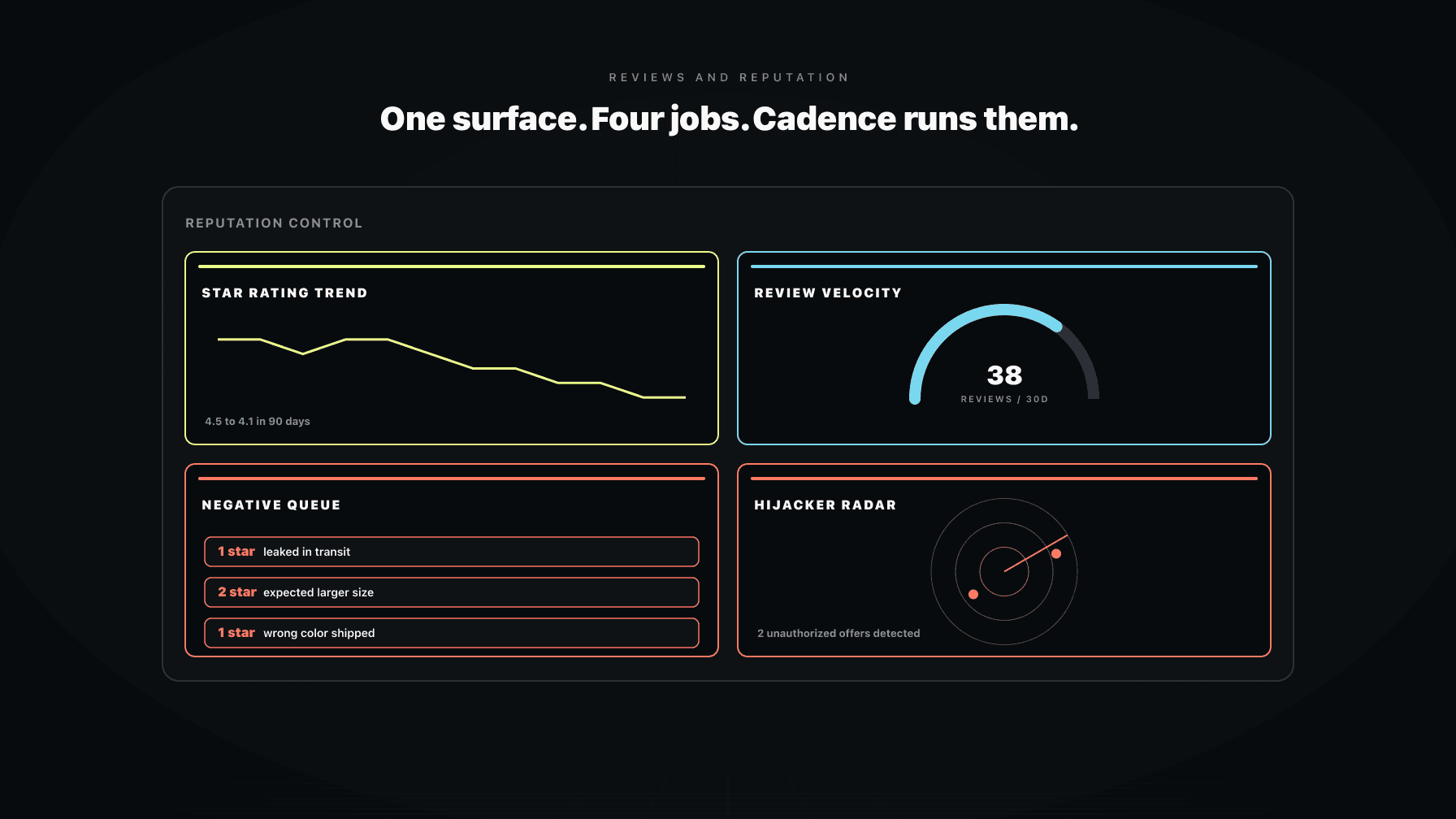
This is the operator playbook for treating reviews and reputation as a system, not a panic. Velocity at launch, response on the negatives, compliance in the messaging, defense against the bad actors, and the variation strategy that decides which reviews show on which listing. Five jobs. All five of them belong inside the cadence. Most of them belong to an agent.
## Key takeaways >- Reviews are an operations problem, not a marketing one. Star rating gates conversion, ad efficiency, and organic rank at the same time.- There are five jobs underneath reviews and reputation. Velocity, response, messaging compliance, hijacker defense, and variation pooling. Each belongs to a defined owner and a defined cadence.- Negative review response is a workflow, not a vibe. Speed, content, escalation path, and a clear rule on what to ignore.- The first 50 reviews matter disproportionately. Vine, post-purchase sequences, and a small number of disciplined launch moves do most of the work.- The agent does the monitoring, the routing, and the first draft. The human approves before anything goes to a customer.
The marketing-team framing treats reviews as a content asset. Get good ones. Counter the bad ones. Move on. That framing is wrong because it ignores the operational reality: reviews move every day, they affect every other lever on the listing, and they cannot be ignored for a quarter without consequence.
Star rating is the most underrated input on Amazon. A 4.5 listing converts better than a 4.2 listing at the same price, with the same image, with the same copy. The 0.3-star difference quietly compounds across every click. Ad spend gets worse because ACoS is worse at lower conversion. Organic rank gets worse because Amazon rewards listings that convert. The lower rating becomes the cause of three other problems that look unrelated but trace back to the same number.
That is why reviews belong in operations. Not because the marketing team should not care. Because if the only people watching reviews are the people who care about brand voice, the operational consequences land too late. By the time anyone notices that ACoS drifted up, the rating has already been at 4.1 for six weeks and the damage is baked in.
From reading to action
If the framework above sounds familiar, your Amazon account is probably carrying the same drag. Apply and we will show what Marko, Oracle, and Bruno would change in your first week.

Ran a 7-figure Amazon brand for a decade. Founded Skubana (acquired). Co-founded Prosper Show. 15+ years on Amazon.
Join the brands that replaced agencies and tools with AI employees.
The fix is treating review monitoring as a daily operational job, the same way you treat inventory cover and Buy Box. Something an agent watches, an operator approves on, and the cadence handles. Not a brand-team project that runs once a quarter.
There are five distinct jobs inside this surface, and they get conflated all the time.
Velocity. Getting enough reviews to keep the listing competitive, especially at launch and after a major variation expansion. Vine, post-purchase sequences, and the small disciplined moves that get a new ASIN past the first 50 reviews without breaking the rules. The review velocity and Vine post covers the operator approach.
Response. What to do when a negative review hits. Whether to respond publicly, whether to message the buyer, what counts as a defect signal and what counts as noise. There is a workflow underneath this that most operators do not have. The negative review response post walks the framework.
Messaging compliance. Buyer-seller messaging is one of the easiest places to get suspended without realizing it. Amazon's Communication Guidelines forbid review solicitation language that most operators do not think is solicitation. The messaging compliance post covers what can and cannot go in the sequence.
Hijacker and counterfeit defense. Brand Registry is necessary, not sufficient. Hijackers, counterfeit listings, and review attacks happen to every brand at some scale. The hijacker defense post covers the operator routine.
Variation pooling. Whether to pool reviews across a parent ASIN matters enormously. Done right, it accelerates rating on new variations. Done wrong, it dilutes the parent or merges incompatible products. The variation review pooling post covers when to pool and when to split.
Five jobs. Five owners. Most brands have zero of them assigned formally. That is the gap.
The daily piece is simple. Every morning, the agent surfaces:
That is the daily exception report. It is not a dashboard you scroll. It is a list the agent generates when there is something to report, and an empty inbox the rest of the time. The morning Mission Control check (covered in the operations playbook) includes a 60-second pass over this list.
The weekly piece is rating trend by ASIN, review velocity by ASIN, and a structured look at the negative reviews from the week. Not every negative review needs a response. The weekly review is where you decide which ones cross the threshold.
The monthly piece is the strategic one. Which products have a defect signal worth escalating to supply chain. Which variations should be split or merged. Whether the Vine and post-purchase sequence is doing its job. Whether the messaging compliance is clean.
Three loops. Same structure as the operations cadence. The reviews surface plugs into it cleanly because the cadence was built for exactly this kind of multi-loop workflow.
The single most common mistake on negative reviews is responding to the wrong ones. Operators see a one-star and rush to respond publicly because it feels urgent. Most of those responses make the situation worse. The buyer is not reading them. The next prospect is reading them. And a defensive response on the listing reads as defensive, which is worse than no response at all.
The framework is this. First, classify the review.
Most operators respond to everything. The pros respond to almost nothing publicly, and act privately on the signals that matter.
When a public response is warranted (rare), it should be short, factual, point to a specific resolution path, and never argue with the buyer. The audience is the next prospect, not the reviewer. The negative review response post gives the response templates and the threshold rules.
A new ASIN with 8 reviews at 4.6 stars converts worse than the same ASIN with 50 reviews at 4.4 stars. Volume creates trust. Perfection without volume reads as suspicious.
The operator's job at launch is getting to 50 reviews fast, inside the rules, without compromising the product fit. Vine is the primary tool. Post-purchase messaging (the compliant kind) is secondary. Insert cards that ask for honest feedback are gray-zone and worth avoiding unless you are very careful.
The mistake most operators make is treating Vine as a launch tactic and then forgetting it. Vine works across the product lifecycle. New variations, new colorways, refreshed formulations: every one of them benefits from a Vine cohort in the first 30 days. The review velocity post covers the operator's Vine playbook.
Amazon's Communication Guidelines forbid a lot of language that operators do not realize is forbidden. You cannot ask for a review. You cannot incentivize a review. You cannot offer a refund in exchange for changing a review. You cannot send marketing messages outside the proactive permitted templates.
Most brands are violating these guidelines without knowing it, usually inside an automated post-purchase sequence that was set up two years ago. A suspension on Communication Guidelines is a real risk and it is one of the few places where ignorance does not protect you.
The compliant post-purchase sequence is narrow. A delivery confirmation that asks the buyer to reach out if there is a problem. A product-care or how-to-use message that helps them get value. That is it. No "would you leave us a review." No "if you loved the product please rate it." No incentive language at all.
The messaging compliance post details exactly what stays inside the lines.
Brand Registry is necessary infrastructure. It is not a finished defense. Every brand at scale will get hijacked, counterfeited, or attacked. The question is whether you have a routine that catches it inside a week or whether you find out three months later when sales have already moved.
The routine has three parts.
Listing watch. Daily check (agent does it) on every active ASIN for unauthorized sellers, suspicious offer changes, and title or image alterations. This catches hijacking and unauthorized resellers fast.
Review pattern watch. Weekly check for review velocity anomalies that indicate a review attack. A sudden spike of negative reviews from buyers who never bought from your seller account is a tell. So is a cluster of negative reviews that all mention the same false claim.
Counterfeit search. Monthly search across the marketplace for listings that copy your branding, imagery, or product. This is slow work and partly manual, but the cost of not doing it is losing the search position to a counterfeit.
The hijacker defense post walks the operator's routine in detail, including the Project Zero, Transparency, and IP enforcement options most brands underuse.
This is the same pattern as the rest of the AI operating system. The agent monitors. The agent classifies. The agent drafts. The human approves anything that touches a customer or a public surface.
The agent watches reviews 24/7 and surfaces the exception list every morning. The agent classifies each negative review (defect, service, expectation, noise) and routes it. The agent drafts the public response when one is warranted. The agent runs the daily hijacker scan and surfaces unauthorized listings. The agent generates the weekly rating-trend report.
The human reviews the morning exception list, approves or rejects each public response, makes the call on which defect signals escalate to supply chain, decides which variations get split or merged, and owns the strategic conversation about reputation.
The split works because public responses to customers and decisions about brand strategy are the kind of work where a wrong call is expensive and a right call is high-judgment. That is human work. Watching, sorting, drafting, monitoring: agent work. The rule is the same as everywhere else in the AI operating system. Routine and structural decisions are agent work. Decisions that affect customers or brand are human work, but the agent prepares them.
Daily (15 min): morning Mission Control check includes the reviews exception list. Any sub-3-star review, any 0.2-star drop, any defect-keyword flag. The agent surfaces. The operator decides.
Weekly (45 min): rating trend by ASIN, review velocity by ASIN, defect-signal pattern check, hijacker scan summary. The structural conversation happens here.
Monthly (90 min): full reputation review. Which products need supply-chain conversations. Which Vine cohorts to schedule. Whether the messaging sequence is still compliant and effective. Whether any ASINs need variation restructuring.
The cadence is the same shape as operations, pricing, PPC, and inventory. That is the point. The cadence is the operating system. Reviews is one more surface that plugs into it.
A lot of negative reviews are listing problems, not product problems. The buyer thought they were buying something else. The image misled them on size. The bullet implied a feature the product does not have. The variation parent grouped a product that does not fit the family.
These show up as one-star reviews about expectations, not defects. Most operators read them as "the customer did not understand the product." The honest read is usually "the listing did not explain the product."
The catalog auditor agent is built for this. Every review tagged "expectation gap" gets read against the listing, and the system flags the specific bullet, image, or A+ section that probably created the misread. That feeds into the listing optimization loop and closes a feedback loop that most brands never close.
Three reasons.
First, reviews are emotional. Operators read a one-star and react. The reaction is what makes the response wrong. The framework exists to remove the emotion from the decision.
Second, reviews are scattered. They live on the listing, in the Voice of the Customer dashboard, in the Brand Registry alerts, and in the post-purchase data. Nobody pulls them together. The agent's job is exactly that.
Third, reviews look like a small problem until they are a big one. A 0.2-star drop is invisible to operators who are not watching the trend. It becomes visible six weeks later when sales fell and nobody knows why. The cadence catches it at the 0.1-star drop, before the sales follow.
Reviews and reputation is an operating-system surface. It has a cadence. It has an owner. It has an agent doing the watching and a human doing the deciding. It plugs into the same Mission Control that runs the rest of the brand. The five jobs underneath it (velocity, response, messaging, defense, pooling) each get their own deep-dive in this cluster. Read whichever one solves the problem in front of you. Then add the routine to your cadence and stop running reviews on panic.
Daily for exceptions (any sub-3-star, any meaningful rating drop, any defect-signal keyword). Weekly for trends (rating direction, velocity, pattern detection). Monthly for strategy (Vine planning, variation decisions, supply-chain feedback). The daily check should be agent-surfaced, not operator-scrolled. If you are reading reviews for 30 minutes a day, you are doing the agent's job.
No. Respond only to reviews where a public response gives the next prospect useful information they cannot get elsewhere. The audience is never the reviewer (who is not reading) and always the next buyer. Most negative reviews should be acted on privately (defect signal to supply chain, listing fix to catalog, fulfillment trace to ops) rather than responded to publicly.
It depends on the product price and category, but the working rule is that a launching ASIN needs to hit 50 reviews inside the first 60 days to compete. After that, ongoing velocity should roughly track sales velocity, which means a healthy ASIN gets reviews continuously, not in bursts. Velocity dropping to zero for 14+ days on a selling product is a flag worth investigating.
Sometimes. Amazon will remove reviews that violate their guidelines (profanity, off-topic content, reviews about shipping or service rather than the product, reviews that appear to be from competitors or bots). Reviews that are simply negative but legitimate cannot be removed. Most brands underuse the report flow. Worth running through the report process on any review that plausibly violates the guidelines.
Directly and indirectly. Directly, hijackers selling counterfeit or expired product generate negative reviews that attach to your listing. Indirectly, hijackers running the Buy Box undercut your price and your service standards, which produces unhappy buyers who leave negative reviews. The defense is the daily listing-watch routine plus Brand Registry enforcement plus, at scale, Transparency or Project Zero.
Pool when the variations are genuinely interchangeable from the buyer's experience (color, size, scent of the same product). Split when the variations are meaningfully different products that happen to share branding (different formulations, different use cases, different materials). The wrong call dilutes the parent or merges products that should not share a star rating. The variation pooling post walks the decision.
Expectation-gap reviews. They look like product complaints but they are listing problems. The buyer received exactly what was on the page and was disappointed because the page was not honest enough about what the product is and is not. These reviews are gold for the catalog auditor: every one of them points to a specific listing change that would prevent the next disappointed buyer.
This is not a special problem. Reviews and reputation is one more operating-system surface. It gets a cadence. It gets an owner. The agent does the watching and the drafting. The human does the approving and the deciding. The same shape that runs pricing, PPC, inventory, listings, and operations runs reviews.
If you want to see what the full system looks like, the AI operating system post covers the whole architecture. If you want to talk about wiring this up for a real brand, apply here.