Chad Rubin
June 12, 2026 · 12 min read
Operator notes by email
Short, opinionated takes on AI agents, Amazon PPC, pricing, and inventory. No fluff. About once a week.
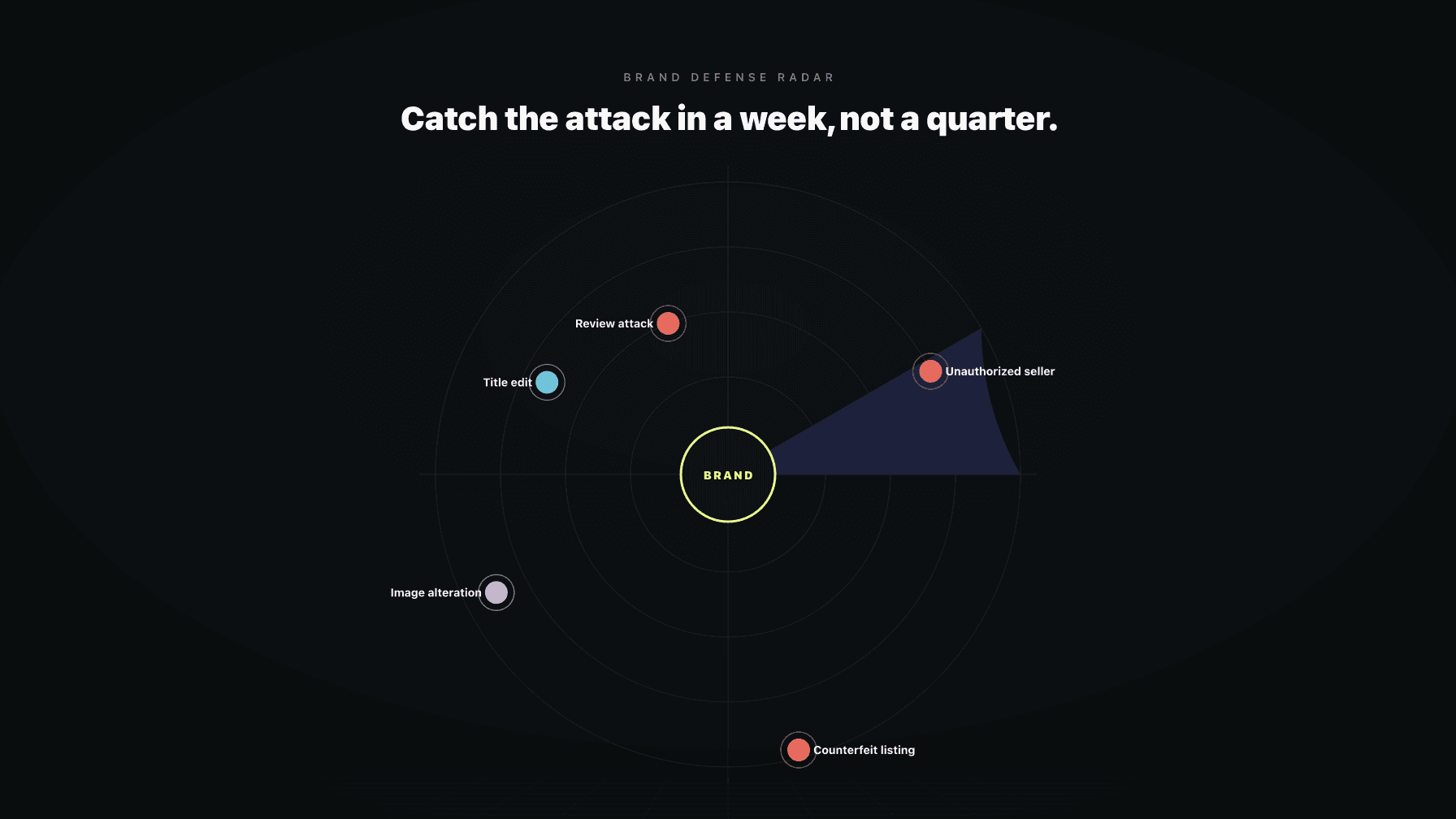
Every brand that gets to real volume on Amazon gets attacked. That is not a worst case scenario, it is the base rate. Once your ASIN crosses a revenue threshold that makes you visible in category rankings, you become a target for unauthorized resellers, hijackers who jump on your listing with counterfeit inventory, foreign sellers running price arbitrage on your branded SKU, and the occasional competitor who decides the cheapest growth lever is to torpedo your reviews instead of improving their own product.
I have been on the operator side of this for over a decade. I have watched a top seller go from a clean offer to fourteen unauthorized sellers in a weekend. I have watched a hero ASIN take a coordinated review attack that dropped its rating from 4.7 to 4.3 in 96 hours. I have also watched brands recover from both of those, fully, because they had a routine in place to catch the attack inside a week and a documented escalation path for getting Amazon to act.
The question is never whether you will get attacked. The question is how many days pass between the attack starting and you noticing it. For most brands, the answer is somewhere between two weeks and never. That is the gap this post is about.
Brand Registry is the foundation. Project Zero and Transparency are the tools. But the actual defense is a routine. A daily, weekly, and monthly cadence that scans for the patterns that mean trouble, and an enforcement sequence that turns detection into removal. The brands that protect their catalog are not the ones with the most aggressive lawyers. They are the ones with the tightest operational loop. This is the loop.
Brand Registry is the front door. If you do not have it enrolled, nothing else in this post matters, because you do not have standing to file most of the reports. So if you are reading this and you have not enrolled, stop and do that first. You need a registered trademark in the country you want protection in (the US Patent and Trademark Office for the US marketplace, EUIPO for Europe, and so on), and you need to be the owner or authorized agent of the brand.
Here is what Brand Registry actually gives you once you are in. You get image rights, which means you can report unauthorized use of your product photography and have it pulled. You get access to A+ Content, which is the enhanced description module on the listing. You get Sponsored Brands and Sponsored Display ads, which require Brand Registry enrollment to run. You get the IP enforcement portal, which is the formal channel for submitting takedown requests. You get eligibility for Project Zero and Transparency, which are the higher-tier counterfeit programs. And you get the Brand Dashboard, which surfaces some (limited) alerts about catalog issues.
Here is what Brand Registry does not give you. It does not automatically remove hijackers from your listing. An unauthorized seller can list on your ASIN tomorrow and Brand Registry will not catch them, you have to. It does not automatically remove counterfeits. Even with Project Zero, the removal requires you to submit each violating listing. It does not protect you from review attacks. The review system is a separate beast with separate enforcement, covered in the . It does not prevent listing hijacking via title or image edits in foreign marketplaces where another seller has more documented evidence than you. And it does not enforce your MAP (minimum advertised price) policy, because Amazon does not enforce MAP at all.
From reading to action
If the framework above sounds familiar, your Amazon account is probably carrying the same drag. Apply and we will show what Marko, Oracle, and Bruno would change in your first week.

Ran a 7-figure Amazon brand for a decade. Founded Skubana (acquired). Co-founded Prosper Show. 15+ years on Amazon.
Join the brands that replaced agencies and tools with AI employees.
So Brand Registry is necessary. It is the credential that lets you file. But the filing itself is operational work, and that work happens on a cadence.
The routine has three layers. Daily, weekly, monthly. Each one catches a different pattern, and the gaps between them are where most attacks slip through.
Daily listing watch. Every day, every ASIN gets scanned for three things. First, unauthorized sellers on the offer. If the offer count on your branded ASIN went from one (you) to four (you plus three resellers) overnight, that is a flag. Some of those resellers might be legitimate authorized partners, but most are not, and the ones that are not need to be evicted before they bleed your Buy Box and your margin. Second, suspicious edits to the listing itself. Title changes, bullet swaps, image replacements, category re-classification. Amazon's catalog system lets multiple contributors edit a shared listing, and a hijacker's first move is often to subtly degrade your title or swap a hero image to a low-quality version that destroys conversion. Third, Buy Box theft. If you held the Buy Box yesterday at $39.99 and today an unauthorized seller is winning it at $32.50, that is not a pricing problem, it is a hijacking problem.
Doing this manually across 100 ASINs is impossible. You need an agent. The catalog auditor agent runs this scan every morning and surfaces the exceptions. The operator looks at the exceptions, not at every ASIN.
Weekly review-pattern watch. Once a week, review velocity gets cross-referenced against purchase data. The patterns you are looking for are: a cluster of negative reviews from accounts with no verified purchase on your product, a sudden spike of one-stars that share suspiciously similar phrasing (the same complaint, the same word choice, posted within hours of each other), and review removal that does not match your sales (if you sold 500 units this week and got 47 reviews but only 12 show up on the listing, something is being filtered). This connects directly to the review velocity and Vine workflow and to the negative review response routine, because the data you need to spot an attack lives in the same place as the data you need to respond to legitimate complaints. Variation children also need to be checked here because pooled reviews can mask attacks on individual SKUs, which is why the variation review pooling audit matters.
Monthly counterfeit search. Once a month, somebody (or an agent) does a manual sweep of cross-marketplace listings that copy your branding. This means searching your brand name in international Amazon marketplaces, eBay, Walmart Marketplace, AliExpress, and any other channel where a counterfeiter would dump knockoff inventory. You are looking for listings that use your product photography, your brand name, or your trademarked design elements without authorization. The monthly cadence is right because counterfeit listings have a longer half-life than hijacker offers and the search is more time-consuming, but waiting a quarter is too long because by then the counterfeiter has accumulated reviews and is harder to dislodge.
These are three different tools and operators confuse them constantly. Here is the breakdown.
IP enforcement is the baseline. It is the report-a-violation portal inside Brand Registry. You submit a complaint with evidence (a screenshot of the violating listing, a description of the IP being infringed, your trademark registration number) and Amazon's IP team reviews it. Response time is somewhere between 24 hours and three weeks, with most cases resolved in five to seven days. Removal rate when the evidence is clean is high (well above 80% in my experience), but you have to submit every violating listing individually and you have to do it consistently. This is your everyday tool. It works for trademark infringement, image theft, copyright violations on listing copy, and obvious counterfeits.
Project Zero is the upgraded version of IP enforcement for brands that have demonstrated a high accuracy rate on their IP submissions. Once you qualify (Amazon invites you, typically after you have submitted clean reports without false positives for several months), you get a self-service tool that removes counterfeit listings instantly when you flag them. No review queue, no waiting. You also get an automated protection layer that scans listings for counterfeits matching your brand profile and removes them proactively. The tradeoff is accountability: if you abuse the self-service tool and remove listings that turn out to be legitimate, you lose access. Project Zero is the right call for brands with a serious counterfeit problem and a disciplined enforcement operator on the team. For brands with light counterfeit pressure, IP enforcement is enough.
Transparency is the unit-level serialization program. Every unit of your product gets a unique alphanumeric code, applied as a sticker or printed directly on the package, and Amazon scans the code at the warehouse before shipping it to the customer. If the code is missing or invalid, the unit is rejected. The effect is that no counterfeit unit can physically pass through Amazon's fulfillment network, because the counterfeiter does not have valid codes to apply. Transparency is powerful, but it has real costs. You pay a per-code fee (currently in the low single-digit cents per unit), you have to integrate the code application into your manufacturing or repacking process, and you have to enroll every ASIN you want protected. For a brand selling 10,000 units a month of a $40 product in a high-counterfeit category (supplements, electronics accessories, beauty), the math on Transparency is easy: a few cents per unit is nothing against the margin you lose to counterfeits eating your reviews. For a brand selling 200 units a month of a niche industrial product, Transparency is overkill. Run the math on your category, your margin, and your actual counterfeit incidence.
When the daily scan flags an unauthorized seller, the eviction sequence is the same every time. It is slow, it is repetitive, and it works.
Step 1: Test buy. Order a unit from the unauthorized seller. Pay full price, ship to a real address, document the order ID. This is the foundation of your case and skipping it is the single most common reason hijacker reports get denied.
Step 2: Document. When the unit arrives, photograph it next to a verified authentic unit. Look for differences: packaging quality, product weight, lot codes, manufacturing markings, instruction inserts, any element that identifies it as counterfeit or distinguishes it from your authorized inventory. Even if the unit appears authentic (which happens, because some hijackers are just unauthorized resellers of legitimately diverted inventory), the documentation matters because it establishes that you investigated.
Step 3: Report via Brand Registry. File a violation report in the IP enforcement portal. Attach the test buy evidence, the photographs, and a clear statement of the violation (trademark infringement is the standard claim for an unauthorized seller using your brand name and your product photography). Reference your trademark registration number.
Step 4: Wait 72 hours. Amazon's response window is inconsistent, but 72 hours is the right interval for a check-in. If the listing has been corrected or the unauthorized seller removed, you are done. If not, escalate.
Step 5: Escalate. Escalation means filing a second report, referencing the first case number, and adding any new evidence. If the second report goes nowhere in another 72 hours, escalate again, this time through the Brand Registry support contact and, if you have one, your Amazon account manager. Tier-three escalation pulls in legal counsel for a formal cease-and-desist sent to the unauthorized seller directly. Most hijackers fold at the cease-and-desist stage because they do not want to be on a paper trail. The ones that do not fold get removed by Amazon at the third or fourth round of escalation, because at that point the case file is thick enough that the IP team takes it seriously.
The pattern is patience and persistence. Brands that report once and give up have a 30% removal rate. Brands that report, escalate, escalate again, and follow up have a removal rate above 90%. The work is the same, the outcome is not.
Review attacks are a different animal because the enforcement path runs through a different team at Amazon and the evidence required is different. The patterns to watch for: reviewer accounts with no purchase history (or a purchase history that does not match the product they are reviewing), identical or near-identical phrasing across five or more negative reviews posted within a short window, a sudden velocity spike of one-stars that breaks your historical pattern, and reviews that make specific false claims (the product arrived broken, the product never shipped, the seller is a scam) that contradict your verified shipment data.
When you spot the pattern, report it through the review violation form, attach screenshots of the suspicious reviews, and provide the verified order data showing the shipments went out clean. Most attacks get reversed if you document. Amazon's review team is overwhelmed and slow, but they do remove fraudulent reviews when the evidence is clean. The win rate on reported attack patterns is roughly 60-70% in my experience, and the rest can be pushed up with a second submission. While reviews are coming off, keep your buyer-seller messaging cadence compliant, because a messaging violation in the middle of an attack is the last thing you need.
A brand with 100 ASINs cannot manually scan every listing every day. The math is impossible. Even at a generous 90 seconds per ASIN, that is 150 minutes a day of pure scanning, and that is before you do anything about what you find. So the scan has to be agentic. The operator does not look at every ASIN, the operator looks at the exceptions. The exceptions are surfaced by the agent.
That is the model the AI operating system for Amazon brands is built around. The catalog auditor runs the daily scan and flags unauthorized sellers, suspicious edits, and Buy Box anomalies. A review monitor runs the weekly pattern check and flags clusters that match attack profiles. A counterfeit search runs the monthly cross-marketplace sweep. The operator gets a queue of exceptions, not a list of ASINs to check. The queue is small enough to clear in 30 minutes. The catalog stays clean because every exception gets worked, not because somebody has the patience to scan 100 ASINs by hand.
This is what operations mission control is designed for, and it is the same shape as the listing optimization workflow: agent does the scan, operator works the exceptions, decisions get made on signal not noise. Hijackers and counterfeits are not a problem you solve once. They are a recurring operational load that gets cheaper or more expensive depending on how much of it you automate.
If you want to run this routine across your catalog without hiring a full-time IP enforcement specialist, you can apply to deploy the agent.
Project Zero is Amazon's self-service counterfeit removal program. Once enrolled, you can remove counterfeit listings instantly without waiting for Amazon's IP team to review your report. Eligibility requires Brand Registry enrollment, a high-accuracy track record on prior IP reports (typically several months of clean submissions without false positives), and an invitation from Amazon. You cannot apply directly, Amazon invites brands once they have demonstrated they will not abuse the self-service tool.
The typical removal window for a clean IP enforcement report is between 24 hours and seven days, with most resolved in five to seven days. Brands that escalate persistently see faster removal on subsequent rounds because the case file accumulates evidence. First-time submitters with thin evidence often wait two to three weeks. Project Zero enrollees see near-instant removal for counterfeit listings flagged through the self-service tool.
Yes. Amazon requires an active registered trademark in the country where you want Brand Registry protection. For the US marketplace, that means a registration with the US Patent and Trademark Office (not a pending application in most cases, though some pending applications now qualify under the IP Accelerator program). For the EU, EUIPO. Trademarks can be word marks or design marks, and the brand name on the trademark must match the brand name used on your Amazon listings.
Transparency is a unit-level serialization program. Every unit gets a unique alphanumeric code that Amazon scans before shipping. Units without valid codes are rejected at the fulfillment center, which physically prevents counterfeits from passing through Amazon's network. It is worth it for brands in high-counterfeit categories (supplements, electronics accessories, beauty, baby) selling enough volume to amortize the per-code cost. It is overkill for low-counterfeit categories or low-volume products.
The patterns are reviewer accounts with no purchase history on the product, identical phrasing across multiple reviews posted in a short window, a sudden velocity spike of one-stars that breaks your historical pattern, and reviews making specific false claims that contradict your shipment data. Most legitimate negative reviews are unique in phrasing and spread over time. Coordinated attacks are clustered and repetitive.
Not entirely. Amazon does not enforce MAP policy or selective distribution agreements directly. What you can do is enforce trademark and image rights, which removes unauthorized sellers who use your branded photography or claim affiliation with your brand. You can also use Transparency to prevent counterfeit and diverted inventory from passing through Amazon's fulfillment. Pure resale of legitimately obtained authentic inventory is hard to stop on Amazon, and that is by design of the first-sale doctrine.
No. Brand Registry gives you the standing to file enforcement actions, but it does not automatically detect or remove hijackers. The detection is your job, which is why the daily scan routine matters. Project Zero adds an automated protection layer for counterfeits, but the broader hijacker problem (unauthorized resellers, suspicious listing edits, Buy Box theft) requires active monitoring on your side.