Chad Rubin
June 13, 2026 · 12 min read
Operator notes by email
Short, opinionated takes on AI agents, Amazon PPC, pricing, and inventory. No fluff. About once a week.
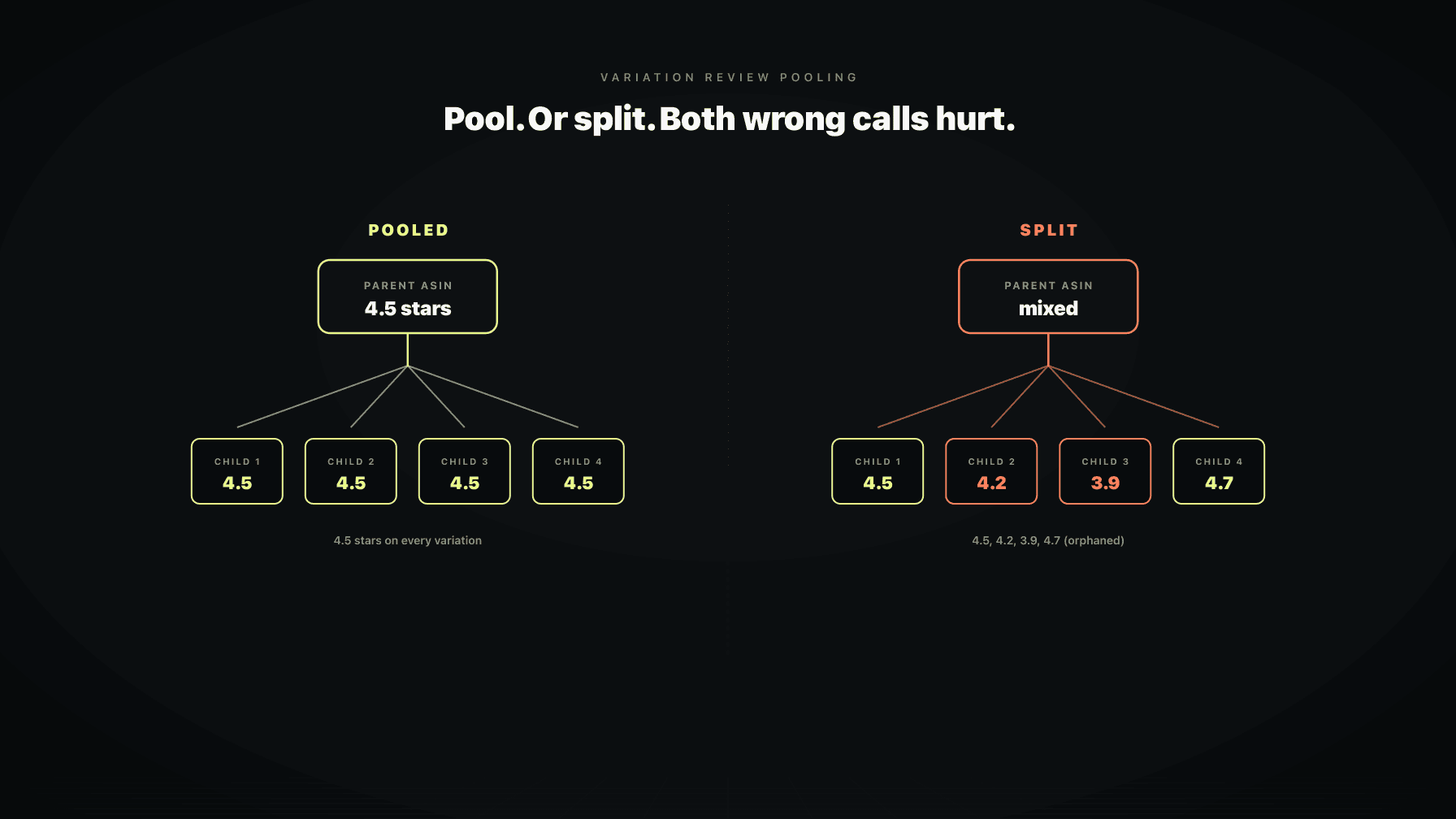
Most brands get variation pooling wrong in one of two directions, and both directions cost real money. The first mistake is pooling variations that should not be pooled. A brand launches a new product, a different formula or a meaningfully different SKU, and shoves it under the parent ASIN of an existing bestseller to inherit the star rating. For a few weeks it looks brilliant. Then the expectation-gap reviews start. Buyers thought they were getting the original, got something slightly different, and the parent's rating starts sliding. Six months later the family is at 4.2 instead of 4.6 and nobody can quite pinpoint why.
The second mistake is the opposite. A brand splits variations that should have been pooled. Every new color, every new size, every new scent launches as its own parent with zero reviews. The team treats each variation as a separate product, which means each variation has to climb the review velocity hill from scratch. A 4.6-star bestseller with 8,000 reviews could have lent its rating to the new color on day one. Instead the new color sits at zero reviews for ninety days while the brand wonders why it is not converting.
Both mistakes come from the same root cause: nobody on the team has a written rule for when variations belong together and when they do not. The decision gets made by whoever set up the listing that week, usually based on whatever felt fastest. This post is the framework I use to make that decision consistently, and the way our catalog auditor agent watches for pooling damage after the fact. For the broader review system context, the Amazon reviews reputation playbook is the parent piece. This is the variation-specific deep dive.
A parent ASIN is not a product. It is a container. The actual products are the child ASINs underneath it, each with its own SKU, its own inventory, its own buy box, and its own reviews. When a buyer leaves a review, that review attaches to the specific child ASIN they purchased. If they bought the medium black t-shirt, the review is on the medium black child ASIN, not on the parent and not on the large red child.
What the parent does is display. When a buyer lands on the listing, they see a star rating and a review count at the top of the page. Those numbers are the pooled total of every child ASIN in the family. If you have ten variations and each has 500 reviews averaging 4.6 stars, the parent displays 5,000 reviews at 4.6 stars. Buyers do not have to click through every variation to see the social proof. They see one number, and the number is the family aggregate.
This pooling is asymmetric in an important way. The display is pooled. The attribution is not. Each individual review is still tied to one child. Some reviews mention which variation they bought (color, size, scent). Many do not. Amazon shows the variation a review was for if the reviewer selected it, but buyers usually scroll past that detail. The dominant signal is the aggregate star rating at the top of the page.
From reading to action
If the framework above sounds familiar, your Amazon account is probably carrying the same drag. Apply and we will show what Marko, Oracle, and Bruno would change in your first week.

Ran a 7-figure Amazon brand for a decade. Founded Skubana (acquired). Co-founded Prosper Show. 15+ years on Amazon.
Join the brands that replaced agencies and tools with AI employees.
This is why pooling matters so much. The star rating on the parent is what shapes conversion across every variation in the family. A new variation that joins an established 4.6-star parent inherits that 4.6 from minute one, even with zero reviews of its own. A defective variation that drags its own rating down to 3.2 still pulls the family aggregate down with it, and every other variation in the family pays for that defect at the buy box. The pooling decision is upstream of conversion for the entire family.
Amazon's enforcement on what can and cannot be variated has tightened over the years. Color, size, and scent of the same product are clearly allowed. Bundles, multipacks, and meaningfully different products are not, though enforcement is uneven and brands routinely push the boundary until they get caught. The variation policy itself is worth reading carefully alongside the variation parent ASIN strategy deep dive, because the policy and the strategic decision are two different questions.
Here is the rule that runs the framework: pool when the variations are interchangeable from the buyer's experience. Split when they are meaningfully different products.
Interchangeability is the test. Imagine a buyer reads a review on the parent listing and then buys a different variation than the reviewer did. If their experience with the product they bought would be substantially the same as the experience the reviewer described, the variations are interchangeable. Pool them. If their experience would be meaningfully different, the review is misleading them, and that is the case for splitting.
A few concrete examples make this clearer. A cotton t-shirt in five colors: interchangeable. The buyer's experience with the red shirt is the same as the buyer's experience with the blue shirt, modulo color. Pool. A coffee mug in three sizes (8oz, 12oz, 16oz): interchangeable enough. The buyer's experience scales with size but the product itself is the same mug. Pool. A skincare cream in two scents (lavender and unscented): interchangeable, because the buyer is choosing scent preference, not a different product. Pool.
Now the other side. A skincare cream in two formulations (one for oily skin, one for dry skin): not interchangeable. A buyer with dry skin reading reviews from buyers with oily skin is going to get a misleading impression of how the product works for them. Split. A protein powder in flavored and unflavored versions where the unflavored is also unsweetened: not interchangeable, because the experience is meaningfully different. Split. A blender bottle in 24oz and 32oz that uses the same product but a kitchenware tool in 8oz that is actually a kids' cup with a different lid system: split, because the smaller version is a different product class.
The harder calls are in the middle. A vitamin in 60-count and 120-count bottles: pool, because the product is identical and the only difference is quantity. A vitamin in a regular formula and an extra-strength formula: split, because the experience and the expected outcome are meaningfully different. A coffee in light roast and dark roast: this one is closer. The buyer expectations are different enough that I lean toward split, but I have seen brands successfully pool roasts as long as the listing makes the variation choice obvious. A coffee in whole bean and ground: pool, because it is the same coffee just processed differently.
The mistake I see most often is brands using the parent ASIN as a marketing tool rather than a buyer-experience container. They want the inherited star rating, so they pool things that fail the interchangeability test. Three months later the expectation-gap reviews start. By the time the brand notices, the pooled rating has dropped half a star and recovery takes a year. The interchangeability test is not optional. Apply it before launching the variation, not after.
The other failure mode is splitting out of habit. The team has always launched new colors as separate ASINs because that is how they did it five years ago when Amazon's variation rules were murky. The lost inherited rating is a real cost. A new color of an established bestseller has every advantage when it inherits the family rating. Treating it as a standalone product means giving up that advantage for no reason. The listing optimization post covers the listing-level mechanics of structuring variations correctly.
The biggest single benefit of correct pooling is launch velocity. A new variation under an established parent does not start at zero. It starts at the parent's rating and the parent's review count, and the buyer sees those numbers from the first day the variation is live. That is enormous for conversion.
Consider the math. A new product on Amazon at zero reviews typically converts at half the rate it will once it has a few hundred reviews. The first ninety days are a velocity grind: get inventory moving, get reviews, build the rating, climb the rankings. A new variation that inherits a 4.6-star parent with 8,000 reviews skips all of that. Day one conversion is the same as the established product's conversion. The variation can hit normal volume immediately, which means the velocity flywheel starts spinning on day one instead of day ninety.
Vine helps here too, but in a different way. Vine reviews on the new child ASIN add to the pool, which strengthens the family aggregate over time. The review velocity and Vine post covers how to layer Vine on top of organic velocity. With a pooled family, every variation's Vine reviews benefit every other variation through the aggregate display.
Pooling also smooths out variance. A single child ASIN with 200 reviews can see its rating swing meaningfully on a single bad batch. A pooled parent with 8,000 reviews barely moves. The aggregate dilutes individual variation noise, which is good when the variation is genuinely interchangeable with the rest of the family. The pool absorbs the noise without losing the signal.
There is a portfolio-level benefit too. A correctly pooled family looks more authoritative on the search results page. Buyers see the high review count, the high star rating, and they treat the listing as a confident, established choice. The aggregate is doing work that no individual child ASIN could do alone. For brands trying to defend category leadership, that aggregate is a moat. The brand registry and hijacker defense post covers the other side of that moat, which is keeping bad actors from siphoning the family's authority.
The damage is asymmetric. A correctly pooled family lifts every variation. An incorrectly pooled family drags every variation down, and the damage compounds.
The most common failure is the defective variation. A brand has a stable family of four colors at 4.6 stars, launches a fifth color, and the fifth color has a quality issue. The fifth color's individual rating drops to 3.4. The pooled family rating drops from 4.6 to 4.4. Every other color in the family is now selling against a lower aggregate, and conversion on the established colors drops even though those colors are physically unchanged. The defect on one child is taxing every sibling.
The second failure is the misclassified product. A brand pools a meaningfully different product under an existing parent to inherit the rating. Buyers come in expecting the original, get something different, and write expectation-gap reviews. "I bought this thinking it was the regular version but it's actually different and I didn't realize." Those reviews are not low-star because the new product is bad. They are low-star because the buyer's expectation was set by the parent rather than the child. The pooling itself created the disappointment.
The third failure is dilution at scale. A brand keeps adding variations to a parent without enforcing the interchangeability test, and the family becomes a junk drawer. Some variations are correctly pooled, some are not, and the reviews are a mix of accurate and misleading signals. Buyers stop trusting the aggregate because the aggregate is no longer telling them anything specific. Conversion drops across the board even though no individual variation has a quality problem. The structure itself is the problem.
I have seen brands lose half a star on a pooled family because of a single misjudged variation that they could not bring themselves to split out, often because the team did not want to "lose the reviews." The reviews on that misjudged variation were not helping. They were hurting every other variation in the family. The negative review response post covers how to handle the individual reviews once damage is done. But the structural fix is splitting the variation back out, which is its own decision.
When you detach a child from a parent, the reviews on that child stay with that child. You do not lose the reviews on the variation you are splitting out. You lose the aggregate display benefit, which is different. The detached variation now shows its own rating and its own review count rather than the family aggregate.
This is usually painful in the short term and correct in the long term. The detached child has a lower rating than the parent did, because the whole point of splitting was that this child was dragging the parent down. Selling against the lower rating is hard. But it is honest, and it stops the bleeding on every other variation in the family that was being penalized for this child's existence.
The mechanics are straightforward. Detach the child from the parent in the variation family. The child becomes its own standalone ASIN with its own listing. You then have to rebuild the listing content for the standalone, because it was previously inheriting parent-level content. The family rating recovers over time as the remaining variations accumulate fresh reviews that no longer include the misjudged child's drag.
The decision is worth it when the misjudged variation is meaningfully hurting the family. If the variation is at 3.4 and the rest of the family is at 4.6, split it. If the variation is at 4.4 and the rest is at 4.6, the drag is small enough that splitting probably costs more than it saves. Run the numbers on what the family aggregate would be without the misjudged child. If the difference is more than two-tenths of a star, split.
This is the kind of structural problem that does not surface itself. Nobody on the team wakes up one morning and notices that one child ASIN is dragging the family rating. It happens slowly, over months, and by the time anyone notices the damage is already done.
Our catalog auditor agent watches three patterns specifically. The first is per-child review distribution within a parent. When one child has a meaningfully lower average rating than its siblings, the agent flags it for review. Sometimes the explanation is benign (small sample size, recent batch issue) and sometimes it is structural (this variation does not belong in this family).
The second pattern is expectation-gap language. Reviews that say "I thought I was getting X but I got Y" are a signal that the variation does not match the parent's identity. The agent surfaces those patterns at the parent level so the team can decide whether to clarify the listing or split the variation out.
The third pattern is defect concentration. When negative reviews mentioning a specific defect (broken, leaking, wrong size, smells bad) cluster on a single child ASIN within a family, that child has a quality issue the rest of the family does not share. Pooling that defect into the family aggregate is taxing every other variation. The agent flags the concentration for the operations team.
All three signals feed into the Operations Mission Control view, which is where the broader AI operating system for Amazon brands brings catalog, ops, and ads into one place. Variation pooling is one of those decisions that looks small in isolation and shapes conversion across the entire portfolio over time. Get it right and the family compounds. Get it wrong and the family bleeds.
If you want a second set of eyes on your variation structure and your review distribution, that is what we do. Apply here and we will run the audit.
The new variation does not get its own reviews backfilled, but it inherits the parent's aggregate star rating and review count display from day one. Reviews stay attached to the specific child ASIN that earned them. The new child starts at zero reviews of its own, but buyers see the family aggregate at the top of the listing, which is what drives conversion.
Sometimes. Amazon will remove reviews that violate their guidelines (profanity, seller feedback in a product review, off-topic content, verified abuse). They will not remove a review just because it is negative or because you disagree with it. If the review is policy-compliant and accurate, splitting the variation is usually the only structural fix for the damage it is causing to the family aggregate.
Usually yes, because color is the textbook case of interchangeable variation. A buyer's experience with the red version is materially the same as their experience with the blue version, so pooling reviews is accurate and helpful. The exception is when the colors imply different use cases (a children's color versus an adult color of the same product, for example), in which case the interchangeability test gets closer to the line.
Reviews stay attached to the child ASIN they were written for. When you detach a child, it keeps its own reviews and loses access to the family aggregate display. The detached listing then shows its own rating and review count rather than the pooled family number. You do not lose reviews. You lose the pooled display benefit.
Yes, but quietly. The variation a review was written for is displayed if the reviewer selected it (color, size, scent), and it appears in small text near the review. Most buyers do not pay close attention to this. The dominant signal that shapes their decision is the aggregate star rating at the top of the listing, which is why the pooling decision matters so much more than individual review attribution.
Risky. If the formulation is meaningfully different from a buyer's perspective (different ingredients, different effects, different texture), pooling it under the old parent will generate expectation-gap reviews from buyers who expected the original. If the refresh is genuinely minor and the buyer experience is unchanged, pooling can work. The interchangeability test is the call: would a buyer reading old reviews accurately predict their experience with the new formula? If no, split.
Apply the interchangeability test before you launch. Imagine a buyer who reads a review of any sibling variation and then buys the new variation instead. Would their experience match the reviewer's description, modulo the obvious dimension being varied (color, size, scent)? If yes, pool. If no, split. The test is buyer-facing, not catalog-facing, and that is the part most teams get wrong.