Chad Rubin
June 18, 2026 · 10 min read
Operator notes by email
Short, opinionated takes on AI agents, Amazon PPC, pricing, and inventory. No fluff. About once a week.
After 15 years operating on Amazon, building Skubana from zero to acquisition, co-founding Prosper Show, and now running Profasee, I have lived through three full turns of what I call the Amazon Capital Cycle. This is my model. It is not academic. It is the framework I use to decide where to spend, when to sell, when to buy, and when to shut up and survive.
The reason a phase framework matters is simple: the tactics that win in one phase actively lose money in another. Spending hard on PPC and inventory in 2021 made you a millionaire. The exact same behavior in 2024 made you insolvent. Selling your brand in 2020 at 6x was genius. Selling it in 2025 at 2.4x was capitulation. The variables did not change. The phase did.
Most operators do not get killed by Amazon. They get killed by running a playbook that belongs to a different phase. They run hot-phase aggression into a tightened market and bleed out. They run tightened-phase defense into a recovering market and miss the up-leg. The average operator underperforms the cycle by negative margins because they are always fighting the last phase.
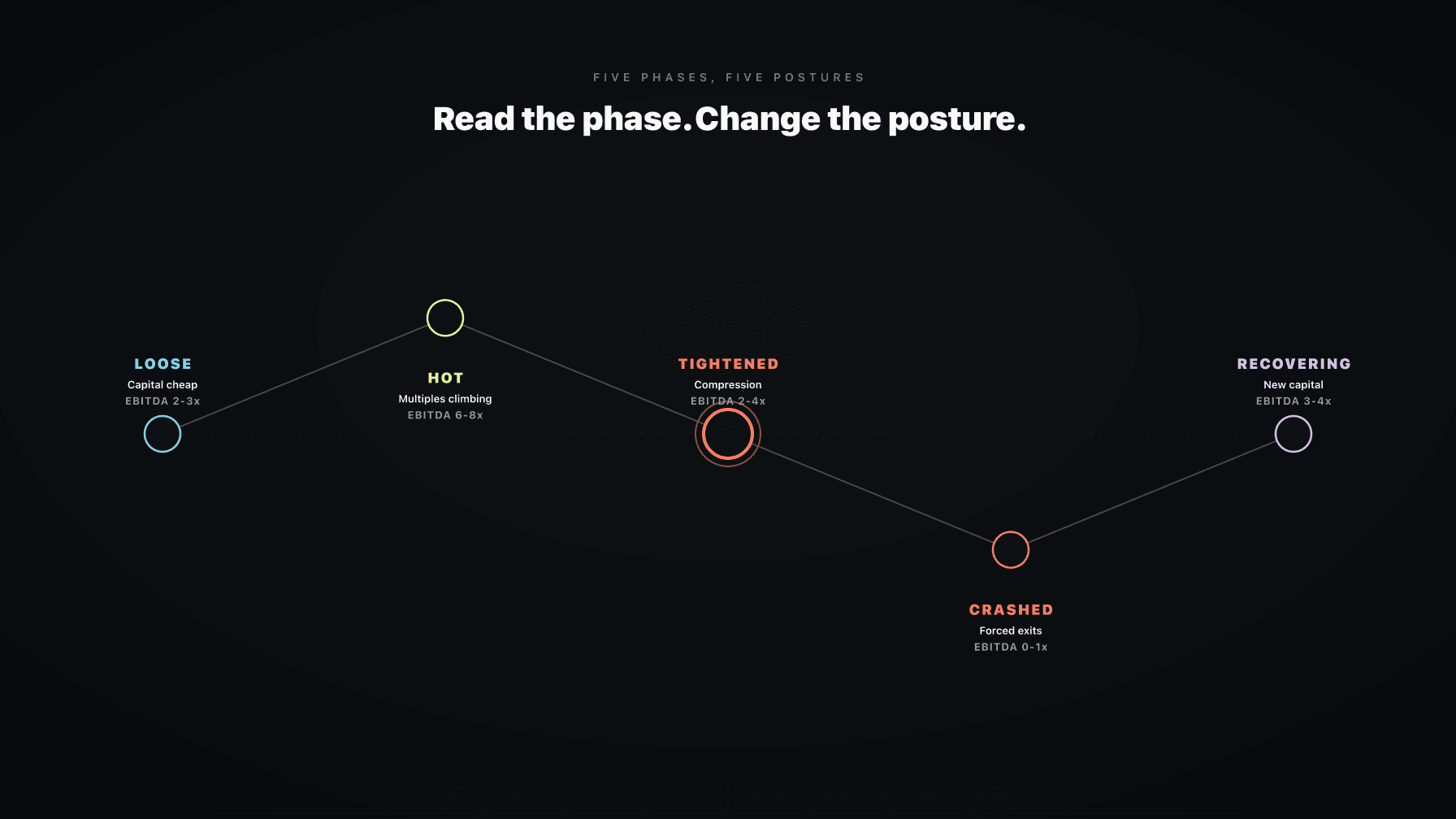
There are five phases in this model: Loose, Hot, Tightened, Crashed, and Recovering. They are not equal in length. They do not always run in clean sequence. But they always come back around. Here is the field guide.
Loose is the setup phase. Capital is cheap, financing is easy, and new sellers are entering the marketplace because the friction to start is low and the unit economics look obvious on a spreadsheet. Multiples in the M&A market are climbing from a baseline of around 2 to 3x SDE toward 4x. Brokers are picking up the phone again. Lenders are sending unsolicited inventory financing terms. The category positions that will matter for the next decade are being staked right now, but nobody is paying attention yet because the press has not arrived.
The signals are quiet but real. SBA loan approvals for ecommerce tick up. Amazon launches new seller incentives. Software companies in the Amazon stack start raising Series A rounds at reasonable valuations. Operator-Twitter is mostly tactical (how to source from China, how to launch a listing) rather than philosophical. There is no aggregator narrative yet.
The right posture in Loose is to grow and stake category positions. You are not optimizing for margin. You are optimizing for shelf space, review counts, and brand registry coverage in categories you intend to own for ten years. You launch SKUs. You buy keywords that will be expensive later. You build the operational chassis that will hold up when the Hot phase arrives. This is the phase where Skubana was built. The 2014 to 2017 window was textbook Loose: cheap capital, low competition for the best private label slots, and almost nobody talking about FBA at dinner parties.
The mistake operators make in Loose is being too conservative. They treat it like a tightened market and miss the staking window. Then they try to buy in during Hot, when shelf space costs ten times more. If you are reading this and the next Loose phase has begun, do not wait for confirmation. Build your discipline now so you can spend confidently when the spend window opens.
From reading to action
If the framework above sounds familiar, your Amazon account is probably carrying the same drag. Apply and we will show what Marko, Oracle, and Bruno would change in your first week.

Ran a 7-figure Amazon brand for a decade. Founded Skubana (acquired). Co-founded Prosper Show. 15+ years on Amazon.
Join the brands that replaced agencies and tools with AI employees.
Hot is the phase where the cycle becomes self-aware. Aggregators are paying 6 to 8x EBITDA, sometimes higher with earnouts. Mainstream press is covering FBA as a new asset class and a wealth-creation engine for normal people. The "everyone is winning" narrative is loud, well-funded, and visible at every conference. Demand is still outrunning supply for most reasonable categories. New entrants are coming in not as operators but as buyers, which is the giveaway.
The signals in Hot are unmistakable once you have seen one. LinkedIn is full of acquisition announcements. New aggregator brands launch every quarter. Multiples cross 5x and keep going. Inventory financing is offered with terms that should make any operator nervous (negative working capital, advance rates above 80%, light covenants). Software valuations in the stack go vertical. Operator-Twitter shifts from tactical posts to identity posts ("I am an Amazon brand owner") and exit posts.
The right posture in Hot is to sell, raise, or consolidate aggressively. If you have a sellable brand, this is when you sell it. If you have a great brand you do not want to sell, this is when you raise growth capital at favorable terms. If you have operational chops, this is when you consolidate by buying smaller brands that lack your back office. What you do not do in Hot is treat the multiples as the new normal and build your plan around them. They are not the new normal. They are the peak.
The COVID-era 2020 to 2022 window was the canonical Hot phase of this cycle. Aggregators raised more than $15 billion. Multiples for clean brands crossed 6x routinely. The narrative was that FBA was a permanent wealth machine. I wrote a post-mortem on why the aggregators failed because the same operators are about to misread the next Hot phase the same way. The Hot phase is real. The valuations are not.
Tightened is where most operators reading this are sitting right now. Capital has tightened. Inventory financing has dried up or repriced to terms that no longer pencil. Sellers are reducing inventory commitments because cost of capital plus Amazon storage fees plus tariff uncertainty makes "just one more container" a coin flip. Aggregators are quiet. Some are quietly selling brands they bought in Hot at write-downs. Multiples have compressed back to 2 to 4x for healthy brands and zero for unhealthy ones. Operator pessimism is at multi-year highs.
The signals in Tightened are everywhere if you are watching. Amazon fee announcements feel punitive. Aggregator websites stop publishing acquisition press releases. Conference attendance drops. Software vendors lower prices or get acquired in shotgun deals. Operator-Twitter shifts to gallows humor and "is FBA dead" posts. Anyone who took on aggressive debt in Hot is now refinancing or restructuring.
The right posture in Tightened is to become a steward of capital. Cut every dollar of spend that does not produce profit. Coordinate decisions across pricing, PPC, and inventory so you are not making three contradicting bets every week. Tighten your P&L by SKU until you can see exactly which units are funding the business and which are bleeding it. This is the phase where I talk about the CFO frame and being a steward of capital because the operators who survive Tightened are the ones who stop treating their P&L like a vibe and start treating it like a quarterly close.
If you have capital and chops in Tightened, you can also buy. There are good brands with bad balance sheets available right now at multiples that will look insane in three years. I wrote a separate piece on how to find and fix distressed Amazon businesses. The window for that opportunity is not infinite.
The 2024 to 2026 window is textbook Tightened. We are still in it as I write this in mid-2026. For the broader picture of where we sit in the current cycle, see my Amazon Capital Cycle 2026 overview.
Crashed is what happens when Tightened goes past the point where weak balance sheets can absorb it. Insolvencies accelerate. Forced exits hit the market in volume. Multiples for unhealthy brands go to zero, meaning the inventory and brand assets sell for liquidation value with no goodwill premium attached. Tools and software companies in the Amazon stack consolidate or shut down because their customers are gone. Operator-Twitter goes quiet because most of the loudest voices in Hot have left the industry.
The signals in Crashed are blunt. Brokerages stop publishing multiples because the data is too ugly. Inventory financing is essentially unavailable except to the strongest balance sheets. Amazon itself takes a different tone in seller communications because it needs the marketplace to recover. You start seeing brand acquisitions happen through asset-purchase agreements at inventory value, with the brand and reviews thrown in for free.
The right posture in Crashed depends entirely on what you have. If you have capital and operational chops, this is the buying phase of the decade. Brands that will be worth 4 to 6x in the next Hot phase are being bought at sub-1x SDE multiples right now. But the operational lift is real. You are buying broken P&Ls and fixing them, not buying clean assets. If you do not have capital, your only job in Crashed is to survive. Cut everything. Hold inventory positions in your one or two truly defensible SKUs. Do not try to grow. Do not try to be a hero. Crashed phases are short relative to the others (typically 6 to 18 months), and the operators who survive them by going small are the ones who get to participate in Recovering.
The historical analog for Crashed in this marketplace is the 2008 to 2009 ecommerce downturn for any operator who was around for it. Different mechanics, same dynamic: forced sellers, no buyers, and a small group of well-capitalized operators picking up assets that defined the next decade.
Recovering is the phase where the survivors get rewarded. Multiples expand again, starting around 3x and climbing back toward 4 to 5x over 12 to 24 months. The surviving brands are leaner because they had to be. New capital comes in cautiously, mostly from operators and family offices rather than the speculative LP money that defined Hot. New aggregator forms emerge, smaller and sharper than the last generation, and they are usually built around AI-driven operations rather than pure roll-up financial engineering.
The signals in Recovering are slow and easy to miss. The first one is usually a single high-profile clean acquisition at a multiple that looks surprisingly strong. Then a second. Software vendors in the stack start hiring again. Inventory financing reopens with tighter terms but real availability. Operator-Twitter shifts from gallows humor to cautious optimism, then to tactical posts again as the Loose phase approaches.
The right posture in Recovering is to grow again, but smarter than last time. You do not run the Hot-phase playbook in Recovering. You run a disciplined growth playbook built around unit economics, coordinated decisions across pricing, PPC, and inventory, and an operational layer that scales without proportional headcount. This is exactly why I built Profasee as an AI operating system for Amazon brands and why the Mission Control frame matters. The next Recovering phase will reward operators who can grow without adding 20 people. The ones who try to staff up the way they did in 2021 will be the next generation of cautionary tales.
The new aggregators that emerge in Recovering will not look like the last ones. They will be operationally focused, AI-native, and they will buy fewer, better brands and actually run them. That is the version of the aggregator model that should have existed the first time.
You do not need to guess what phase you are in. The signals are public and observable. Here is the checklist I run through quarterly to ground myself in the current phase. If you want the full mechanical version of this, see how I think about Amazon brand valuation in 2026.
If you can hold this list in your head and run it quarterly, you will outperform the average Amazon operator on every cycle turn for the rest of your career.
In my experience, Loose phases run 2 to 4 years. Hot phases are the shortest, usually 18 to 30 months. Tightened phases run 18 to 36 months. Crashed phases are short and sharp, 6 to 18 months. Recovering phases run 12 to 24 months before they tip back into Loose. The full cycle averages 7 to 10 years. The 2020 to 2022 Hot phase compressed faster than usual because of COVID-era stimulus distortion. Do not anchor on that timeline.
Tightened, with early Crashed signals in the weakest cohort of brands. Multiples for healthy brands are sitting in the 2.5 to 3.5x range. Aggregators are quiet. Inventory financing is repriced. Distressed deals are available. Recovering is probably 12 to 18 months out if no exogenous shock accelerates the Crashed phase first. For a deeper read, see my 2026 cycle post.
Three signals together: aggregator portfolio write-downs become public, inventory financing defaults cluster, and at least one previously well-known brand goes through a forced asset sale at zero goodwill. When all three hit in the same quarter, you are in Crashed. Until then, you are in deep Tightened.
No. It distorted the magnitude and compressed the timeline, but the structure held. The post-COVID Tightened phase proved the cycle is more durable than the once-in-a-generation narrative. The next Hot phase will be smaller in peak multiple and shorter in duration, but it will arrive.
If you have a healthy brand with clean financials and you can wait 18 to 36 months, wait. Selling in late Tightened or early Crashed locks in the worst pricing of the cycle. If you cannot wait (personal liquidity, founder burnout, capital call), sell now and accept the multiple. The worst outcome is waiting six months, missing the bottom by a quarter, and selling into Crashed.
Related, not identical. Amazon-specific factors (fee structure, FBA capacity, aggregator capital flows, category competition) drive the marketplace cycle more than macro rates do. The two correlate during extreme events (2020, 2022) but diverge during normal years. Treat them as overlapping but distinct.
Three things. First, lock down your unit economics now so you have a clean P&L to show. Second, build the operational layer (pricing, PPC, inventory coordination, ideally AI-driven) that lets you scale without proportional headcount. Third, stake category positions during Recovering before competition arrives. The brands that get Hot-phase multiples are the brands that did the operational work in Tightened and Recovering. Always.
If you want help building the operational chassis that survives Tightened and scales into the next Hot phase, apply to work with us. That is the work we do.