Chad Rubin
June 20, 2026 · 12 min read
Operator notes by email
Short, opinionated takes on AI agents, Amazon PPC, pricing, and inventory. No fluff. About once a week.
In 2021, every Amazon brand was getting a 6x offer. Some were getting 7x. A few were getting 8x with earnouts on top. I watched founders I had known since the early Skubana days field three or four LOIs in the same week, all in the same range, all from buyers who had never run a P&L on a private label SKU in their lives.
Those buyers paid that multiple because they assumed they could professionalize what they bought. They assumed the brand they were paying 6x for would be running at 8x of synergized EBITDA inside eighteen months. They were wrong. I wrote the long version of why, but the short version is that they bought hundreds of brands and learned that running an Amazon catalog at scale is not a financial engineering problem. It is an operational coordination problem. They could not coordinate it, and the brands they bought decayed inside their portfolios.
That whole cycle is over. The capital flowing into Amazon brand acquisition is now coming from operators, not financiers. I covered the macro picture in the 2026 Amazon capital cycle post and the longer arc in the five phases of the Amazon capital cycle. The buyers writing checks today have actually run accounts. They know what a 14-day BSR slide looks like. They know what happens to a hero SKU when its main keyword loses relevance. They are not paying for a story. They are paying for proven EBITDA quality.
Which means the multiple is no longer the question. In 2021 the multiple was the starting point of every conversation. "We are seeing 5 to 6x" was the opening line of every broker pitch deck. In 2026 the multiple is the output, not the input. It is the result of how clean your EBITDA actually is once a buyer with operator brain looks at it. Two brands with the same trailing twelve EBITDA can get offers 2.5x apart based on what is underneath that number.
This post is the framework I use when I look at a brand and try to figure out what it is actually worth in this market. It is the same framework operator-buyers are using on the other side of the table.
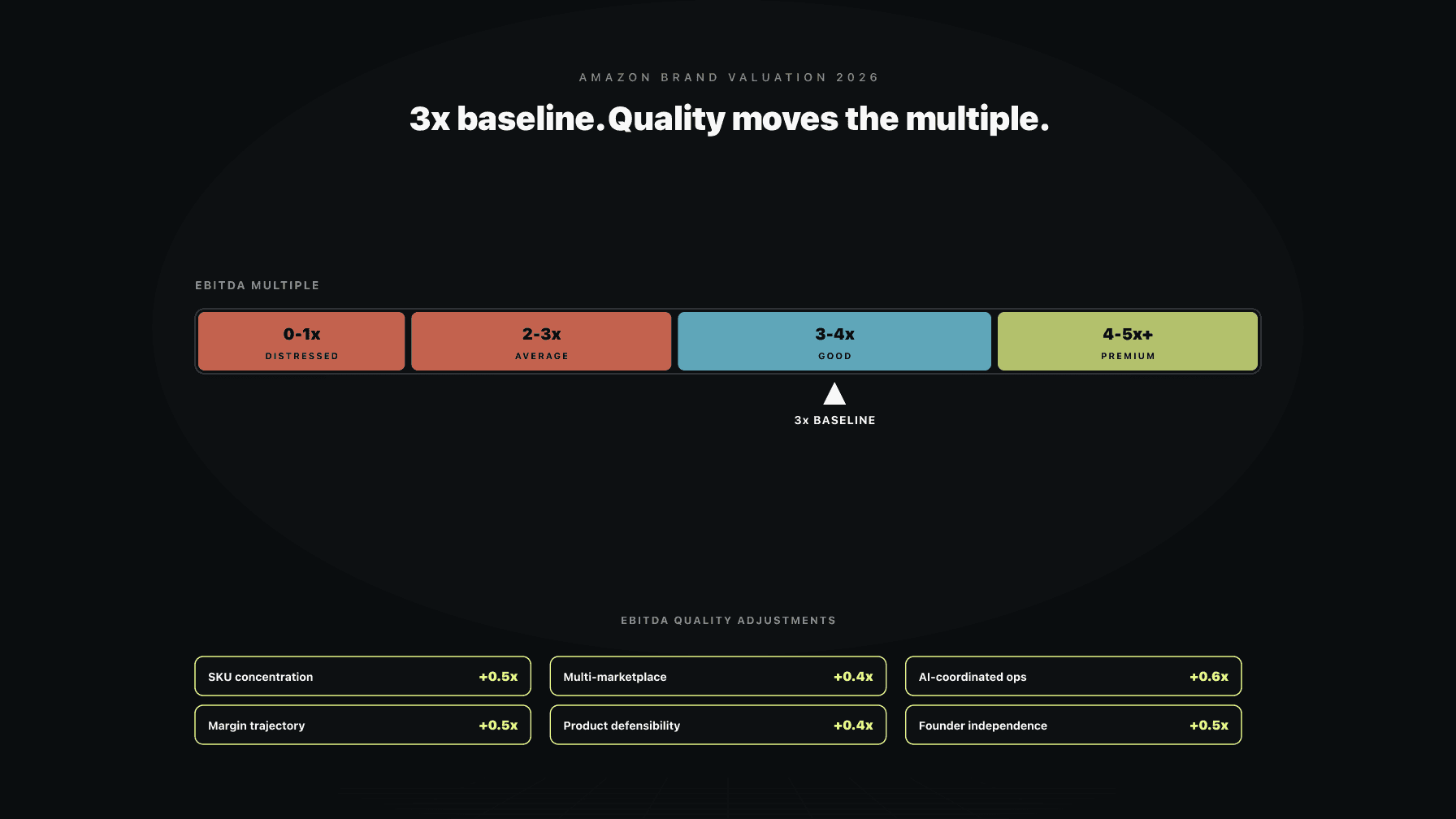
Here is the realistic range I am seeing right now. None of this is broker math. This is what closes.
Distressed brands: 0 to 1x EBITDA, or asset sale only. These are brands where the trailing EBITDA exists on paper but is unsustainable. Hero ASIN suppressed and not coming back. Account Health Rating below 200. IP infringement complaints stacked up. Founder burned out and not transitioning. In a lot of these cases the buyer is paying for inventory and the brand registry, nothing else. I have looked at distressed Amazon businesses where the right number was the cost of the inventory on hand, full stop.
From reading to action
If the framework above sounds familiar, your Amazon account is probably carrying the same drag. Apply and we will show what Marko, Oracle, and Bruno would change in your first week.

Ran a 7-figure Amazon brand for a decade. Founded Skubana (acquired). Co-founded Prosper Show. 15+ years on Amazon.
Join the brands that replaced agencies and tools with AI employees.
Average brands: 2 to 3x EBITDA. This is where most brands land. The numbers are real, the operation is functional, but there is nothing about the brand that makes a buyer want to lean in. Single marketplace, top-five SKUs doing more than 70% of revenue, agency-managed PPC, no clear margin trajectory, founder runs everything from a laptop. 2 to 3x is the honest price. Brokers will tell you otherwise and you will get to your second LOI and find out.
Good brands: 3 to 4x EBITDA. These are brands that have done some of the work. Top-five SKU concentration under 60%. At least one secondary channel doing real revenue. Margins flat or trending up over the last twelve months. Some defensibility on the product itself. Founder still essential but documented. 3 to 4x is achievable and there are buyers competing for these.
Premium brands: 4 to 5x EBITDA and up. These are rare. Under 50% SKU concentration. Multi-channel revenue mix that does not collapse if Amazon coughs. Margins trending up six quarters in a row. AI-coordinated operations, not agency-dependent, not hand-managed in spreadsheets. Defensible product the next entrant can't knock off in six weeks. Founder dependency low enough that the brand runs without daily intervention. These brands trade at a premium even in a tightened market because there are not many of them.
Strategic buyers, meaning someone who is buying you for a specific capability rather than for the cash flow alone, can pay above 5x. A strategic buyer is paying for your supplier relationships, your patent portfolio, your channel position in a category they want to enter, or your team. Those deals exist but they are not the comp set most sellers should be planning around. If you build a brand specifically hoping for a strategic exit, you are doing speculative math.
The shift from 2021 is brutal if you anchor on the old numbers. A brand that would have gotten 6x in 2021 might get 3x in 2026. That is a 50% haircut on enterprise value at the same EBITDA. Founders who anchor on the 2021 number get angry, refuse the deal, and then watch their EBITDA decay for another twelve months before coming back to the table at a worse number.
Once a buyer pulls the financials apart, they are looking at six things. These are the six factors that move you from a 2x offer to a 4x offer, or vice versa, at the same EBITDA.
Look at trailing twelve months. What percentage of revenue comes from your top five ASINs?
If the answer is over 70%, you are in concentration risk territory and you will get a discount. Buyers know that one of those five ASINs going down for thirty days takes 14% of your revenue with it. Suppression, a relevance hit, a supply gap, a hijacker, any of these things turns into an existential problem when concentration is that high.
If the answer is under 50%, you have real diversification and you earn a premium. The brand has more than one engine. Buyers can sleep.
The fix takes years, not months. You launch new SKUs in adjacent categories, you build out variation parents thoughtfully, you do not let your hero get to 40% of revenue by itself. If you are at 70% concentration today and want to sell in eighteen months, the work to bring that down starts now.
In 2021, Amazon-only was a feature. Buyers wanted clean Amazon-native cash flow. In 2026, Amazon-only is a discount.
Why the flip? Because every buyer with an operator brain has watched Amazon-only brands get hammered by single-platform risk. Fee structure changes. Account suspension out of nowhere. A relevance algorithm shift on a Tuesday morning that drops your hero from page one to page three.
Brands with 20 to 40% of revenue off Amazon, meaning Walmart, real DTC, B2B, retail, are now earning the premium that pure-play Amazon brands got four years ago. The buyer's risk math has flipped.
This is the one I care about most because it is the lever you can actually move fastest. Who runs the operation? Three categories.
This is the factor where operator-buyers in 2026 are paying the most attention. They have all seen what happens when you buy an agency-dependent brand. The agencies leave with the founder, the new owner can't replicate the relationships, and EBITDA caves in.
Buyers look at the slope, not the snapshot. A brand at 15% net margin trending up to 18% is worth more than a brand at 22% net margin trending down to 18%. Same destination. Different multiple.
What buyers want to see: contribution margin per unit improving quarter over quarter on the hero SKUs. Contribution margin per unit is the cleanest signal because it cuts through revenue growth and isolates whether you actually make more money per unit shipped today than you did six months ago. If yes, you have operating leverage and the buyer is paying for that compounding.
If your margins are sliding, you can fix this before going to market, but it takes two clean quarters minimum to show a trend.
Can the next entrant copy you in six weeks? If yes, you trade at a discount, full stop.
What real defensibility looks like:
A commodity private label in a low-barrier category is not defensible. A patented mechanical product made by one supplier in one country with seven years of brand awareness is defensible. The first earns 2x. The second earns 4x or more at the same EBITDA.
The question buyers actually ask: does this brand work without the founder running it daily?
You can answer this yes only if your operation runs without you for two weeks at a time and the numbers don't move. If the answer is no, the buyer is going to discount or structure a long earnout to keep you locked in. Either way you are taking less cash on close.
This is partly a documentation problem and partly an automation problem. Documented SOPs solve some of it. Real systems doing the work solve more of it. A brand where the founder is the operating system trades at a discount because the operating system is the asset and it is leaving with the seller.
Here is the math. Sit down with your P&L and do this in one pass.
Step 1: Calculate trailing twelve months EBITDA. Revenue minus COGS, Amazon fees, fulfillment, advertising, payroll, and reasonable owner add-backs. Be honest. The number a buyer's QoE accountant lands on is going to be lower than the number you start with. Bake in some realism upfront. If you do not have a clean P&L that reconciles to Seller Central and your bank statements, read the Amazon P&L operator guide and rebuild it before going further.
Step 2: Score each of the six quality factors 1 to 5. Be brutal. A 5 means you are best-in-class on that factor. A 3 means you are average. A 1 means you are below average and a buyer is going to flag it.
Step 3: Sum the scores and translate. Sum out of 30.
Step 4: Multiply. Take your trailing twelve EBITDA, apply the multiple, that is your range. The honest range, not the broker range.
Step 5: Sanity check against comparables. Look at recent closed deals in your category. Not LOIs, not asking prices. Closed deals. Brokers will share rough comps if you push.
This will not give you the exact number a buyer will offer. It will give you the band the offer is going to land in. If you are way off from where you wanted to be, you now know exactly which of the six factors to work on.
The diligence process has tightened. Things that got waved through in 2021 are now deal-killers.
The buyers asking these questions in 2026 are former operators or have operators on their diligence team. They know what to ask. You will not get away with a sloppy answer.
The few brands earning 4 to 5x and above in this market all look pretty similar to each other.
They share a pattern. Tight unit economics with contribution margin per unit improving quarter over quarter. SKU concentration under 50%. Real revenue off Amazon, usually 25 to 40% through DTC or Walmart or B2B. AI-coordinated operations that do not require the founder to be in Seller Central every day. Defensible product, usually with IP and supplier moats. A founder who has built the brand to run without them, and who is willing to do a reasonable transition and then walk.
These brands look very different from the average brand on the market. They were built by operators who thought about the exit four years before the exit. They built the operation to be sellable. They thought like a steward of capital the whole time.
If you want a 4x or 5x exit in this market, the work is not the deal. The work is the eighteen to thirty-six months before the deal. You bring SKU concentration down. You launch off-Amazon channels. You move your operation from agency-dependent to AI-coordinated. You document everything. You make yourself replaceable.
The brands that did that work over the last two years are getting premium offers right now. The brands that did not are getting 2x and feeling robbed. The market is not robbing them. The market is correctly pricing what they actually built.
If you are building a brand and want to exit at a premium multiple in this environment, apply to work with us. We rebuild Amazon operations to the standard buyers are paying premiums for.
The average closed multiple I am seeing is 2 to 3x trailing twelve EBITDA. That is the band most brands land in. The 6 to 8x ceiling of 2021 is gone. Premium brands still get 4 to 5x but they are rare and they are the brands that did the operational work before going to market.
Move the six EBITDA quality factors. Bring SKU concentration under 50%. Launch real revenue off Amazon. Move from agency-managed or manually-managed operations to AI-coordinated operations. Get margin trajectory pointing up for two clean quarters. Lock in defensibility through IP, supplier exclusivity, and product complexity. Document the operation so it runs without you. Each of these moves the multiple incrementally. Done together over eighteen months, they can move you from 2x to 4x at the same EBITDA.
EBITDA quality is the cleanliness of the EBITDA number once a buyer with operator brain looks at it. Two brands with the same headline EBITDA can have very different EBITDA quality. The brand with low SKU concentration, diversified marketplaces, AI-coordinated operations, improving margins, defensible product, and low founder dependency has high-quality EBITDA. It earns a higher multiple. The brand with the opposite profile has low-quality EBITDA at the same headline number and gets discounted accordingly.
Depends on where your six quality factors score. If you score 24 or above and you are personally ready to exit, the market is paying for what you have built. If you score below 18, you are leaving money on the table by going to market now. Eighteen months of focused work on the lowest-scoring factors will likely earn you more total proceeds than selling today at the current multiple, even with the time value of money discount.
Trailing twenty-four months of P&L reconciled to Seller Central and bank statements. Unit economics by SKU. Inventory and supplier schedules. Concentration risk schedules at the ASIN, supplier, and channel level. Brand Registry status and IP filings. Account Health Rating history. Operations infrastructure documentation, meaning what runs on what system. Founder transition plan. Employment and contractor agreements. Tax filings. Pretty much everything you would expect, but tighter than 2021.
Yes, when they exist. A strategic buyer is paying for something specific your brand has that they want, supplier access, IP, channel position, team capability. They will pay above the financial multiple to acquire that specific thing. The catch is that strategic buyers are rare and category-specific. You cannot plan an exit assuming you will find one. Build to the financial multiple. If a strategic buyer shows up, it is upside.
Six to nine months from going to market to close, in my experience. LOI typically thirty to sixty days. QoE and diligence sixty to ninety days. Definitive agreement and transition planning thirty to sixty days. Faster is possible if the brand is clean, your data room is ready, and your diligence answers are tight. Sloppy data rooms add two to three months and sometimes kill the deal.