Chad Rubin
June 19, 2026 · 12 min read
Operator notes by email
Short, opinionated takes on AI agents, Amazon PPC, pricing, and inventory. No fluff. About once a week.
The aggregator era was a financial fraud disguised as a thesis.
I want to be careful with that sentence. I do not mean fraud in the legal sense. I mean it in the operator sense. The story sold to limited partners was that you could buy small Amazon brands, drop them into a holding company, apply something called "professional management," and resell the bundle at a higher multiple. That story was repeated so many times that everyone forgot to ask whether the professional management part actually existed.
It did not. I watched it not exist in real time.
The original pitch sounded reasonable on a Tuesday afternoon in 2021. Buy third-party Amazon brands at 4-5x EBITDA. Centralize PPC, supply chain, and back office. Capture scale economies. Hold for cash flow or exit at 8-10x. The deck always had a triangle on it. Sometimes the triangle was an iceberg. The math worked on a spreadsheet and the spreadsheet was the product.
As of 2026, most of the largest aggregators are gone, in restructuring, or quietly liquidating portfolios at distress prices. The public aggregator restructurings of 2023-2024 are the part you read about in the trade press. The part you do not read about is the cap-table carnage at the second and third tier, the brands that have been resold twice, the founders who took stock and watched it go to zero, the operators who got laid off three times in eighteen months.
I have sat across the table from multiple aggregator portfolio managers who came back to ask Profasee for help after their books flipped underwater. The conversations are always the same. "We bought this thing at 7x. It is now generating half the EBITDA we modeled. We do not have the operating bench to fix it." That is the post-mortem in one sentence. I am going to give you the longer version, because if you are sitting on an Amazon brand in 2026, or thinking about acquiring one, the lessons matter more than the gossip.
Read this next to the broader Amazon capital cycle and the five phases of that cycle. The aggregator collapse is not a one-off scandal. It is a textbook Hot-phase blowup.
The original investment case was clean enough that I understand why it raised so much capital so fast.
Step one, buy. Amazon was minting third-party sellers doing $5M to $30M in revenue at margins that looked decent on the surface. Most of them were husband-and-wife operations, garage-built, run on spreadsheets and Slack. The story was that these businesses were undermanaged. You could buy them at 4-5x EBITDA because the sellers were tired, illiquid, and lacked sophisticated buyers to bid against.
Step two, professionalize. Bring in real PPC managers. Real supply chain people. Real finance. Real catalog managers. The thesis assumed there was a 20-30% EBITDA lift sitting in each brand that the mom-and-pop founder had left on the table because they did not know what they did not know.
From reading to action
If the framework above sounds familiar, your Amazon account is probably carrying the same drag. Apply and we will show what Marko, Oracle, and Bruno would change in your first week.

Ran a 7-figure Amazon brand for a decade. Founded Skubana (acquired). Co-founded Prosper Show. 15+ years on Amazon.
Join the brands that replaced agencies and tools with AI employees.
Step three, centralize and capture scale economies. Once you owned 50 brands, you could in theory negotiate better freight rates, share a PPC team across multiple ASINs, run one Seller Central infrastructure instead of fifty, and split corporate overhead across a larger revenue base. Per-brand operating cost was supposed to fall as the portfolio grew.
Step four, exit. Either flip the bundle to a strategic at 8-10x EBITDA, hold for cash distributions, or list publicly. The IPO comp tables were impressive. Consumer roll-ups in other categories had traded at double-digit multiples for decades.
Step five, repeat. Once the playbook worked on the first fund, raise a bigger one.
The thesis was not stupid. Consumer brand roll-ups exist in plenty of categories and some of them work. The problem is that the assumptions that make roll-ups work in shelf-stable grocery or beauty distribution do not transfer to third-party Amazon. The aggregators bought a category they did not understand using a model from a category that does not behave like it.
If you want to see how a brand is supposed to be valued today, read my updated framework on how to value an Amazon brand in 2026. The multiples have changed. The diligence has changed. The buyers have changed.
There are four failure modes. Each one was knowable in advance. None of them were priced in.
1. They confused capital for operating skill.
This is the headline. Capital is a speed boat, not a life boat. Capital lets you go faster in the direction you are already pointed. It does not change the direction. The aggregators raised billions of dollars and assumed that the money itself would attract operators capable of running the brands. It did not. What it attracted was finance people, M&A people, and consultants. Buying 50 brands does not make you better at running 1. You cannot buy your way to operational chops. Operational chops come from years of running a P&L where a stockout in week 32 costs you Q4. None of the deck-builders had that scar tissue.
2. The scale economies never materialized.
This is the one nobody wants to talk about because the whole pitch rested on it. Amazon PPC does not get cheaper at scale. Sponsored Products auction prices are set by your competitors in your category, not by your portfolio size. If your portfolio includes a knife sharpener and a yoga mat, those two ASINs are bidding in different auctions against different competitors and the buying power of the holding company is irrelevant to either auction. Inventory financing does not get cheaper because you own 50 brands instead of 5, because lenders price the line against the underlying inventory, not the parent. Supplier negotiations are brand-specific. The knife sharpener factory in Yangjiang does not care that you also own a yoga mat brand. Even within a single category, FBA fees, storage fees, and referral fees are set per ASIN by Amazon and are not negotiable. There is no volume discount on the marketplace.
The only real scale economy was corporate overhead, and the aggregators spent that one in the first year by overhiring. More on that in a second.
3. They overpaid at the Hot-phase peak.
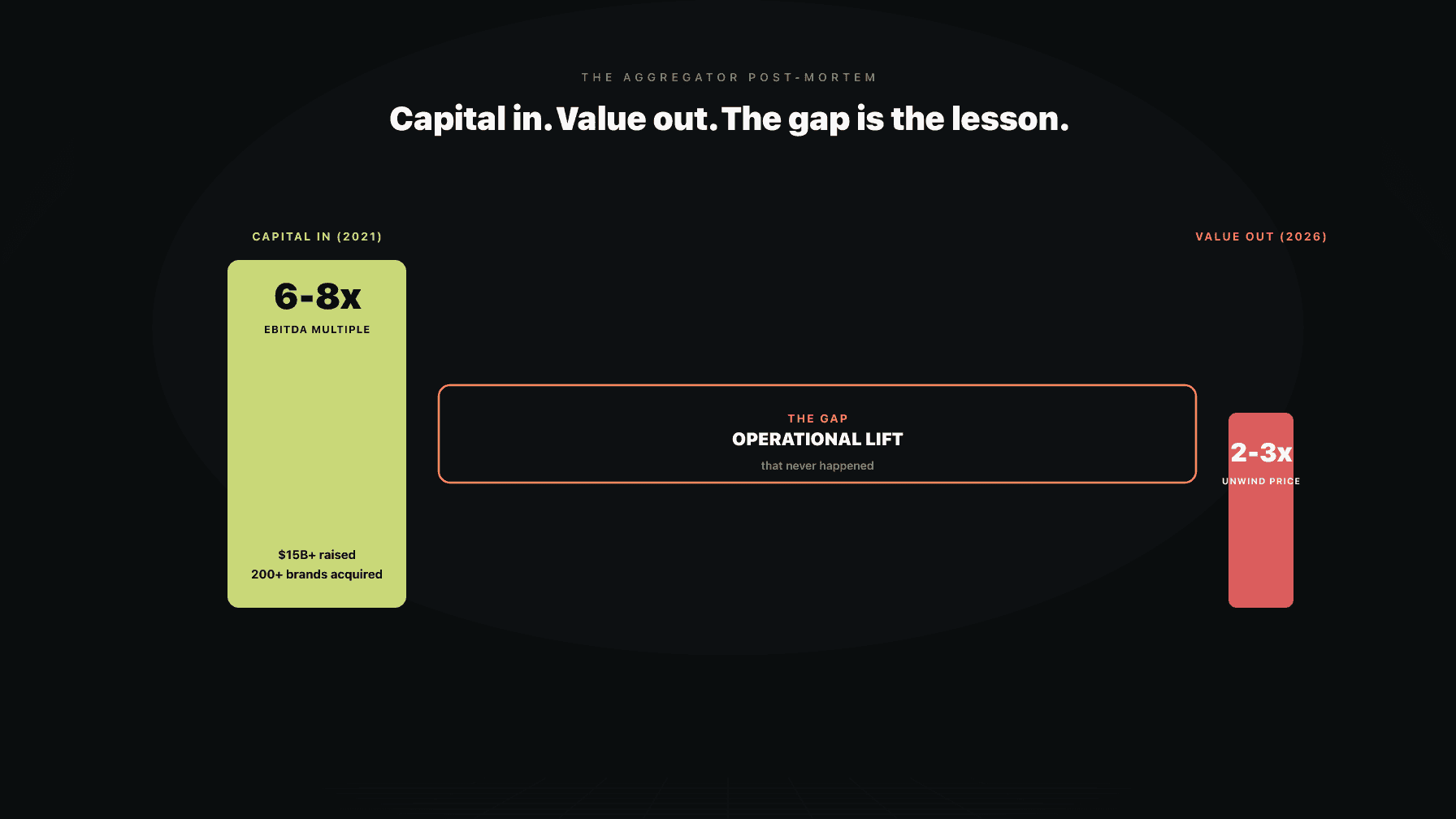
In 2020-2021, every brand on the market was generating EBITDA that was 50-80% higher than its true run rate because of the COVID demand spike. Categories like home fitness, home office, kitchen, and outdoor recreation saw demand pull-forward that anyone with a decade of operating history could have flagged as transitory. The aggregators bought at 6-8x EBITDA on what was effectively a one-time number. When demand normalized in 2022-2023, the underlying EBITDA fell back to its actual run rate, and the multiple paid against the new EBITDA was suddenly closer to 12-15x. They overpaid by roughly 2x on average. That gap is the entire problem.
This is the textbook Hot-phase mistake. If you read my steward-of-capital frame, you already know the rule: a great brand bought at a bad price is a bad investment.
4. They overhired and overbuilt corporate.
The aggregator model assumed you could run a portfolio of 50 brands with a centralized team of 200-300 corporate staff. That was the scale-economy story. What actually happened is that the team grew to 400-500 because each brand required category-specific expertise that the central team did not have. So instead of consolidating, headcount expanded. The same volume can be run today on a team of 30-40 humans plus an AI operating layer. That is a 90% headcount reduction against the 2021 model. The brands the aggregators bought did not need 400 corporate staff to be well-run. They needed cross-functional coordination, which is software, not bodies.
Walk through the plan step by step against the outcome.
Acquisition multiple. Plan: buy at 4-5x EBITDA. Outcome: bidding wars pushed multiples to 6-8x, and in some headline deals north of that, against EBITDA that was COVID-inflated.
Post-acquisition operational lift. Plan: 20-30% EBITDA lift in year one through professionalization. Outcome: EBITDA declined 20-40% in the first 18 months, because the central team disrupted what was working at the brand level, founders left, institutional knowledge walked, PPC was rebuilt from scratch by people who did not understand the category, and supply chain decisions were made by a corporate function that had never met the supplier.
Scale economies. Plan: per-brand operating cost falls as the portfolio grows. Outcome: per-brand operating cost rose because the corporate overhead grew faster than the revenue base, and the cost of integrating each new brand onto the central systems was higher than the cost of running it independently. The integration tax was real and nobody modeled it.
Working capital. Plan: centralized inventory financing at preferred rates. Outcome: each brand still needed brand-specific inventory, in brand-specific quantities, with brand-specific lead times, and the central treasury function could not predict cash needs because they did not know the unit economics of any single ASIN well enough.
Exit multiple. Plan: sell the bundle at 8-10x EBITDA to a strategic. Outcome: there were no strategic buyers, because the strategics looked at the portfolios and saw 50 unrelated brands with no synergies and declining EBITDA. The IPO window slammed shut. The bundles ended up being sold piece by piece at 2-3x to operators with cash.
That last line is the real punchline. Brands bought at 7x are being resold at 2x. Somebody is on the other side of that trade.
The unwind has three shapes.
The public restructurings are the visible part. Chapter 11 filings, debt-for-equity swaps, board reshuffles, portfolio sales. The trade press covers these in detail. I will not rehearse the names.
The quiet portfolio liquidations are the bigger part. A holding company decides it cannot fix forty brands at once, so it triages. It picks the top five, invests in them, and sells the other thirty-five over eighteen months at whatever bid clears. Those secondary sales are happening in the 2-3x EBITDA range, sometimes lower, and almost always to operators rather than financial buyers. If you have been watching the distressed Amazon business market, you know the buying opportunity right now is unusually good if you have the operational chops to fix what you buy.
The third shape is the founder buybacks. In some cases the original founder is buying their brand back from the aggregator at a fraction of what they sold it for. I have seen 4-6x discounts on the original sale price. The founder gets the brand back, the cash they took out in 2021 is now working capital, and the aggregator gets to mark the asset off the books. Everyone moves on.
What is emerging out of the unwind is a phrase you are going to hear more often: operationally-stronger, capital-lighter. The next form of roll-up is going to be smaller, sharper, and run by operators rather than dealmakers. It is going to look nothing like 2021.
I am bullish on a new model. I am bearish on the old one.
The next form of aggregation is built on cross-functional coordination, not headcount. The AI operating layer is the differentiator. If you can run pricing, PPC, inventory, catalog, and supply chain as one coordinated system instead of five disconnected ones, you can run more brands on fewer people. That is the unlock the old aggregators missed. Read the AI operating system framework for the longer architecture.
The next aggregator looks like this. Ten to fifteen brands, not fifty. Picked for category overlap, not opportunistically. Run by an operator with twenty years of marketplace scar tissue, not a finance team. Backed by patient capital sized to the actual return profile, not growth-equity capital priced for a 10x exit. Anchored on AI-driven operations rather than headcount growth. A central mission control that gives the operator real-time visibility into every brand, every ASIN, every metric. Lean human teams of 30-40 across the whole portfolio, with AI agents doing the work that the 400-person corporate teams used to do badly.
The economics are different. Acquisition multiples are 2-3x because the market has reset. EBITDA lifts of 30-50% are achievable because the gap between average brand operations and AI-operationally-good brand operations is enormous in 2026. Exit multiples will be lower than the 2021 dream, but the cost basis is so much lower that the IRR works without heroic exit assumptions.
The survivors of the aggregator wave are pivoting toward this model right now. They have cut headcount, killed the centralized functions that did not work, kept the ones that did, and brought in AI tooling on top. Some of them are going to be fine. Some of them are not.
Three lessons. Write them on the wall.
Capital is not a substitute for operational skill. This is the lesson that keeps getting re-learned because every cycle of cheap money convinces a new generation that money itself is a strategy. It is not. Money is fuel. You still need a driver. The aggregators were boats without drivers and the tide came in.
The Hot phase ends. Always. Every time. The brands you buy at the peak of demand will revert to their true run rate inside 18-24 months. If your model only works at the peak, your model does not work. Buy as if the next two years will be worse than the last two. Most of the time you will be right. Read the capital cycle phases and figure out which phase you are actually in before you write a check.
Scale economies are mostly mythical in Amazon brand operations. This is the hardest one for spreadsheet people to accept because their entire training is built on the assumption that scale produces leverage. On Amazon, it produces complexity. The leverage comes from software and coordination, not size. A small, AI-operationally-leveraged team running fifteen brands will out-execute a large, headcount-heavy team running fifty. The numbers I have seen on the inside of multiple portfolios confirm this with no ambiguity.
If you are sitting on a brand and considering selling to an aggregator in 2026, take a long look at the buyer's operating bench before you take the offer. If you are an aggregator portfolio that needs operational lift on the brands you already own, come talk to us. We have seen this movie. We have helped restructure portfolios out of the hole. The next chapter looks nothing like the last one, and that is good news for anyone who actually knows how to operate.
An Amazon aggregator is a holding company that acquires third-party Amazon brands, typically private-label sellers doing $1M to $50M in revenue, and rolls them into a single portfolio. The 2020-2022 wave of aggregators raised over $15B in venture and growth capital with the thesis that they could buy small brands cheaply, professionalize operations, and exit at higher multiples. Most of the largest names from that wave have since restructured, liquidated, or sold portfolios at distressed prices.
Four reasons. They overpaid at the 2020-2021 peak on EBITDA that was inflated by COVID demand pull-forward. They assumed scale economies that do not exist in Amazon brand operations, because PPC, FBA fees, and inventory financing do not get cheaper with portfolio size. They overhired centralized corporate teams that disrupted what was working at the brand level. And they confused capital for operating skill, raising large funds without a deep operating bench capable of actually running the brands they bought.
The 2021 model is dead. Most of the largest aggregators are gone, restructuring, or selling portfolios. But a new form is emerging that is smaller, AI-operationally-focused, and built around cross-functional coordination rather than headcount and capital. That model is early but it is working.
The market has reset. In 2026, healthy private-label Amazon brands are trading in the 2.5-4x EBITDA range for most deals, with distressed portfolio sales happening as low as 1.5-2x. Branded, defensible businesses with strong moats and clean unit economics can still command 4-5x, but the 6-8x peaks of 2021 are gone. Diligence is also much heavier. Buyers are scrutinizing unit economics ASIN by ASIN and discounting promotional EBITDA aggressively.
Yes, and that is the model that will survive. The key shifts are smaller portfolios of 10-15 brands rather than 50-plus, lean human teams of 30-40 augmented by AI agents instead of 400-person corporate functions, category focus instead of opportunistic acquisitions, and lower entry multiples that do not require heroic exit assumptions to generate returns. The differentiator is the operating layer, not the capital stack.
It depends on the buyer. The diligence you need to run on a 2026 aggregator is the inverse of what mattered in 2021. Then, you cared about price. Now, you care about whether the buyer can actually run your brand without breaking it, whether they have an operating bench, whether their existing portfolio brands are growing or declining, whether their first earn-out checks are clearing, and whether you are getting paid in cash, stock, or seller notes. Stock and seller notes from a financially shaky aggregator are not worth the paper they are printed on.
The post-aggregator model is what I call operationally-stronger, capital-lighter. Fewer brands. Sharper category focus. AI-driven operating leverage instead of headcount leverage. Patient capital sized for realistic multiples rather than growth-equity capital sized for unicorn returns. Operators in the lead seat rather than dealmakers. If you want to see what that looks like in practice, come talk to us. We are building toward that model right now and helping other portfolios pivot toward it.